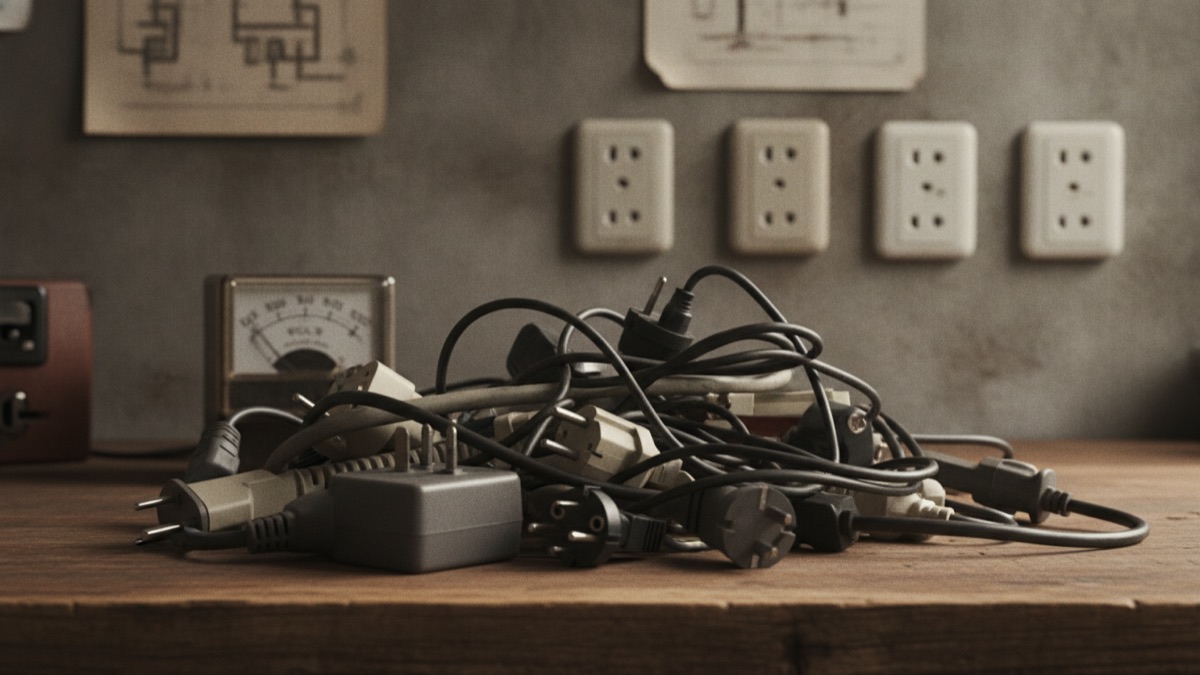
Voltage standards vary by country largely because electrical grids were built independently around the world in the late 19th and early 20th centuries, before any international body existed to coordinate a single global standard.
Two main voltage families emerged: roughly 110 to 127 volts, adopted early in the United States and parts of the Americas, and roughly 220 to 240 volts, adopted across most of Europe, Africa, and Asia, each reflecting different early engineering trade-offs around safety, efficiency, and cost.
A Split That Happened Over a Century Ago
Why No One Standardized It Later
Higher voltage systems transmit power somewhat more efficiently over distance with less energy lost as heat, but lower voltage systems were seen by some early adopters as marginally safer for household use, and both approaches had enough technical merit that neither side had a compelling reason to switch.
Once a country's electrical infrastructure, appliances, and building codes were built around a specific voltage standard, the cost and disruption of switching became enormous, which is largely why the original early-20th-century divide has persisted essentially unchanged to today.
Sources
- Wikipedia — overview of global voltage standards by country
- International Electrotechnical Commission — international standards body background on electrical systems
- Institute of Electrical and Electronics Engineers (IEEE) — technical background on power transmission and voltage engineering
FAQ
What are the two main voltage standards used worldwide?
Roughly 110 to 127 volts, used in the US and parts of the Americas, and roughly 220 to 240 volts, used across most of Europe, Africa, and Asia.
Why didn't the world eventually standardize on one voltage?
Once electrical infrastructure and appliances were built around a specific standard, the cost and disruption of switching became too large to justify.
Is one voltage standard clearly better than the other?
Not decisively — higher voltage transmits power somewhat more efficiently, while lower voltage was seen as marginally safer, giving both approaches enough merit to persist.
About the Author
We reference Wikipedia, International Electrotechnical Commission, and Institute of Electrical and Electronics Engineers (IEEE) to explain the background and current understanding of this topic.
Loved This Article?
Share it on WhatsApp → Share it on WhatsApp
Get more guides in your inbox — Subscribe to our newsletter for weekly surprising stories from Egypt, Saudi Arabia, Dubai, and beyond.