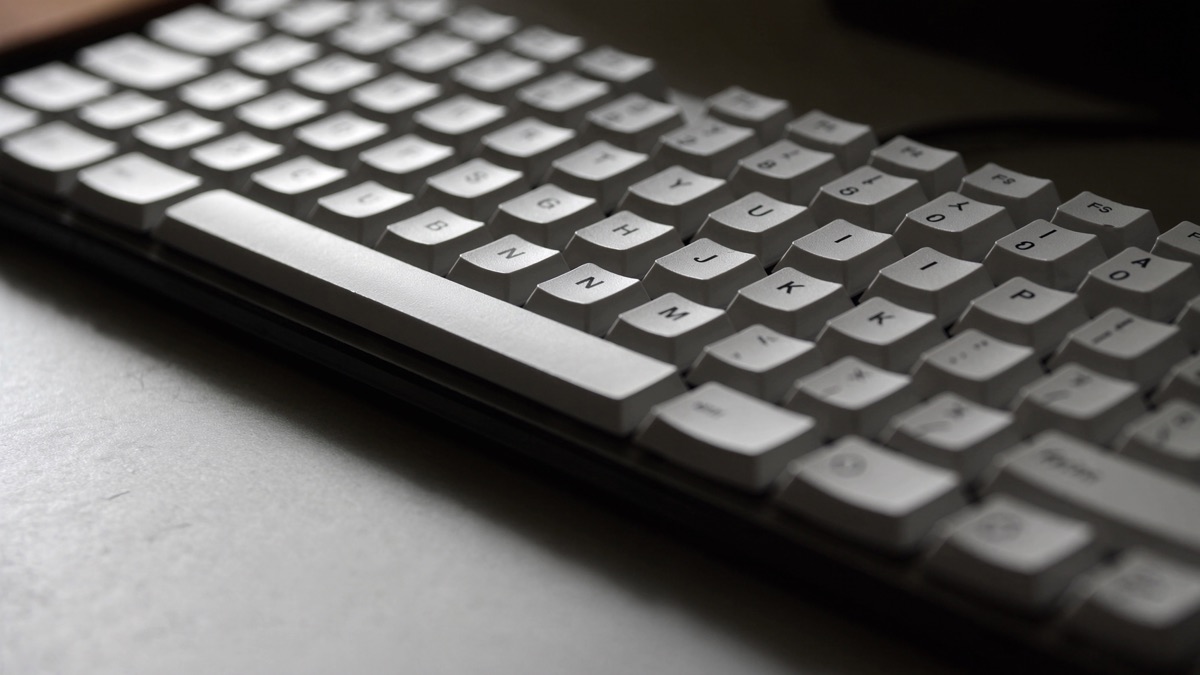
The QWERTY keyboard layout was actually designed to keep the mechanical typebars of early typewriters from jamming, not to deliberately slow typists down as popular legend claims. Christopher Latham Sholes, the inventor credited with the first commercially successful typewriter, spent years rearranging letter positions specifically to reduce jams, and the layout that survived is the one that caused the fewest of them in practice.
Why QWERTY Was Never Designed to Slow Typists Down
Early typewriters used individual metal typebars, one per letter, that swung up from a circular basket to strike the paper through an inked ribbon, and if two nearby bars were struck in quick succession they could collide and tangle before either fully returned to its resting position.
Sholes and his collaborators tested and revised the letter arrangement across several patents through the 1870s, and the widely repeated claim that he deliberately slowed typists down has no support in the surviving patent history — the actual goal documented at the time was mechanical reliability, not intentional inefficiency.
How Letter Frequency Actually Shaped the Layout
A key design principle was separating the typebars for letters that commonly appeared together in English words, since those pairs were the ones most likely to be struck close together in time and therefore most likely to jam if their typebars sat near each other in the basket.
This is why common letter pairs like "T" and "H", or "S" and "T", ended up positioned in ways that keep their mechanical arms physically distant inside the typebar basket, even though this sometimes means the fingers doing the typing have to travel further across the keyboard than a purely speed-optimized layout would require.
The Remington Typewriter and Mass Standardization
Sholes sold his invention and its associated patents to E. Remington and Sons, a firearms manufacturer diversifying into other machinery, and the Remington No. 2 typewriter, released in 1878, became the first commercially successful model widely adopted across offices.
Because Remington effectively controlled the dominant typewriter of its era, the QWERTY layout it shipped with became the de facto standard that competing manufacturers eventually adopted too, less because it was mechanically superior to every alternative and more because typists trained on Remington machines were the available, hireable labor pool.
Why Switching Away From QWERTY Became Nearly Impossible
Once large numbers of typists had trained specifically on the QWERTY layout, and once large numbers of employers had built hiring and training practices around that trained workforce, both sides of the labor market developed a mutual dependency that made any alternative layout an expensive, coordinated switching cost rather than a simple product choice.
Economists studying this pattern later coined the term path dependence, describing situations where an early, possibly arbitrary technical choice becomes effectively permanent because too many interlocking systems and habits have formed around it for any single participant to unilaterally switch without cost.
The Dvorak Simplified Keyboard Challenge
August Dvorak, an educational psychologist, patented an alternative layout in 1936 specifically designed to place the most frequently used English letters on the home row and reduce finger travel distance, claiming meaningful speed and fatigue improvements over QWERTY in his own published studies.
Independent, methodologically rigorous studies conducted decades later found far more modest advantages than Dvorak's original claims suggested, and the layout never achieved anywhere near the market penetration needed to overcome QWERTY's entrenched training and manufacturing infrastructure, remaining a niche choice among enthusiasts rather than a genuine mass-market alternative.
Why Typewriter Jamming Stopped Mattering Decades Ago
Electric typewriters, which largely replaced mechanical typebar models by the mid-20th century, eliminated the physical jamming problem entirely by using a single spinning typeball or print element rather than dozens of individually swinging metal arms that could collide with each other.
Despite jamming becoming a non-issue with electric typewriters and later computer keyboards, which have no mechanical typebars at all, QWERTY persisted anyway, precisely because the layout's survival had already become a function of trained muscle memory and market inertia rather than the mechanical constraint that originally shaped it.
How QWERTY Made the Jump to Computer Keyboards
When electronic computer keyboards emerged in the mid-20th century, manufacturers simply mimicked the existing typewriter layout that millions of trained typists already knew, since building an entirely new input device around an unfamiliar key arrangement would have required retraining an enormous existing workforce for no compelling functional benefit.
This continuity meant that a layout originally optimized to prevent mechanical typebar collisions ended up governing input on a technology with no typebars whatsoever, a striking illustration of how deeply a legacy design choice can outlive the specific physical problem it was created to solve.
International QWERTY Variants Around the World
Different language communities adapted the base QWERTY layout to accommodate their own alphabets and common letter combinations, producing variants like QWERTZ used across much of central Europe, which swaps the positions of Y and Z to better match German letter frequency patterns.
AZERTY, used primarily in France and some French-speaking regions, rearranges several letters and numbers entirely, reflecting different common letter combinations and accented character needs in French, showing that even within the QWERTY family, layouts still adapted somewhat to serve the specific language typed most often on a given machine.
Why Smartphone Keyboards Kept the QWERTY Layout
Touchscreen smartphone keyboards have no mechanical typebars, no physical keys that could jam, and no inherent reason to preserve any particular letter arrangement, yet virtually all of them default to QWERTY specifically because that is the layout hundreds of millions of users already know from a lifetime of physical keyboard use.
A handful of touch-optimized alternative layouts have been proposed and even implemented as optional keyboards, claiming reduced thumb travel distance for two-thumb typing specifically, but none has achieved meaningful adoption against the overwhelming familiarity advantage QWERTY carries into every new device category.
The Home Row and Touch Typing Method
Touch typing, the technique of typing without looking at the keys, relies on the home row — the middle row of keys where the fingers rest by default, with small raised bumps on the F and J keys letting a typist's fingers find correct position purely by feel.
This standardized resting position and its associated finger-to-key assignments were formalized decades after QWERTY itself, as typing instruction became systematized in schools and business colleges, turning what had started as an engineering solution into a codified skill taught with a consistent finger-mapping method worldwide.
Measuring Typing Speed and the Layout Debate
Modern typing speed research, using large samples of real typists across both QWERTY and alternative layouts, generally finds that skilled typists reach comparable top speeds on either layout, suggesting that trained proficiency matters far more for real-world typing speed than the underlying key arrangement itself.
This finding undercuts much of the historical argument for switching away from QWERTY on pure efficiency grounds, since any theoretical advantage an alternative layout offers appears to be smaller in practice than the enormous retraining cost required to actually realize it across a population already fluent in QWERTY.
The Number Row and Symbol Placement Logic
The numbers along the top row of a QWERTY keyboard are arranged in straightforward ascending order from left to right, a layout choice that predates and is independent of the letter arrangement below it, since number keys on early typewriters had no letter-pair jamming problem to solve.
Punctuation and symbol keys, by contrast, were placed more opportunistically around the edges of the letter grid as typewriters gained additional characters over successive models, explaining why symbol placement feels comparatively less systematic than the deliberately engineered letter arrangement at the keyboard's core.
Why Left-Hand Letters Outnumber Right-Hand Letters
QWERTY assigns a noticeably larger share of English's most frequently used letters to the left hand than the right, a distribution some historians attribute to Sholes accommodating the habits of specific early telegraph operators who provided feedback during development, since Morse code transcription work influenced some of the era's early typewriter testing.
Whatever the precise historical cause, the resulting left-hand bias means touch typists using QWERTY do measurably more work with their non-dominant hand for most right-handed users than a layout balanced purely for hand-usage efficiency would produce, a quirk usually invisible to typists who never learned an alternative for comparison.
How Stenography Keyboards Solved a Different Problem
Court reporters and captioners use an entirely different keyboard technology called stenotype, which allows multiple keys to be pressed simultaneously to represent whole syllables or common word chunks phonetically, enabling transcription speeds far exceeding what any single-letter-at-a-time keyboard, QWERTY or otherwise, can achieve.
Stenotype exists specifically because real-time verbatim transcription of spoken speech demands speeds beyond ordinary typing's physical limits, illustrating that QWERTY's dominance applies specifically to general-purpose typing rather than every possible text-input use case.
Ergonomic Keyboards That Kept QWERTY's Letters
Split and curved ergonomic keyboards, designed to reduce wrist strain and repetitive stress injuries, typically preserve the standard QWERTY letter arrangement entirely while changing only the physical geometry of the keys themselves — splitting the board into two angled halves or adding a scooped, wave-like key surface.
This design choice reflects the same underlying reality driving smartphone keyboard design: changing physical ergonomics is a far easier sell to typists than asking them to relearn an unfamiliar letter arrangement, even when both changes are marketed under the same broad ergonomics label.
The Myth-Busting Historical Research
Historians Koichi and Motoko Yasuoka published detailed research in the early 2010s tracing QWERTY's evolution through Sholes's actual patent filings and prototype machines, directly challenging the popular "designed to slow typists down" narrative by showing the layout changed incrementally to solve documented mechanical jamming problems specific to each prototype.
Their work, along with earlier research by other historians examining the same patent trail, has become the standard academic rebuttal to the persistent myth, though the myth continues circulating widely in casual conversation and even some educational materials precisely because it makes for a more dramatic story than gradual mechanical engineering.
What a Truly Optimized Modern Layout Might Look Like
Computational linguists and interface researchers have designed several theoretically optimized layouts using computer modeling of English letter frequency and finger movement efficiency, generally placing vowels and the most common consonants on the home row to minimize total finger travel across typical English text.
None of these theoretically superior layouts has meaningfully displaced QWERTY, reinforcing the pattern already visible with Dvorak decades earlier: a layout's success in the real world depends far more on installed user base and training infrastructure than on any measurable efficiency advantage it can demonstrate in a controlled study.
Voice Input and the Long-Term Future of Typing
Voice-to-text technology has improved dramatically in accuracy and speed over the past decade, and some researchers speculate that voice input could eventually reduce reliance on any keyboard layout at all for a meaningful share of everyday text creation, particularly on mobile devices where physical typing is inherently more awkward.
Even so, keyboards remain essential for precise editing, quiet environments, and situations requiring exact text control that voice recognition still struggles to match reliably, suggesting QWERTY's practical relevance is likely to persist for a long time yet even as voice input grows alongside it rather than replacing it outright.
Why QWERTY Endures as a Case Study Beyond Typing
Economists, historians, and technology researchers regularly cite QWERTY as the textbook example of how an early technical decision, made for reasons that later became irrelevant, can become permanently locked in through network effects and training costs rather than ongoing merit.
The lesson generalizes well beyond keyboards: any technology where a large trained user base and interlocking infrastructure develop around an initial standard tends to resist replacement by objectively better alternatives, making QWERTY less a story about typewriters specifically and more a durable case study in how standards actually get chosen and kept.
Sources
- Wikipedia — history and design of the QWERTY keyboard layout
- Smithsonian Magazine — history of typewriter development
- Wikipedia — overview of the Dvorak Simplified Keyboard
FAQ
Was QWERTY really designed to slow typists down?
No; historical patent research shows it was designed to separate the typebars of commonly paired letters so they would not collide and jam, not to intentionally reduce typing speed as the popular myth claims.
Why did QWERTY survive after typewriters stopped jamming?
Once millions of typists trained specifically on QWERTY and employers built hiring practices around that workforce, switching became a coordinated cost too large for any single participant to bear, a pattern economists call path dependence.
Is the Dvorak keyboard actually faster than QWERTY?
Independent studies found far more modest advantages than Dvorak's original claims suggested, and skilled typists generally reach comparable top speeds on either layout, undercutting the case for switching.
Why do computer keyboards still use QWERTY if there is no jamming risk?
Manufacturers simply mimicked the typewriter layout millions of trained typists already knew, since building a new device around an unfamiliar arrangement would require retraining an enormous workforce for no compelling benefit.
What is QWERTZ and why does it exist?
QWERTZ is a variant used across central Europe that swaps the Y and Z keys to better match German letter frequency patterns, showing regional adaptation within the broader QWERTY family.
Why do smartphone touchscreens still default to QWERTY?
Touchscreens have no mechanical typebars and no jamming risk at all, but virtually all default to QWERTY anyway because that is the layout hundreds of millions of users already know from physical keyboards.
Does QWERTY favor one hand over the other?
Yes; it assigns a noticeably larger share of frequently used English letters to the left hand, a distribution some historians trace to early telegraph operator feedback during development.
What is stenotype and why don't court reporters use QWERTY?
Stenotype allows multiple keys to be pressed simultaneously to represent whole syllables phonetically, enabling transcription speeds far beyond what any single-letter-at-a-time keyboard can achieve.
Do ergonomic keyboards use a different letter layout?
Usually not; split and curved ergonomic keyboards typically keep the standard QWERTY letter arrangement and change only the physical geometry of the keys to reduce wrist strain.
Who debunked the "designed to slow typists" myth?
Historians Koichi and Motoko Yasuoka published research in the early 2010s tracing QWERTY through Sholes's actual patents, showing it evolved to solve documented mechanical jamming problems, not to slow anyone down.
Have researchers designed a more efficient modern layout?
Yes, several computationally optimized layouts exist, but none has meaningfully displaced QWERTY, reinforcing that installed user base matters more than measurable efficiency gains.
Could voice input eventually replace keyboard typing?
Voice-to-text has improved significantly, but keyboards remain essential for precise editing and quiet environments, so QWERTY is likely to remain relevant well alongside growing voice input.
Why is QWERTY used as an economics case study?
It is a textbook example of how an early technical decision can become permanently locked in through network effects and training costs rather than ongoing merit, a lesson that generalizes far beyond keyboards.
How is the home row used in touch typing?
The home row is the middle row where fingers rest by default, with raised bumps on the F and J keys letting typists find correct finger position without looking at the keyboard.
Why does the number row follow simple ascending order?
Number keys on early typewriters had no letter-pair jamming problem to solve, so they were arranged straightforwardly left to right, unlike the more deliberately engineered letter arrangement below them.
About the Author
We reference Wikipedia and other authoritative sources to explain the background and current understanding of this topic.
Loved This Article?
Share it on WhatsApp → Share it on WhatsApp
Get more guides in your inbox — Subscribe to our newsletter for weekly surprising stories from Egypt, Saudi Arabia, Dubai, and beyond.