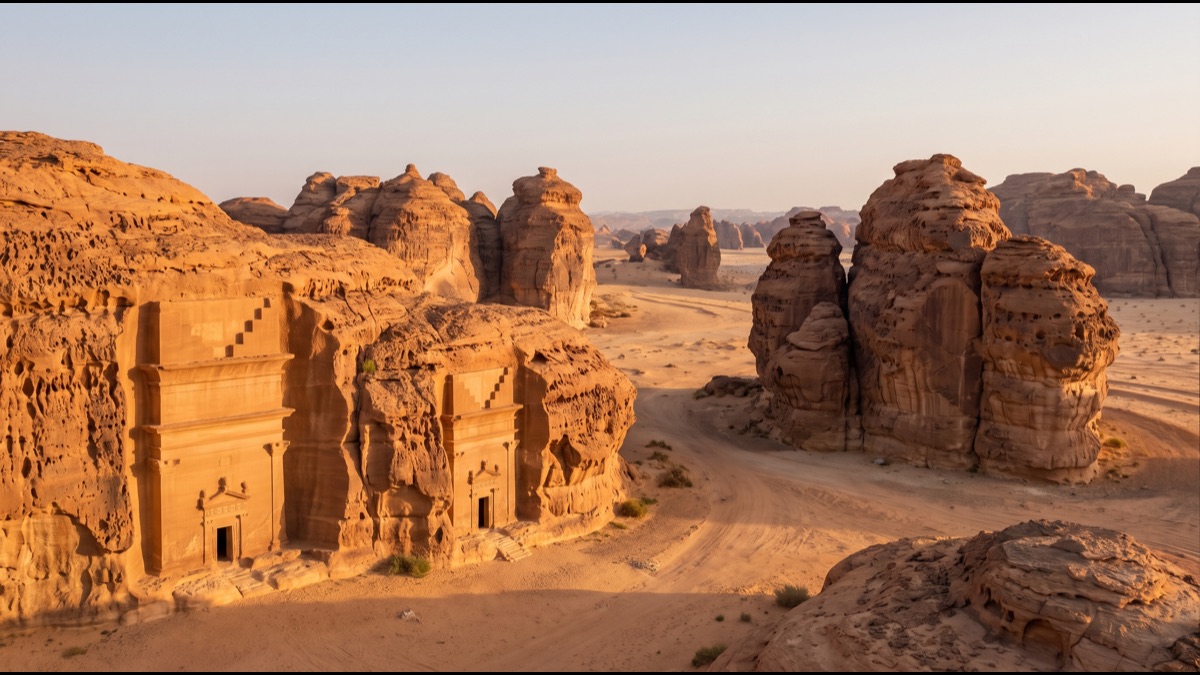
AlUla Saudi Arabia: Ancient Wonder & Modern Destination
Two thousand years ago, a trader from Petra stood before a carved rock face in AlUla. He read the names: "Lihyan son of Kuza," "his descendants and offspring." It was a funeral monument, but also a declaration of identity. "We were here. We are remembered." That same feeling — awe mixed with pride — is what every visitor to AlUla Saudi Arabia experiences today.
AlUla is not just another archaeological site. It is one of the richest concentrations of ancient history on Earth, layered with civilizations that span from the Stone Age to the Ottoman era. Under Saudi Vision 2030, it is also being transformed into a world-class tourism destination. This article explores what makes AlUla truly special, from the Nabataean tombs of Hegra to the luxury resorts rising from the desert.
Where Is AlUla?
AlUla lies in northwestern Saudi Arabia, in the Wadi al-Qura valley. For thousands of years, it served as a strategic stop on ancient trade routes. Caravans carrying frankincense and spices from Yemen passed through here. Traders from Egypt and the Levant stopped for water and rest. AlUla was a land port, a meeting place, and a crossroads of cultures.
The historical layers of AlUla are extraordinarily diverse. A visitor can see:
- Remains of the Dadanite civilization (800–600 BCE)
- Traces of the Lihyanite kingdom (600–200 BCE)
- Hegra — the southern capital of the Nabataean Kingdom
- Rock inscriptions and petroglyphs dating to the prehistoric era
- Ottoman and Islamic ruins from the medieval period
This diversity makes AlUla unique. It is not a single archaeological site. It is a library of history with a thousand volumes, each telling a different story of human civilization on the Arabian Peninsula.
Hegra: The Crown Jewel
In the first century BCE, AlUla became part of the Nabataean Kingdom. The Nabataeans — who built Petra in Jordan — expanded southward. They found in AlUla magnificent pink sandstone, fertile plains, and a strategic location that connected them to the incense trade.
They built 131 rock-cut tombs here. Their carved facades in the rose-colored rock rival those of Petra. But Hegra is less crowded, more silent. It feels like it is waiting for someone to come and ask about its stories.
The most important tombs include:
- Qasr al-Farid: The most famous tomb, rising 16 meters with a perfectly carved facade.
- Qasr al-Sani: Smaller but more detailed in its inscriptions.
- Qasr al-Bint: Features carvings of goddesses and Nabataean symbols.
- Diwan al-Jabal: A gathering place that proves the city was not just a cemetery but a living community.
In 2008, UNESCO inscribed Hegra on the World Heritage List. This was the step that put AlUla on the global map of cultural tourism. Today, guided tours take visitors through the tombs at sunset, when the pink sandstone glows in shades of gold and amber. It is one of the most photographed landscapes in Saudi Arabia.
The Ancient Kingdoms of Dadan and Lihyan
Before the Nabataeans arrived, AlUla was the heart of two powerful kingdoms: Dadan and Lihyan. The Dadanite civilization thrived between 800 and 600 BCE, controlling the incense trade that passed through the Arabian Peninsula. Their capital, located in the valley of AlUla, was one of the most important cities of its time.
The Lihyanite kingdom succeeded Dadan around 600 BCE and ruled for several centuries. They built massive stone temples, carved lion sculptures into the rock faces, and established a writing system that scholars are still decoding. The Lihyanites were not merely traders; they were builders, artists, and diplomats who maintained relationships with kingdoms across the ancient Near East.
Recent excavations by Saudi and international archaeological teams have uncovered new temples, burial chambers, and inscriptions that reshape our understanding of pre-Islamic Arabia. The Royal Commission for AlUla has invited researchers from France, the United States, and Germany to collaborate on ongoing digs. What they find continues to surprise even the experts.
Jabal Ikmah: The Library of Rock
Jabal Ikmah is often called the "Library of Rock." This canyon contains thousands of inscriptions carved into the sandstone walls — names, prayers, laws, and poems left by travelers who passed through AlUla over three millennia. Some inscriptions are in Dadanitic, some in Lihyanite, some in Nabataean, and some in Thamudic script.
For historians, Jabal Ikmah is a goldmine. It offers a direct window into the languages, beliefs, and daily lives of ancient Arabians. The site is now protected and accessible through guided tours organized by the Royal Commission for AlUla. Visitors walk through the canyon with archaeologists who explain the meaning behind the symbols. It is an experience that bridges the gap between the past and the present.
AlUla Under Saudi Vision 2030
Under Saudi Vision 2030, AlUla has been transformed from a remote archaeological site into a global tourism destination. The Royal Commission for AlUla, established in 2017, manages an ambitious project aiming to attract 2 million visitors annually by 2035.
The project includes:
- Maraya: A stunning mirrored concert hall that reflects the surrounding desert landscape. It holds the Guinness World Record for the largest mirrored building.
- Sharaan Resort: A luxury hotel carved into the rock, inspired by Nabataean architecture and designed by Jean Nouvel.
- Winter at Tantora: An annual cultural and music festival held in the desert, attracting world-class performers and visitors from across the globe.
- Hot Air Balloons: Sunrise flights over the Nabataean tombs offer a breathtaking aerial perspective.
- Darb Zubaydah: A section of the historic Hajj pilgrimage route is being restored for modern visitors.
These developments are not about erasing the past. They are about making it accessible. The Saudi government has repeatedly emphasized that all tourism projects in AlUla are designed with sustainability and heritage preservation in mind. Archaeological zones are strictly protected, and new construction is limited to areas that do not interfere with ancient sites.
Why AlUla Matters Today
What makes AlUla exceptional is not just the ruins. It is the dialogue between time periods. You can sleep in a luxury tent overlooking Nabataean tombs. You can dine beside inscriptions that are 3,000 years old. You can cycle along a pilgrimage route that thousands of Hajj travelers walked a thousand years ago.
This intersection — between ancient heritage and modern tourism — is what Saudi Vision 2030 is creating across the Kingdom. It is not about destroying the past. It is about rediscovering it. AlUla is not merely a memory. It is an invitation to the future.
For travelers, historians, and curious minds, AlUla Saudi Arabia offers something that few places on Earth can match: the ability to walk through multiple civilizations in a single day. From the stone lions of Dadan to the mirrored walls of Maraya, the valley tells a story of human creativity that spans millennia.
Sources
- Royal Commission for AlUla — Official site for AlUla development, tourism, and heritage preservation.
- UNESCO World Heritage Centre — Hegra inscription details and World Heritage status.
- Visit Saudi — Official Saudi tourism portal with AlUla travel guides and booking.
- Smithsonian Magazine — Archaeological coverage of AlUla and Nabataean discoveries.
- National Geographic — Features on AlUla's transformation and cultural significance.
FAQ
What is Hegra?
Hegra, also known as Madain Salih, is the southern capital of the Nabataean Kingdom. It contains 131 rock-cut tombs carved into pink sandstone, dating back to the first century BCE. It was inscribed as a UNESCO World Heritage Site in 2008.
Can tourists visit AlUla?
Yes. AlUla opened to international tourism in 2020. Visitors can book tickets and experiences through the official Experience AlUla website. Guided tours, luxury accommodations, and cultural events are available year-round.
What is Winter at Tantora?
Winter at Tantora is an annual cultural and music festival held in AlUla. It features world-class musicians, art installations, and heritage experiences set against the desert landscape. It is one of the flagship events of Saudi Vision 2030.
How old are the AlUla inscriptions?
The inscriptions at Jabal Ikmah and surrounding sites span more than 3,000 years. They include writings from the Dadanite, Lihyanite, Nabataean, and Thamudic civilizations, making AlUla one of the richest epigraphic sites in the world.
How do I get to AlUla?
AlUla has its own international airport (AlUla International Airport, ULH), with direct flights from Riyadh, Jeddah, and Dubai. The airport is approximately 30 kilometers from the city center and main heritage sites.
About the Author
doyouknow.app AI-assisted Editorial Workflow — This article was prepared with AI-assisted research and editing, using the sources listed on the page. It is not based on firsthand testing, on-the-ground reporting, or a claim of personal experience or professional credentials. Please check official sources for current details.
Loved This Article?
Share it on WhatsApp → Share on WhatsApp
Get more Saudi facts in your inbox — Subscribe to our newsletter for weekly surprising stories from Saudi Arabia, the UAE, and beyond.