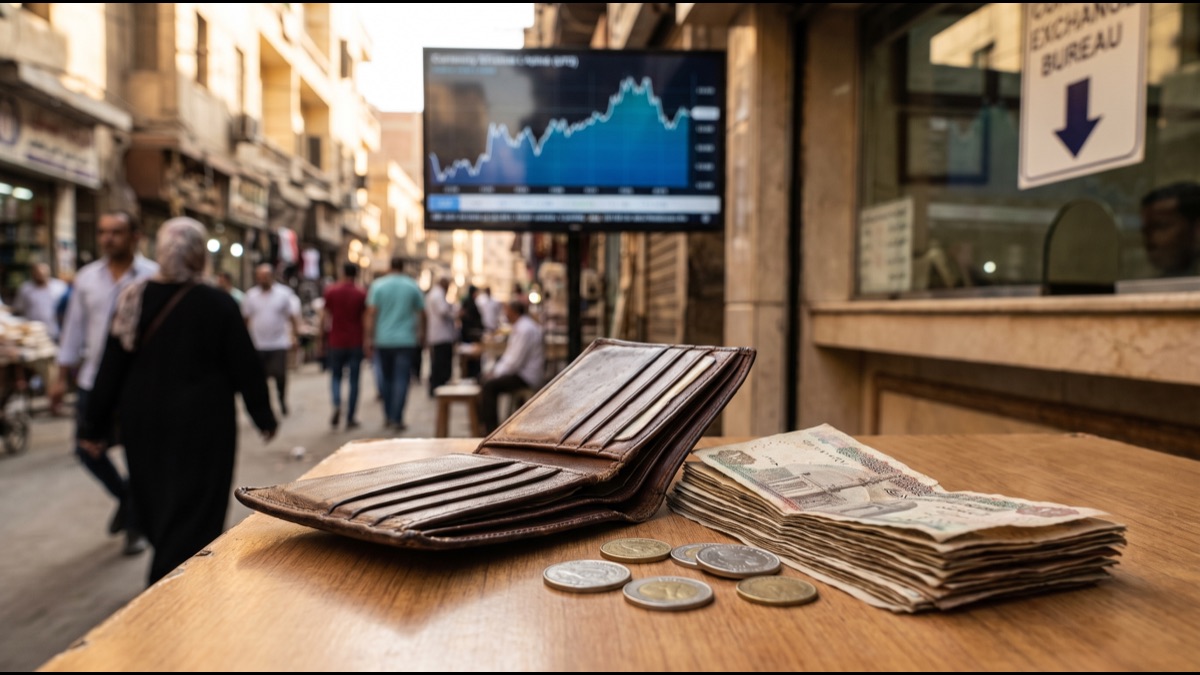
Introduction
The Egyptian pound (EGP) is Egypt's national currency, issued by the Central Bank of Egypt and divided into 100 piastres. Its exchange rate against the US dollar is the single most-watched number in Egyptian economic life, because it shapes the price of bread, fuel, medicine, and nearly everything imported.
This explainer covers how the pound's exchange-rate regime has changed over two decades, why the currency loses value in waves, how devaluations feed inflation, where Egypt earns its hard currency, and why a parallel dollar market keeps appearing and disappearing. Exchange rates move daily, so the figures here are approximate and describe the situation as of mid-2026.
A Short History of Floats
For most of its modern history the pound was managed against foreign currencies. Egypt first attempted a float in January 2003, when the pound slipped from around 3.4 to roughly 6–7 per dollar within about two years before stabilizing. After the 2011 revolution drained reserves and tourism income, pressure built again: on November 3, 2016, the central bank freely floated the currency under a $12 billion IMF program, and the pound collapsed from 8.88 to about 14.7 per dollar on the first day, settling in a 16–18 range for several years.
The next shock came with the Russia-Ukraine war in early 2022, which triggered the exit of tens of billions of dollars of foreign money from Egyptian treasury bills. Egypt devalued in steps: March 2022 (from about 15.7 toward 18.5), October 2022 (toward 24), and January 2023 (toward 30). Finally, on March 6, 2024, the central bank unified the exchange rate and let it trade freely, and the pound dropped roughly 38% from about 30.8 to the 47–50 zone, where it has broadly stayed since, trading approximately in the high-40s to low-50s per dollar as of mid-2026.
Why the Pound Moves
A currency's price is set by supply and demand for foreign exchange. Egypt's demand for dollars is structural: it imports most of its fuel, a large share of its wheat, and many production inputs, and it must service external debt and allow companies to repatriate profits. Supply comes from tourism, Suez Canal fees, remittances, exports, and investment inflows. When supply falls short and the official rate is defended anyway, backlogs of unmet dollar demand build up at banks and the pressure eventually forces a devaluation.
Global conditions matter as much as local ones. Foreign investors hold large positions in Egyptian treasury bills when local interest rates are attractive, but that "carry trade" money leaves quickly when US rates rise or risk sentiment turns — exactly what happened in early 2022. Each exit wave drains reserves and reopens the currency question.
The Inflation Link
Because Egypt imports so much of what it consumes, a weaker pound raises the local-currency cost of imports, and businesses pass that cost to consumers. Economists call this exchange-rate pass-through, and in Egypt it is strong. After the 2022–2023 devaluations, annual urban inflation peaked at about 38% in September 2023, the highest in the country's recorded history.
After the March 2024 float, the central bank raised policy rates to around 27–28% and held them there while the exchange rate stabilized and a backlog of roughly $7–8 billion in unmet dollar demand was cleared. Inflation then fell steadily — through the 20s in 2024, toward the mid-teens by late 2025, and lower still into 2026 by most official readings — allowing the central bank to start cutting rates in stages during 2025. The lesson Egyptians know well: the pound's fall shows up in the market basket months later.
Where Egypt's Dollars Come From
Four pillars supply most of Egypt's foreign currency. Remittances from Egyptians working abroad are the largest and most stable, reaching a record of nearly $30 billion in 2024 after the float brought transfers back to official channels. Tourism is the second, also hitting record levels above $14 billion a year in the mid-2020s. Suez Canal fees are the third — a record of about $9.4 billion in fiscal 2022–23, before Red Sea shipping disruptions cut receipts to roughly $5.5–7 billion. Exports of goods such as natural gas, agricultural produce, and textiles make up the fourth.
On top of these come exceptional inflows. The February 2024 Ras El-Hekma agreement brought $35 billion of UAE investment into a Mediterranean development site — the largest single foreign investment in Egypt's history — and the IMF expanded its support program to $8 billion in March 2024. Together they rebuilt gross reserves to the mid-to-high $40 billions by early 2026.
The Parallel-Market Gap
Whenever official dollars become scarce while the exchange rate is defended, an informal parallel market appears and the pound trades there at a premium. In late 2016, just before the float, the parallel rate neared 18.5 per dollar against an official 8.88 — a premium of about 100%. History repeated itself in 2023 and early 2024, when the official rate was pinned near 30.8 while dollars changed hands informally at roughly 60–70.
Both times, floating closed the gap: once banks can price dollars freely, there is no reason to pay the informal premium, and remittances and export proceeds flow back into the banking system. Since March 2024 the spread between official and parallel rates has effectively disappeared. Analysts watch one indicator above all for early warning: any renewed delay in meeting dollar requests at banks, which historically signals the gap's return.
Sources
- CAPMAS — Egypt's official statistics agency, publisher of the monthly inflation readings
- World Bank — Egypt Overview — Macro context and development updates on the Egyptian economy
- The National — Report on the IMF program's expansion to $8 billion in March 2024
- Al Jazeera — Assessment of Egypt's post-float stabilization and its social costs
FAQ
What is the Egyptian pound's exchange-rate regime today?
Since March 6, 2024, the pound trades under a market-determined, managed float agreed as part of Egypt's IMF program. It has moved mostly in a band of roughly 47–51 per US dollar since then, though the rate changes daily and should be checked live.
How many times has Egypt devalued or floated the pound?
Five major episodes in two decades: the 2003 float, the full float of November 2016, three step devaluations in March 2022, October 2022, and January 2023, and the exchange-rate unification of March 2024.
Why does a weaker pound raise prices in Egypt?
Egypt imports most of its fuel, much of its wheat, and many industrial inputs. A cheaper pound raises the local-currency cost of those imports, and businesses pass the increase into consumer prices — which is why inflation peaked near 38% after the 2022–2023 devaluations.
What are Egypt's main sources of US dollars?
Remittances from Egyptians abroad (a record near $30 billion in 2024), tourism revenues (above $14 billion a year at recent records), Suez Canal fees, and goods exports, supplemented by foreign investment and occasional one-off deals such as the $35 billion Ras El-Hekma agreement.
What is the parallel market for dollars in Egypt?
An informal currency market that emerges when official dollars are scarce. Premiums over the official rate reached about 100% in 2016 and around double in 2023–early 2024, before the March 2024 float unified the rates and the gap effectively vanished.
About the Author
doyouknow.app Editorial Team — We base currency explainers on official statistics and multilateral reporting, and we give exchange rates as dated, approximate ranges because they move every day.
Loved This Article?
Share it on WhatsApp → Share on WhatsApp
Get more guides in your inbox — Subscribe to our newsletter for weekly surprising stories from Egypt, Saudi Arabia, Dubai, and beyond.