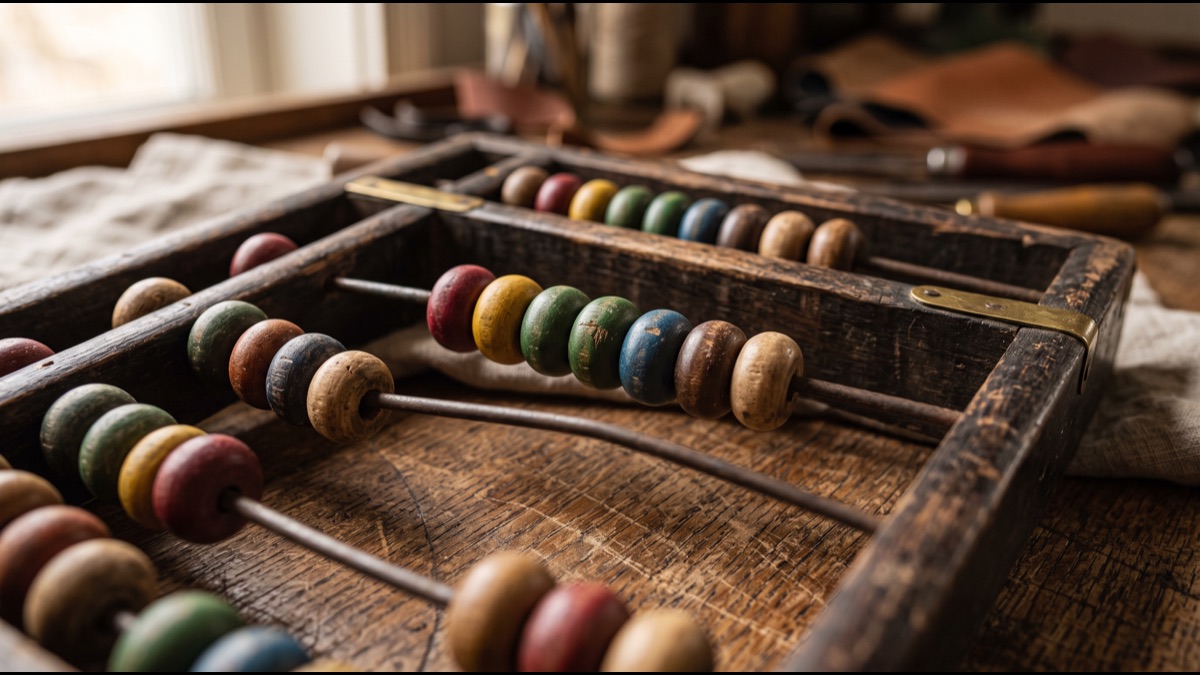
The earliest counting devices were simple counting boards, flat surfaces marked with lines or grooves along which pebbles were moved to represent numbers. Babylonians used versions of these as early as roughly 2700-2300 BCE, and the oldest surviving physical example, the Salamis Tablet, a marble counting board used by the ancient Greeks, dates to around 300 BCE.
The bead-on-rod design most people picture today developed independently in several regions rather than spreading from one single source. China's suanpan appeared by the 2nd century BCE and was standardized into its familiar form, with two beads above a divider and five below on each rod, by roughly the 14th century.
From Counting Boards to Bead Frames
A Tool Still Fast Enough to Beat a Calculator
Japan adapted the suanpan into its own soroban between the 14th and 15th centuries, later simplifying it in a 1930s reform to one bead above and four below each rod, matching the base-10 system exactly and dropping beads that had only been useful for older calculation methods. Russia developed a separate design, the schoty, using simple horizontal rows of ten beads each.
In a famous 1946 contest held in Tokyo, a Japanese postal clerk using a soroban competed against a US Army clerk using an electric calculator across several categories of arithmetic. The soroban operator won most events, including addition and multiplication, though the calculator held an edge in some complex division problems. Soroban-based mental math, a technique called anzan, is still taught in some schools today to build number sense.
Sources
- Britannica — the history of the abacus
- Computer History Museum — early calculating devices
- Smithsonian Magazine — the 1946 soroban vs. calculator contest
FAQ
Did the abacus originate in one single country?
No, bead-based counting devices developed independently in several regions, including China's suanpan, Japan's soroban, and Russia's schoty, each with its own distinct design.
Did an abacus really beat an electric calculator in a real contest?
Yes, in a well-documented 1946 contest in Tokyo, a Japanese postal clerk using a soroban outperformed a US Army clerk using an electric calculator in most arithmetic categories, including addition and multiplication.
Is the abacus still used or taught today?
Yes, some schools still teach soroban-based mental math, a technique called anzan, as a way to build strong number sense and calculation speed in students.
About the Author
We reference Britannica, Computer History Museum, Smithsonian Magazine to explain the background and current understanding of this topic.
Loved This Article?
Share it on WhatsApp → Share it on WhatsApp
Get more guides in your inbox — Subscribe to our newsletter for weekly surprising stories from Egypt, Saudi Arabia, Dubai, and beyond.