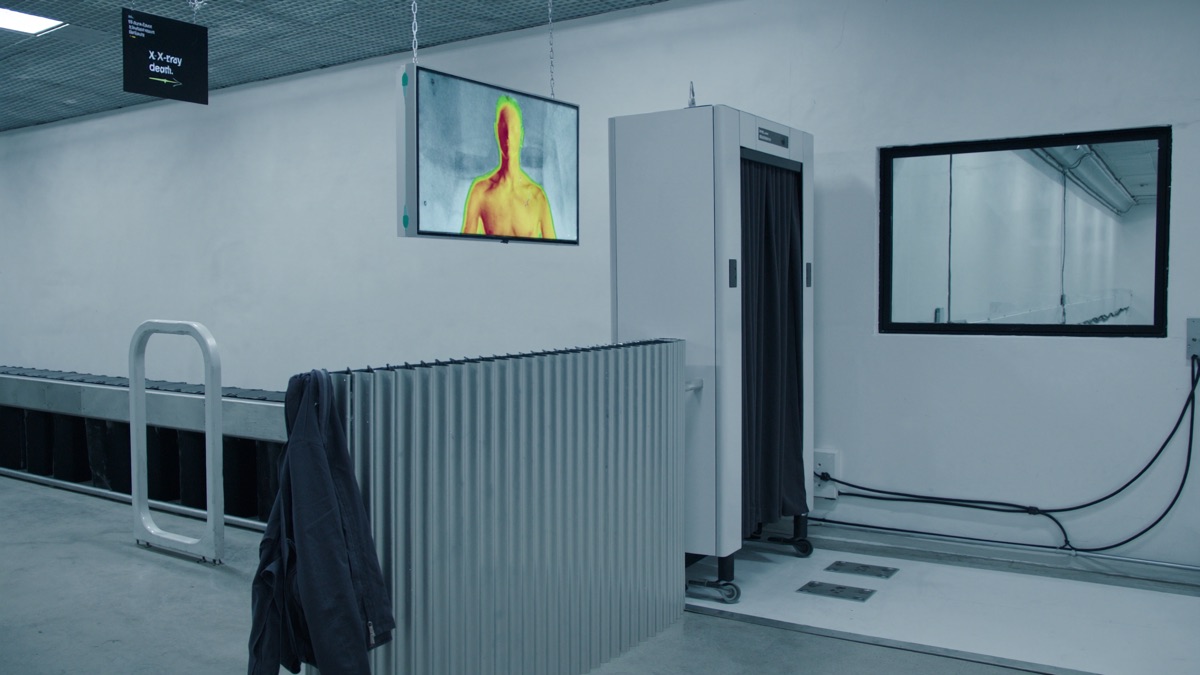
The full-body scanners used at most modern airport security checkpoints do not take an X-ray photograph of a passenger's body, despite that being the most common assumption. The machines widely deployed today use millimeter-wave technology, a low-energy form of radio wave, and the image an officer actually sees is a generic, computer-generated outline flagged with boxes over suspicious areas, not a detailed image of the passenger's body.
This distinction matters both technically and for understanding why the scanners work the way they do: millimeter waves interact with the body and with hidden objects in a fundamentally different way than X-rays do, which shapes both what the machine can detect and what it cannot.
The technology's history also matters for understanding today's rules: today's software-based privacy protections and non-ionizing scanning technology exist specifically because earlier, more invasive versions of the same basic idea provoked enough public and regulatory pushback that manufacturers and governments were forced to redesign the entire system around those specific objections rather than simply defending the original approach.
Millimeter Waves, Not X-Rays
Millimeter-wave scanners bounce very short radio waves off a passenger's skin and any material on top of it, then measure how that energy reflects back to build an image, a process closer to radar than to conventional medical imaging.
Because these waves sit at the low-energy end of the electromagnetic spectrum, far below X-rays in energy, they do not ionize tissue or pose the radiation exposure concerns that older backscatter X-ray scanners raised before being phased out at many airports.
Why Clothing Is Effectively Invisible to the Scan
Ordinary fabric is largely transparent to millimeter waves, which is what allows the scan to pick up skin and any concealed object without needing a passenger to remove clothing, while dense materials like metal, ceramics, liquids, and thick plastics reflect the waves differently and stand out against the body's reflection pattern.
This is why the system is genuinely built to detect concealed objects rather than to render detailed anatomy: the underlying physics naturally separates "body" from "foreign object" based on how differently each reflects the wave, regardless of what clothing sits in between.
From Raw Reflection Data to a Generic Outline
The scanner does not display the raw reflected data as an image of the passenger at all; onboard software processes it and overlays the result onto a generic, identical stick-figure-style outline used for every passenger, with a colored box appearing only over the specific area where an anomaly was detected.
This software-based privacy filter was specifically developed and mandated after early millimeter-wave scanners, which did show a more literal, revealing body outline, drew substantial public and regulatory pushback over privacy concerns.
What Actually Triggers a Box on the Screen
A box appears when the software detects a reflection pattern in a specific body zone that does not match the expected reflection profile of skin or normal clothing alone, meaning the alert is based on an anomaly in the raw reflected signal, not on the system identifying what the object specifically is.
This is precisely why the scanner can and does flag ordinary items like a thick belt buckle, a folded receipt, dense hair, or medical equipment: the machine is not attempting to classify objects, only to note that something in that zone reflected differently than expected.
Why Officers Still Do a Manual Pat-Down on a Flagged Zone
Because the scanner's software only flags a general body region rather than identifying the object itself, security officers are trained to resolve every flagged box with a targeted physical pat-down or a secondary handheld scan of that specific area rather than treating the alert as conclusive on its own.
This two-step process, automated anomaly detection followed by human verification, is a deliberate design choice: the machine is fast and consistent at flagging deviations, while a trained officer is far better suited to quickly resolving what a given deviation actually is.
The Backscatter X-Ray Scanners That Came Before
An earlier generation of full-body scanners used low-dose backscatter X-ray technology instead of millimeter waves, and while regulators considered the radiation dose from a single scan to be extremely small, the fact that it involved any ionizing radiation at all, combined with the same privacy concerns over overly literal body images, led most of these units to be phased out and replaced with millimeter-wave systems.
This shift is a useful marker of how the underlying technology, not just the software, evolved specifically to address both the radiation-exposure and privacy objections raised by security researchers, civil liberties groups, and health regulators.
What the Scanner Genuinely Cannot Detect
Millimeter-wave technology is fundamentally a surface-reflection method, meaning it is far less effective at detecting objects concealed inside a body cavity compared with items hidden against the skin under clothing, a known and publicly acknowledged limitation of the technology.
This is one of several reasons airport security relies on a layered system, combining body scanners with metal detectors, explosive trace detection swabs, X-ray screening of carry-on items, and behavioral and document checks, rather than treating any single technology as a complete solution on its own.
How Scan Speed and Throughput Actually Work
A full millimeter-wave scan typically completes in only a few seconds because the machine sweeps a rotating set of low-power transmitters and receivers around the passenger rather than needing a slow, high-resolution imaging pass the way medical scanners do.
This speed is a genuine operational requirement, not just a convenience: security checkpoints are specifically designed around scanners fast enough to keep passenger flow moving during peak travel periods without meaningfully increasing wait times compared with older metal-detector-only lanes.
Why Some Countries and Contexts Still Use Metal Detectors Alone
Not every airport or security checkpoint worldwide uses millimeter-wave body scanners; many still rely primarily on traditional walk-through metal detectors combined with manual searches, generally reflecting differences in security budgets, regulatory requirements, and each country's own risk-based security policy rather than the newer technology being unavailable.
This variation is part of why a traveler can genuinely experience noticeably different screening processes at different international airports even on the same overall journey, despite the underlying security objective being identical everywhere.
The Ongoing Privacy and Regulation Debate
Even with the generic-outline privacy software in place, body scanners remain a genuinely debated security measure in some jurisdictions, with privacy advocates continuing to raise questions about data retention policies, algorithmic bias in what gets flagged, and whether the generic outline approach fully resolves the underlying privacy concerns the technology originally raised.
Aviation security regulators in most countries have responded by publishing specific policies mandating that scan images cannot be stored or transmitted from the machine in normal operation, a direct regulatory response to the earlier privacy backlash rather than a voluntary industry choice.
Why This Matters Beyond the Airport
The same millimeter-wave scanning principle is increasingly used in other high-security settings beyond aviation, including some courthouses, government buildings, and large public events, precisely because it offers a genuinely faster, non-contact alternative to manual pat-downs at scale.
Understanding how the underlying reflection-based detection actually works also helps explain its real limitations honestly: it is a fast, effective screening layer for concealed objects against the skin, not an all-seeing imaging technology, and airport security systems are deliberately designed around that honest limitation rather than around it.
The Timeline From Backscatter X-Ray to Millimeter Wave
Backscatter X-ray scanners were the dominant full-body scanning technology at many major airports through the late 2000s and early 2010s, and while regulators at the time generally judged the radiation dose from a single scan to be extremely small compared with everyday background radiation exposure, the technology produced images detailed enough that privacy advocates and some passengers found genuinely objectionable, since the raw image could reveal a fairly literal outline of a passenger's body beneath clothing.
That specific privacy objection, combined with ongoing scientific debate over whether any additional ionizing radiation exposure to millions of frequent flyers was truly justified given available non-ionizing alternatives, led aviation security agencies in the United States and several other countries to formally phase out backscatter units over just a few years, replacing them with millimeter-wave systems that solved both problems simultaneously by using non-ionizing waves and generic privacy-filtered imaging.
This relatively fast technology transition is a useful case study in how public pressure and independent scientific review can directly reshape a deployed security technology, rather than security agencies simply defending an existing system indefinitely once it has already been built and paid for at scale.
How International Airports Coordinate Screening Standards
Aviation security screening standards are coordinated internationally through bodies that set baseline recommendations member countries generally align their own national requirements around, though final screening technology choices, staffing levels, and specific procedures still vary meaningfully by country based on each government's own risk assessment, budget, and regulatory framework.
This means a millimeter-wave body scanner encountered at one international airport is very likely built to broadly similar underlying technical standards as one encountered at another, even when the two airports are operated by entirely different national aviation authorities, since manufacturers generally build toward these shared international baseline specifications rather than country-by-country custom designs.
Despite this technical convergence, passengers still experience real differences in how strictly a given standard is enforced, how often secondary screening is triggered, and how much staff discretion is built into the process, reflecting the genuine gap between a shared international technical baseline and each country's own specific implementation choices.
Why Some Passengers Are Selected for Additional Screening
Beyond a scanner flagging a specific physical anomaly, security agencies also use randomized selection and behavioral or risk-based criteria to choose some passengers for additional screening entirely independent of what any scanner detected, a layered approach specifically designed so that a person cannot reliably predict or game the screening process based purely on understanding how the scanning hardware itself works.
This randomization component exists because security researchers generally agree that a screening system relying purely on predictable, fixed triggers is inherently more vulnerable to a determined bad actor studying and circumventing those specific triggers than a system that combines predictable technical detection with a genuinely unpredictable random selection layer.
This is one of several reasons security researchers caution against over-focusing on the millimeter-wave scanner's specific technical limitations in isolation, since the scanner is only one layer within a deliberately overlapping, partially unpredictable overall security system rather than the sole line of defense.
How Manufacturers Test and Certify a New Scanner Model
Before a millimeter-wave scanner model can be deployed at commercial airports, it typically undergoes an extended certification process involving both detection-capability testing against a standardized set of concealed test objects and independent radiation-safety verification, a process that can take years from initial engineering prototype to a fully approved, deployment-ready production unit that regulators are satisfied performs consistently across a wide range of body types, clothing materials, and environmental conditions.
This lengthy certification timeline is one reason genuinely new scanning technologies tend to enter service gradually rather than replacing an entire airport's existing scanner fleet overnight, since aviation security agencies generally require extensive real-world pilot deployment data at a handful of test airports before committing to the cost and logistics of a nationwide rollout.
Manufacturers competing in this space are also required to demonstrate their software's false-alarm rate stays within an acceptable range, since a scanner that flags too many harmless objects creates its own security problem by overwhelming security staff with unnecessary manual checks and slowing the entire checkpoint down for every passenger in line.
What Travelers With Medical Devices or Implants Should Expect
Passengers with pacemakers, insulin pumps, prosthetic limbs, or other medical implants are specifically instructed by most aviation security agencies to inform screening staff before entering a millimeter-wave scanner, not because the non-ionizing waves themselves pose any documented interference risk to these devices, but because the device itself will very likely trigger a location-specific anomaly flag that then requires a manual follow-up check regardless.
This guidance reflects a genuinely practical rather than safety-driven consideration: proactively informing staff generally speeds up the resulting manual check and reduces potential confusion or discomfort, since staff already expecting a medical-device-related flag at a specific body location can resolve it more quickly and with a clearer understanding of what caused it than staff encountering an unexplained anomaly cold.
Some manufacturers and aviation authorities have published specific guidance letters travelers with certain implants can carry to further streamline this interaction, an accommodation that has become more standardized as medical implant use among the general flying population has grown steadily over the past two decades.
Sources
- Transportation Security Administration — official explanation of millimeter-wave scanner technology and screening procedures
- Wikipedia — overview of millimeter-wave and backscatter X-ray scanning technologies
- Food and Drug Administration — radiation and health guidance on airport security screening technologies
FAQ
Do airport body scanners use X-rays?
Most modern scanners use millimeter-wave technology, a low-energy radio wave, not X-rays; older backscatter X-ray scanners have largely been phased out at major airports.
Can the scanner see through clothing to show a detailed body image?
The raw reflection data could technically show more detail, but privacy software overlays results onto a generic, identical outline for every passenger, flagging only anomaly locations with a box.
Why does the scanner sometimes flag something harmless like a belt or hair clip?
The system detects any reflection pattern that differs from expected skin and clothing reflection, without identifying what the object actually is, so ordinary dense items can trigger a flag needing manual follow-up.
Can body scanners detect objects hidden inside the body?
No; millimeter-wave scanning is a surface-reflection technology and is far less effective at detecting anything concealed inside a body cavity compared with objects against the skin.
Is millimeter-wave scanning radiation exposure a health concern?
Millimeter waves are non-ionizing and sit at the low-energy end of the electromagnetic spectrum, and regulators consider the exposure from a scan to carry no meaningful radiation health risk.
Why do officers still pat down a flagged area after the scan?
The scan only flags a general body zone with an anomaly, not the specific object, so a manual check or secondary scan is used to resolve what actually triggered the alert.
About the Author
We reference Wikipedia and other authoritative sources to explain the background and current understanding of this topic.
Loved This Article?
Share it on WhatsApp → Share it on WhatsApp
Get more guides in your inbox — Subscribe to our newsletter for weekly surprising stories from Egypt, Saudi Arabia, Dubai, and beyond.