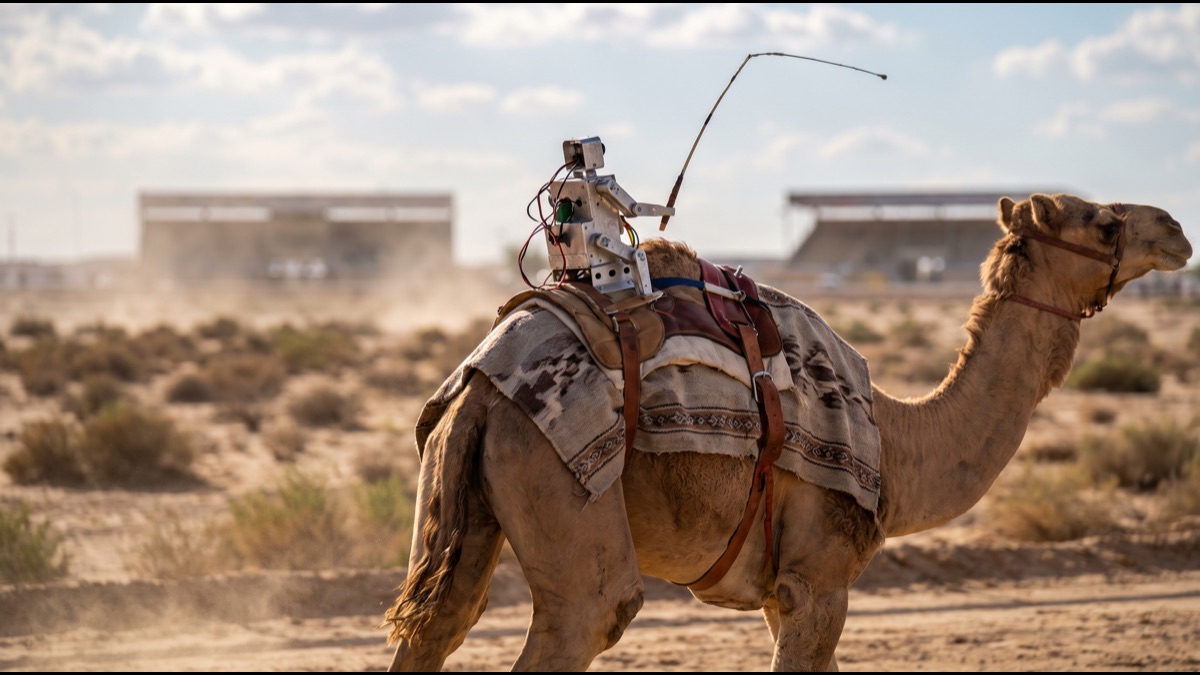
Racing camels across the Gulf now carry riders weighing barely a few kilograms, strapped to the saddle, controlled entirely by radio signal from a trainer driving alongside the track in an SUV. There is no human jockey risking injury atop these animals anymore; there is a small robot, and understanding why it exists reveals one of the more unusual and genuinely consequential engineering responses to a human rights crisis in modern sport history.
Camel racing is a genuinely ancient tradition across the Arabian Peninsula, deeply embedded in Bedouin culture and celebrated at major tracks across the Gulf, but for decades the sport carried a hidden cost that eventually forced a genuine reckoning: the extremely light weight needed to make a racing camel fast was traditionally supplied by young children, many trafficked from impoverished families abroad, and the technology that replaced them is a genuinely remarkable engineering response to sustained international pressure.
Why Camel Racing Needed Extremely Light Riders
A racing camel's speed depends heavily on the weight it carries relative to its own body mass, following a similar underlying logic to horse racing, where jockeys are selected and trained specifically to be as light as possible while still capable of controlling the animal, since even a few extra kilograms measurably affect a competitive time over a race distance.
For camels, this weight sensitivity is particularly acute given the sport's traditionally very high speeds and the animal's own already substantial body mass, creating strong competitive pressure among owners and trainers to find the lightest possible rider capable of directing the camel and applying encouragement during a race, historically satisfied by using children rather than adult jockeys.
Racing camels themselves are specifically bred and trained for speed over distances typically ranging from a few kilometers up to longer endurance races, and the sport carries genuine prestige and significant financial investment across Gulf societies, with successful racing camels commanding substantial prices and their owners competing for prize money and status at prominent tracks throughout the racing season.
What the Child Jockey Crisis Actually Involved
For decades, camel racing across the Gulf relied substantially on child jockeys, many as young as four or five years old, with a documented pattern of children being trafficked or sold into this role from poor families in countries including Sudan, Bangladesh, Pakistan, and elsewhere, often with promises of paid work that turned into exploitative and dangerous labor.
These children faced genuine physical danger from falls at speed, malnutrition deliberately imposed to keep their weight low, and separation from their families for extended periods, a pattern that human rights organizations and international media investigations increasingly documented and publicized through the 1990s and early 2000s, generating sustained diplomatic and public pressure on Gulf governments to act.
Governments in countries the children were trafficked from, alongside international bodies including the International Labour Organization and various human rights organizations, brought increasing pressure to bear on Gulf states through diplomatic channels, coordinated advocacy campaigns, and repatriation programs aimed at identifying and returning affected children to their families, a process complicated by the informal and often deliberately obscured nature of the trafficking networks involved.
Why Bans Alone Could Not Fix the Problem
Gulf states including the UAE progressively introduced formal bans on the use of child jockeys below specific age and weight thresholds in the early 2000s, but enforcement proved genuinely difficult in practice, since the underlying economic incentive to field the lightest possible rider remained entirely unchanged even after the specific practice was formally outlawed.
Simply banning child jockeys without offering camel owners and trainers a viable alternative risked pushing the practice further underground rather than eliminating it, which is precisely why the emergence of a credible technological substitute mattered so much to actually changing behavior across the sport rather than merely changing what was written in law.
How the Robot Jockey Was Actually Developed
Robot jockeys were developed in the early to mid-2000s, with early prototypes drawing on robotics expertise from outside the region, refined over subsequent years into a purpose-built device specifically engineered for the unique demands of sitting securely on a moving camel at speed while remaining light enough to preserve the animal's competitive performance.
The core engineering challenge was never simply building a robot capable of holding a whip; it was building one light enough, secure enough, and reliable enough under harsh outdoor racing conditions including dust, heat, and the physical jolting of a galloping camel, to genuinely replace a human rider without introducing new safety or reliability problems of its own.
Early development work reportedly drew on established radio-control and robotics expertise more commonly associated with hobbyist and industrial applications than sporting equipment, adapted specifically to the unusual combination of requirements a camel saddle presented: extreme weight sensitivity, resistance to vibration and impact, reliable outdoor radio communication over the distance a trainer's vehicle needed to maintain alongside a fast-moving camel, and simple enough operation that trainers without engineering backgrounds could use the devices confidently under race-day pressure.
What a Robot Jockey Actually Looks Like
A modern robot jockey is a compact mechanical unit, typically weighing just a few kilograms, mounted securely to the camel's saddle and equipped with a mechanical arm holding a small whip, a built-in camera providing a live video feed back to the trainer, and a radio receiver allowing remote operation throughout the race.
Unlike early crude prototypes that drew some criticism for looking unsettling or overly mechanical, more recent designs have generally become more compact and functional in appearance, prioritizing secure attachment and reliable operation over any attempt to visually resemble a human rider, since the functional replacement of the child jockey's role, not visual mimicry, was always the actual engineering objective.
Manufacturers of these devices, several based outside the Gulf region and supplying racing tracks across multiple countries, have iterated the design considerably since the earliest versions, incorporating lighter composite materials, improved battery life, more reliable camera systems, and generally more robust weatherproofing suited to the extreme heat and dust conditions typical of desert racetracks throughout much of the year. This ongoing refinement has turned what began as a fairly improvised emergency response into a mature, commercially supported product category with its own specialized suppliers, spare parts, and after-sales service, a level of industrial maturity few would have predicted for a device invented specifically to solve one very particular regional sporting problem.
How the Whip Mechanism Actually Works
The robot's whip mechanism is directly controlled by the trainer via remote control, allowing precise, real-time application of encouragement to the camel during the race in a manner intended to replicate what a human jockey would have done, timed to specific moments in the race based on the trainer's assessment of the camel's position and effort.
This remote operation genuinely requires skill and judgment on the trainer's part, since effective camel racing tactics depend on knowing when to encourage additional effort and when to conserve the animal's energy for a final push, meaning the human expertise involved in camel racing was relocated from atop the animal to alongside the track rather than eliminated from the sport altogether.
How Trainers Actually Control the Robot Mid-Race
During an actual race, the trainer drives alongside the track in a vehicle, typically an SUV or similar four-wheel-drive capable of keeping pace with a galloping camel across desert terrain, watching the animal directly and via the robot's camera feed, adjusting the remote control inputs continuously throughout the race based on real-time conditions.
This arrangement has itself become a distinctive visual feature of modern Gulf camel racing, with rows of vehicles moving alongside the track during a race, each driven by a trainer or owner intently focused on their own camel's robot jockey, a scene that would have looked entirely unfamiliar to anyone watching the sport before the technology's adoption.
Some tracks have introduced dedicated lanes or designated zones specifically for these support vehicles, reflecting formal recognition that the trainer's vehicle is now as integral to running a race safely and fairly as the racetrack itself, requiring its own traffic management, safety rules, and infrastructure considerations that simply did not exist when human jockeys rode the camels directly.
Why Lighter Jockeys Actually Made Camels Faster
The dramatic weight reduction achieved by switching from even a small child jockey to a robot weighing only a few kilograms produced a genuine, measurable improvement in competitive times, confirming that the underlying physics driving the original preference for extremely light riders was accurate rather than merely a traditional assumption.
This performance improvement gave camel owners and trainers a genuine competitive incentive to adopt the new technology quickly rather than resisting it, since a faster camel using a legal, ethically uncontroversial robot jockey offered a clear competitive advantage over continuing to rely on increasingly scrutinized and legally risky human child riders.
How the Technology Spread Across the Gulf
Following initial adoption in the UAE, robot jockeys spread relatively quickly to camel racing tracks across Qatar, Saudi Arabia, Bahrain, and other Gulf states with established camel racing traditions, reflecting both the shared cultural significance of the sport across the region and coordinated regional pressure on the underlying human rights issue.
Manufacturing and refinement of the technology has continued in the years since initial adoption, with successive generations of robot jockeys generally becoming lighter, more reliable, and more sophisticated in their remote-control capabilities, reflecting ongoing investment in a technology that proved genuinely essential to the sport's continued operation rather than a temporary stopgap measure.
What Race Day Actually Looks Like Now
Major camel racing venues, including tracks like Al Marmoum in Dubai, now regularly host races featuring dozens of camels each carrying a robot jockey, drawing spectators, owners, and enthusiasts in a scene that blends an ancient Bedouin sporting tradition with visibly modern robotics technology in a way genuinely unusual among traditional sports worldwide.
Camel racing remains a serious and prestigious pursuit within Gulf culture, with significant prize money, valuable breeding camels, and substantial owner investment involved, meaning the robot jockey technology serves a genuinely important and economically significant sport rather than a marginal novelty attraction. Some of the region's most prominent racing camels are worth substantial sums, comparable in some cases to valuable racehorses elsewhere in the world, giving owners considerable financial motivation to invest in the most reliable and effective robot jockey equipment available rather than treating it as an afterthought.
How Camel Owners Actually Feel About the Robots
Camel owners and trainers have generally adopted the technology enthusiastically once its performance and reliability were established, viewing it as a straightforward net improvement over the previous system: faster camels, no legal or reputational risk associated with human child jockeys, and no need to manage the practical and ethical complications that came with fielding young riders.
Some longtime participants in the sport have expressed a degree of nostalgia for aspects of the traditional human-jockey era, though this sentiment is generally framed around the broader cultural tradition of camel racing itself rather than genuine regret over the elimination of child jockeys, which is almost universally acknowledged within the sport as a necessary and overdue change.
Whether the Human Rights Problem Was Actually Solved
The introduction of robot jockeys, combined with formal bans and increased enforcement, substantially reduced the specific practice of using trafficked child jockeys in Gulf camel racing, representing a genuine and measurable improvement over the situation that prevailed through the 1990s, verified by ongoing monitoring from international organizations tracking the issue.
Human rights organizations have continued to press for accountability regarding previously affected children, including compensation and rehabilitation support for those trafficked and exploited before the reforms took effect, noting that a technological solution to prevent future exploitation does not automatically address the harm already done to children affected under the previous system. Some Gulf governments have funded repatriation and support programs for affected former jockeys, though advocacy groups continue to argue that the scale and consistency of this support has varied considerably between countries and has not always matched the severity of harm documented in earlier investigations.
Why This Remains a Genuinely Unusual Engineering Story
Robot jockeys represent a rare case where a specific, targeted piece of robotics engineering was developed not primarily for commercial profit or scientific curiosity but as a direct, practical response to a documented human rights abuse, successfully replacing exploited human labor with a mechanical alternative while simultaneously improving the underlying activity's competitive performance.
That combination of ethical necessity and genuine technical achievement is unusual enough to make robot jockeys worth understanding well beyond their specific application to camel racing, offering a concrete example of engineering being deployed deliberately to close off an entire category of human exploitation rather than merely to make an existing activity more efficient or profitable. Few pieces of sporting equipment anywhere in the world can claim that specific combination of purpose, and fewer still have succeeded at it as thoroughly as the small mechanical rider now strapped to the saddle of nearly every competitive racing camel across the Gulf.