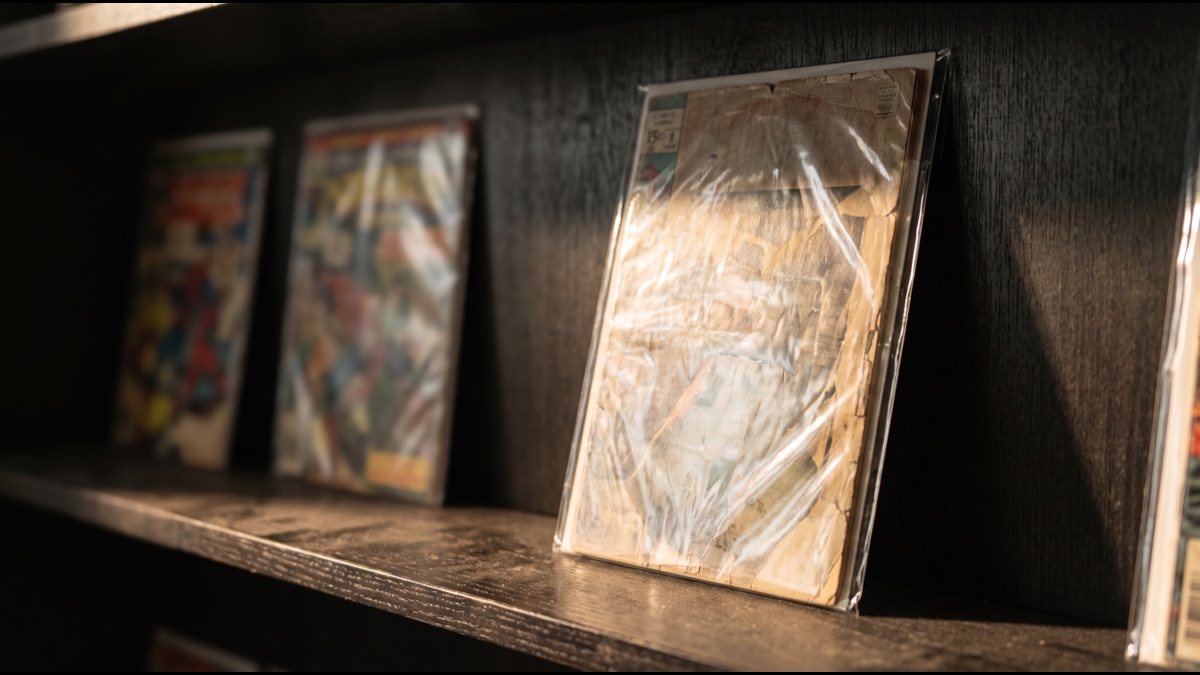
A comic book that looks essentially identical to the untrained eye can sell for either a few hundred dollars or well over a hundred thousand, and the entire difference frequently comes down to a single number stamped on a small label inside a sealed plastic case. That number is a professional grade, and the industry built around assigning it treats a decades-old pamphlet with the same forensic seriousness a jeweler brings to appraising a diamond.
Understanding how that grade actually gets assigned, and why collectors pay such a large premium for a difference of even half a point, explains a surprisingly rigorous discipline hiding behind what looks, from the outside, like a simple opinion about a comic's condition.
Why Comic Grading Became a Serious Industry
Comic books were treated as disposable entertainment for most of the twentieth century, printed on cheap newsprint and expected to be read, traded, and eventually thrown away rather than preserved, which is precisely what makes genuinely well-preserved vintage copies so scarce today.
As a secondary collectors' market matured through the 1970s and 1980s, buyers needed a way to trust a seller's claim about a comic's condition without physically inspecting every page themselves, especially once high-value sales started happening remotely through mail order and later the internet.
Third-party grading emerged to solve exactly that trust problem, borrowing its basic model from coin and stamp grading, where an independent expert examines an item and issues a standardized, numerical assessment that both buyer and seller agree to treat as authoritative.
What the Numerical Grading Scale Actually Represents
Professional comic grading uses a 0.5-to-10.0 scale, with 10.0 representing a theoretically perfect copy and lower numbers representing progressively more wear, damage, or defects, mapped onto named condition tiers like Near Mint, Very Fine, and Good that collectors use in everyday conversation.
A grade of 9.8, commonly called Near Mint Minus, is treated in practice as close to the realistic ceiling for most vintage books, since a genuine 10.0 essentially requires the book to have never been meaningfully handled since leaving the printing press, which is exceptionally rare for anything printed before comics were treated as collectibles.
The scale is deliberately granular in its upper range, with half-point and even tenth-point distinctions between 9.0 and 9.8 carrying real market consequences, because collector demand concentrates so heavily at the top of the condition spectrum that fine gradations there matter enormously to price.
How a Grader Physically Examines a Comic
A trained grader examines a submitted comic under controlled lighting, checking the front and back cover, spine, and interior pages for a specific checklist of defects including creases, tears, foxing, discoloration, staple rust, and any prior restoration work.
The spine receives particular scrutiny because it is structurally the most stressed part of a comic and the most common site of visible wear, with even a single small stress line or subtle color-breaking crease along the spine capable of dropping a grade by a full point or more.
Corners, page quality and color, cover gloss, and centering of the printed image within the trimmed page edges are all separately assessed and combined into the final overall number, meaning a book can be flawless in most respects and still be capped by a single significant defect in one area.
Why Two Books From the Same Print Run Can Grade Differently
Comics from the same print run, printed on the same press within minutes of each other, routinely grade very differently once decades of individual handling history are factored in, since one copy might have sat untouched in a drawer while an identical copy circulated through several owners and multiple house moves.
Storage conditions matter enormously over long timescales, since humidity, direct sunlight, and temperature swings degrade paper and ink in ways that are frequently invisible on casual inspection but become obvious under a grader's controlled lighting and magnification.
This is why provenance, meaning a documented ownership and storage history, increasingly matters to serious collectors independent of the assigned grade itself, since a well-documented history of careful storage adds genuine buyer confidence beyond what the number alone communicates.
How Restoration Gets Detected and Disclosed
Amateur or professional restoration work, including color touch-up, tear seals, staple replacement, and trimming, was historically sometimes passed off as original condition to unsuspecting buyers, which is one of the specific problems third-party grading was built to solve.
Graders use techniques including raking light, which illuminates a surface at a low angle to reveal texture irregularities invisible under normal lighting, along with magnification and, in ambiguous cases, blacklight examination to detect touch-up ink and adhesive residue from restoration work.
A book with detected restoration does not simply fail grading; it receives a specific label disclosing the restoration alongside a grade in a visually distinct color, since some collectors specifically seek out honestly disclosed restored copies of otherwise unaffordable books at a lower price point.
Why Sealed Encapsulation Became the Industry Standard
Once a grade is assigned, major grading companies seal the comic inside a rigid, tamper-evident plastic holder often called a slab, with the assigned grade and identifying information printed on an internal label visible through the clear case without needing to open it.
This encapsulation serves two purposes simultaneously: physically protecting the book from further degradation from handling, humidity, and light, while also making it essentially impossible to swap a lower-grade book into a higher-grade holder without visible evidence of tampering.
The tradeoff is that a slabbed comic can no longer be read or handled directly, which is why serious readers who want to actually experience the story frequently maintain a separate, ungraded reading copy alongside a graded copy purchased purely as an investment or display piece.
How Market Value Scales With Grade
The relationship between grade and price is not linear; it is typically closer to exponential at the top of the scale, where the jump in price from a 9.6 to a 9.8 on a genuinely significant key issue can dwarf the entire price of a mid-grade copy of the same book.
This steep curve reflects genuine scarcity rather than arbitrary collector preference, since the number of surviving copies of any vintage comic in true Near Mint condition is a tiny fraction of the original print run, making the highest grades legitimately rare regardless of how common the book was when it was first sold.
Lower-grade copies of the same issue, sometimes with genuine and obvious damage, remain affordable entry points into collecting a specific title or era, meaning the grading scale effectively creates an entire spectrum of price points for the same underlying comic.
What Makes a Comic a Genuine Key Issue
A key issue is a comic recognized by the collecting community as historically significant, most commonly because it contains the first appearance of a character who later became culturally significant, though first appearances of important storylines or creative teams can also qualify.
Key status is established retroactively by the market rather than declared in advance, which is why comics that sold for cover price when originally published can become extraordinarily valuable decades later once the character or story inside turns out to matter far more than anyone anticipated at release.
Grading interacts powerfully with key status because a poorly preserved copy of even a highly significant key issue commands a fraction of the price a high-grade copy achieves, meaning the same underlying cultural significance produces wildly different market outcomes depending purely on preservation.
Why Grading Companies Guard Their Standards Carefully
Multiple companies offer third-party comic grading, and the market has settled on trusting a small number of established firms whose grading standards, while never published as an exact numerical formula, are understood by experienced collectors through years of comparing graded books against known reference points.
Consistency across thousands of graders examining millions of books over decades is itself a genuine operational challenge, and grading companies maintain internal review processes, including having multiple graders independently examine higher-value submissions before a final grade is agreed upon.
A grading company's commercial value is entirely built on market trust in its consistency, which is why an established firm has strong incentive to maintain rigorous internal standards rather than inflate grades to please submitting customers in the short term.
How Submission and Turnaround Actually Work
Collectors submit comics to a grading company along with a declared estimated value, which determines both the fee charged and the level of insurance coverage during the grading process, with higher-value submissions typically receiving more careful handling and review.
Turnaround time varies considerably by service tier, ranging from a standard multi-week process to expedited options that can return a graded book within days for a substantially higher fee, a tradeoff collectors weigh based on how urgently they need the book for a sale or auction.
Once graded and encapsulated, a book receives a unique certification number that can be looked up in the grading company's public database, allowing a buyer to verify a specific slab's authenticity and grading history before completing a purchase.
Why Some Collectors Deliberately Avoid Grading Their Books
Not every serious collector chooses to grade their collection, since grading fees add real cost, encapsulation prevents actually reading the physical comic, and some collectors specifically value the tactile experience of handling an original, unsealed book over the investment-grade presentation a slab provides.
Grading also makes the most economic sense for higher-value books where the fee is small relative to the value added by a trusted, documented grade, meaning many collectors selectively grade only their most significant or valuable pieces while leaving the bulk of a collection raw.
This creates a genuine cultural divide within the hobby between collectors who see comics primarily as an investment asset class and those who see grading as, at best, a necessary tool for specific transactions rather than the point of collecting itself.
How Grading Reshaped the Broader Comic Market
The rise of standardized grading fundamentally changed how vintage comics get bought and sold, shifting a market that historically relied heavily on in-person inspection and trust between known dealers toward one where high-value transactions routinely happen sight-unseen between strangers based purely on a trusted grade.
This shift enabled the growth of major public comic auctions and a much larger pool of remote, non-specialist buyers willing to invest significant money into a hobby they might never have entered without the confidence a standardized, third-party grade provides.
It also introduced new dynamics, including speculative grading submissions of recently published comics that dealers hope will become future key issues, a practice some longtime collectors view skeptically as treating comics more like a commodity than a storytelling medium.
What Common Grading Terminology Actually Means
Terms like Near Mint, Very Fine, and Fine correspond to specific numerical ranges on the grading scale, and understanding this correspondence lets a collector translate between the informal language used in casual conversation and the precise number that actually determines market value.
The label Signature Series indicates a book was graded alongside verification that a signature present on the cover or interior is authentic, a separate certification process from condition grading that specifically addresses the ongoing problem of forged creator signatures in the secondary market.
Understanding this vocabulary is genuinely necessary for participating confidently in the collecting community, since online listings and auction descriptions assume familiarity with these standardized terms rather than explaining them for newcomers each time.
Why Grading Disputes Still Happen Despite Standardization
Grading remains ultimately a trained human judgment applied to a standardized rubric, not a fully mechanical measurement, which means reasonable disagreement between experienced graders on a borderline case, particularly around half-point distinctions, remains a genuine and acknowledged part of the process.
Major grading companies offer a formal review process allowing a submitter to challenge an assigned grade, though this is used sparingly since repeatedly challenging grades can itself affect how a submitter's future submissions are handled by graders who track submission history.
Collectors sometimes crack open an encapsulated book to resubmit it for regrading, hoping a different grader on a different day assigns a marginally higher number, a practice widely acknowledged within the hobby despite the genuine risk of damaging the book during the process.
What This Means for Someone Considering Their First Submission
A first-time submitter should research recent sale prices for comparable graded copies of their specific book before paying a submission fee, since grading only makes clear financial sense when the expected grade and resulting value increase meaningfully exceed the cost of the service.
Examining a book carefully under strong, angled light before submission, checking specifically the spine and corners where the most common grade-limiting defects occur, gives a realistic sense of the likely outcome and avoids an unpleasant surprise when the graded book returns.
Ultimately, grading exists to answer a specific question, namely how a specific physical object compares to a standardized condition scale, and it is most useful when a collector already has a clear reason, whether selling, insuring, or preserving, for wanting that question answered with third-party authority.
How Digital Comics Changed What Grading Even Means
The rise of digital comic distribution introduced a genuinely new question for the grading world: what does condition even mean for a file that never physically degrades, never gets a bent spine, and can theoretically be copied infinitely without losing any quality at all.
Grading companies have largely stayed out of digital comics entirely, since their core value proposition, verifying the physical condition of a scarce printed object, simply does not translate to a digital file that exists in unlimited identical copies rather than a finite, aging physical print run.
Some collectors experimented with blockchain-based ownership certificates for digital comics during periods of speculative interest, though the practice never gained anywhere near the trust or liquidity of physical third-party grading, and most serious collectors still treat physical, gradable print copies as the meaningful collectible.
Why International Print Variants Complicate Grading
Comics historically printed for different regional markets sometimes used different paper stock, printing processes, or even cover variants, meaning an international edition of an otherwise identical issue can carry a genuinely different baseline condition ceiling than its domestic counterpart.
Graders familiar with a specific market's typical printing quality can spot an international variant relatively easily, and specialized collectors of a specific region's print runs develop deep expertise in the subtle paper texture and color differences that distinguish one printing from another.
This regional variation adds a layer of authentication complexity beyond simple condition assessment, since confirming which specific print run and region a book actually came from is sometimes as important to serious collectors as the numeric grade itself.
Why Insurance and Estate Planning Increasingly Rely on Grades
A documented, third-party grade has become a standard reference point for insuring valuable comic collections, since insurers generally require an objective, independently verifiable condition assessment rather than relying purely on an owner's own description when setting coverage value.
The same logic increasingly applies to estate planning, where a collection passed down to heirs benefits enormously from having each significant book already professionally graded and encapsulated, removing ambiguity about value that could otherwise complicate an estate settlement or lead to a collection being significantly undervalued when sold.
This growing institutional reliance on grading, beyond the collector hobby itself, is part of why the practice has become so deeply embedded in how the entire secondary comic market now operates.
What looks from the outside like an arbitrary number on a sticker is, underneath, a genuinely disciplined forensic process built to convert a subjective impression of condition into a defensible, repeatable grade that a market of collectors, dealers, and auction houses can trust enough to price real money against.
The premium buyers pay for a higher grade is not really a payment for the number itself, but for the certainty that number represents: a professional third party has examined the book under controlled conditions and staked its reputation on the claim that this specific copy is genuinely closer to how it looked the day it left the printing press.
Sources
- Wikipedia — overview of comic book collecting and the grading industry
- Library of Congress — archival standards for preserving paper-based print media
- Smithsonian Institution — research on print media preservation and conservation
- U.S. Federal Trade Commission — consumer guidance on collectibles authentication and grading disclosures
FAQ
What does a 9.8 grade actually mean?
It means the comic is in Near Mint Minus condition, extremely close to how it looked leaving the printing press, with only the most minor detectable imperfections.
Can a slabbed comic be removed from its case and read?
Yes, a book can be cracked out of its holder, but doing so voids the encapsulation protection and the book would need to be resubmitted and repackaged to be graded again.
Does restoration always lower a comic's grade?
Restoration doesn't necessarily cap the numeric grade itself, but it is disclosed on a distinct label, and most collectors pay significantly less for a restored copy than an unrestored one at the same grade.
Why do half-point grade differences matter so much?
Because collector demand concentrates heavily at the top of the condition scale, small grade differences near 9.8-10.0 can represent a large share of the surviving population's price spread.
Is third-party grading required to sell a valuable comic?
No, but for high-value books it substantially increases buyer confidence and typically results in a meaningfully higher achievable sale price compared to an ungraded copy.
About the Author
We reference Wikipedia, the Library of Congress, the Smithsonian Institution, and the U.S. Federal Trade Commission to explain the background and current understanding of this topic.
Loved This Article?
Share it on WhatsApp → Share it on WhatsApp
Get more guides in your inbox — Subscribe to our newsletter for weekly surprising stories from Egypt, Saudi Arabia, Dubai, and beyond.