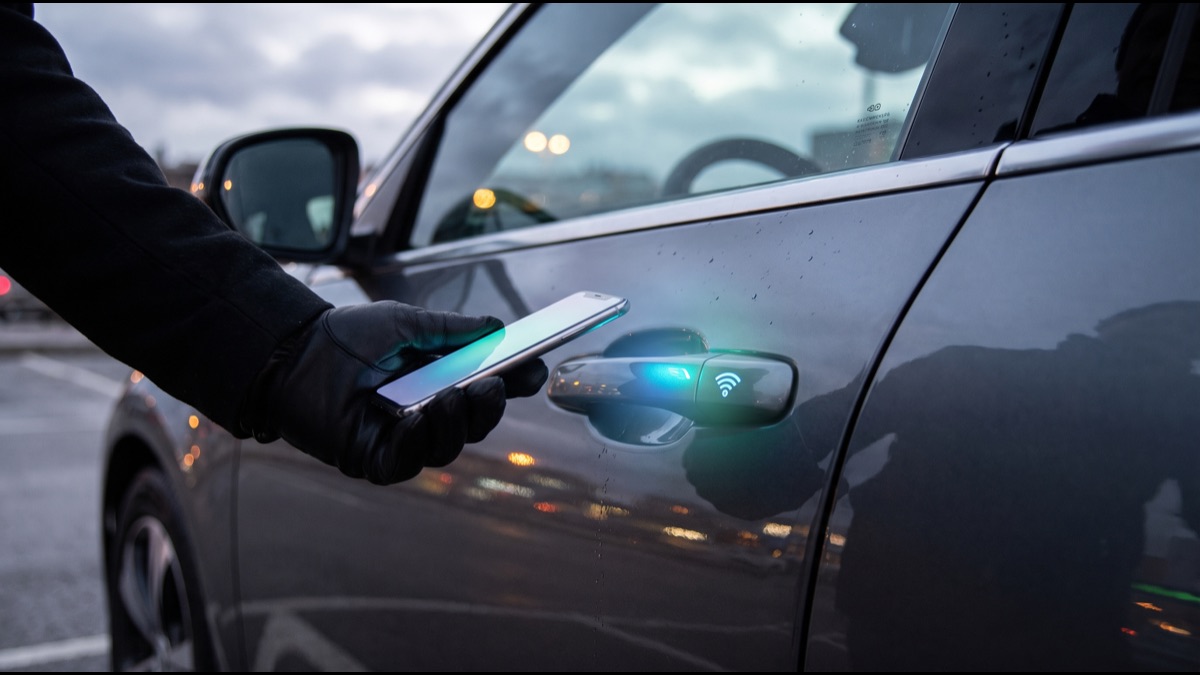
A phone with a completely dead battery can sometimes still unlock a car parked right next to it. That single fact confuses most people the first time they hear it, because a phone that will not turn on is not supposed to be able to do anything, let alone authenticate itself to a two-tonne vehicle and pop open its doors.
The explanation sits in a small reserve power circuit and a radio standard most owners have never heard of, and understanding it means looking past the phone app entirely and into how a digital car key actually proves its identity over the air.
Millions of drivers now unlock a car, start its engine, and hand a temporary copy of that access to a valet or a family member without a single metal key ever changing hands, and the system quietly doing all of that work borrows more from contactless payment cards and secure phone chips than from anything in traditional automotive engineering.
Why a Digital Key Is Not Just an App
The visible car key app on a phone's screen is mostly a convenience layer, a settings panel that lets an owner add a key, share it with a family member, or revoke access remotely. The actual unlocking exchange happens beneath that interface, between a small radio chip inside the phone and a matching chip inside the car, using a short-range wireless standard rather than an internet connection.
This distinction matters because it explains why digital keys keep working in underground parking garages with no cellular signal and no Wi-Fi: the phone and the car are talking directly to each other over a few centimetres or a few metres of open air, not routing anything through a distant server.
It also explains why turning on airplane mode does not disable a digital car key the way it disables calls or mobile data, since the short-range radios responsible for unlocking sit on a separate hardware path from the cellular modem and are deliberately left active even when broader wireless connectivity is switched off.
The Two Radio Technologies Doing the Actual Work
Most digital car key systems rely on one of two short-range radio technologies: Near Field Communication, the same tap-to-pay technology used at checkout terminals, and Ultra-Wideband, a newer standard that measures distance far more precisely than ordinary Bluetooth ever could.
NFC-based systems typically require the phone to be held directly against a sensor built into the door handle, much like tapping a card reader, while Ultra-Wideband systems can detect a phone in someone's pocket from several metres away and unlock the door automatically as the owner walks up, without any tap or button press at all.
Many current vehicles actually ship with both technologies active at once, using NFC as a guaranteed fallback for phones that lack an Ultra-Wideband chip and reserving the fuller walk-up experience for phones and trims where the newer hardware is present on both sides of the exchange.
How Ultra-Wideband Tells Real Distance From a Guess
Ordinary Bluetooth estimates distance by measuring how weak a signal has become, a method that is easily fooled because walls, bodies, and even humidity change how much a signal fades over a given distance, which is exactly the weakness thieves have exploited with relay attacks against older keyless systems.
Ultra-Wideband instead measures the actual time it takes a radio pulse to travel between the phone and the car, down to fractions of a nanosecond, and because that travel time is governed by the fixed speed of radio waves rather than signal strength, it produces a genuine distance measurement that is dramatically harder to spoof or artificially extend.
Automotive security researchers specifically pushed for this time-of-flight approach after demonstrating, on camera, that a pair of cheap radio relays held near a house and near a parked car could trick older keyless systems into thinking the real fob was sitting right next to the door handle when it was actually asleep on a kitchen counter far away.
What Actually Happens in the Milliseconds Before a Door Opens
When an owner approaches a car equipped with a digital key system, the vehicle periodically sends out a low-power wake-up signal searching for an authorized device nearby, and once the phone responds, the two devices perform a cryptographic handshake, exchanging encrypted codes that prove each side holds a matching secret key without ever transmitting that key itself over the air.
Only after this handshake succeeds and the distance measurement confirms the phone is genuinely close, not relayed from a thief's amplifier parked outside a house, does the car's control module release the door latches, and the whole sequence, from wake-up signal to unlocked door, is typically designed to complete in well under a second.
The same handshake, running continuously in the background while the owner drives away, is also what allows the car to automatically re-lock itself once the paired phone drifts out of range, closing the loop on the same distance measurement used to unlock the doors in the first place.
Why a Dead Phone Can Still Unlock the Car
Several phone manufacturers include a small reserve power feature for exactly this scenario: a dedicated NFC chip and a tiny amount of stored power that remain active for a limited window, sometimes several hours, after the main battery has otherwise died, because losing car access the moment a phone dies would make digital keys far less trustworthy than a physical fob.
This reserve mode intentionally supports only the lowest-power NFC tap-to-unlock function rather than the full Ultra-Wideband walk-up experience, since even that minimal capability draws enough current that it cannot be sustained indefinitely on a phone that is otherwise completely powered down.
Owners who rely on this feature regularly still tend to notice its limits eventually, since the reserve window is measured in hours rather than days, and a phone left dead over a long weekend will typically exhaust even that small buffer before its owner returns to the car.
How a Key Gets Shared, Revoked, or Lost
Adding a new person to a digital key typically means generating a fresh cryptographic credential tied to their specific phone and sending it to them through an encrypted link inside a manufacturer's app, rather than literally copying a master key the way a physical key gets duplicated at a hardware store.
Because each phone holds its own distinct credential, an owner who lends a car to a friend for a weekend, or who needs to cut off access after a phone is lost or a family member no longer needs it, can revoke that one credential remotely without affecting any other authorized phone or needing to re-key the entire vehicle.
Some manufacturer apps also let an owner issue a deliberately limited credential, one that only unlocks the doors and starts the engine without granting access to the glovebox lock or trunk release, which is specifically useful for handing a car to a valet or a workshop technician without giving away full access.
Digital Keys Still Do Not Replace the Physical Backup
Almost every vehicle sold with a digital key system also ships with a small physical card or fob, usually tucked in the glovebox or a door pocket, specifically for situations a phone cannot cover: a completely drained phone battery beyond even the reserve window, a phone that has been lost entirely, or a passenger who simply does not own a compatible device.
Manufacturers treat this physical backup as a mandatory fallback rather than an afterthought, because a car that becomes inaccessible whenever a single phone misbehaves would undermine the entire premise of convenient keyless entry.
This backup card is also typically what a dealership hands over first when a car is sold or transferred, since it carries none of the personal account information tied to an owner's phone-based credential and can simply be reprogrammed for a new owner without touching anyone's digital identity.
The Cross-Brand Standard Behind the Scenes
Rather than each automaker inventing its own incompatible protocol, an industry group called the Car Connectivity Consortium maintains a shared Digital Key specification that phone makers and automakers both build against, which is the underlying reason a single phone can, in principle, hold digital keys for cars from more than one brand using the same basic radio and cryptographic framework.
This shared standard also lets a phone maker add support for new automakers without redesigning the phone's hardware each time, since the radio chips and secure element already built into recent phones for payments and access control are the same components a car manufacturer's implementation ultimately relies on.
Because the specification is versioned like any other software standard, older phones sometimes miss out on the newest capabilities, such as Ultra-Wideband ranging, simply because they shipped before that particular radio hardware became standard equipment, even though their software otherwise supports the digital key feature.
Where the Actual Security Guarantee Comes From
The cryptographic secret that proves a phone is authorized never leaves a dedicated, tamper-resistant secure element inside the device, a small isolated chip separate from the phone's main processor and operating system, which means that even if the phone itself were compromised by malicious software, the car key credential stored in that secure element is designed to remain protected.
This is the same category of hardware-isolated storage phones already use for storing payment card details and biometric templates, repurposed for vehicle access because the security requirements, proving identity without ever exposing the underlying secret, are functionally identical.
Independent security labs have specifically tested this isolation by attempting to extract stored car key credentials from compromised phones, and the results generally show the secure element resisting extraction even when the rest of the phone's software has been fully compromised, which is the entire point of keeping that component physically separate.
Why Some Owners Still Distrust Phone-Based Keys
Skepticism toward digital car keys often centers on a scenario physical keys never faced: what happens during a software update gone wrong, an app crash, or a phone that needs a factory reset while its owner is far from the car, situations that can temporarily lock a phone's key credential in a way a metal key blade never could.
Automakers have addressed most of these edge cases through cloud-backed credential recovery that restores access once the phone is back online, but the underlying dependency on software working correctly, rather than a purely mechanical mechanism, remains the core trust gap that keeps some drivers carrying a physical fob out of habit even after enabling a digital one.
Surveys of new-car buyers consistently show a generational split on this point, with younger drivers who already trust a phone for banking and identification adopting digital keys readily, while longtime owners of older vehicles tend to treat the feature as a nice extra layered on top of a metal key they still consider the real one.
What Happens if the Car Itself Loses Power
A digital key handshake still requires the car's own electronics to be awake and listening, so a vehicle with a fully dead 12-volt battery cannot respond to a phone's signal any more than it could respond to a traditional remote fob, which is why manufacturers typically also provide a mechanical key blade hidden inside the fob or card as an absolute last resort for physically opening a door.
Once a door is opened mechanically, most vehicles include a concealed slot near the ignition or wireless charging pad where the physical key card can be placed to authenticate power-up, a deliberately old-fashioned failsafe sitting underneath an otherwise fully digital system.
This layered fallback design, mechanical latch first, then a low-power authentication read second, is deliberately kept independent of the car's main battery so that a flat 12-volt battery affects only the convenience features and not the fundamental ability to get inside and eventually start the car with roadside assistance.
Where Digital Key Technology Is Headed Next
Newer specification versions extend digital keys beyond simply locking and unlocking doors toward starting the engine, adjusting seat and mirror positions automatically per authorized driver, and even authorizing one-time access windows for delivery drivers or valets that expire automatically after a set period, turning the phone into something closer to a full identity credential for the vehicle rather than just a door key.
As Ultra-Wideband chips become standard across more phone models, the walk-up-and-unlock experience is expected to become the default rather than the exception, gradually pushing the tap-based NFC method into the same secondary, backup-style role that the physical key card already occupies.
Longer term, the same secure-element approach is also being extended to smartwatches and even rings, suggesting that the phone itself may eventually become just one of several interchangeable devices capable of holding a car's digital identity rather than the single required gateway it is today.
Sources
- Wikipedia — overview of digital car key standards and adoption
- Car Connectivity Consortium — industry Digital Key specification maintained across automakers and phone makers
- IEEE Spectrum — engineering reporting on Ultra-Wideband and secure ranging technology
- NFC Forum — technical background on Near Field Communication used in tap-to-unlock systems
FAQ
Can a digital car key work if the phone battery is completely dead?
Many phones reserve a small amount of power specifically for a limited-time NFC tap-to-unlock function after the main battery dies, though this reserve mode eventually runs out and does not support the longer-range walk-up unlock feature.
Is a phone-based car key safer than a traditional key fob?
Modern Ultra-Wideband digital keys measure genuine signal travel time rather than signal strength, which makes them significantly more resistant to the relay attacks that have been used against older keyless entry fobs, though both systems still rely on encrypted cryptographic handshakes for authentication.
Can one phone hold digital keys for cars from different brands?
In principle yes, because a shared industry specification from the Car Connectivity Consortium defines the underlying radio and cryptographic standard, though actual support still depends on whether a specific phone model and car manufacturer have both implemented that shared standard.
What happens if a phone with a digital key is lost or stolen?
An owner can revoke that specific phone's credential remotely through the manufacturer's app without affecting any other authorized device, and because the cryptographic secret lives inside a tamper-resistant secure element, a thief cannot easily extract it even with physical access to the phone.
Do cars with digital keys still come with a physical key?
Yes, nearly every vehicle offering a digital key also includes a small physical card or fob as a mandatory backup, specifically for situations like a fully drained phone, a lost device, or a passenger without a compatible phone.
Why does a digital car key still work in airplane mode?
The short-range radios used for unlocking, such as NFC and Ultra-Wideband, sit on a hardware path separate from the cellular modem that airplane mode disables, so they stay active even when broader wireless connectivity is switched off.
About the Author
We reference Wikipedia and other authoritative sources to explain the background and current understanding of this topic.
Loved This Article?
Share it on WhatsApp → Share it on WhatsApp
Get more guides in your inbox — Subscribe to our newsletter for weekly surprising stories from Egypt, Saudi Arabia, Dubai, and beyond.