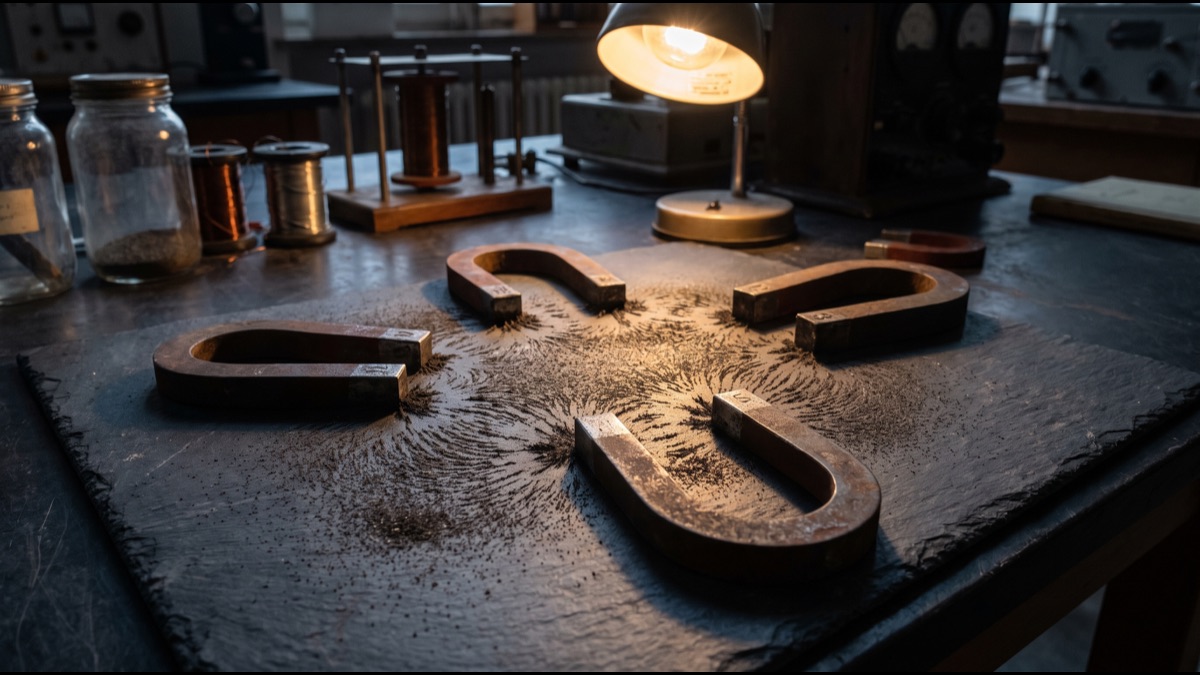
Every electron behaves like a tiny magnet because of its spin, but in most materials those countless tiny magnetic fields point in random directions and cancel each other out. In a handful of elements, iron, nickel, and cobalt among them, neighboring electrons naturally align their spins within small regions called magnetic domains.
In a piece of unmagnetized iron, those domains still point every which way, so their fields cancel out at the larger scale even though each domain is internally aligned. Bring a strong external magnetic field close, and the domains rotate to line up with it, and with each other, turning the whole object into a magnet.
Aligned Electrons and Magnetic Domains
Why Heat and a Hard Hit Can Erase It
That alignment is fragile. Heat a magnet past a threshold called its Curie temperature — 770°C for iron — and thermal vibration scrambles the domains faster than the magnetic field can hold them in place, and the magnetism disappears. A sharp physical shock can have a similar, if smaller, effect by jostling the domains out of alignment.
Earth itself is a magnet for a different reason: churning currents of molten iron in its outer core generate a magnetic field through a process called the geodynamo. That field has flipped its north and south poles many times over geological history, with the last complete reversal roughly 780,000 years ago.
Sources
- NASA — Earth's magnetic field and the geodynamo
- USGS — geomagnetic reversal history
- Britannica — magnetic domains and ferromagnetism
FAQ
Can any metal be made into a magnet?
No, only ferromagnetic metals like iron, nickel, cobalt, and some of their alloys hold a lasting magnetic field; most metals, including aluminum and copper, don't respond to magnets at all.
Why do magnets lose strength over time?
Repeated heating, physical shocks, or storing magnets touching in opposing orientations can gradually knock their internal domains out of alignment, weakening the field.
Does Earth's magnetic field ever fully disappear?
During a reversal it weakens substantially and becomes more complex for a period lasting centuries to millennia, but evidence from rock magnetism shows it hasn't dropped to zero during past flips.
About the Author
We reference NASA, USGS, Britannica to explain the background and current understanding of this topic.
Loved This Article?
Share it on WhatsApp → Share it on WhatsApp
Get more guides in your inbox — Subscribe to our newsletter for weekly surprising stories from Egypt, Saudi Arabia, Dubai, and beyond.