Introduction
DNA (deoxyribonucleic acid) is the molecule that carries the genetic instructions for building, developing, and maintaining every known living organism, from bacteria to blue whales, encoded through an elegantly simple chemical system that has remained essentially unchanged across billions of years of evolution.
Despite its central importance to all life, DNA's basic structure is remarkably simple: it's built from just four different chemical building blocks, repeated in different sequences and combinations, that together can encode the instructions for an organism as complex as a human being.
The Double Helix Structure
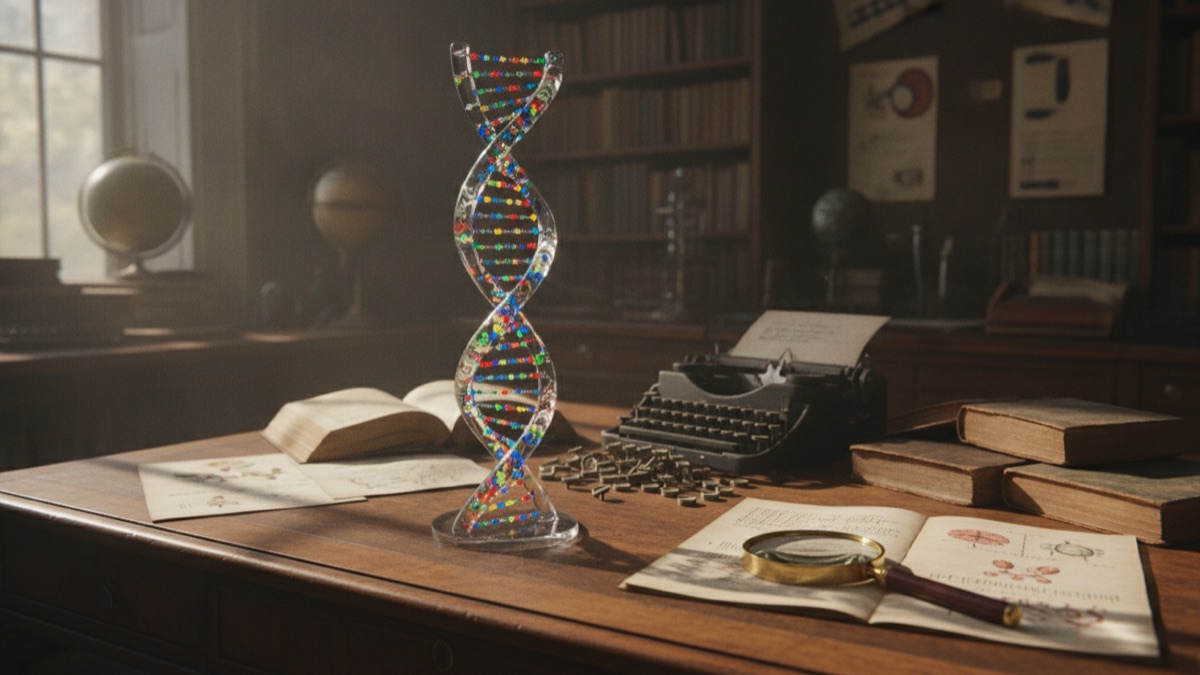
DNA's structure was famously determined in 1953 by James Watson and Francis Crick, building substantially on X-ray crystallography data produced by Rosalind Franklin, whose critical contribution to the discovery was not fully publicly credited during her lifetime, and Maurice Wilkins, revealing that DNA forms a double helix — two long strands twisted around each other like a spiral staircase.
Each strand is made of a sequence of four chemical bases: adenine (A), thymine (T), guanine (G), and cytosine (C). Crucially, these bases pair up in a specific, predictable way across the two strands — A always pairs with T, and G always pairs with C — a property called complementary base pairing that turns out to be essential both for how DNA stores information and how it gets accurately copied.
How the Genetic Code Actually Works
DNA encodes information through the specific sequence, or order, of its four bases along a strand, functioning conceptually similar to how a sequence of letters forms words and sentences in written language, except DNA's 'alphabet' has just four letters (A, T, G, C) instead of 26.
Specific sequences of three consecutive bases, called codons, each correspond to a specific amino acid, the building blocks of proteins; since proteins carry out most of the actual functional work within cells, a gene's specific DNA sequence essentially provides a precise blueprint for building a specific protein with a specific function in the body.
Genes, Chromosomes, and the Complete Genome
A gene is a specific segment of DNA that contains the complete instructions for building one particular protein or functional RNA molecule; the complete set of an organism's genetic material, including all its genes, is called its genome. The human genome contains roughly 3 billion base pairs organized into an estimated 20,000-25,000 genes, packaged into 23 pairs of structures called chromosomes found within the nucleus of nearly every human cell.
Remarkably, genes actually make up only a small fraction, roughly 1-2%, of the total human genome; the vast majority of human DNA doesn't directly code for proteins, and while some of this 'non-coding' DNA plays important regulatory roles controlling when and how genes are activated, researchers are still actively studying the function of significant portions of it.
DNA Replication and Genetic Inheritance
DNA's complementary base-pairing structure is what makes accurate replication possible: when a cell divides, the double helix unwinds and separates into two single strands, and each original strand serves as a template for building a new complementary strand, since the specific pairing rules (A with T, G with C) mean each strand contains enough information to accurately reconstruct its exact partner strand.
This replication mechanism is also the basis for biological inheritance: when organisms reproduce, they pass copies of their DNA to offspring, which is why children inherit specific genetic traits, including physical characteristics and predisposition to certain hereditary conditions, from their biological parents, with the specific combination of inherited genetic material determining much (though certainly not all) of an individual's biological characteristics.
Sources
- US National Human Genome Research Institute — Official reference on DNA structure, genes, and the human genome
- Nature journal — Original 1953 publication describing the DNA double helix structure
- US National Institutes of Health — Reference on genetics, gene function, and DNA replication
FAQ
Who discovered the structure of DNA?
James Watson and Francis Crick famously determined DNA's double helix structure in 1953, building substantially on X-ray crystallography data produced by Rosalind Franklin and Maurice Wilkins.
What are the four bases that make up DNA?
DNA is made of four chemical bases: adenine (A), thymine (T), guanine (G), and cytosine (C), which pair up in a specific way (A with T, G with C) across the double helix's two strands.
How does DNA actually encode genetic information?
DNA encodes information through the specific sequence of its four bases along a strand, with specific three-base sequences called codons each corresponding to a specific amino acid, the building blocks of proteins.
What is the difference between a gene and a genome?
A gene is a specific DNA segment containing instructions for one particular protein, while a genome is the complete set of an organism's genetic material, including all its genes; the human genome contains an estimated 20,000-25,000 genes.
Do genes make up most of human DNA?
No. Genes actually make up only about 1-2% of the total human genome; the vast majority of human DNA doesn't directly code for proteins, though some of this non-coding DNA plays important regulatory roles.
About the Author
doyouknow.app Editorial Team — We reference official genomics institutes and foundational published research to explain DNA structure and function clearly.
Loved This Article?
Share it on WhatsApp → Share on WhatsApp
Get more guides in your inbox — Subscribe to our newsletter for weekly surprising stories from Egypt, Saudi Arabia, Dubai, and beyond.