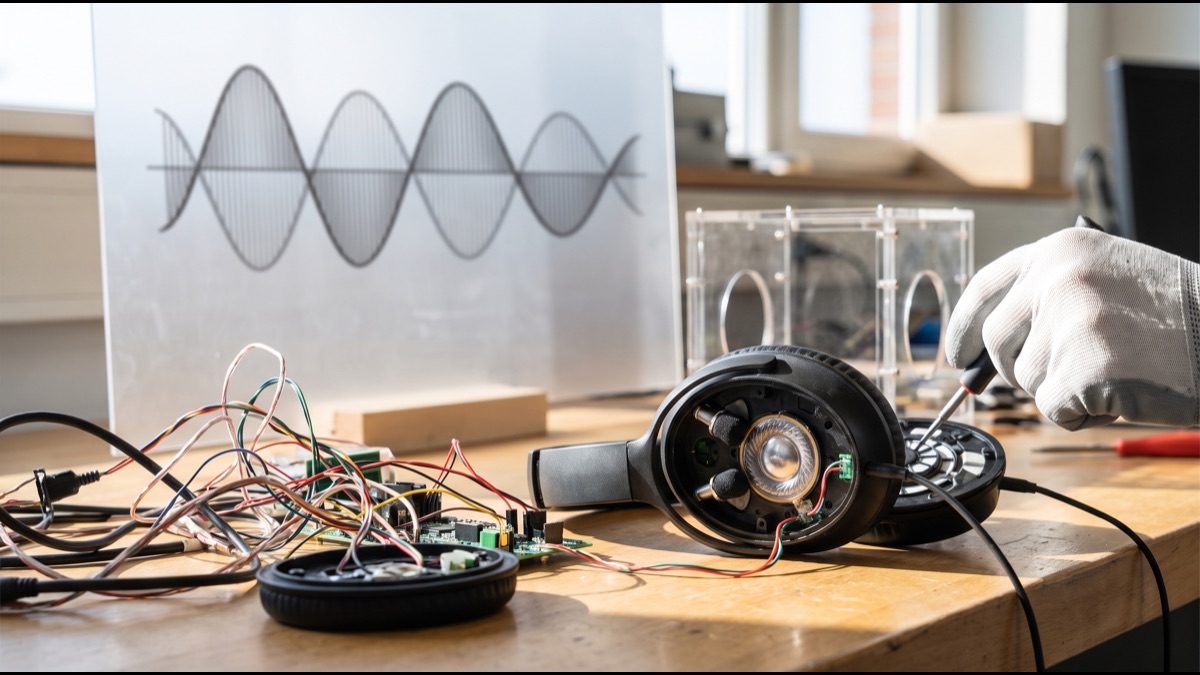
Introduction
Put on a good pair of noise cancelling headphones, flip the switch, and the roar of a jet cabin or an air conditioner simply melts away — before any music even starts playing. It feels like the device is creating silence. In fact, it is doing something stranger: it is fighting sound with more sound.
The technology is called active noise cancellation (ANC), and it is one of the most elegant everyday applications of wave physics. Instead of blocking noise physically, the headphones listen to incoming sound, calculate its exact opposite, and play that anti-sound into your ear, cancelling the noise before your brain ever hears it.
The Physics of Sound
Sound is a pressure wave traveling through air: a repeating pattern of compressions (high pressure) and rarefactions (low pressure). When two waves meet, they combine through superposition — their pressures add together point by point. If a compression meets a compression, you get a louder sound; this is constructive interference.
But if a compression meets a rarefaction of exactly equal size, the two cancel out and the result is near silence. This is destructive interference. A wave shifted so its peaks align with another wave's troughs is said to be 180 degrees out of phase. Noise cancellation is simply the art of generating a mirror-image sound wave, perfectly out of phase with the noise, in real time.
How the Circuitry Works
An ANC headphone is a tiny real-time physics lab. Tiny microphones — on the outside of the ear cup (feedforward), inside near your ear (feedback), or both — constantly sample ambient noise. A digital signal processor analyzes the waveform, generates an inverted copy of it, and the speaker driver plays that anti-noise along with your music. The whole listen-invert-play loop happens in microseconds, fast enough to keep up with the incoming sound.
The idea dates to a 1978 flight. Amar Bose, the MIT professor who founded the Bose Corporation, was frustrated that the roar of the aircraft engines ruined the airline's headphones, and he sketched the mathematics of noise cancellation mid-flight. Bose spent more than a decade on research and released the first commercially successful noise cancelling aviation headset in 1989, built for pilots. Consumer versions arrived in 2000 with the QuietComfort line, and today the technology lives in devices as small as wireless earbuds.
What ANC Can and Cannot Do
ANC is superb against low-frequency, steady sounds: engine drone, air conditioners, train rumble, fan hum — roughly the 50 to 1,000 hertz range. These waves are long and predictable, giving the processor time to compute an accurate anti-wave, and cancelling them can cut perceived noise dramatically, which is why frequent flyers swear by the technology.
It is much weaker against sudden, high-pitched, or irregular sounds — speech, a crying baby, clattering dishes. Those waveforms change too fast to invert reliably, so headphones rely on passive isolation (the physical seal of the ear cups) for the higher frequencies. This is also why some people feel an odd 'pressure' sensation with ANC: the absence of low-frequency sound tricks the brain into perceiving a pressure change, though no actual pressure on the eardrum exists. Modern adaptive ANC tunes itself to your surroundings, and transparency modes deliberately pipe outside sound in so you can hear announcements or traffic.
Sources
- HowStuffWorks — accessible explanation of how noise cancelling headphones sample and invert sound
- Wikipedia — the theory, history, and applications of active noise control
- Encyclopaedia Britannica — the wave-interference physics that makes noise cancellation possible
FAQ
Do noise cancelling headphones work without music playing?
Yes. Active noise cancellation is independent of your audio: the microphones and anti-noise circuitry run on their own, so you can use ANC headphones just for quiet, with no music at all.
Why do noise cancelling headphones create a pressure feeling?
The sensation is an illusion. When low-frequency ambient sound suddenly disappears, your brain interprets the change similarly to a pressure shift like taking off in a plane. No real pressure is applied to your eardrum, and most people adapt quickly.
Why can't ANC block voices and sudden sounds?
Speech and sharp noises are high-frequency and change too quickly for the processor to generate an accurate anti-wave in time. Headphones handle those frequencies with passive isolation — the physical seal of the ear cups — rather than active cancellation.
Are noise cancelling headphones bad for your ears?
No evidence suggests ANC itself harms hearing — the anti-noise cancels sound rather than adding to what reaches your ear. ANC can even protect hearing, because you can listen at lower volumes in noisy places. The main risk, as with any headphones, is excessive volume.
What is the difference between noise cancelling and noise isolating?
Noise isolation is passive: materials physically block sound, like earplugs or snug ear cups. Active noise cancellation uses microphones and speakers to generate anti-noise that erases incoming sound waves electronically. Good headphones combine both.
About the Author
doyouknow.app Editorial Team — We reference acoustics research and engineering sources to explain the physics of active noise cancellation.
Loved This Article?
Share it on WhatsApp → Share on WhatsApp
Get more guides in your inbox — Subscribe to our newsletter for weekly surprising stories from Egypt, Saudi Arabia, Dubai, and beyond.