Introduction
Every year, hundreds of millions of people are rendered completely unconscious on purpose, their bodies cut open and repaired, and then woken up with no memory of any of it. It is one of the greatest gifts in the history of medicine — and one of its strangest mysteries. General anesthesia works so reliably that we plan surgery around it, yet scientists still cannot fully explain how it switches consciousness off.
What is clear is that anesthesia is not sleep. It is a reversible, drug-induced coma: a controlled state in which the brain cannot form consciousness, cannot record memories, cannot move, and cannot feel pain. Understanding how drugs produce that state means understanding, at least partly, how the brain produces awareness itself.
What Anesthesia Does to the Brain
Most general anesthetics — intravenous propofol and inhaled gases like sevoflurane — work mainly by boosting the brain's own braking system. They bind to GABA-A receptors, the docking sites for GABA, the brain's chief inhibitory neurotransmitter, and make them more effective. Neurons across the cortex become harder to excite, and the normal chatter between brain regions fades.
The crucial effect is not that brain cells go quiet individually, but that they stop talking to each other. Brain imaging shows anesthetics disrupt the long-range connections between the thalamus and the cortex and between the front and back of the brain — the communication networks thought to be essential for unified conscious experience. The hardware still works; the network that assembles experience into awareness is unplugged.
The Four Components of Anesthesia
A complete anesthetic actually delivers four separate things, often with different drugs. Unconsciousness (hypnosis) comes from agents like propofol. Amnesia ensures no memories form even if some awareness flickers. Analgesia — blocking pain signals — usually comes from opioids such as fentanyl, because hypnotics alone do not fully stop the body's stress response to being cut. And immobility comes from neuromuscular blockers, drugs that temporarily paralyze muscles so the patient cannot move or breathe on their own, which is why a ventilator takes over.
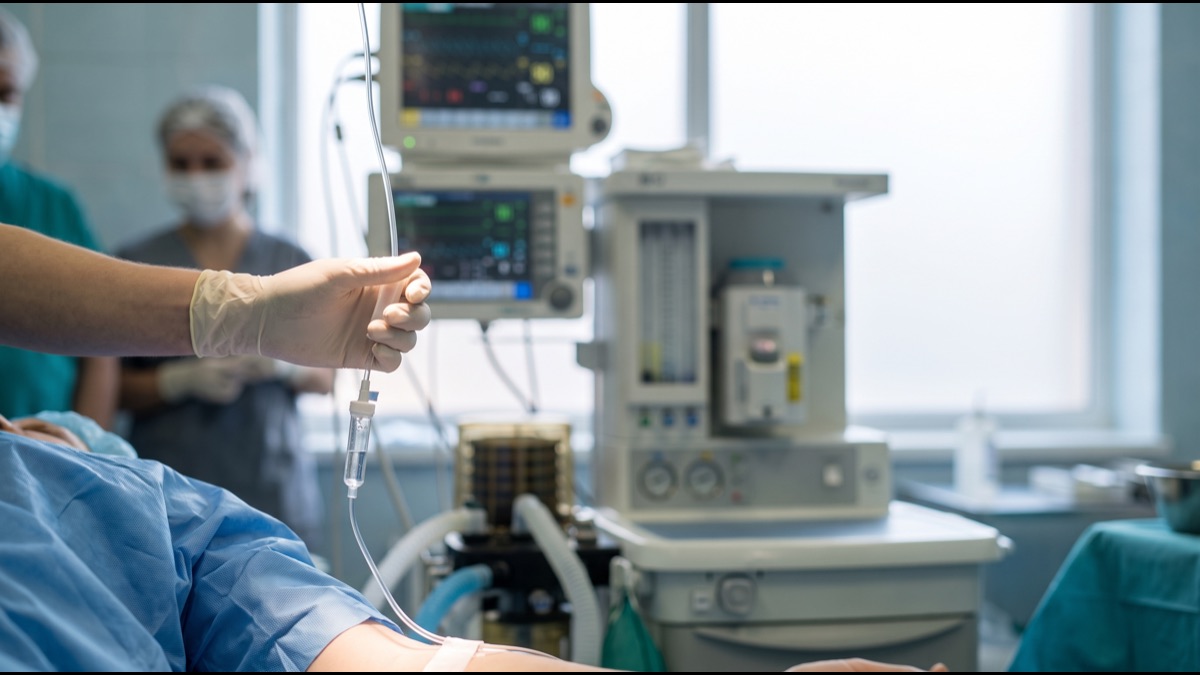
An anesthesiologist continuously balances this cocktail, tracking heart rate, blood pressure, oxygen, and exhaled anesthetic concentration, and often a processed-EEG monitor such as the BIS index, which estimates the depth of unconsciousness from brain-wave patterns on a 0-to-100 scale. Dosing is remarkably precise: too little and the patient may wake; too much and blood pressure and brain activity are suppressed dangerously.
What Science Still Doesn't Know
Here is the humbling part: after nearly 180 years, no one has a complete theory of how anesthetics produce unconsciousness. Drugs as chemically different as propofol, xenon gas, and ketamine all abolish awareness through partly different mechanisms, which suggests consciousness itself may emerge from brain processes we have not yet pinned down. Anesthesia is, in effect, the world's largest ongoing experiment on the nature of consciousness.
There are also unsolved clinical puzzles. Anesthesia awareness — waking up paralyzed during surgery — happens in roughly 1 to 2 of every 1,000 general anesthetics, and researchers still cannot perfectly predict who is at risk. Whether anesthetic exposure harms the developing brains of very young children, or accelerates cognitive decline in the elderly, remains actively debated. The drugs work; the full explanation of why still sits on the frontier of neuroscience.
A Brief History
Before anesthesia, surgery was a horror of speed and restraint: surgeons amputated limbs in under a minute while assistants held screaming patients down, with alcohol or opium offering little real relief. That changed on October 16, 1846, when dentist William Morton demonstrated ether at Massachusetts General Hospital in Boston, in the amphitheater now known as the Ether Dome. A tumor was removed from a patient's neck as he slept peacefully, and the surgeon famously declared, 'Gentlemen, this is no humbug.'
The news crossed the Atlantic in weeks. James Young Simpson introduced chloroform in Edinburgh in 1847, and John Snow — later famous for cholera research — administered chloroform to Queen Victoria during childbirth in 1853, making anesthesia respectable. Modern agents like propofol, introduced in the 1980s, and today's monitoring technology have made anesthesia so safe that death attributable to it is now estimated at roughly 1 in 100,000 to 200,000 procedures.
Sources
- National Institute of General Medical Sciences (NIH) — how anesthetic drugs act on the nervous system and what researchers still study
- Encyclopaedia Britannica — types, history, and mechanisms of anesthesia
- NHS — patient-facing explanation of how general anesthesia is given and monitored
FAQ
Is anesthesia the same as being asleep?
No. Anesthesia is a reversible, drug-induced coma, not sleep. Unlike sleep, you cannot be woken by noise or shaking, your brain cannot form dreams in the normal sense, and consciousness is suppressed rather than cycling through sleep stages.
Can you wake up during surgery under anesthesia?
Rarely. Anesthesia awareness occurs in about 1 to 2 of every 1,000 general anesthetics, most often during emergency, cardiac, or cesarean surgeries where light anesthesia is deliberate. Anesthesiologists monitor brain activity and drug levels specifically to prevent it.
How do anesthetic drugs actually work?
Most general anesthetics enhance GABA-A receptors, boosting the brain's inhibitory signaling so neurons become less excitable and communication between brain regions breaks down. Without that long-range connectivity, the brain cannot assemble conscious experience.
Is general anesthesia safe?
Yes, remarkably so. Death directly attributable to anesthesia is estimated at roughly 1 in 100,000 to 200,000 procedures in developed countries, thanks to modern drugs, monitoring, and trained anesthesiologists. Side effects like nausea and grogginess are common but temporary.
How do doctors know you are fully unconscious?
They combine clinical signs (no movement, stable heart rate and blood pressure) with monitoring of exhaled anesthetic concentration and often a processed-EEG device like the BIS monitor, which scores brain-wave activity from 0 (no activity) to 100 (fully awake).
About the Author
doyouknow.app Editorial Team — We reference medical research and anesthesiology sources to explain how anesthesia silences consciousness.
Loved This Article?
Share it on WhatsApp → Share on WhatsApp
Get more guides in your inbox — Subscribe to our newsletter for weekly surprising stories from Egypt, Saudi Arabia, Dubai, and beyond.