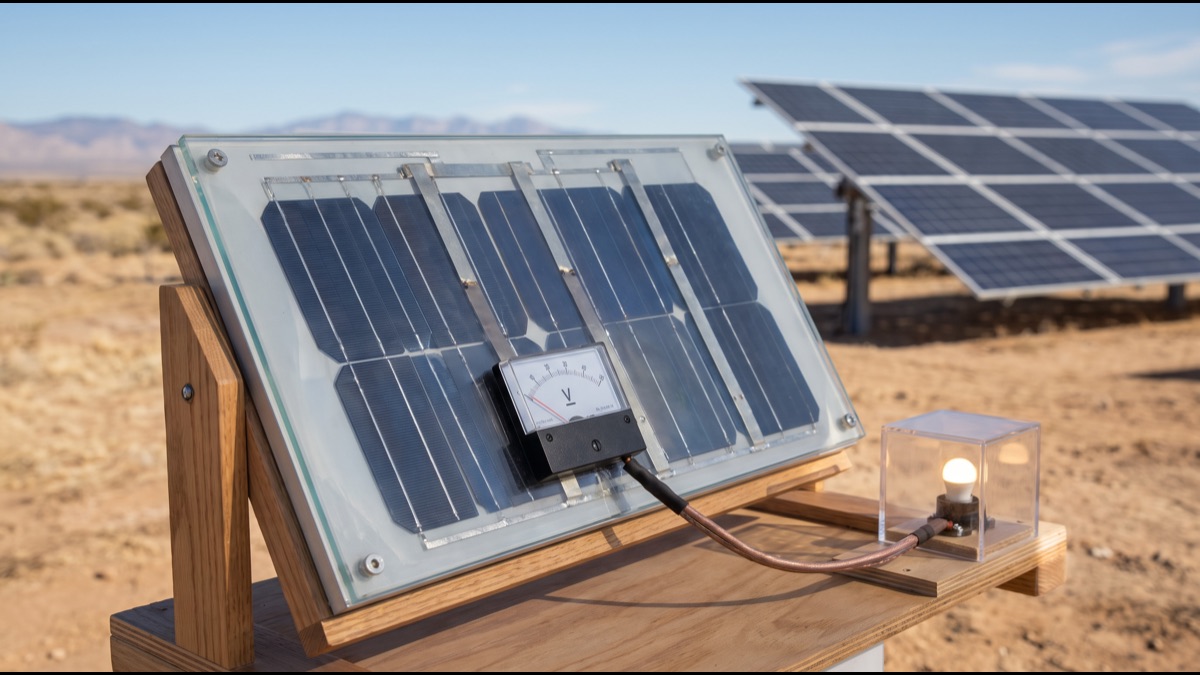
Solar panels generate electricity through the photovoltaic effect, first observed in 1839 by French physicist Edmond Becquerel. Most solar cells are made from silicon, a semiconductor material that releases electrons when struck by photons of light.
A single solar cell produces only a small amount of electricity, so many cells are wired together into a panel, and multiple panels are typically combined into an array to generate meaningful amounts of power for a home or business.
The Photovoltaic Effect Explained
From Sunlight to Usable Electricity
Inside each cell, layers of silicon are treated to create an electric field, commonly through a boundary between "n-type" and "p-type" silicon. When light strikes the cell, it frees electrons, and this internal electric field pushes them to flow in one direction, creating direct current (DC) electricity.
Because most homes and electrical grids run on alternating current (AC), an inverter converts the panel's DC output into usable AC power. Efficiency for common commercial panels is typically in a range of roughly 15 to 22 percent, according to U.S. Department of Energy data, though the figure continues to improve as technology advances, so current specifications should be checked for any new installation.
Sources
FAQ
Do solar panels work on cloudy days?
Yes, but at reduced output; panels still generate some electricity from diffused sunlight on cloudy days, just less than on a clear, sunny day.
Who discovered the photovoltaic effect?
French physicist Edmond Becquerel first observed the photovoltaic effect in 1839.
How long do solar panels typically last?
Most manufacturers warranty panels for around 25 years, though many continue producing power beyond that at a somewhat reduced output.
About the Author
We reference U.S. Department of Energy, International Renewable Energy Agency (IRENA) to explain the background and current understanding of this topic.
Loved This Article?
Share it on WhatsApp → Share it on WhatsApp
Get more guides in your inbox — Subscribe to our newsletter for weekly surprising stories from Egypt, Saudi Arabia, Dubai, and beyond.