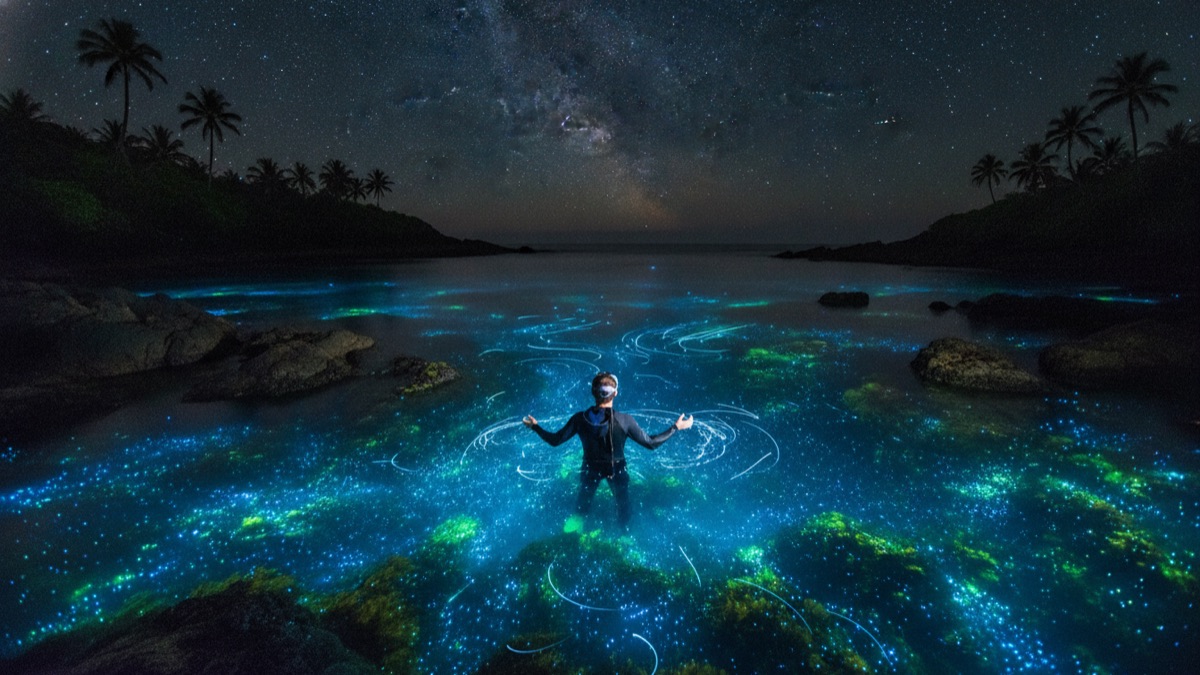
Bioluminescence happens when a molecule called luciferin reacts with oxygen inside an organism's cells, catalyzed by an enzyme called luciferase. The reaction releases its energy almost entirely as light rather than heat, which is why scientists call it "cold light" — well over 90% of the energy becomes visible light, compared to roughly 10% for an incandescent bulb.
The exact luciferin molecule differs across species, which is why fireflies glow yellow-green while many deep-sea creatures glow blue, the wavelength that travels farthest through seawater. Some organisms, like certain jellyfish, also carry a separate protein that shifts the color of the light after it's produced.
A Chemical Reaction, Not Electricity
Why So Much Life in the Deep Ocean Glows
Bioluminescence is remarkably common below where sunlight reaches — researchers estimate a large majority of animals living deeper than 200 meters produce their own light. Anglerfish dangle a glowing lure to attract prey, while some squid use "counter-illumination," matching faint light on their undersides to the dim glow from the surface above so predators looking up can't see their silhouette.
On land, fireflies use precise flash patterns to identify their own species and attract mates, with each species blinking a slightly different rhythm. Fungi, certain earthworms, and even a few sharks also glow, and marine dinoflagellates can turn entire breaking waves an eerie blue at night when disturbed.
Sources
- NOAA Ocean Exploration — how and why marine organisms glow
- Smithsonian Ocean — the chemistry of bioluminescence
- Britannica — luciferin and luciferase reaction mechanics
FAQ
Do all glowing animals live in the ocean?
No, fireflies, some fungi, and a handful of terrestrial worms and insects glow too, though the trait is far more common among deep-sea species than land ones.
Can humans make use of bioluminescent chemistry?
Yes, luciferase is widely used in labs as a "reporter" enzyme to track gene activity, the same basic chemistry behind glow-based research tools used in medical testing.
Is bioluminescence the same as fluorescence?
No, fluorescence requires absorbing outside light first and re-emitting it, while bioluminescence generates its own light internally through a chemical reaction, with no external light source needed.
About the Author
We reference NOAA Ocean Exploration, Smithsonian Ocean, Britannica to explain the background and current understanding of this topic.
Loved This Article?
Share it on WhatsApp → Share it on WhatsApp
Get more guides in your inbox — Subscribe to our newsletter for weekly surprising stories from Egypt, Saudi Arabia, Dubai, and beyond.