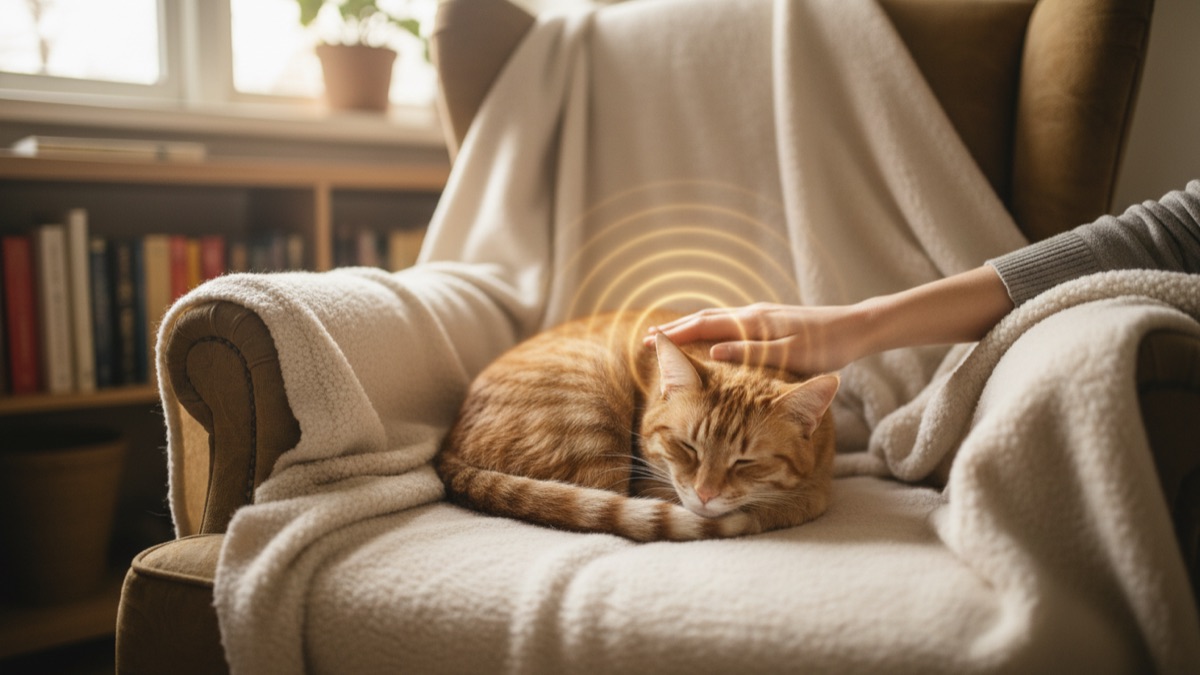
Cats purr by rapidly contracting the muscles of their larynx roughly 25 to 150 times per second, creating vibrations as they breathe in and out.
It's a sound produced by nearly all domestic cats but, notably, not by big cats like lions and tigers, which have a differently structured larynx.
How the Sound Is Physically Made
Unlike vocal sounds made only on the exhale, purring happens continuously during both inhalation and exhalation because of a neural oscillator in the cat's brain.
That oscillator repeatedly signals the laryngeal muscles to twitch, causing the vocal folds to separate and vibrate as air passes through.
Why Cats Purr — It's Not Just Happiness
Cats commonly purr when content, but they also purr when injured, frightened, giving birth, or even dying, leading researchers to theorize purring may also serve a self-soothing and healing function.
Studies have found the dominant frequency range of cat purrs, around 25–50 Hz, overlaps with frequencies shown in other research to promote bone density and tissue healing, though the theory remains actively studied rather than fully proven.
Sources
- Wikipedia — overview of purring mechanics and theories
- Cornell Feline Health Center — veterinary background on cat behavior
- Scientific American — coverage of purring frequency research
FAQ
Do all cats purr?
Nearly all domestic cats purr, but most big cats like lions and tigers cannot — their differently structured larynx lets them roar instead.
Why would an injured cat purr?
Researchers believe purring may have a self-soothing or even physically therapeutic function related to specific vibration frequencies, not just an expression of contentment.
What causes the purring sound?
Rapid, repeated twitching of the laryngeal muscles, triggered by a neural oscillator in the brain, vibrates the vocal folds during both inhaling and exhaling.
About the Author
We reference Wikipedia and the Cornell Feline Health Center and Scientific American to explain the background and current understanding of this topic.
Loved This Article?
Share it on WhatsApp → Share it on WhatsApp
Get more guides in your inbox — Subscribe to our newsletter for weekly surprising stories from Egypt, Saudi Arabia, Dubai, and beyond.