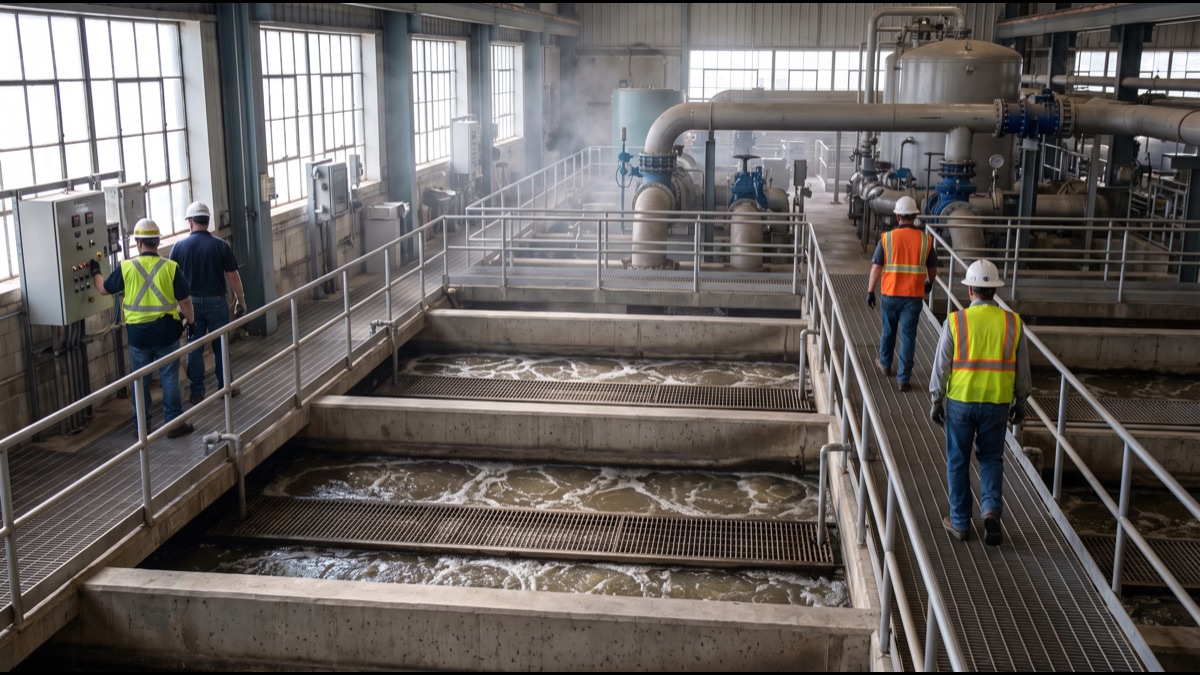
Treating drinking water is plausibly the most effective public health intervention ever deployed, having eliminated waterborne epidemics that killed enormous numbers of people in cities within living memory. It works so reliably in wealthy countries that most people never think about it at all.
What is less appreciated is how much of the system exists to protect water after it leaves the treatment plant, and how much of what people worry about is not what treatment was designed to remove. Understanding what each stage actually does explains why old pipes matter more than the plant, why chlorine is still used despite better alternatives existing, and which contamination concerns are genuine.
What Treatment Is Actually For
The primary purpose of water treatment is preventing infectious disease, since contaminated water transmits pathogens capable of causing epidemics that spread through an entire city rapidly.
Chemical contaminants are a secondary concern addressed by separate processes, and the two objectives require quite different treatment approaches.
This priority ordering explains the design of nearly every treatment plant, since a system that removed chemicals perfectly but allowed pathogens through would be far more dangerous than the reverse.
Why Source Protection Comes First
The cheapest treatment is preventing contamination in the first place, which is why many cities protect the land around their reservoirs and restrict activity in catchment areas.
Some large cities supply water requiring minimal treatment because their catchments are protected wilderness, which saves enormous sums compared with treating polluted water.
Groundwater is frequently cleaner than surface water because soil filters it naturally over long periods, though this also means contamination is far harder to remedy once it occurs.
How Coagulation Removes the Invisible
Much of what makes water cloudy consists of particles too small to settle out on their own, which would remain suspended indefinitely no matter how long the water stood.
These particles carry electrical charges that repel each other, and treatment adds chemicals that neutralise those charges so particles can stick together.
This is the first stage in nearly every conventional plant, and it works on the principle of making small problems into larger ones that physics can then handle.
Why Flocculation Is Deliberately Gentle
After coagulant is added, water is stirred slowly to encourage neutralised particles to collide and build up into visible clumps called floc.
The mixing must be gentle, since vigorous agitation breaks apart clumps that have already formed and undoes the process rather than accelerating it.
This stage typically takes tens of minutes, which is why treatment plants contain large basins that appear to be doing nothing when observed.
What Sedimentation Achieves
Water then moves slowly through large tanks where the accumulated clumps sink to the bottom under gravity and are removed as sludge.
This removes the large majority of suspended material, which matters enormously because particles shield pathogens from disinfection later in the process.
The tanks are large because the process cannot be rushed, and residence time is the main design variable rather than any active mechanism.
How Filtration Catches the Rest
Water passes through beds of sand and other granular media that trap remaining particles, working through adhesion within the bed rather than merely straining at the surface.
Filters clog progressively and are cleaned by reversing the flow, which lifts and scours the media, sending accumulated material to waste.
The performance target is measured by turbidity, since consistently clear water indicates that particles capable of harbouring pathogens have been removed effectively.
Why Chlorine Changed Public Health
Adding chlorine to municipal supplies in the early twentieth century produced dramatic and immediate reductions in deaths from waterborne disease in every city that adopted it.
The effect was large enough to be visible in national mortality statistics, and it is credited with a substantial share of the increase in urban life expectancy during that period.
It remains among the most consequential public health measures ever implemented, achieved at a cost per person that no medical intervention approaches.
What Residual Disinfection Means
Chlorine's defining advantage is that it persists in the water after leaving the plant, continuing to suppress bacterial growth throughout the distribution network.
This matters because pipes can be contaminated by leaks, pressure loss, or repairs, and water may spend days in the system before reaching a tap.
A disinfectant that acts only at the plant leaves the network unprotected, which is why chlorine remains standard despite alternatives that kill pathogens more effectively.
Why Disinfection Byproducts Are a Real Tradeoff
Chlorine reacts with natural organic material in water to form compounds that are regulated because long-term exposure is associated with small increases in certain cancer risks.
This creates a genuine tension, since reducing chlorine lowers byproduct formation but increases microbial risk, and the microbial risk is immediate while the chemical risk is chronic.
Regulators consistently prioritise pathogen control, on the reasoning that an outbreak kills people within days while byproduct exposure produces small risks over decades.
How Ultraviolet Treatment Differs
Ultraviolet light damages the genetic material of microorganisms so they cannot reproduce, which inactivates them without adding any chemical to the water.
It is particularly valuable against certain parasites that are highly resistant to chlorine, and its adoption followed outbreaks caused by exactly those organisms.
Its limitation is that it provides no residual protection, so plants using it still add a chemical disinfectant afterwards to protect water in the distribution network.
Why Ozone Is Used Despite the Cost
Ozone is a powerful disinfectant that also improves taste and odour and breaks down some chemical contaminants, which chlorine does not.
It must be generated on site because it decomposes rapidly, which means plants using it require dedicated equipment and considerably more energy.
Like ultraviolet treatment it leaves no residual, so it is used as a primary disinfectant with chlorine added afterwards for distribution protection.
What Membranes Can and Cannot Do
Membrane filtration passes water through material with pores small enough to physically exclude bacteria and parasites, providing a barrier that does not depend on chemistry.
Finer membranes remove dissolved substances including salts, which is the basis of desalination, but this requires substantial pressure and correspondingly more energy.
Membranes foul over time and require regular cleaning and eventual replacement, which is the main operating cost and the reason adoption is slower than performance alone would suggest.
Why Lead Pipes Are the Hardest Problem
Lead does not come from the source or the treatment plant but from pipes and fittings between the main and the tap, which means treatment cannot address it directly.
Water utilities manage the risk by adjusting chemistry so a protective mineral scale forms inside pipes, physically separating water from the lead surface.
This works reliably until the chemistry changes, and documented crises have occurred when a switch in source water disturbed established scale and released lead into supply.
How Corrosion Control Actually Works
Utilities add compounds, typically phosphate-based, that react with pipe surfaces to build a barrier layer restricting contact between water and metal.
The chemistry must be maintained continuously, since the layer dissolves if conditions change, and rebuilding it takes considerable time during which exposure is elevated.
This makes corrosion control an ongoing operational commitment rather than a one-time treatment, and lapses have caused some of the most serious drinking water failures on record.
Why Distribution Networks Are the Weak Point
Water leaving a treatment plant meets regulatory standards, but it then travels through kilometres of pipe of varying age and condition before reaching anyone.
Pipes leak in both directions, and a pressure drop can draw contaminated groundwater into the network through the same defects that normally lose water outward.
This is why boil water notices frequently follow main breaks and repairs, since the integrity of the barrier rather than the quality of treatment is what has been compromised.
What Water Age Does
Water can spend days in a distribution system, particularly in oversized pipes or at network extremities where demand is low and flow is slow.
Long residence allows disinfectant to decay, biofilm to develop on pipe walls, and taste and odour problems to emerge even when the water left the plant in good condition.
Utilities manage this by flushing sections deliberately, which appears wasteful but is a genuine water quality measure rather than negligence.
Why Fluoride Is Added
Fluoride is added in many jurisdictions specifically to reduce tooth decay, making it unusual as a treatment step that provides a health benefit rather than removing a hazard.
The evidence for reduced decay is substantial and long-standing, though the effect size has narrowed since fluoride toothpaste became universally available.
It remains politically contested, with the core objection being that it constitutes medication without individual consent rather than a dispute about the underlying chemistry.
What Hardness Actually Is
Hard water contains dissolved calcium and magnesium picked up from rock, which causes scale in kettles and pipes and reduces how well soap lathers.
Hardness is not a health concern and some evidence suggests mineral content may be mildly beneficial, so many utilities do not soften water at all.
Where softening is done it is generally for practical reasons including protecting infrastructure, rather than because the water would otherwise be unsafe.
Why Emerging Contaminants Are Difficult
Conventional treatment was designed for pathogens and particles, and removes many trace chemicals only incidentally rather than by design.
Pharmaceutical residues, industrial compounds, and persistent synthetic chemicals pass through conventional processes largely unchanged and require advanced treatment to remove.
Detection has improved faster than treatment, meaning substances are now measurable at concentrations far below any level at which health effects are established, which complicates public communication considerably.
How Persistent Chemicals Changed the Picture
A class of synthetic compounds used for their resistance to heat and water has proved extremely persistent in the environment and is now detected widely in water supplies.
They resist conventional treatment entirely, requiring activated carbon, specialised resins, or high-pressure membranes, all of which add substantial cost.
Regulatory limits have been tightened considerably in several jurisdictions, which is driving major investment in treatment upgrades that most systems were never designed to accommodate.
What Monitoring Actually Involves
Utilities test continuously for indicators including turbidity and disinfectant residual, since these can be measured in real time and reveal problems immediately.
Microbial testing looks for indicator organisms rather than for specific pathogens, because indicators are far easier to detect and their presence signals that contamination pathways exist.
Chemical testing occurs on defined schedules, which means detection of an intermittent chemical problem depends substantially on whether sampling coincided with the event.
How Wastewater Treatment Differs
Treating sewage works on largely biological principles, using bacteria to consume organic material rather than removing particles and disinfecting as drinking water treatment does.
The objective is protecting the receiving river or sea rather than producing something drinkable, so the standards and processes are entirely different despite superficial similarity.
Because most drinking water sources receive treated wastewater from communities upstream, the quality of sewage treatment directly determines how much work drinking water treatment must do.
Why Water Reuse Is Expanding
Several water-scarce regions now treat wastewater to drinking standard and return it to supply, using membranes, advanced oxidation and extended monitoring.
The engineering is well established and the resulting water frequently exceeds conventional supply in purity, since the treatment train is considerably more aggressive.
The obstacle has consistently been public acceptance rather than technology, which is why many schemes route treated water through a reservoir or aquifer before reuse.
What Happens During a Boil Notice
A boil notice is issued when the integrity of treatment or distribution cannot be guaranteed, typically after a pressure loss, main break, or a monitoring result outside limits.
Boiling is recommended because heat reliably inactivates the pathogens of concern, whereas it does nothing about chemical contamination and can concentrate it slightly.
Notices are usually precautionary and lifted after repeated clear samples, which takes at least a day because bacterial testing requires time for organisms to grow.
Why Bottled Water Is Not Obviously Safer
Bottled water is frequently regulated as a food product under standards that are not necessarily stricter than those applied to municipal supply, and testing frequency is generally lower.
A meaningful share of bottled product originates from municipal supply, receives additional treatment, and is then packaged, which means the source is the same system it is marketed against.
Where municipal water is compromised, bottled water is a genuine safeguard, but in systems meeting standards the case rests on taste and convenience rather than safety.
What Home Filters Actually Remove
Activated carbon filters improve taste, remove chlorine, and reduce certain organic compounds, which is what most consumer filters are designed to achieve.
They do not reliably remove dissolved metals, nitrate, or most pathogens, and a filter left beyond its rated life can accumulate bacteria and worsen quality.
Reverse osmosis units remove substantially more including dissolved metals and many synthetic compounds, at the cost of wasting water and removing beneficial minerals along with everything else.
Why Global Access Remains the Real Issue
A large share of the world's population lacks a safely managed supply, and waterborne disease remains a leading cause of childhood death in many countries.
The obstacle is rarely treatment technology, which is well understood and inexpensive at scale, but rather infrastructure, maintenance capacity, and reliable power and funding.
This is why interventions focus on distribution and sanitation as much as on treatment, since clean water delivered through a contaminated network provides no benefit.
Why Taste Complaints Are Usually Harmless
Most taste and odour problems come from natural compounds released by algae in reservoirs, which are detectable by humans at concentrations far below any health significance.
The human nose is extraordinarily sensitive to these substances, which means water can smell unpleasant while being entirely safe by every measured standard.
Utilities treat them anyway, because complaints drive people toward bottled water and undermine confidence in a supply that is performing correctly.
What the System Actually Depends On
Safe drinking water is the product of continuous operation rather than installed equipment, requiring constant monitoring, chemical adjustment, and maintenance to remain safe.
Most serious failures trace to operational lapses, deferred maintenance, or chemistry changes handled without adequate assessment, rather than to technological limitations.
The reliability people experience is therefore the visible result of a system that must work continuously and receives attention almost exclusively when it stops.
Chlorinating municipal water produced reductions in death from waterborne disease large enough to show up in national mortality statistics, at a cost per person no medical intervention approaches. That is the core of what treatment is for — pathogens first, chemicals second. A plant that removed every chemical but let pathogens through would be far more dangerous than the reverse, which is why the priority ordering shapes nearly every design decision. Chlorine also survives despite better disinfectants existing, because its defining advantage is not killing power but persistence. Ultraviolet and ozone inactivate pathogens more effectively but leave nothing behind, and water may spend days travelling through kilometres of pipe that can leak in both directions. A disinfectant that only acts at the plant leaves the network unprotected. That network is where most real risk lives. Lead does not come from the source or the plant but from pipes between the main and the tap, managed by maintaining a protective mineral scale that dissolves if water chemistry changes — the mechanism behind documented crises. And the newer problem is chemical rather than microbial: persistent synthetic compounds pass through conventional treatment unchanged, requiring carbon, specialised resins or membranes that most systems were never built to accommodate.
Sources
- Wikipedia — overview of treatment processes and their history
- World Health Organization — drinking water quality guidelines and global access data
- US Environmental Protection Agency — regulatory standards, lead rules, and contaminant limits
- US Centers for Disease Control and Prevention — waterborne disease surveillance and chlorination history
- American Water Works Association — treatment practice, distribution systems, and corrosion control
FAQ
Why is chlorine still used if better disinfectants exist?
Because it persists in the water after leaving the plant. Ultraviolet and ozone kill pathogens more effectively but leave nothing to protect water travelling through the pipe network.
Does treatment remove lead?
No — lead comes from pipes between the main and the tap, not the source. Utilities manage it by adjusting chemistry so a protective scale forms inside the pipes.
Is bottled water safer than tap water?
Usually not where municipal water meets standards. Bottled water is often regulated as food with less frequent testing, and much of it originates from municipal supply.
What do home water filters actually remove?
Carbon filters improve taste and remove chlorine and some organics. They do not reliably remove dissolved metals, nitrate, or pathogens, and can harbour bacteria if left too long.
Why are disinfection byproducts allowed at all?
Reducing chlorine lowers byproducts but raises microbial risk. Regulators prioritise pathogens because an outbreak kills within days while byproduct exposure carries small risks over decades.
About the Author
We reference Wikipedia, World Health Organization, US Environmental Protection Agency, US Centers for Disease Control and Prevention, and American Water Works Association to explain the background and current understanding of this topic.
Loved This Article?
Share it on WhatsApp → Share it on WhatsApp
Get more guides in your inbox — Subscribe to our newsletter for weekly surprising stories from Egypt, Saudi Arabia, Dubai, and beyond.