Subtitles are not a transcript, and dubbing is not translation read aloud, which is why both are frequently criticised for being inaccurate by viewers comparing them against what was actually said. In both cases the constraint is not language but physics.
A subtitle must be readable in the time it is on screen, which limits it to roughly a third of the words a person actually speaks. A dubbed line must fit the visible mouth movements of an actor who was speaking a different language. Understanding these constraints explains most of what looks like poor translation, and explains why the two approaches produce such different versions of the same film.
Why Subtitles Cannot Match Speech
People speak considerably faster than they read, and a subtitle must remain on screen long enough for a viewer to read it while still watching the image.
Industry guidelines therefore cap reading speed at a specific number of characters per second, which typically permits far fewer words than were actually spoken.
The practical result is that subtitling is fundamentally an exercise in compression, where the translator must decide which information survives rather than how to render all of it.
What the Two-Line Limit Enforces
Conventional subtitles occupy at most two lines with a limited number of characters each, since more text obscures the image and cannot be read in the available time.
This constraint has held despite screens becoming larger and higher resolution, because the limiting factor is human reading speed rather than available display space.
Where a character speaks continuously, the subtitle must be split across successive cards, with each break chosen to fall at a natural grammatical boundary so meaning is not disrupted.
How Subtitles Are Timed
Each subtitle has an in and out point specified to the frame, and these must align closely enough with speech that viewers do not perceive a mismatch.
Convention holds that a subtitle should not appear before the speech begins, since revealing a line early spoils comedic timing and dramatic reveals.
Subtitles are also generally not allowed to cross a shot change, because the eye re-reads text when the image cuts, which forces a re-read of something already processed.
Why Some Information Is Deliberately Dropped
Subtitlers routinely omit content the audience can obtain from the image or the soundtrack, including names being said while a character is visible and repeated interjections.
This is not carelessness but a deliberate allocation of the limited character budget toward information the viewer cannot get any other way.
The most common complaint about subtitle accuracy comes from viewers who understand some of the source language and notice these omissions without recognising the constraint driving them.
What Makes Dubbing Harder Than Translation
A dubbed line must be spoken in approximately the time the original actor's mouth is moving, which means the translated text must have a specific duration rather than merely a correct meaning.
It must also match the visible shape of the mouth at key moments, particularly at the start and end of a line and on any close-up where lip movement is clearly readable.
This means the translator is writing to a set of physical constraints that frequently rule out the most accurate rendering, requiring an alternative that fits the mouth.
How Lip Sync Is Actually Achieved
Certain sounds are visually distinctive, particularly those made by closing the lips completely, and these are the points where a mismatch is most noticeable to viewers.
Adaptors therefore prioritise matching these specific moments rather than attempting to match every syllable, since the eye detects a missing lip closure far more readily than a general timing drift.
Vowel shapes matter at close range, with wide open sounds needing to fall where the actor's mouth is open, which frequently determines which of several possible translations is used.
Why Languages Have Different Lengths
Languages differ substantially in how many syllables are required to express the same content, which means a faithful translation is frequently much longer or shorter than the original line.
Where the translation runs long, the adaptor must cut content or find a more compact phrasing, and where it runs short, material must be added or the delivery slowed.
This is a structural reason dubbed dialogue sometimes contains information absent from the original, since something had to fill the time the actor's mouth was still moving.
What an Adaptor Actually Does
Dubbing typically involves two distinct roles, with a translator producing an accurate rendering and an adaptor rewriting it to fit timing and mouth movement.
The adaptor is effectively a dialogue writer working under severe constraint, and the quality of dubbing depends far more on this stage than on translation accuracy.
In markets with strong dubbing traditions this is a recognised specialist craft with its own training and professional standing, rather than a technical afterthought.
Why Some Countries Dub and Others Subtitle
The division is largely historical, with several large European markets establishing dubbing during a period when it also served political control over imported content.
Smaller markets generally subtitled because dubbing is far more expensive, requiring studios, actors, and extensive post-production for each language.
These patterns proved remarkably persistent, with audiences developing strong preferences for whichever they grew up with, which streaming services have had to accommodate rather than override.
How Streaming Changed the Economics
Global streaming services release content simultaneously in dozens of languages, which requires localisation at a scale and speed that traditional distribution never demanded.
This substantially increased demand for both subtitling and dubbing, and exposed a shortage of qualified translators in many language pairs that the industry is still addressing.
It also normalised dubbing in markets that had historically subtitled, since services default to dubbed audio in many regions and a large share of viewers never change the setting.
Why Subtitle Quality Became Contested
Rapid expansion produced widely publicised complaints about subtitle quality on major releases, particularly where translations flattened distinctive speech or lost cultural nuance.
A structural cause is that subtitles are frequently produced from an intermediate English version rather than the original language, which compounds any loss at each step.
Rates paid to subtitlers have also come under criticism, with professional bodies arguing that compensation no longer reflects the skill the work genuinely requires.
What Pivot Language Translation Costs
Translating from an original into English and then from English into many other languages is far cheaper than sourcing translators for every direct pair.
The cost is accumulated distortion, since each stage makes choices that the next stage cannot see behind, and errors introduced early propagate into every downstream language.
It also strips information that exists in the original but has no English equivalent, particularly formality levels and honorifics that many languages mark explicitly.
Why Formality Is So Difficult
Many languages distinguish formal and informal address grammatically, and the moment characters shift between them is frequently a significant story beat.
English has no equivalent marking, so this information disappears when English is used as a pivot, and cannot be recovered when translating onward into a language that does mark it.
Translators working into such languages must therefore infer the appropriate register from context, which introduces interpretation where the original was explicit.
How Humour Resists Translation
Wordplay depending on the sound or double meaning of specific words generally cannot survive translation, which forces a choice between accuracy and preserving the joke.
The usual solution is substitution, writing a different joke that works in the target language and lands at the same moment, which is standard practice rather than a failure.
This is why comparing a dubbed comedy line against the original frequently shows no relationship at all, since the aim was equivalence of effect rather than of content.
What Happens to Songs
Musical numbers present the hardest case, requiring a translation that fits the melody, preserves the rhyme scheme, matches lip movement, and retains narrative meaning.
Some productions translate songs fully, some subtitle them over the original audio, and some leave them entirely untouched, with the choice varying by market and genre.
Animated musicals typically receive full translation because the audience skews young and cannot read subtitles quickly, which is a substantial part of why animation is dubbed almost universally.
Why Animation Is Easier to Dub
Animated mouths are simplified and less precisely articulated than filmed human mouths, which gives adaptors considerably more latitude in matching the visible movement.
There is also no original performance visible on a real face, so a dubbed voice does not compete with an actor's physical delivery in the way live-action dubbing does.
Some productions animate mouths after recording the original voice track, which means the animation is matched to one specific language and other versions inherit that constraint.
How Voice Casting Works
Dubbing markets frequently assign the same voice actor to a given foreign performer across their entire career, so audiences associate a specific voice with that face.
This produces genuine continuity, and replacing an established voice generates audience complaints comparable to recasting a role.
It also creates a distinct profession with substantial local recognition, where dubbing actors are well known within their market despite being unheard in the original productions.
What the Recording Process Involves
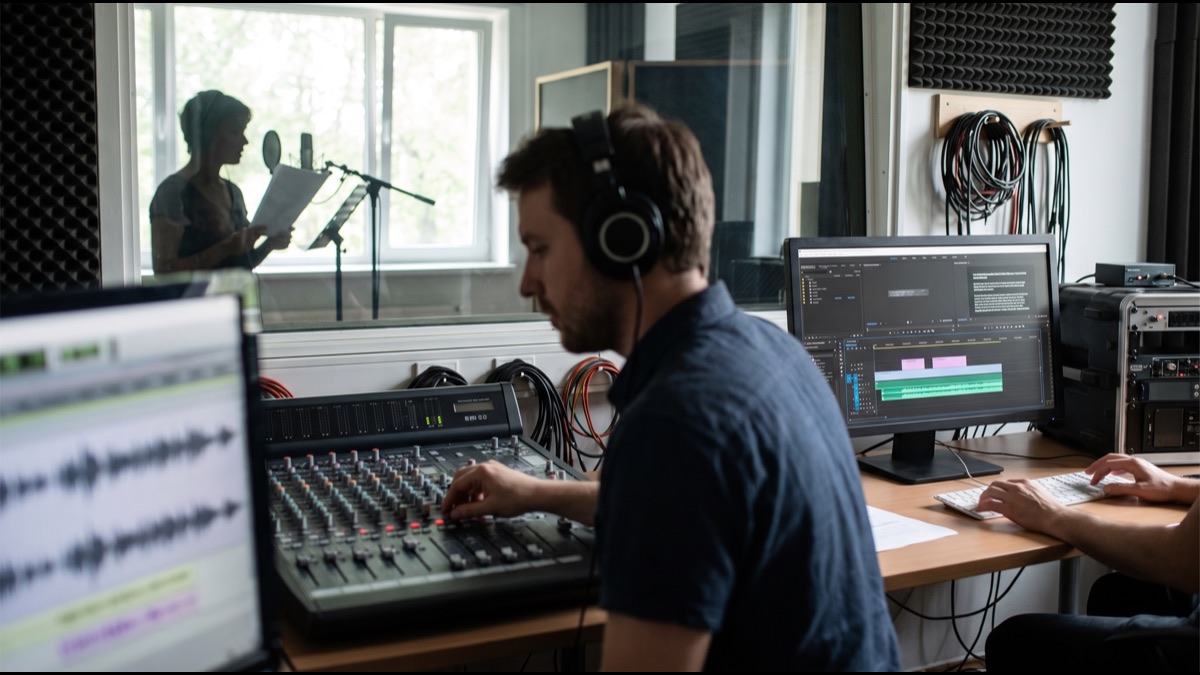
Actors typically record alone in a booth, watching the scene on a monitor while listening to the original audio through headphones and delivering their line to fit.
Lines are recorded in short segments repeated until timing and delivery align, which means a scene is assembled from fragments rather than performed continuously.
This makes dubbing performance a specific technical skill, since actors must produce emotional continuity across takes recorded out of order against a fixed timing target.
Why Audio Is Rebuilt Rather Than Replaced
Dialogue cannot simply be swapped, since the original recording contains dialogue mixed with ambient sound, effects, and music that must be preserved.
Productions therefore supply a separate mix containing everything except dialogue, which allows the new voice track to be inserted without losing the rest of the soundscape.
When this separated mix is unavailable, which happens with older films, effects and ambience must be recreated from scratch, which is expensive and rarely matches the original exactly.
Why On-Screen Text Is a Separate Problem
Signs, letters, newspapers and phone screens appearing in shot carry information the audience needs, and none of it is spoken, so it falls outside normal dialogue translation.
Solutions include an additional subtitle placed near the text, a voiced reading in dubbed versions, or replacing the graphic entirely in the image, which is the most expensive option.
Productions increasingly shoot with localisation in mind, leaving space for translated graphics or avoiding embedded text where the meaning can be carried some other way.
How Accents and Dialects Are Handled
When a character's regional accent carries meaning about class or origin, translators must decide whether to signal it in the target language and how to do so without importing unwanted associations.
Substituting a regional accent from the target country generally fails, because it transplants the story into an unrelated social geography that the rest of the film contradicts.
The usual compromise marks register and vocabulary rather than accent, signalling social position through word choice, which is subtler but avoids the false relocation.
Why Timing Differs Between Formats
Cinema subtitles have historically allowed slower reading speeds than television, on the reasoning that a captive audience in a dark room reads differently from a distracted one at home.
Streaming disrupted these conventions because the same file is watched on cinema screens, televisions, laptops and phones, where reading conditions vary enormously.
Most services have settled on a single standard tuned toward the harder viewing conditions, which means cinema audiences now receive subtitles more compressed than the format strictly requires.
How Accessibility Subtitling Differs
Subtitles intended for deaf and hard of hearing viewers include information beyond dialogue, describing relevant sounds, identifying speakers, and noting music that carries meaning.
This makes them denser than translation subtitles, and they are typically produced separately rather than adapted, since the goals only partially overlap.
Many streaming interfaces conflate the two, offering same-language subtitles that may be either type, which is why the level of sound description varies unpredictably between titles.
Why Same-Language Subtitles Became Popular
A substantial share of viewers who can hear perfectly well now watch with subtitles enabled, driven by unclear dialogue mixing, viewing in noisy environments, and unfamiliar accents.
Dialogue intelligibility has genuinely declined in some productions, partly due to mixing choices optimised for cinema systems and partly due to naturalistic performance styles.
The result is that subtitles have shifted from an accessibility feature to a default viewing mode for many people, which has raised expectations of their quality considerably.
What Machine Translation Has Changed
Automated translation has become good enough to produce usable first drafts, and much commercial subtitling now involves human editing of machine output rather than translation from scratch.
This reduces cost but tends to produce flatter results, since machine output regresses toward common phrasing and loses the distinctive voice that makes dialogue feel authored.
Automatic speech recognition has similarly improved, which helps produce same-language subtitles quickly but performs poorly with accents, overlapping speech, and background noise.
How Synthetic Voices Are Entering Dubbing
Voice synthesis can now produce speech in a target language while preserving characteristics of the original performer's voice, and some services have begun deploying it.
Techniques also exist to alter visible mouth movement so it matches the dubbed audio, which would remove the lip sync constraint that shapes adaptation.
These developments are contested by voice actors and translators, and disputes over consent and compensation for voice reuse have become a significant issue in the industry.
Why the Two Approaches Produce Different Films
Subtitles preserve the original performance while dividing attention between reading and watching, so the viewer receives the actor's real voice but sees less of the image.
Dubbing preserves full visual attention while replacing the performance entirely, meaning the viewer sees everything but hears a different actor's interpretation.
Neither is more faithful in general terms, since each preserves what the other sacrifices, which is why the preference is genuinely a matter of what a viewer values rather than of accuracy.
What Both Are Actually Doing
Both processes are constrained rewriting rather than translation, with subtitling limited by reading speed and dubbing limited by mouth movement and duration.
Judging either against a literal transcript misses the point, since a literal rendering would be unreadable in one case and unwatchable in the other.
The useful standard is whether a viewer of the localised version has an experience comparable to a viewer of the original, which is a considerably harder thing to achieve and to assess.
The reason subtitles do not match what was said is arithmetic, not carelessness. People speak far faster than they read, and industry guidelines cap subtitles at a reading speed that typically allows around a third of the spoken words. Subtitling is therefore compression, and the translator's real decision is which information survives — usually dropping whatever the viewer can get from the image or soundtrack instead. Dubbing operates under a different physical constraint. A line must last as long as the actor's mouth moves and match the visible shape of it at key moments, particularly full lip closures, which the eye catches immediately. Because languages need different numbers of syllables for the same content, the most accurate translation is frequently unusable, and something must be found that fits the mouth. This is why dubbed dialogue sometimes contains information the original never had. Neither approach is more faithful in general. Subtitles keep the original performance but take attention away from the image; dubbing keeps full visual attention but replaces the performance entirely. Each preserves what the other gives up. Judging either against a literal transcript misses what they are doing — the real standard is whether the localised version produces a comparable experience, which is much harder both to achieve and to measure.
Sources
- Wikipedia — history and practice of dubbing and audiovisual translation
- BBC — published subtitle guidelines including reading speed standards
- Ofcom — broadcast accessibility requirements and subtitle quality measurement
- European Audiovisual Observatory — data on localisation practice across European markets
- SAG-AFTRA — voice actor agreements covering dubbing and synthetic voice use
FAQ
Why don't subtitles match what characters actually say?
Reading is much slower than speech. Guidelines cap subtitles at a reading speed allowing roughly a third of the spoken words, so subtitling is compression rather than transcription.
Why does dubbed dialogue sometimes add information?
Languages need different numbers of syllables for the same meaning. If the translation is shorter than the actor's mouth movement, material must be added to fill the time.
Is dubbing or subtitling more faithful?
Neither in general. Subtitles keep the original performance but divide attention from the image; dubbing keeps visual attention but replaces the performance. Each preserves what the other sacrifices.
Why is animation almost always dubbed?
Animated mouths are simplified, giving adaptors more latitude, and there is no filmed performance to compete with. Audiences also skew younger and read subtitles more slowly.
Why do so many hearing viewers use subtitles now?
Dialogue intelligibility has declined in some productions due to mixing choices and naturalistic performance, and many people watch in noisy settings or with unfamiliar accents.
About the Author
We reference Wikipedia, BBC, Ofcom, European Audiovisual Observatory, and SAG-AFTRA to explain the background and current understanding of this topic.
Loved This Article?
Share it on WhatsApp → Share it on WhatsApp
Get more guides in your inbox — Subscribe to our newsletter for weekly surprising stories from Egypt, Saudi Arabia, Dubai, and beyond.