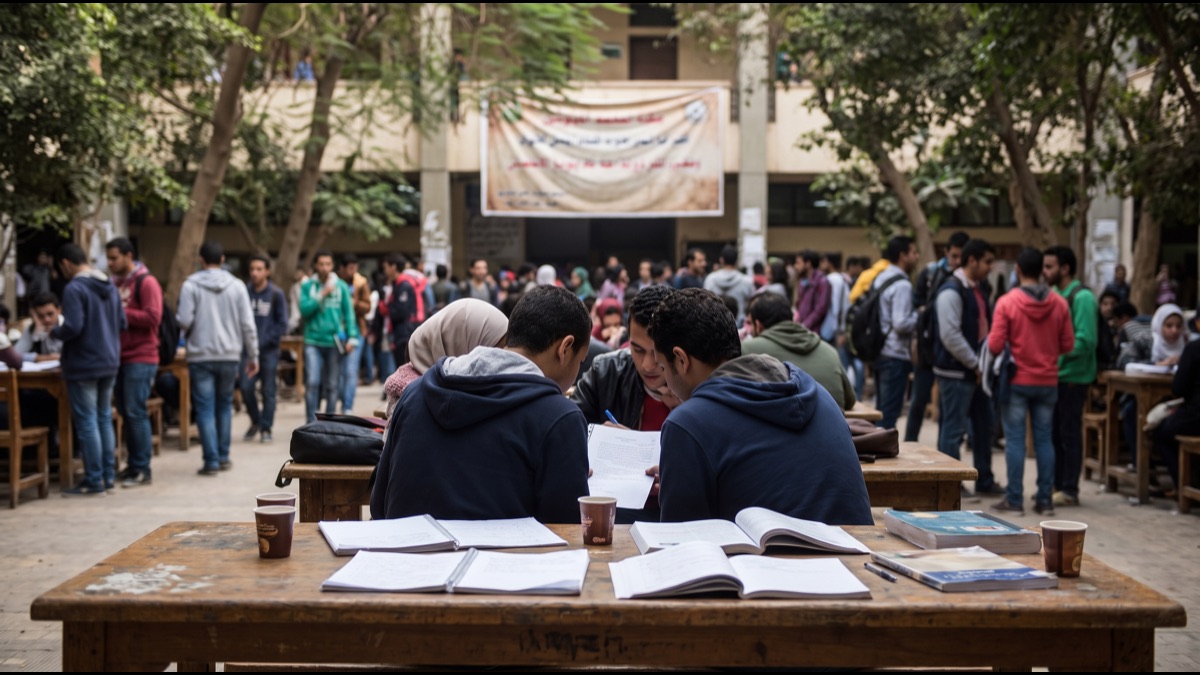
For roughly two weeks every summer, a single set of examinations effectively decides the entire future career path of hundreds of thousands of Egyptian eighteen-year-olds at once. Thanaweya Amma, Egypt's general secondary certificate exam, converts three years of high school study into one final percentage score, and that number alone, not interviews, essays, or extracurricular activity, determines which university and which specific major a student can realistically pursue.
Understanding why this single exam carries so much weight, how the national placement system actually processes hundreds of thousands of results, and why reform attempts have repeatedly struggled reveals a great deal about the pressures facing Egyptian secondary education more broadly.
What Thanaweya Amma Actually Is
Thanaweya Amma is the general secondary education certificate awarded at the end of Egypt's high school system, based primarily on a comprehensive set of final examinations covering the subjects studied during the third and final year of secondary school, the year that overwhelmingly determines the certificate's final percentage.
Unlike university admission systems built around multiple weighted factors such as standardized tests, personal essays, letters of recommendation, and extracurricular achievement, Egypt's system reduces admission almost entirely to this one number, making the exam period genuinely decisive rather than merely one input among several.
The certificate itself has existed in various forms since the mid-twentieth century, evolving through several curriculum and structural reforms over the decades, but its core function as the primary gateway to Egyptian higher education has remained remarkably consistent even as the specific subjects tested and grading methodology have periodically changed.
Why the Final Score Carries So Much Weight
The percentage a student achieves on Thanaweya Amma functions as the primary currency of Egyptian higher education access, used nationally to rank every graduating student against every other graduating student in the same academic track for the purpose of university and major placement.
This ranking-based approach means a student's outcome depends not only on their own absolute performance but also on how everyone else nationally performed that year, since available seats in competitive programs are limited and are allocated to the highest-ranked students first regardless of what specific score threshold happens to be reached in a given year.
How Tansik Actually Allocates Students to Majors
Following the exam, Egypt operates a centralized coordination process known as Tansik, which collects every student's final percentage nationally, then works down the ranked list allocating available university seats to programs in order of preference, subject to each program's specific minimum score requirement for that particular year.
Because Tansik processes rankings and preferences algorithmically at national scale, the system produces results with minimal room for individual negotiation, appeal, or holistic reconsideration of a borderline case, a stark contrast to admissions processes elsewhere built around individualized committee review.
Students submit a ranked list of program preferences before results are released, and the algorithm works through the entire ranked student list from the top score downward, assigning each student to the highest preference on their list for which a seat remains available at the moment their turn in the ranking is reached, a process that can take several rounds to fully settle across all programs nationally.
Why Medicine and Engineering Demand the Highest Scores
Medicine, dentistry, pharmacy, and engineering programs at Egypt's most prestigious public universities consistently require among the very highest Thanaweya Amma percentages nationally, reflecting both genuinely limited seat capacity relative to demand and these fields' strong cultural association with prestige and financial security.
This concentration of demand at the very top of the score distribution means the practical difference between being admitted to competitive medicine and being redirected toward a less sought-after program can come down to a fraction of a single percentage point, a margin many families find genuinely difficult to accept as fair given how much rides on it.
How the Science and Literary Tracks Actually Differ
Egyptian secondary students choose, or are guided into, either a science track or a literary track partway through high school, a decision that fundamentally shapes which university programs later remain available to them regardless of their eventual Thanaweya Amma percentage within their chosen track.
Science-track students studying mathematics, physics, chemistry, and biology gain eligibility for engineering, medicine, and related technical fields, while literary-track students studying history, geography, and philosophy become eligible for law, humanities, and social science programs instead, meaning the track choice itself, made years before the final exam, already substantially narrows a student's eventual options.
Why Private Tutoring Became a Parallel Industry
Given how decisively the final score shapes a student's entire future, combined with persistent concerns among families about overcrowded classrooms and inconsistent teaching quality in some public schools, private supplementary tutoring has grown into a substantial parallel education economy operating alongside formal schooling.
Families across a wide range of income levels commonly budget significant sums for private lessons in core exam subjects, a practice so widespread that it has become a normalized and expected part of Thanaweya Amma preparation rather than an exceptional supplement reserved only for struggling students.
This parallel tutoring economy has grown large enough to support well-known individual private tutors who can command substantial fees and attract very large group sessions, sometimes broadcast or recorded for wider distribution, effectively creating a secondary layer of educational infrastructure operating alongside and, in the eyes of many families, more trusted than the formal classroom experience itself.
What the Exam Period Actually Looks Like Nationally
The Thanaweya Amma exam period unfolds as a genuinely nationwide event, with security measures around exam centers, media coverage tracking exam difficulty and student reactions daily, and even periodic government measures like internet restrictions during specific exam sessions aimed at preventing question leaks.
The scale of logistics involved in administering, securing, and grading examinations for the entire national cohort of final-year secondary students within a compressed multi-week window represents a significant annual administrative undertaking for Egypt's education ministry, coordinated across every governorate simultaneously.
Print and transport security for exam papers themselves has historically been treated as a matter of considerable seriousness, given the disruption a leaked question paper can cause to the fairness of the entire national ranking, and past leak incidents have prompted tightened printing, sealing, and distribution protocols in subsequent years, along with harsher legal penalties for anyone caught attempting to circulate exam content in advance.
How Cutoff Scores Are Calculated Each Year
Minimum score cutoffs for each university program are not fixed in advance but are instead calculated after the exam based on that year's specific distribution of student scores and the number of available seats, meaning the same numerical percentage that secured admission one year might fall short the following year purely due to how that cohort performed overall.
This year-to-year variability adds a further layer of uncertainty for students and families, since a target score considered safe based on the previous year's cutoff can shift meaningfully depending on whether the current cohort's overall performance ran higher or lower than the year before.
Why a Single Point Can Change a Student's Entire Path
Because Tansik allocates seats strictly by rank order against a hard cutoff, students clustered near a competitive program's cutoff score experience the system's sharpest edge, where a single additional percentage point, sometimes representing just one or two extra correct exam answers, can be the entire difference between admission to a first-choice program and redirection elsewhere.
This razor-thin margin at competitive cutoffs is a frequent subject of public debate in Egypt, with critics arguing that a system this sensitive to marginal scoring differences may not meaningfully distinguish between students of genuinely comparable underlying ability and preparation, a criticism defenders of the system counter by pointing out that any cutoff-based ranking mechanism will inevitably produce close calls somewhere along the distribution.
What Happens to Students Who Fall Short of Their Goal
Students whose final percentage falls below the cutoff for their preferred program are placed instead into lower-ranked available programs according to their stated preference order and remaining available capacity, a process that can result in a student studying a field considerably different from their original ambition.
Alternative pathways exist, including private universities with different admission criteria, technical institutes, and in some cases retaking the final year to attempt a higher score the following year, though each of these alternatives carries its own financial cost, social perception, and practical tradeoffs that families must weigh carefully.
Private universities in particular have expanded significantly in recent decades, generally accepting a wider range of Thanaweya Amma scores in exchange for tuition fees considerably higher than public university costs, creating a parallel higher education track that has grown into a genuinely significant part of the overall university system rather than a marginal alternative.
How Digital Reforms Have Changed Parts of the Exam
Egypt's education ministry has introduced various technological changes to the exam process over recent years, including digitized exam distribution and grading components in some subjects, aimed at reducing logistical burden and improving security against the question leaks that have periodically disrupted exam sessions in the past.
Some reform efforts have also explored incorporating continuous assessment components spread across the academic year rather than concentrating the entire outcome in a single final examination window, though implementation of such structural changes has proceeded cautiously given the exam's deeply entrenched role in the broader higher education system.
Why the System Has Proven So Hard to Reform
Fundamental reform of Thanaweya Amma faces a genuine structural challenge: any change to how university seats are allocated affects the entire downstream higher education admission system simultaneously, meaning incremental reforms must be carefully coordinated with university capacity planning across every public institution in the country at once.
This interconnectedness, combined with the exam's deep cultural embedding as a rite of passage and the practical difficulty of transitioning an entire national cohort to a fundamentally different admission model without disadvantaging some group of students in the process, has made comprehensive structural reform politically and administratively difficult to execute successfully.
Any government proposing a major overhaul must also contend with the exam's status as a broadly trusted, if imperfect, mechanism precisely because it is difficult to manipulate compared with more subjective evaluation criteria, meaning reform proposals must credibly demonstrate they preserve that perceived fairness rather than simply promising improvement in the abstract.
How Families Experience the Exam Season
The exam period is widely understood in Egyptian households as an intensely stressful family event rather than an individual student experience alone, with households often organizing daily routines, reducing social obligations, and coordinating study schedules around a child's exam preparation for months beforehand.
This family-wide investment reflects genuine awareness of the stakes involved, since the outcome affects not just the student's own trajectory but often carries broader family expectations around professional prestige, financial stability, and social standing tied to the eventual university program and career path secured.
Mental health professionals and school counselors in Egypt have increasingly spoken publicly about the psychological toll the exam period places on students, and periodic public campaigns have encouraged families to manage stress constructively during the preparation months, reflecting growing recognition of the emotional weight the system places on teenagers at a formative stage of life.
What International Comparisons Reveal About the Model
Education researchers comparing centralized, single-exam-driven university admission systems like Egypt's to more holistic, multi-factor systems used elsewhere generally note a tradeoff: single-exam systems offer greater perceived fairness and transparency through a clear, hard-to-manipulate numerical ranking, but at the cost of enormous pressure concentrated into one narrow assessment window.
Several countries in the region and beyond operate broadly comparable centralized exam systems, and comparative research into their outcomes consistently highlights similar patterns around private tutoring growth, exam-period stress, and periodic but difficult reform efforts, suggesting these are structural features of the model itself rather than issues unique to Egypt specifically or easily solved by any single policy adjustment.
Why the Stakes Remain So High Despite Criticism
Despite persistent public debate about the exam's fairness, stress burden, and narrow definition of academic merit, Thanaweya Amma has remained the central gateway to Egyptian higher education because no alternative model has yet demonstrated it can replace the current system's core practical advantages: national scalability, resistance to the kind of subjective bias that can affect holistic review, and broad public trust in a transparent numerical ranking.
Until a genuinely workable alternative addressing these practical strengths while reducing the current system's acknowledged pressures gains sufficient political and institutional support, Thanaweya Amma is likely to remain what it has been for generations: the single most consequential set of exams in an Egyptian teenager's life, converting three years of study into one number that shapes a career path for decades to come, watched closely each summer by millions of families across the country as results are finally announced.
Sources
- Wikipedia — overview of the Thanaweya Amma system and its structure
- UNESCO — comparative research on centralized examination systems and education access
- BBC — reporting on Egyptian exam reform efforts and student pressure
- Egyptian State Information Service — official coverage of education policy and exam administration
FAQ
What is Thanaweya Amma exactly?
It is Egypt's general secondary school certificate examination, taken at the end of the final year of high school, whose final percentage score is the primary factor determining university and major admission nationwide.
How does Tansik actually allocate students to majors?
Tansik is the centralized coordination system that ranks students by their Thanaweya Amma percentage and assigns university and major placements based on that ranking against minimum score cutoffs set for each program each year.
Why do minimum score cutoffs change every year?
Cutoffs are recalculated annually based on how many seats are available in each program and how the actual distribution of student scores falls that year, so a cutoff can rise or fall depending on the specific cohort's performance.
Why is private tutoring so common alongside Thanaweya Amma?
Given how much rides on the final score and persistent concerns about classroom quality and overcrowding, many families pay for supplementary private lessons, creating a large parallel tutoring economy alongside formal schooling.
Has Egypt tried to reform the Thanaweya Amma system?
Yes, including shifts toward more digital and continuous assessment components and periodic curriculum changes, though the exam's fundamental role as the near-sole determinant of university admission has proven difficult to change.
About the Author
We reference Wikipedia, UNESCO, BBC, and Egyptian State Information Service to explain the background and current understanding of this topic.
Loved This Article?
Share it on WhatsApp → Share it on WhatsApp
Get more guides in your inbox — Subscribe to our newsletter for weekly surprising stories from Egypt, Saudi Arabia, Dubai, and beyond.