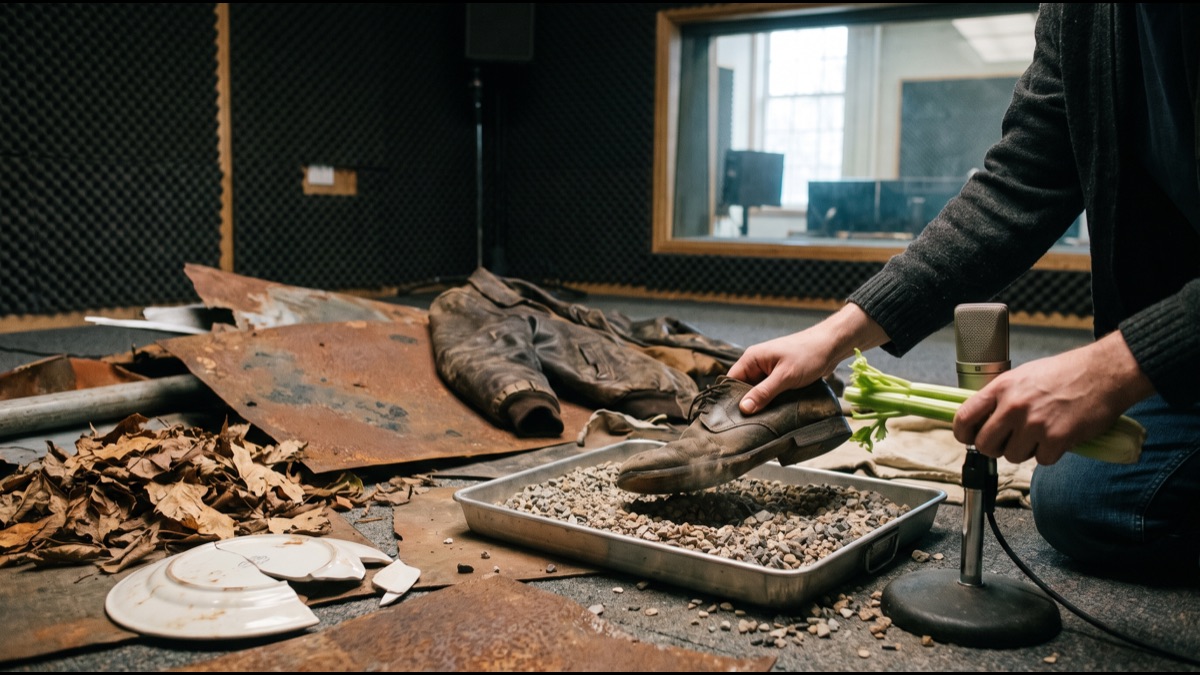
Almost every footstep, rustle of clothing, and punch impact you hear in a film was never actually recorded during filming. It was performed afterward, in a small padded studio, by a specialist watching the finished scene on a screen while physically recreating each sound in real time using props that frequently have nothing to do with what is shown on camera.
This craft is called foley, named after Jack Foley, the sound technician who pioneered the technique at Universal Studios in the 1920s as film transitioned from silent pictures to sound. Understanding how it actually works reveals one of cinema's most physical and least automated crafts, still performed almost entirely by hand in an industry otherwise dominated by digital tools.
Why On-Set Audio Is Almost Never Usable for Effects
Production sound recorded on a film set is captured primarily to preserve dialogue clearly, using microphones positioned and aimed specifically to isolate an actor's voice, which means the incidental sounds of movement, clothing, and props picked up alongside that dialogue are usually too quiet, inconsistent, or contaminated by set noise to use directly.
Camera equipment, crew movement, air conditioning, and the physical distance between a boom microphone and an actor's feet or hands all degrade the quality of any incidental sound captured during filming, making it functionally unusable in a final mix that demands clean, precisely timed audio.
Rather than attempting to extract usable sound from a noisy on-set recording, sound teams instead discard nearly all of it beyond the dialogue itself and rebuild every other audible action from scratch during post-production, which is precisely the job foley exists to do.
How the Foley Process Actually Begins
Before any performing happens, a sound editor conducts what is called a spotting session, watching the finished picture scene by scene and cataloging every sound that will need to be recreated, from obvious actions like footsteps and doors to subtle details like the rustle of a hand brushing against fabric.
This cue list becomes the shot-by-shot blueprint for the foley recording session, breaking a film down into hundreds or even thousands of individual sound events that must each be performed and recorded separately, then synchronized precisely to the corresponding frame of picture.
Complex scenes with multiple characters moving simultaneously are often split into separate passes, with a foley artist recording just the footsteps for the entire scene first, then returning to add clothing rustle, then prop handling, layering each element independently rather than attempting everything in a single take.
What a Foley Stage Actually Looks Like
A foley stage is a specialized recording studio containing multiple pits, sunken sections of floor filled with different surface materials including gravel, sand, wood, tile, and concrete, allowing a performer to walk convincingly on whatever surface a scene depicts simply by stepping into the corresponding pit.
Surrounding the pits is typically a vast collection of props and materials with no obvious connection to their eventual on-screen sound, organized by the texture and acoustic quality they produce rather than by what they actually are, since a foley artist cares only about the sound an object makes, not its literal identity.
The room itself is acoustically treated to eliminate unwanted reflections and background noise, since the recorded foley needs to sound clean and controllable in the final mix rather than carrying the ambient character of the room it was performed in.
How Footstep Performers Actually Match an Actor on Screen
The specific foley artist who performs footsteps is sometimes called a walker, and matching an actor's on-screen movement convincingly requires studying that actor's gait, weight, and pace closely enough to recreate the physical rhythm of their walk rather than simply stepping in a generic pattern.
A walker performs while watching the scene projected in front of them, timing each step to land in sync with the corresponding footfall on screen, a skill that takes considerable practice since even a slight timing mismatch is immediately noticeable to an audience even if they cannot consciously identify why a scene feels slightly wrong.
Footwear choice matters enormously, and professional foley studios maintain large collections of shoes specifically because the same actor's dress shoes, boots, and bare feet all produce genuinely different sounds that must be matched to whatever is actually shown on screen in that specific shot.
Why Everyday Objects Substitute for What You See on Screen
Some of the most famous examples in the craft involve substituting an everyday object for something entirely different on screen, including using crushed celery or snapped celery stalks to simulate the sound of breaking bones, or twisting a leather wallet to recreate the creak of footsteps in snow.
This substitution happens because the literal object shown on screen frequently does not produce a sound that reads as convincing or dramatic enough through a microphone and speaker system, so foley artists select whatever prop genuinely produces the most emotionally effective sound rather than the most literally accurate one.
Building this mental library of substitute sounds is a core professional skill developed over years of practice, and experienced foley artists often keep extensive personal collections of unusual objects specifically because a prop that seems useless for years can suddenly become the perfect match for an unexpected scene.
How Cloth and Movement Sound Gets Layered In
Beyond footsteps, a separate foley pass typically covers what is broadly called cloth and movement, the rustle of clothing, the creak of a leather jacket, or the subtle sound of someone shifting their weight in a chair, details that are individually almost inaudible but collectively make a scene feel physically present rather than sterile.
Performers use actual fabric swatches and garments rather than the literal costume shown on screen, selecting materials specifically for the sound they produce when moved rather than their visual appearance, since a costume built to look right on camera frequently does not sound right when brushed against a microphone.
This layer of sound is often the first thing removed when editors want to test how a scene feels without it, and its absence is immediately noticeable, revealing how much of a scene's sense of physical presence actually comes from these seemingly minor performed details rather than dialogue or music.
How Prop Sounds Get Built From Scratch
Prop foley covers the specific sound of objects being handled, picked up, set down, or used within a scene, including anything from a coffee cup being placed on a table to a sword being drawn from a sheath, each requiring its own dedicated recording pass matched precisely to the visible action.
Foley artists frequently build composite props specifically for a single effect, combining multiple objects or materials to create a sound that no single real prop produces on its own, since the goal is always the most convincing recorded result rather than strict fidelity to a single physical object.
This is one of the more inventive aspects of the craft, and experienced foley artists develop a genuinely creative reputation within the industry for finding surprising combinations of ordinary materials that produce a specific, previously elusive sound a director is looking for.
Why Timing Precision Matters More Than Almost Anything Else
A foley performance can use a perfectly appropriate prop and still fail completely if the timing does not align precisely with the corresponding action on screen, since even a small delay of a fraction of a second reads to an audience as subtly wrong even when they cannot articulate exactly why.
Foley artists watch the scene on a loop, performing the same action repeatedly until the timing feels genuinely natural, often recording several takes of the same cue so an editor can select or blend the best-timed version during the final mix.
Modern foley sessions use precise frame-accurate playback systems specifically to support this repeated practice-and-record workflow, allowing a performer to rehearse against the exact same footage dozens of times until their physical performance locks convincingly into sync with the picture.
How Digital Tools Changed but Did Not Replace Foley
Sound libraries containing thousands of pre-recorded effects exist and are genuinely used throughout film and television production, particularly for simple or generic sounds where a library recording is functionally indistinguishable from a freshly performed one and far cheaper to obtain.
For anything requiring precise synchronization with a specific actor's specific movement in a specific scene, however, library sound generally fails to convince, since it cannot match the exact rhythm, weight, and character of a unique on-screen performance the way a live foley artist watching that exact scene can.
This is the core reason foley has survived as a hands-on craft well into the digital filmmaking era, since the fundamental problem it solves, precisely synchronized, emotionally convincing physical sound tied to a specific visual performance, has not been meaningfully solved by any purely digital alternative.
Why Foley Differs From Sound Design and Sound Effects Editing
Foley is a specific subcategory within the broader discipline of film sound, distinct from sound design, which creates atmospheric and often non-realistic sounds like a spaceship engine or a monster's roar, and distinct from sound effects editing, which places and processes pre-existing recorded sounds like gunfire or explosions.
The dividing line is roughly that foley specifically covers human-scale physical actions performed by a person watching picture in real time, while the other disciplines more often involve sourcing, synthesizing, or heavily processing sound rather than physically performing it live against a projected scene.
These roles frequently overlap on smaller productions where the same sound team handles multiple responsibilities, but on larger films they are typically distinct specialized crafts, each requiring genuinely different skills and often performed by different specialists entirely.
What Skills a Professional Foley Artist Actually Needs
Beyond obvious physical performance ability, a skilled foley artist needs a trained ear capable of judging whether a recorded sound genuinely matches what a scene emotionally requires, a skill closer to sound editing or even acting than to simple prop manipulation.
Physical stamina matters more than most people expect, since a demanding scene can require dozens of takes of the same physical action performed precisely and repeatedly, and professional foley artists develop genuine athletic conditioning specific to the repetitive physical demands of the job.
Most professional foley artists train through years of apprenticeship on a working stage rather than through formal classroom instruction, since the craft depends heavily on tacit, hands-on knowledge about which specific props produce which specific sounds that is difficult to teach outside direct practice.
How a Foley Session Actually Gets Recorded and Mixed
A typical foley session uses multiple microphones simultaneously, often positioned at different distances and angles to capture both a close, detailed version of a sound and a more distant, roomier version that a mixer can blend together later to achieve the desired final character.
Recordings are captured as separate, isolated tracks for each type of sound, footsteps, cloth, and specific props, allowing a re-recording mixer significant flexibility later to adjust the balance, add processing, or replace any single element without needing to redo the entire performance.
The final mix combines these foley tracks with dialogue, music, and other sound effects into the completed soundtrack, a process requiring careful balance since foley that is too loud or too perfectly clean can paradoxically feel artificial rather than the naturalistic effect it is meant to achieve.
Why Animation and Video Games Rely on Foley Even More Heavily
Live-action film at least starts with some usable on-set reference sound, but fully animated productions and video games have no production audio at all to reference, meaning every single sound heard by an audience or player must be built entirely from foley and sound design with no shortcut available.
This makes foley teams working in animation and games arguably even more central to the final product than their live-action counterparts, since there is no fallback recording to lean on if a performed sound does not quite work, only the option to perform it again until it does.
The interactive nature of video games adds a further layer of complexity, since foley for a game often needs to be recorded as modular, reusable audio clips that can trigger correctly across countless different player-controlled situations rather than syncing to one fixed, predetermined sequence of events.
How Foley Artists Develop Their Signature Prop Collections
Experienced foley artists frequently maintain personal collections of unusual objects accumulated over an entire career, sourced from flea markets, hardware stores, and everyday life, kept specifically because a seemingly random object once produced a uniquely useful sound that proved impossible to replicate any other way.
These personal collections become a genuine professional asset over time, and some veteran foley artists are specifically sought out by productions precisely because of a reputation built around a particular specialty, whether that is convincing creature movement, period-accurate historical footwear, or a specific category of mechanical sound.
This accumulated, individually idiosyncratic expertise is part of why foley has remained resistant to full standardization or automation, since much of the craft's value lies in decades of personal experimentation that cannot easily be captured in a generic sound library.
What Watching a Film Differently Reveals About Foley
Once a viewer becomes aware of foley as a distinct performed craft, it becomes genuinely difficult to watch an action-heavy or dialogue-light scene without noticing how carefully constructed the physical soundscape actually is, down to the smallest incidental rustle or footfall.
This awareness reveals how much of a film's felt sense of physical reality depends on craft happening entirely outside the frame, performed by someone the audience will never see, using props that frequently bear no resemblance whatsoever to what is actually shown on screen.
Foley remains, ultimately, a quiet reminder that a great deal of what feels most natural and unremarkable about a finished film is often the most deliberately constructed, requiring skilled human performance precisely so the audience never has reason to notice it at all.
Why Foley Artists Rarely Get Public Recognition
Despite the craft's central role in how a finished film actually sounds, foley artists remain among the least publicly recognized contributors to filmmaking, rarely mentioned in mainstream reviews and often absent from casual conversations about a film's craft even when its sound work is genuinely exceptional.
This is partly structural, since foley credit typically appears deep in a film's closing credits alongside dozens of other technical roles, and partly because the craft's entire purpose is to feel invisible and unremarkable when done well, meaning success in the job is measured by not being noticed.
Industry awards for sound, including dedicated categories at major film festivals and craft guild ceremonies, have slowly increased public awareness of foley as a distinct skill, though it still receives far less general recognition than cinematography, editing, or score composition.
How a Foley Career Actually Develops Over Time
Most foley artists begin as assistants or apprentices on an established stage, spending years learning from a mentor before being trusted with lead performance responsibilities on significant productions, since the craft's tacit knowledge is difficult to acquire outside sustained hands-on practice.
Specialization often develops naturally over a career, with some artists becoming particularly known for footstep work, others for prop handling, and others for a specific genre like horror or period drama where the demands on foley performance differ meaningfully from mainstream contemporary filmmaking.
A small number of veteran foley artists eventually become supervisors overseeing an entire stage's output across multiple simultaneous productions, managing scheduling and quality across a team of performers rather than continuing to perform every cue personally.
Why Live Foley Performance Sometimes Happens Alongside Screenings
A handful of specialty screenings, particularly of silent-era films or classic monster movies at festivals, feature foley artists performing sound effects live in front of an audience alongside the projected picture, deliberately exposing the craft that normally happens invisibly behind the scenes.
These live demonstrations have become a popular way for festivals and film schools to teach audiences and students how much deliberate performance goes into what usually feels like an unremarkable, automatic part of a film soundtrack.
Watching a live foley performance alongside a film makes unmistakably clear just how physically demanding and precisely timed the craft actually is, since any visible small error in a live setting cannot be fixed with another take the way it can in a recording studio.
What sounds like the most natural, unremarkable part of a film soundtrack, footsteps crossing a room, a jacket being pulled on, a punch landing, is very often the most deliberately fabricated element of the entire audio mix, built by hand in a padded room using whatever combination of props happens to convincingly recreate the sound a director actually wants the audience to believe they are hearing.
Foley remains one of the rare filmmaking crafts that has resisted full digital replacement, not because better technology has not been tried, but because a skilled performer watching a scene and reacting to it physically, in real time, still produces a more convincingly human result than any synthesized alternative has managed to match.
Sources
- Wikipedia — overview of foley artistry and its history in filmmaking
- Academy of Motion Picture Arts and Sciences — resources on film sound craft and production techniques
- British Academy of Film and Television Arts — recognition and resources on sound craft in film
- Library of Congress — archival documentation of early sound-film production techniques
FAQ
Is any real on-set sound used in the final movie?
Dialogue is typically kept from set recordings when clean enough, but nearly all incidental sounds like footsteps and prop handling are rebuilt afterward through foley.
Why is it called foley?
It's named after Jack Foley, a sound technician at Universal Studios who pioneered the technique of performing synchronized sound effects in the 1920s.
Do foley artists watch the actual costume or object being used?
They watch the picture on screen but usually use substitute materials and props chosen for how they sound rather than the literal item shown.
Why can't sound effect libraries replace foley entirely?
Library sounds rarely sync precisely to a specific actor's unique movement and timing, which live foley performance can match in a way pre-recorded clips cannot.
Is foley used in animation and video games too?
Yes, and often even more heavily than live-action film, since animated productions and games have no on-set audio at all to reference.
About the Author
We reference Wikipedia, the Academy of Motion Picture Arts and Sciences, the British Academy of Film and Television Arts, and the Library of Congress to explain the background and current understanding of this topic.
Loved This Article?
Share it on WhatsApp → Share it on WhatsApp
Get more guides in your inbox — Subscribe to our newsletter for weekly surprising stories from Egypt, Saudi Arabia, Dubai, and beyond.