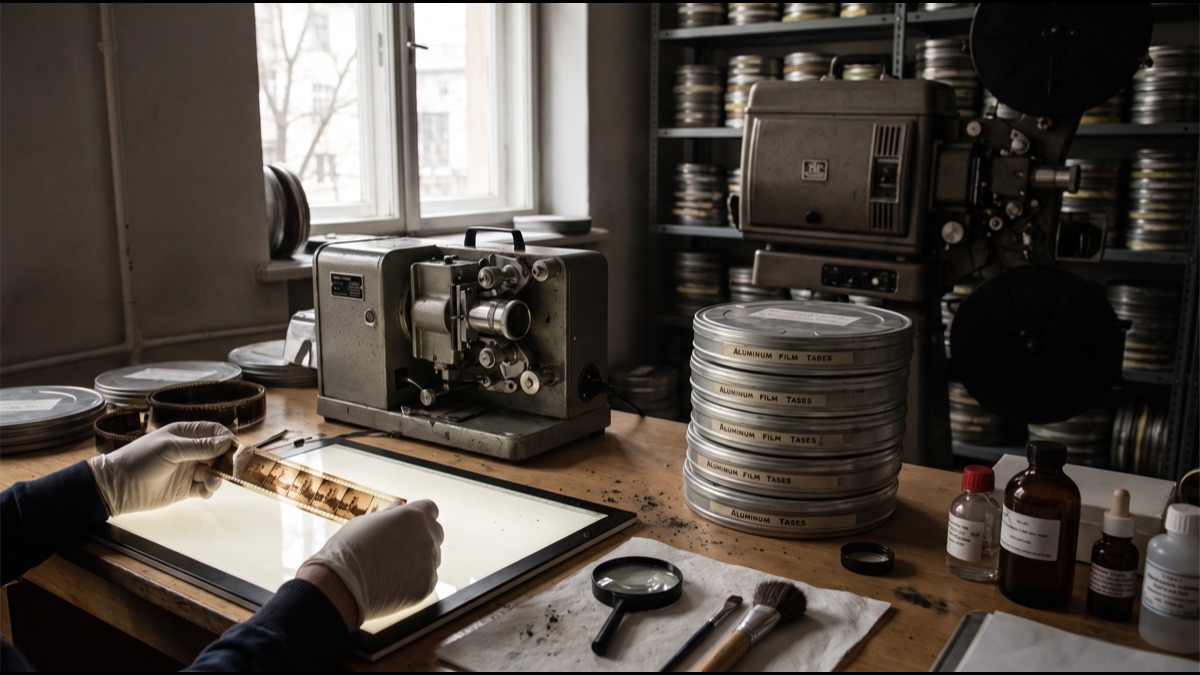
A film print shot in 1962 is not a digital file waiting patiently in storage. It is a physical object made of plastic and light-sensitive chemical emulsion, and like any physical object, it decays, scratches, shrinks, fades, and in the worst cases dissolves into something closer to vinegar than to celluloid. Film restoration is the painstaking process of rescuing what survives of a film's original physical elements and turning them back into something audiences can actually watch, and it is a far more technical, expensive, and judgment-laden process than simply running an old reel through a modern scanner.
Why Physical Film Decays in the First Place
Motion picture film is made from a plastic base coated with a light-sensitive emulsion layer containing silver halide crystals or, in color stock, dye couplers, and both the base and the emulsion are chemically unstable over long timescales even under good storage conditions.
Heat, humidity, and light accelerate deterioration significantly, which is why archives store film in cold, dry, climate-controlled vaults, sometimes as cold as minus five degrees Celsius, specifically to slow chemical reactions that would otherwise degrade a print within decades rather than centuries.
Physical handling also takes a toll independent of chemical decay: repeated projection through mechanical equipment causes scratches, dust embeds itself in the emulsion, and splices made for theatrical distribution or censorship cuts can damage or entirely remove frames from a print over its working life.
Vinegar Syndrome and Nitrate Decomposition Explained
Film shot before the early 1950s was commonly printed on a highly flammable nitrate base, and while nitrate produces a distinctively luminous image prized by archivists, it also decomposes dangerously, becoming increasingly unstable and, in advanced stages, capable of spontaneous combustion.
Safety film, the acetate-based stock that replaced nitrate, brought its own long-term problem known as vinegar syndrome, a chemical breakdown that releases acetic acid, producing the sour vinegar smell that gives the condition its name, along with shrinkage, warping, and increasing brittleness.
Once vinegar syndrome sets in, it cannot be reversed, only slowed through cold storage, which makes early detection through routine archive inspection critical, since a reel caught early can often still be scanned successfully, while one caught too late may already be unusable.
Locating and Assessing Surviving Film Elements
Before any technical restoration work begins, archivists and researchers often have to track down surviving film elements across multiple studio vaults, national archives, and private collections, since original negatives, prints, and separate sound elements were frequently split up, damaged, or lost over decades of studio mergers and format transitions.
It is common for no single surviving element to be complete, meaning restorers must assemble a final version from several partial sources, using the best-quality surviving footage for each scene and sometimes splicing together material from prints struck in different countries or different release versions.
This assessment phase includes detailed condition reports on shrinkage, color fading, physical damage, and chemical decay for every reel located, since the technical approach a lab takes to scanning and repair depends heavily on exactly how fragile and how far along in decay a given element actually is.
How Film Is Physically Cleaned Before Scanning
Before scanning, film elements typically go through a careful physical cleaning process to remove decades of accumulated dust, dirt, and mold, usually using specialized film-cleaning machines with soft rollers and solvent baths formulated specifically not to damage fragile emulsion.
Technicians also perform physical repair work at this stage, replacing damaged sprocket holes, re-splicing broken sections with archival-safe tape or ultrasonic welding, and in some cases physically flattening warped film using humidification chambers before it can safely pass through a scanner.
This physical preparation stage can take as long as the digital restoration work that follows, particularly for severely decayed nitrate or vinegar-syndrome-affected reels, where a single frame can require individual manual handling before it's stable enough to scan without further damage.
Wet-Gate and Dry-Gate Scanning Explained
Once cleaned, film is scanned frame by frame using specialized archival film scanners, commonly capturing each frame at 2K or 4K resolution, and increasingly 8K for high-profile restorations intended for future-proof archival masters rather than just an immediate rerelease.
Wet-gate scanning runs the film through a thin layer of liquid with a refractive index closely matching the film base, which optically fills in minor surface scratches during the scan itself, significantly reducing the amount of digital repair work needed afterward for scratch removal.
Dry-gate scanning skips the liquid step and is faster and lower-risk for already-fragile film, but it captures surface scratches exactly as they are, shifting more of the repair burden onto the digital cleanup phase that follows scanning.
Frame-by-Frame Digital Cleanup Work
Once a film exists as a sequence of high-resolution digital frames, restoration artists use specialized software to remove remaining scratches, dust specks, and stains, and to fix flicker caused by exposure inconsistencies between frames that weren't originally visible on projected film but become noticeable at digital resolution.
Digital stabilization corrects the frame weave and jitter common in old film caused by worn sprocket holes and imprecise mechanical registration during the original shoot or later printing, smoothing out a wobble that audiences would otherwise perceive as distracting on a modern large screen.
This cleanup work is done shot by shot and sometimes frame by frame for the most damaged sequences, and on major restorations it can involve teams of dozens of technicians working for months, since fully automated cleanup tools still require substantial human review to avoid introducing new digital artifacts.
Color Grading and Staying True to the Original Look
Color grading a restoration is one of the most consequential and debated steps, since faded dyes in old color prints can shift dramatically over decades, and restorers must decide how to reconstruct colors that are closer to what audiences originally saw rather than simply what looks appealing by contemporary standards.
Reputable restoration projects lean heavily on reference materials, including surviving vintage prints in better condition, technicolor separation negatives where available, behind-the-scenes photography, and in some cases direct input from the original cinematographer or their collaborators, to guide color decisions rather than modern aesthetic preference alone.
This is also where restoration ethics get genuinely contested, since two labs working from the same damaged source material can reach meaningfully different color results depending on which reference prints they trust and how conservatively they interpret ambiguous or contradictory evidence.
Restoring Sound Alongside the Picture
Audio restoration runs in parallel with picture work and presents its own challenges, since optical soundtracks printed directly onto the film edge degrade differently than separate magnetic or digital sound elements, and older films frequently have surviving sound sources of noticeably different quality than the picture.
Restorers use digital audio tools to reduce hiss, pops, and clicks accumulated from decades of physical wear, while trying to preserve the original dynamic range and tonal character of the recording rather than applying modern noise reduction so aggressively that dialogue and music lose their period-appropriate texture.
For films where the original sound elements are lost entirely, restoration teams sometimes have to rebuild audio from lower-quality surviving prints or dupes, a compromise that can leave the sound quality of an otherwise pristine picture restoration noticeably behind.
The Ethics of How Far Restoration Should Go
A recurring debate in the field concerns how much digital repair is appropriate before a restoration stops representing the original film and starts representing a modern reinterpretation of it, particularly around aggressive noise removal that can strip out the natural film grain that was part of the original image.
Preservationist-minded restorers generally argue for retaining visible film grain and accepting some remaining imperfections as part of an honest historical record, while more commercially oriented rereleases sometimes favor a cleaner, smoother look intended to feel more comfortable to modern audiences unfamiliar with film's native texture.
Archival institutions increasingly document their restoration choices publicly, including which reference materials were used and what specific digital interventions were applied, treating that documentation as part of the scholarly record rather than a marketing footnote.
Who Actually Funds Major Restoration Projects
Funding for film restoration comes from several overlapping sources: major studios restoring valuable catalog titles for rerelease and licensing revenue, national film institutes and government cultural agencies treating restoration as heritage preservation, and nonprofit foundations dedicated specifically to funding restoration work for films that lack a commercially motivated owner.
Streaming platforms have become a significant funding source in recent years as they compete to offer prestige classic-film libraries, often commissioning new 4K restorations of catalog titles specifically to differentiate their platform's back catalog from competitors.
International co-funding is common for films with complex ownership or surviving elements scattered across multiple countries, since assembling a complete restoration sometimes requires coordinated cooperation and cost-sharing between archives in different nations that each hold only part of the surviving material.
Notable Restoration Projects Worth Knowing
Major nonprofit efforts, including foundations focused specifically on classic film preservation, have funded and coordinated restorations of hundreds of significant films over recent decades, often working directly with studio archives and international film institutes to locate and combine the best surviving elements.
High-profile theatrical rereleases of digitally restored classics have demonstrated strong audience demand for seeing landmark films on a big screen again, sometimes outperforming new releases at specialty cinemas during limited engagement runs built around a restoration's premiere.
Silent-era films represent some of the most urgent restoration work globally, since a large share of films made before the widespread adoption of sound are believed to be permanently lost, making surviving prints and ongoing archive discoveries especially significant to film historians.
Why Some Films Can Never Be Fully Restored
For a meaningful share of film history, no surviving elements exist at all, whether due to nitrate fires, which destroyed entire studio vaults on several notable occasions, deliberate destruction for silver reclamation in decades when preservation wasn't a priority, or simple loss during studio relocations and ownership changes.
Even when elements survive, some are too chemically degraded to scan safely at all, meaning restorers sometimes have to accept permanent gaps, missing scenes, or visibly damaged sequences in an otherwise completed restoration rather than presenting a falsely seamless result.
In these cases, archivists generally favor transparency over invisible digital reconstruction, often leaving a damaged sequence visibly imperfect or supplementing missing footage with production stills and title cards rather than digitally inventing frames that were never actually filmed.
Digital Preservation After Restoration Is Finished
A completed restoration isn't the end of the preservation story, since digital files themselves require active, ongoing management, migration to new storage formats as older ones become obsolete, and redundant backup across multiple physical locations to guard against the same kind of loss that threatened the original film.
Archives typically preserve both a high-resolution uncompressed digital master and the physical film elements used to create it, since physical film, properly stored, has a longer proven track record of multi-century stability than any current digital storage medium.
This dual-track approach, keeping both digital masters and physical originals, reflects an industry consensus that digital files alone are not yet considered a fully reliable long-term archival strategy on their own.
Restoration in the Age of AI Upscaling Tools
Machine-learning-based upscaling and automated damage-repair tools have become increasingly common in restoration workflows over the past several years, capable of removing certain kinds of damage and increasing apparent resolution far faster than traditional frame-by-frame manual cleanup.
These tools have also generated real controversy within the preservation community, since AI upscaling can generate plausible-looking but historically inaccurate detail, effectively inventing texture that was never actually captured on the original film, a risk that responsible archives treat very differently from legitimate damage repair.
Most serious restoration houses currently use AI tools as an assistive first pass under close human supervision rather than a fully automated substitute for expert judgment, treating the technology as a productivity aid rather than a replacement for archival scholarship.
Why Archival Cinema Matters to Audiences in the Gulf
Regional film festivals across the Gulf and wider MENA region, alongside cultural institutions in cities like Abu Dhabi and Doha, have increasingly programmed restored classic cinema, including restorations of significant Arab and Egyptian film heritage that had been at serious risk of permanent loss.
Egyptian cinema in particular has a vast catalog of mid-twentieth-century films that exist today only as aging, deteriorating prints scattered across regional archives, making restoration work specifically focused on Arab film heritage a growing priority for regional cultural institutions and international preservation partners alike.
As regional museums and cultural venues continue expanding programming around classic and restored film, audiences across Saudi Arabia, the UAE, and Egypt are increasingly encountering restoration work not just as a technical curiosity but as a direct way of experiencing regional film history that would otherwise be effectively inaccessible.
Film restoration sits at an unusual intersection of chemistry, computer science, and historical scholarship, and every completed restoration represents a race against physical decay that archives are not guaranteed to win for every title. Understanding the actual mechanics, from vinegar syndrome and wet-gate scanning through the genuine ethical debate over how much digital cleanup is too much, makes clear why a beautifully restored classic on a streaming platform or in a cinema seat represents years of specialized, often uncertain work rather than a simple technical upgrade.
Sources
- The Film Foundation — Nonprofit organization dedicated to film preservation and restoration.
- Library of Congress National Film Preservation Board — U.S. government body overseeing national film preservation policy.
- International Federation of Film Archives (FIAF) — Global association of film archives and preservation standards.
- British Film Institute — National archive and restoration research on British and international cinema.
- Academy of Motion Picture Arts and Sciences Science and Technology Council — Technical research on film preservation and digital restoration standards.
FAQ
What is vinegar syndrome in film preservation?
It is the common name for acetate film base decomposition, a chemical breakdown that produces a distinct vinegar smell along with shrinking, warping, and brittleness, and it is one of the leading causes of film loss worldwide.
How is a film actually scanned for digital restoration?
Restoration facilities use specialized wet-gate or dry-gate film scanners that capture each frame at high resolution, commonly 2K or 4K, sometimes using a liquid gate process to optically minimize surface scratches during the scan itself.
Do restorers change a film's original artistic look?
Reputable restoration projects aim to preserve the filmmaker's original intended look, often consulting original release prints, cinematographer notes, or surviving crew members, rather than modernizing the color and contrast to contemporary taste.
Why can't studios just keep the original film reels forever?
Physical film degrades even under ideal cold storage conditions over long enough timescales, and many older films only survive as incomplete or damaged elements scattered across multiple archives, making digital preservation copies essential.
Who funds major film restoration projects?
Funding comes from a mix of studio archives, national film institutes and government cultural bodies, nonprofit foundations such as The Film Foundation, and increasingly streaming platforms restoring catalog titles for rerelease.
About the Author
We reference The Film Foundation, the Library of Congress National Film Preservation Board, the International Federation of Film Archives, the British Film Institute, and the Academy of Motion Picture Arts and Sciences Science and Technology Council to explain the background and current understanding of this topic.
Loved This Article?
Share it on WhatsApp → Share it on WhatsApp
Get more guides in your inbox — Subscribe to our newsletter for weekly surprising stories from Egypt, Saudi Arabia, Dubai, and beyond.