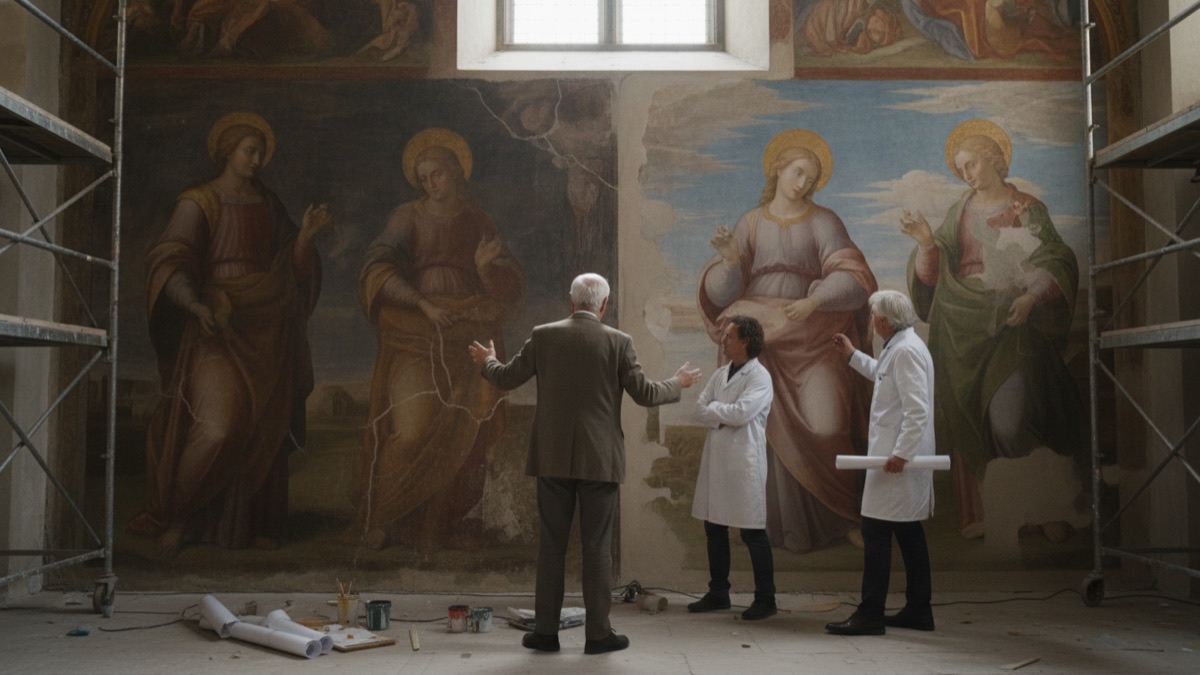
Few debates in the art world generate as much public passion as an argument over whether a centuries-old painting should be cleaned. What looks to an outsider like straightforward maintenance is, to conservators and historians, a series of irreversible judgment calls about color, intention, and authenticity. Every restoration decision runs through a set of philosophical tensions that professionals have never fully resolved, and the controversies that erupt when those tensions become public — a Renaissance ceiling repainted decades apart, a small-town fresco disfigured by an untrained hand — reveal just how much is actually at stake when someone picks up a solvent-soaked swab and approaches a masterpiece.
Two Philosophies of Restoration: Minimal Intervention vs. Revealing the Original
At the center of nearly every restoration dispute sits a disagreement between two broad philosophies. The first, often called minimal intervention, holds that conservators should do as little as possible, stabilizing decay and cleaning only what's necessary while leaving the artist's accumulated history — including centuries of varnish, soot, and even prior restoration work — largely intact. The second treats aggressive cleaning as a legitimate way to recover an artist's true intended appearance, arguing that grime and old varnish are not part of the work but obstructions to it.
Neither camp is simply right or wrong; each reflects a different definition of what a painting or fresco actually is. Minimal-intervention conservators tend to see the object in front of them — including its accumulated age — as the authentic artifact deserving protection. Restorers pushing for deeper cleaning tend to see the artist's original creative act as the authentic object, with everything added afterward, intentionally or not, treated as noise to be removed.
This isn't an abstract academic quarrel. Because cleaning is chemical and largely irreversible, choosing one philosophy over the other can permanently change how future generations experience a work. That permanence is exactly why restoration controversies tend to escalate quickly, and why historians, conservators, and the institutions that fund their work rarely walk away from a disagreement having simply agreed to disagree.
The Sistine Chapel Ceiling: A Cleaning That Divided the Art World
The most famous restoration controversy of the twentieth century centers on Michelangelo's ceiling frescoes in the Sistine Chapel, cleaned by the Vatican's conservation team over roughly a decade beginning in the early 1980s. Centuries of soot from candles and oil lamps, along with layers of animal-glue varnish applied by earlier restorers, had darkened the frescoes considerably, giving the ceiling the muted, shadowy palette generations of visitors associated with Michelangelo's style.
When conservators began removing that grime with a carefully tested solvent gel, the colors that emerged were startling: vivid pinks, oranges, greens, and yellows far brighter than anything visible before the cleaning began. The Vatican presented this as a triumphant unveiling of Michelangelo's true palette, hidden for centuries under dirt no one had realized was there.
The public reaction split sharply. Many art historians and casual viewers welcomed the newly vibrant ceiling as a revelation, while others saw something troubling in colors so different from the version the world had known for four centuries. That disagreement escalated into one of the most bitter restoration disputes in modern art history.
James Beck and the Case Against the Cleaning
The most vocal critic of the Sistine Chapel cleaning was Columbia University art historian James Beck, who argued publicly and repeatedly that the restoration had gone too far. Beck's central claim was that Michelangelo had applied a final layer of glue-based glazing over the fresco after it dried, deliberately darkening and softening the colors to create depth, shadow, and unity across the ceiling's complex figures.
If that glazing existed, Beck argued, the Vatican's cleaning process had stripped away not grime but Michelangelo's own final artistic choices, effectively erasing a deliberate layer of the composition rather than restoring anything. He described the resulting brighter ceiling as closer to a garish reinterpretation than a faithful recovery of the original work.
Beck founded ArtWatch International specifically to campaign against what he viewed as overly aggressive restorations happening at major institutions worldwide, and the Sistine Chapel case became his highest-profile fight. His objections drew wide media coverage and forced the Vatican's restoration team to publicly defend, in unusual technical detail, exactly what had been removed and why.
The Vatican's Case for the Restoration
The Vatican's chief restorer, Gianluigi Colalucci, and the broader conservation team rejected Beck's glazing theory outright, arguing that no scientific evidence supported the existence of a deliberate secco glaze layer applied by Michelangelo after the fresco dried. Their position was that centuries of soot and old varnish, not intentional shading, accounted for the ceiling's darkened appearance before cleaning.
Colalucci's team pointed to test cleanings, cross-section paint samples, and comparisons with other frescoes from the same period as evidence that the brighter colors reflected Michelangelo's actual fresco technique, which relied on pigments applied to wet plaster in ways that inherently produce more vivid results than an aged, soot-covered surface would suggest.
The Vatican's position ultimately prevailed within most of the professional conservation community, and the cleaned ceiling is now widely accepted as closer to Michelangelo's original intent. But the dispute left a lasting mark on the field, establishing the Sistine Chapel cleaning as the reference case any restoration controversy since has been measured against.
What the Cleaning Actually Revealed
Beyond the color debate, the Sistine Chapel cleaning revealed considerable detail that had simply been invisible under centuries of grime, including subtle modeling in the figures' anatomy, finer gradations in facial expressions, and decorative elements in the architecture Michelangelo painted around the biblical scenes.
Conservators also used the project to document Michelangelo's actual working method in unprecedented detail, identifying the giornate — the sections of plaster he completed in a single day's work — and building a far more precise understanding of how quickly and confidently he worked across the enormous ceiling.
This technical windfall is part of why many conservation scientists view the project as a net positive for art history regardless of the color controversy, since it generated documentation and technical knowledge about fresco painting that continues to inform restoration work on other Renaissance-era projects today.
The Ecce Homo Fiasco in Borja, Spain
In 2012, a very different kind of restoration controversy unfolded in the small Spanish town of Borja, where an elderly parishioner named Cecilia Giménez attempted to repair a deteriorating fresco of Christ called Ecce Homo, painted by Elías García Martínez in the sanctuary of a local church.
Giménez, who had no professional conservation training, painted directly over the flaking original using her own materials and judgment, intending to restore what she saw as a fading, damaged image. The result bore little resemblance to the original: a smeared, cartoonish face that quickly earned the nickname "Monkey Christ" once photographs of it spread online.
Unlike the Sistine Chapel debate, which pitted trained professionals against each other over degree and method, the Ecce Homo case involved no professional conservation process at all, making it a useful contrast for illustrating exactly what expertise, training, and institutional oversight are meant to prevent.
How "Monkey Christ" Became a Tourism Phenomenon
What began as an embarrassing local incident evolved into an unlikely tourism phenomenon. Photographs of the botched fresco circulated globally within days, and Borja — a town with little prior claim to art-world attention — found itself fielding a surge of visitors curious to see the image in person.
Local officials, initially mortified, pivoted toward embracing the attention, eventually charging admission to view the fresco and reporting meaningful increases in tourism revenue for the town's businesses. Merchandise featuring the image appeared, and the sanctuary itself became a minor pilgrimage site for people drawn to the story rather than the original artwork.
Conservation professionals have used the Ecce Homo case in teaching and public commentary as a cautionary tale about amateur intervention, while acknowledging the irony that a failed restoration ultimately generated more public attention and economic benefit for the community than a competent one likely would have.
Leonardo's Last Supper and a Restoration Spanning Centuries
Leonardo da Vinci's Last Supper, painted on the refectory wall of Santa Maria delle Grazie in Milan, presents one of the longest and most difficult restoration histories in art conservation, largely because Leonardo used an experimental technique — tempera on dry plaster rather than true fresco — that began deteriorating within his own lifetime.
Over five centuries, the painting was patched, repainted, and touched up by numerous restorers with varying skill and philosophy, layering interpretation upon interpretation over Leonardo's increasingly fragile original work. By the twentieth century, conservators faced the difficult question of how much of what remained was actually Leonardo's hand at all.
The most recent major restoration, completed in 1999 after roughly two decades of work, focused on carefully removing centuries of overpainting to expose whatever original material survived, even where that meant leaving visible gaps rather than inventing plausible replacement paint — a minimal-intervention choice that itself drew both praise and criticism.
Notre-Dame de Paris: Restoring After Fire
The April 2019 fire that severely damaged Notre-Dame de Paris created a restoration controversy on an entirely different scale, one debated in national newspapers and the French parliament rather than confined to specialist conservation journals, because the building functions as a national symbol as much as an architectural and artistic artifact.
The fire destroyed the cathedral's spire and much of its lead-and-oak roof structure, while the stone vaulting below suffered damage from falling debris and the intense heat, along with additional contamination from the toxic lead dust released when the roof melted and collapsed.
French president Emmanuel Macron's initial call for a rapid five-year rebuild, potentially incorporating a "contemporary architectural gesture" for the new spire, ignited immediate controversy among architects, historians, and the public over whether Notre-Dame should be restored exactly as it was or reimagined for the present.
The Stone-Cleaning Debate at Notre-Dame
Beyond the spire debate, restorers faced a more technical but equally contentious question: how aggressively to clean centuries of grime and new lead contamination from the cathedral's limestone surfaces without damaging the stone itself or erasing the visible patina of age that many conservationists consider part of the building's authentic character.
Some conservation voices pushed for thorough cleaning to remove dangerous lead residue and restore the stone's original pale color, arguing public health and historical accuracy both supported aggressive treatment. Others warned that overly harsh cleaning methods could damage centuries-old stone surfaces already weakened by heat and water from firefighting efforts.
The eventual approach settled on more conservative, carefully tested cleaning methods, and the cathedral reopened in December 2024 with its stone visibly lighter than before the fire, but stopping short of the uniform, artificially bright appearance some had feared aggressive cleaning might produce.
Reversibility as a Conservation Ethics Principle
One conservation principle repeatedly invoked throughout these controversies is reversibility — the idea that any restoration intervention should, in theory, be undoable by future conservators using better information, materials, or technology than are currently available.
Reversibility works well for certain techniques, such as applying a removable varnish layer that can later be dissolved without affecting the paint underneath, but it breaks down entirely for interventions like solvent cleaning, which permanently removes material and cannot be reversed by any later technique.
This gap between the ideal of reversibility and the reality of many restoration techniques is part of why cleaning decisions specifically — as opposed to structural stabilization or reversible varnish work — generate the sharpest and most enduring controversies within the field.
Authenticity vs. Legibility: The Core Tradeoff
Underlying nearly every restoration dispute is a tension between authenticity and legibility: the goal of preserving a work exactly as time and history left it, versus the goal of making it clearly, vividly readable to modern viewers who may struggle to appreciate a darkened, damaged, or fragmentary original.
A painting preserved in a heavily aged state may be more historically authentic in the sense of representing an unaltered object, but it may also be genuinely difficult for a general audience to interpret or appreciate, undermining the point of displaying the work publicly in the first place.
Conservators increasingly describe their job as managing this tradeoff case by case rather than resolving it with a single universal rule, since the right balance for a fragile medieval manuscript differs considerably from the right balance for a monumental public fresco meant to be viewed and understood by millions of visitors.
Who Gets to Decide? Funding, Politics, and Restoration Choices
Restoration decisions rarely happen in a vacuum of pure conservation science; they are shaped by funding sources, institutional politics, and public pressure in ways that can push projects toward more dramatic, visible interventions than a purely technical assessment might recommend.
Major donors and sponsoring corporations, whose funding often makes large-scale restoration projects possible in the first place, sometimes favor visibly transformative results that photograph well and generate positive press, creating subtle incentive pressure toward more aggressive cleaning than conservation purists might prefer.
Government bodies overseeing nationally significant sites, as seen clearly in the Notre-Dame case, must also balance conservation best practice against political timelines, tourism revenue considerations, and national symbolism, adding layers of pressure that have little to do with the underlying paint or stone itself.
The Role of Professional Conservation Bodies
International organizations including the International Institute for Conservation of Historic and Artistic Works (IIC) and the International Council of Museums (ICOM) have worked for decades to establish shared ethical standards for conservation practice, publishing codes of ethics that emphasize minimal intervention, documentation, and reversibility wherever possible.
The Getty Conservation Institute, a major research body focused on the science and practice of conservation, has similarly published extensive technical research aimed at giving restorers more evidence-based tools for making these judgment calls, rather than relying purely on individual aesthetic preference.
Despite this professional infrastructure, these standards function more as shared reference points than binding rules, which is precisely why trained, credentialed professionals working on the same object can still reach genuinely different conclusions about how much intervention is appropriate.
Digital and Non-Invasive Restoration Technology
Advances in imaging technology have opened a middle path between doing nothing and physically altering a work: multispectral and infrared imaging can now reveal underdrawings, earlier compositional layers, and pigment degradation without a single physical intervention on the object itself.
These techniques let conservators build detailed maps of a painting's condition and history before deciding whether, where, and how aggressively to intervene physically, turning what was once largely a matter of trained visual judgment into a process informed by substantial diagnostic data.
This shift toward diagnosis-first conservation has measurably reduced the frequency of purely speculative restoration decisions, since conservators can now often identify precisely what lies beneath a damaged surface before committing to any irreversible physical treatment.
AI-Assisted Restoration as an Emerging Middle Path
More recently, machine learning tools have begun assisting with tasks like reconstructing missing sections of damaged paintings or predicting how pigments have likely shifted in color over centuries, offering restorers a data-driven starting point rather than pure conjecture when filling gaps.
Some of the most publicized applications involve digitally reconstructing damaged areas of a painting on a screen first, letting historians and conservators evaluate a proposed physical intervention virtually before ever touching the actual object, reducing the risk of an irreversible mistake.
These tools remain assistive rather than autonomous — conservators still make the final judgment calls — but they represent a meaningful expansion of the non-invasive middle ground between untouched decay and full physical restoration that professionals increasingly favor when the technology is available.
Why Amateur Restoration Attempts Keep Happening
The Ecce Homo case was hardly an isolated incident; smaller, less publicized amateur restoration mishaps occur with some regularity, particularly involving lesser-known works in small churches, private collections, or municipal buildings that lack access to professional conservation funding or oversight.
These incidents typically share common features: a well-meaning individual without formal training, a work in visible decline, and no institutional process requiring professional review before intervention begins, a gap that professional conservation bodies have specifically tried to address through public education campaigns.
The recurring pattern illustrates a genuine resource problem underlying many amateur restoration disasters: professional conservation work is expensive and specialized expertise is unevenly distributed, leaving many smaller, under-resourced institutions with few good options when a beloved but deteriorating work needs attention.
What These Controversies Teach Us About Art Itself
Taken together, these controversies reveal that restoration is never a purely technical exercise; it is an interpretive act that inevitably reflects assumptions about what a given work of art actually is and what obligations the present owes to both the artist's original intention and the accumulated history of the object.
The historians and conservators who disagree most sharply are rarely disputing basic facts about chemistry or material science; they are disputing values — how much weight to give an artist's presumed original vision versus the physical object's honest, aged reality, and who has the standing to decide.
That is precisely why these disputes recur decade after decade across different works, cultures, and institutions, and why no single case, however famous, has ever settled the underlying philosophical question for the field as a whole.
Art restoration controversies persist because the stakes are genuinely high and the underlying questions genuinely unresolved: how much intervention respects a work versus erases part of its history, who has the authority to decide, and what obligation the present generation owes to both the artist and the future. The Sistine Chapel debate, the Ecce Homo fiasco, and the Notre-Dame reconstruction each illustrate a different facet of the same core tension, and as imaging technology and AI-assisted tools continue to expand the non-invasive middle ground, the field is likely to keep developing new ways to manage that tension rather than ever fully resolving it.
Sources
- International Council of Museums (ICOM) — Global body publishing ethical standards and guidance for museum conservation practice.
- International Institute for Conservation of Historic and Artistic Works (IIC) — Professional organization setting shared conservation ethics and technical standards.
- Getty Conservation Institute — Research body publishing technical studies on conservation science and restoration practice.
- Vatican Museums — Institution responsible for the Sistine Chapel restoration and its published technical documentation.
FAQ
Why did the Sistine Chapel cleaning cause such controversy?
Because it revealed far brighter colors than the ceiling's familiar darkened appearance, and historian James Beck argued the cleaning removed a deliberate glazing layer Michelangelo added, a claim the Vatican's restoration team rejected on scientific grounds.
What happened with the Ecce Homo "Monkey Christ" restoration?
An untrained parishioner in Borja, Spain attempted to repair a deteriorating fresco of Christ in 2012, producing a smeared result nicknamed "Monkey Christ" that went viral online and unexpectedly boosted local tourism.
What does "minimal intervention" mean in conservation?
It's a conservation philosophy favoring the least possible intervention, stabilizing decay and preserving a work's accumulated history rather than aggressively cleaning or repainting it.
Why is reversibility important in restoration?
Reversibility means an intervention can theoretically be undone by future conservators with better tools, but many common techniques, like solvent cleaning, permanently remove material and cannot actually be reversed.
How did the Notre-Dame fire create new restoration debates?
The 2019 fire destroyed the spire and roof, forcing decisions on whether to rebuild exactly as before or add contemporary elements, plus debates over how aggressively to clean lead-contaminated stone.
About the Author
We reference the International Council of Museums, the International Institute for Conservation of Historic and Artistic Works, the Getty Conservation Institute, and the Vatican Museums to explain the background and current understanding of this topic.
Loved This Article?
Share it on WhatsApp → Share it on WhatsApp
Get more guides in your inbox — Subscribe to our newsletter for weekly surprising stories from Egypt, Saudi Arabia, Dubai, and beyond.