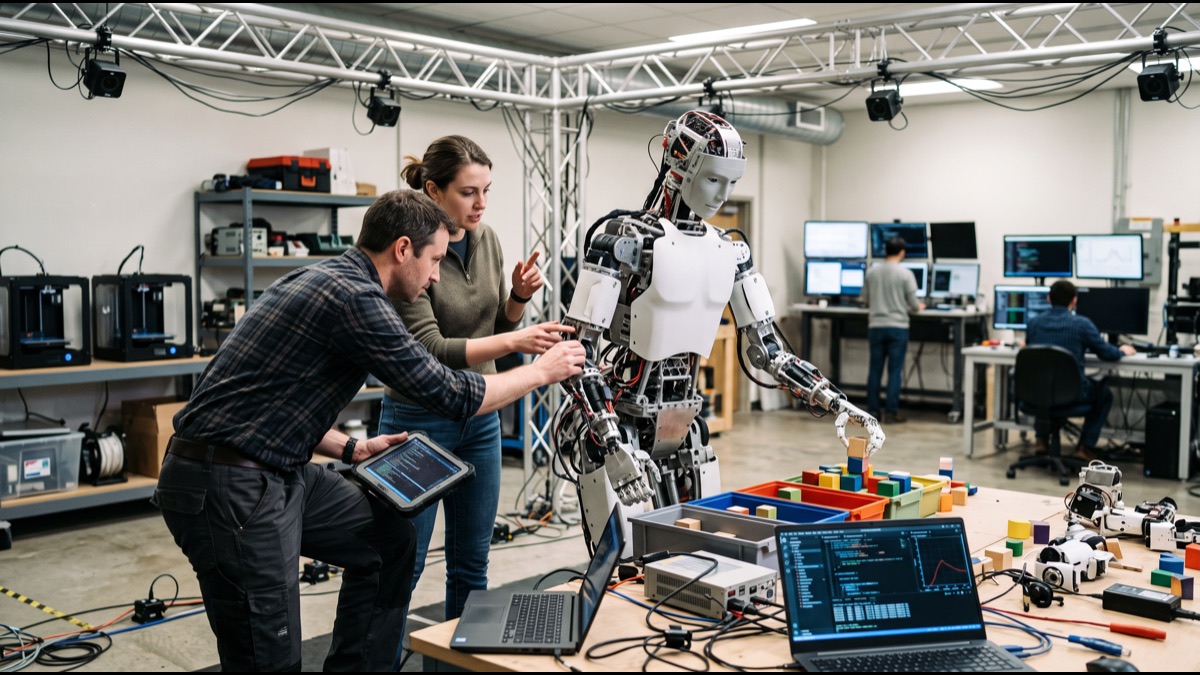
Video clips of humanoid robots walking confidently across uneven terrain, folding laundry, or handling warehouse boxes have become increasingly common and widespread online, often accompanied by breathless claims about how close general-purpose robots are to entering everyday homes and workplaces. What these polished, carefully edited demo clips rarely show is the extraordinarily long, unglamorous, and technically demanding training process that sits quietly behind even just a few seconds of smooth, natural-looking robotic movement.
Understanding how these robotic systems are actually trained, rather than simply marveling at the finished demo footage, reveals both genuinely impressive recent progress and the very real limitations that still separate an eye-catching video clip from a robot that can reliably operate safely and usefully in the messy, unpredictable conditions of a real, uncontrolled human environment.
Why Walking Alone Was Such a Hard Problem
Bipedal walking, moving on two legs the way humans naturally do, is a substantially harder engineering and control problem than it might intuitively seem, since a two-legged robot is inherently and fundamentally unstable and must continuously and precisely balance itself in real time using rapid, coordinated adjustments across dozens of individual joints and motors simultaneously.
Early humanoid robot prototypes decades ago walked slowly, stiffly, and with a notably limited, narrow range of motion, largely because the underlying control systems of that earlier era simply couldn't process sensor information and compute the necessary balance corrections fast enough to keep up with anything resembling natural, fluid human movement in real time.
Modern humanoid robots achieve dramatically more natural-looking movement primarily because of substantial improvements in onboard computing power, motor and actuator design, and above all, the machine learning techniques now used to actually generate and refine each robot's underlying walking and balancing behavior from the ground up.
How Simulation Became the Foundation of Modern Robot Training
Rather than training a physical robot directly through countless real-world trial-and-error attempts, which would be extremely slow and would risk genuinely damaging expensive hardware with every single failed attempt, most modern humanoid robot training begins almost entirely inside a detailed physics simulation, a virtual environment that closely and accurately models real-world gravity, friction, contact forces, and rigid-body motion in fine detail.
Within this simulated environment, a robot's control system, often an artificial neural network, can be run through many thousands or even millions of individual attempts at a given task in a fraction of the real-world time it would otherwise take, since a simulation can typically run considerably faster than real time and, crucially, can also be run many separate times fully in parallel across large clusters of powerful computing hardware.
This simulation-first training approach allows engineers to let a robot fail spectacularly, safely, and repeatedly, over and over again, millions of times without any risk of real-world physical damage or safety concern, gradually and iteratively refining its underlying behavior through those accumulated virtual failures long before any of that learned behavior is ever transferred over to actual, physical hardware.
The Reinforcement Learning Process Behind Robot Movement
Most modern humanoid robot movement is trained using a machine learning technique called reinforcement learning, in which a control system learns entirely through structured trial and error, receiving a mathematical numerical reward signal whenever it successfully makes measurable progress toward a specific defined goal, such as moving forward without falling over.
Over the course of an enormous number of simulated attempts, the underlying learning system gradually adjusts its own internal parameters to more reliably favor and reproduce the specific sequences of actions that consistently led to a higher cumulative reward in the past, essentially discovering an effective, stable, and repeatable walking or balancing strategy through sheer repeated trial-and-error experimentation rather than through any explicit, manually hand-programmed instructions.
This fundamentally trial-and-error-driven approach is precisely why modern robot walking can look genuinely fluid and remarkably natural, even though no human engineer ever explicitly specified the exact precise angle or timing for any single individual joint movement involved; the overall walking behavior instead emerged gradually and organically from the learning process itself, discovered rather than directly designed by hand.
Why the Simulation-to-Reality Gap Is Such a Persistent Challenge
A behavior that works reliably and consistently inside a physics simulation doesn't always transfer cleanly and directly to a real physical robot, a well-known and persistent problem researchers commonly refer to as the sim-to-real gap, since real-world physics inevitably includes subtle imperfections, sensor noise, and mechanical variations that a simulation, however detailed and sophisticated, can never fully and perfectly capture.
To help meaningfully narrow this gap, engineers commonly train robots across many slightly different randomized variations of a given simulated environment, deliberately varying factors like simulated friction, robot weight distribution, or motor response delay, a widely used technique known broadly as domain randomization that helps a robot's learned behavior generalize more robustly and reliably to the messy, unpredictable variability of genuinely real-world physical conditions overall.
Even with these deliberate mitigation techniques applied consistently, a meaningful amount of additional fine-tuning generally still has to happen directly on the real physical robot itself after initial simulation-based training concludes, which is one of the specific reasons why humanoid robot development remains genuinely slow, iterative, and often quite expensive even today.
How Human Demonstration Data Fits Into the Process
Beyond pure simulated trial and error, many modern humanoid robot training pipelines also incorporate real human demonstration data, often captured using motion-capture suits or specialized handheld teleoperation controllers, giving a robot's learning system a genuinely useful and concrete starting reference point for what a specific desired movement should generally look like.
This general technique, often referred to as imitation learning, can meaningfully speed up the overall training process for certain kinds of tasks, particularly for complex hand and finger manipulation skills where discovering an effective strategy through pure simulated trial and error alone would otherwise be prohibitively slow and computationally expensive to achieve.
Increasingly, some robotics companies are also actively collecting and using large volumes of real-world video footage of humans naturally performing everyday tasks, teaching a robot's underlying model to recognize and extract general patterns of common, useful human movement that can then subsequently be adapted for the robot's own specific physical body and mechanical capabilities.
Why Hands and Fine Manipulation Remain Especially Difficult
While walking and general full-body balance have both advanced considerably in recent years, fine motor manipulation, meaning tasks like reliably grasping an oddly shaped object, tying a knot, or handling genuinely delicate or fragile items, remains a substantially harder and less fully solved problem for most current humanoid robotic systems overall.
Human hands contain an enormous number of individual joints, an extraordinarily dense concentration of nerve-based tactile sensors, and remarkably sophisticated, adaptive grip strength control, a combination of biological capabilities that remains extremely difficult to fully replicate mechanically, and even harder still to train a control system to use as skillfully, intuitively, and adaptively as a human does.
Many current humanoid robots specifically designed for real commercial or industrial deployment still rely on comparatively simpler gripper designs rather than fully human-like multi-fingered hands, a deliberate engineering tradeoff that meaningfully reduces mechanical complexity and cost, even though it does also correspondingly limit exactly what kinds of physical tasks the robot can actually perform reliably.
How Companies Are Using Real-World Deployment as Additional Training Data
Several robotics companies have begun deploying early humanoid robot units into real, controlled commercial environments, such as active warehouses or manufacturing floors, partly to genuinely accomplish real, useful work, but also very deliberately to systematically collect real-world operational data that can subsequently be fed back into further refining and improving each robot's underlying training process.
This deliberate real-world deployment approach mirrors a broader, well-established pattern already seen clearly in other applied machine learning fields, where a trained system is deployed cautiously into carefully controlled real-world conditions specifically to generate additional genuine real-world data, which is then used to further refine and meaningfully improve the underlying model in an ongoing, iterative feedback loop over time.
Companies pursuing this specific deployment-as-training strategy generally argue that no simulation, however detailed and sophisticated, can ever fully capture the true, near-infinite variety and unpredictability of genuinely real-world conditions, making direct, careful, monitored real-world exposure a genuinely necessary and valuable complement to simulation-based training rather than an optional or purely secondary consideration.
The Role of Large Foundation Models in Newer Robot Training
A newer, increasingly prominent trend in humanoid robot training involves adapting large general-purpose machine learning models, conceptually similar in underlying architecture to the large language models that power modern text-based AI chatbots, specifically to process and interpret visual and physical sensor information rather than purely written or spoken text.
These substantially larger foundation-style models are generally trained on considerably broader and more diverse datasets than earlier, narrower robotics-specific systems, with the stated goal of learning genuinely general-purpose physical reasoning and manipulation skills that can subsequently transfer across many different specific tasks, rather than requiring an entirely separate, narrow model to be trained individually from scratch for each new task.
Early practical results from this broader foundation-model approach suggest it may meaningfully reduce the total amount of task-specific training data required for any single new capability going forward, though the approach is still comparatively new within robotics specifically, and its ultimate practical limits, especially regarding genuine physical safety and reliability, remain an active and ongoing area of research.
Why Safety Testing Adds Substantial Additional Time
Beyond simply training a robot to reliably perform a specific desired task, engineers also have to extensively and rigorously test how that same robot actually behaves in a wide range of genuinely unexpected or edge-case situations, such as an object unexpectedly slipping mid-grasp, a person unexpectedly walking directly into its path, or a sudden and significant power interruption occurring mid-task.
Rigorous safety testing of this kind is especially critical for any humanoid robot specifically intended to operate directly around actual humans, since a heavy, powerful robot that suddenly loses its balance or otherwise unexpectedly malfunctions in close physical proximity to a person represents a genuinely serious potential safety hazard that has to be comprehensively addressed well before any wider real-world commercial deployment.
This necessary and rigorous safety validation process adds substantial additional development time well beyond what's strictly required to simply get a specific task working reliably under normal, expected conditions, which is one of the specific reasons that widespread, broad commercial humanoid robot deployment has generally progressed more slowly and cautiously than some of the most optimistic public demo videos might otherwise suggest to casual outside observers.
What Genuine Progress Actually Looks Like Compared to the Hype
Independent robotics researchers generally caution that current, most impressive humanoid robot demonstration videos are frequently, though not always, filmed under carefully controlled conditions specifically selected to strongly favor a clean, successful, camera-ready outcome, which can meaningfully overstate how reliably a given robot might actually perform that exact same task under a genuinely wider, more unpredictable range of real-world everyday conditions.
Genuine, meaningful progress in this field tends to look considerably less dramatic and eye-catching than a single polished viral demo clip: incremental and steady improvements in overall task success rate, gradually expanding the specific range of environments a robot can reliably and safely operate within, and slowly, carefully reducing the amount of direct human supervision genuinely required during any given real-world task.
Recognizing this meaningful and important distinction between a single carefully curated demo clip and consistent, broad, statistically reliable real-world performance is genuinely essential to accurately understanding both how far humanoid robotics has already progressed and, just as importantly, how much genuinely difficult engineering and training work still clearly remains before general-purpose humanoid robots become a truly common, everyday commercial reality.
Why Cost and Manufacturing Scale Remain a Separate Barrier
Even a humanoid robot that performs reliably in testing still faces a substantial separate barrier before it can reach wide commercial deployment, namely the cost of manufacturing enough precision motors, sensors, and structural components at a price point that makes economic sense for the specific commercial task the robot is meant to perform.
Many of the individual components used in current humanoid robots, particularly precision actuators capable of both high torque and fine control, are still produced only in relatively small volumes today, keeping unit costs considerably higher than they would likely become once manufacturing scales up to levels closer to those seen in other, more mature robotics or automotive industries.
Several companies are now actively investing specifically in redesigning humanoid robot hardware around components that can be manufactured more cheaply and at genuinely higher volume, a parallel manufacturing-focused effort running alongside the software and training advances discussed throughout this piece, since neither improved training alone nor cheaper hardware alone is sufficient by itself to make humanoid robots broadly commercially viable at real scale.
Investors and industry analysts have increasingly begun treating this manufacturing cost curve as just as important a metric to watch as any specific training or capability benchmark, reasoning that a technically capable robot which remains too expensive to deploy at scale delivers relatively little practical commercial value until unit economics genuinely improve enough to support broad, everyday adoption across ordinary commercial customers.
How Researchers Are Thinking About the Path Ahead
Most serious robotics researchers describe the current period as an early but genuinely promising phase of steady, compounding progress rather than a moment of imminent, sudden breakthrough, expecting humanoid robots to first find genuinely practical, reliable use in narrower, more controlled commercial settings, such as structured warehouse or manufacturing environments, well before they become common in less predictable, more open-ended home settings.
This gradual, settings-first rollout pattern mirrors how several other transformative robotics and automation technologies have historically been adopted, generally starting within tightly controlled industrial environments where conditions can be carefully managed, before slowly expanding outward toward messier, less predictable, and more genuinely open-ended real-world environments over a much longer subsequent timeframe.
Whether the current wave of intense investment and rapid research progress ultimately compresses that historically gradual timeline meaningfully or not, most researchers in the field broadly agree that the fundamental combination of simulation, reinforcement learning, real-world data collection, and rigorous safety validation described throughout this piece will very likely remain the core underlying foundation of how humanoid robots continue to be trained and refined for the foreseeable future, even as the specific tools and models layered on top of that shared foundation keep evolving rapidly year over year.
The smooth, natural-looking movement shown in humanoid robot demo videos is the visible, polished, camera-ready product of an extremely long and technically demanding training pipeline that combines massive-scale physics simulation, reinforcement learning, human demonstration data, careful real-world fine-tuning, and increasingly, large general-purpose foundation models, all layered carefully together rather than any single simple technique working in isolation. Each of these individual components addresses a different specific piece of a genuinely difficult overall underlying problem, from raw physical balance and locomotion to fine hand manipulation to the persistent and stubborn gap between simulated and real-world physical conditions. Understanding this fuller underlying training process helps explain both the genuinely real recent progress in the field and the very real limitations that still meaningfully separate an impressive demo clip from a robot that can reliably and safely operate in the actual, messy, unpredictable conditions of a genuine home or workplace. As simulation techniques, foundation models, and real-world deployment data collection all continue to steadily improve together, the underlying overall pace of progress is likely to keep steadily accelerating over time, but the fundamental engineering challenges involved remain genuinely difficult ones that no single dramatic breakthrough is likely to fully resolve all at once, no matter how impressive any individual future demo clip eventually turns out to look.
Sources
- Wikipedia — overview of humanoid robot design, history, and development
- IEEE Spectrum — technical robotics engineering and research reporting
- MIT Computer Science and Artificial Intelligence Laboratory — academic research on robotics, simulation, and machine learning
- arXiv — peer-reviewed and preprint research papers on robot learning and reinforcement learning
- National Institute of Standards and Technology — standards and safety guidance for robotic systems
FAQ
Do robots learn to walk mostly through real-world practice?
No — most modern humanoid robots are trained primarily inside physics simulations, which allow millions of trial-and-error attempts far faster and more safely than real-world testing would allow.
What is the sim-to-real gap in robot training?
It's the well-known problem where a behavior that works reliably in simulation doesn't always transfer cleanly to a real physical robot, since simulations can't perfectly capture real-world physics and sensor noise.
Why is hand manipulation harder for robots than walking?
Human hands have an enormous number of joints and dense tactile sensing that remains extremely difficult to replicate mechanically and even harder to train a robot to use as adaptively as a human does.
Are humanoid robot demo videos an accurate picture of real-world reliability?
Not always — researchers caution that demos are often filmed under carefully controlled conditions selected to favor a successful outcome, which can overstate real-world reliability.
Why does safety testing take so much additional time?
Because robots operating near humans must be rigorously tested against unexpected edge cases like sudden slips or people walking into their path, since malfunctions near people pose real safety risks.
About the Author
We reference Wikipedia, IEEE Spectrum, MIT Computer Science and Artificial Intelligence Laboratory, arXiv, and National Institute of Standards and Technology to explain the background and current understanding of this topic.
Loved This Article?
Share it on WhatsApp → Share it on WhatsApp
Get more guides in your inbox — Subscribe to our newsletter for weekly surprising stories from Egypt, Saudi Arabia, Dubai, and beyond.