Table of Contents
Overview
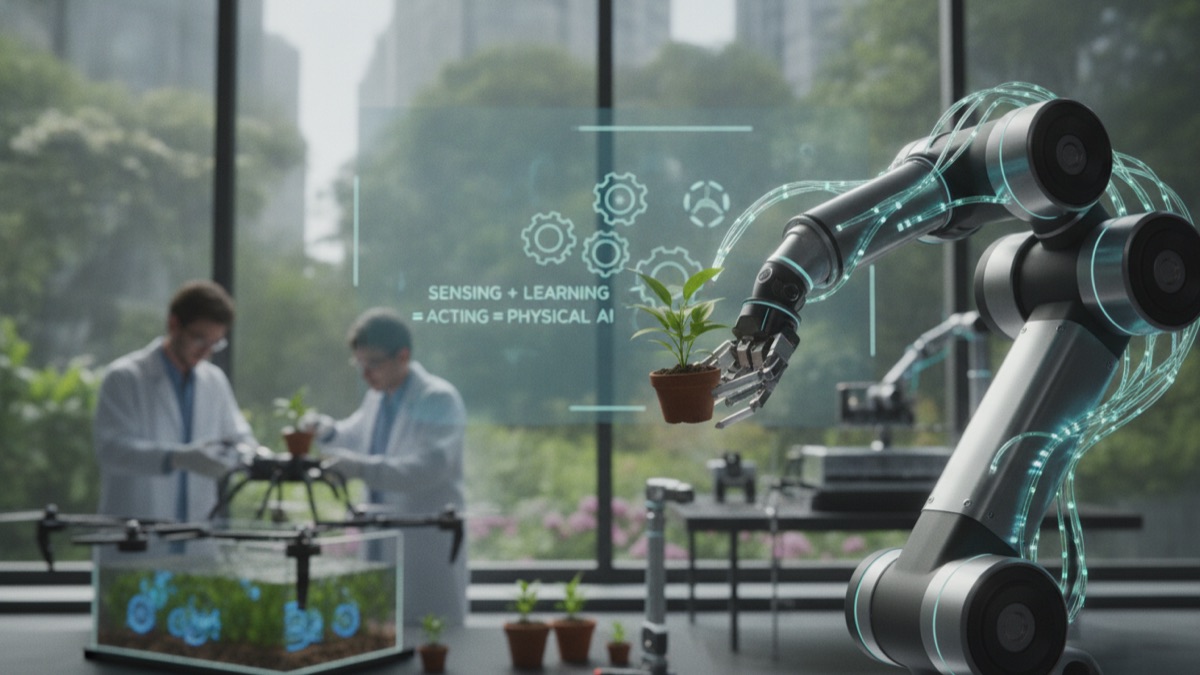
Physical AI is a term used to describe artificial intelligence systems that do not just process text or images on a screen, but perceive, reason about, and act within the physical world through sensors and actuators. Rather than a single product, it is better understood as an umbrella label connecting several fields that were previously discussed separately: robotics, autonomous vehicles, drones, and industrial automation.
This guide explains what makes physical AI a distinct category, how it differs from the conversational AI most people already use, and what is genuinely working today versus what remains an active area of research.
How It Differs from Chatbot-Style AI
A large language model like the ones behind popular chatbots learns patterns in text and generates more text in response. It has no body, no sensors, and no way to directly confirm that what it describes matches physical reality. Physical AI systems, by contrast, are built around a continuous perceive-reason-act loop: cameras, lidar, and touch or force sensors feed real-time data into a model, which then produces commands for motors, wheels, or robotic arms.
This loop introduces problems that text-only models never have to solve. A chatbot's worst-case failure is a wrong sentence. A physical AI system's worst-case failure can be a dropped object, a collision, or a person getting hurt, which is why safety validation, redundancy, and gradual real-world testing matter far more in this field.
Perceiving and Acting in the Real World
Perception in physical AI typically combines several sensor types — cameras for vision, lidar or radar for distance and obstacles, and force or tactile sensors for touch — because no single sensor is reliable in every condition. A camera struggles in poor lighting; lidar struggles with certain reflective or transparent surfaces. Combining sensor streams, known as sensor fusion, is one of the core engineering challenges in the field.
On the action side, models increasingly use techniques adapted from large language models, sometimes called vision-language-action models, which take in an image and a text instruction and output a sequence of physical movements. This approach has made it easier to give robots flexible, general instructions rather than hand-coding every specific motion in advance.
Where Physical AI Is Actually Being Used Today
The most mature real-world deployments remain narrow and industrial: warehouse robots that move inventory along largely predictable routes, robotic arms on assembly lines performing repetitive, well-defined tasks, and driver-assistance systems in cars that handle specific driving scenarios under human supervision. These environments are structured and comparatively predictable, which makes them easier to deploy safely than open, unpredictable settings.
General-purpose physical AI — a single robot capable of reliably handling many different unstructured tasks in a home or public space — remains substantially harder and is where most current research investment and public attention are concentrated, including humanoid robot programs from several major technology and automotive companies.
Why Physical AI Is a Major Trend in 2026
Physical AI has become a frequently cited trend heading into 2026 because progress in large language models and vision models has started to transfer usefully into robotics: models trained on massive amounts of internet text and images provide a foundation that robotics researchers can adapt, rather than building perception and planning systems entirely from scratch. This has meaningfully accelerated the pace of robotics research over the past two to three years.
At the same time, industry interest has grown because labor-intensive sectors like logistics, manufacturing, and agriculture face persistent staffing pressure, making even partial automation of physical tasks commercially attractive.
What Remains Difficult
Physical AI systems still struggle with generalization: a robot trained to pick up boxes in one warehouse often performs poorly in a different warehouse with different lighting, shelving, or object shapes, a problem researchers call the sim-to-real gap. Training in simulation is fast and safe, but transferring that learning reliably to physical hardware in unpredictable real-world conditions remains genuinely unsolved for most general tasks.
Cost, safety certification, and the sheer difficulty of building durable, precise robotic hardware also continue to slow deployment outside of controlled industrial settings, so claims about near-term general-purpose robots should be read with appropriate caution.
Sources
These sources were selected from official documentation and reputable technology explainers. Always check the original pages because AI and computing products change quickly.
Frequently Asked Questions
What is the difference between physical AI and a chatbot?
A chatbot processes and generates text with no ability to sense or act in the physical world. Physical AI systems use sensors to perceive their surroundings and actuators to physically act, in a continuous perceive-reason-act loop.
Is physical AI the same as robotics?
Physical AI is a broader term that includes robotics along with autonomous vehicles, drones, and industrial automation. Robotics is one major application area within the wider physical AI trend.
Are humanoid robots an example of physical AI?
Yes. Humanoid robots are one of the most visible current applications of physical AI, combining perception, planning, and physical actuation, though most are still early in real-world deployment.
Is physical AI ready for general household use in 2026?
Not yet, generally. The most mature deployments remain narrow and industrial, such as warehouse and factory robots. General-purpose robots for unstructured home environments remain an active research challenge.
Why is physical AI getting more attention now?
Progress in large language and vision models has started transferring usefully into robotics, giving researchers a stronger foundation to build on, which has accelerated progress and investment over the past two to three years.
About the Author
The doyouknow.app Editorial Team writes bilingual explainers that make technology and everyday services easier to understand, with attention to primary sources and the limits of fast-changing information.
Loved This Article?
Share on WhatsApp · Subscribe to our newsletter