Table of Contents
Overview
AI chips are processors specifically designed or adapted to perform the mathematical operations behind modern AI models efficiently, at a scale that regular general-purpose computer processors handle poorly. Training and running today's largest AI models would be impractically slow and expensive without specialized hardware, which is why chip design has become one of the most closely watched and capital-intensive parts of the AI industry.
This guide explains the main categories of AI chips, why specialized silicon matters so much for AI specifically, and what current supply and design constraints mean for the pace of AI development.
Why a Regular Processor Isn't Enough
A conventional CPU (central processing unit) is designed to handle a wide variety of tasks one after another very quickly, which suits everyday computing like running an operating system or browsing the web. AI models, particularly neural networks, instead need to perform huge numbers of relatively simple mathematical operations — mostly matrix multiplication — simultaneously, across millions or billions of values at once.
CPUs can do this math, but inefficiently, because they are not built for this kind of massive parallel repetition. This mismatch is the core reason specialized AI hardware became necessary as models grew larger.
GPUs: The Workhorse of AI Training
GPUs (graphics processing units) were originally designed to render graphics for video games, a task that also requires performing the same simple calculation across millions of pixels simultaneously. That parallel architecture turned out to transfer remarkably well to AI workloads, which is why GPUs, particularly from Nvidia, became the dominant hardware for training large AI models over the past decade.
A modern AI training GPU contains thousands of smaller processing cores working in parallel, along with specialized circuitry for the specific matrix math used in neural networks, and high-bandwidth memory designed to feed data to those cores fast enough to keep them continuously busy.
TPUs and Custom ASICs: Purpose-Built Silicon
TPUs (Tensor Processing Units), developed by Google, are a type of ASIC (application-specific integrated circuit) designed from the ground up specifically for the mathematical operations used in AI, rather than adapted from a graphics chip. Because they are built for one narrow purpose, ASICs can be more power-efficient than general-purpose GPUs for that specific task, though they are less flexible for other kinds of workloads.
Several other major technology companies have developed or are developing their own custom AI chips, seeking to reduce dependence on external GPU suppliers and to fine-tune hardware specifically for their own AI models and data center designs.
Chiplets and How AI Chips Keep Scaling
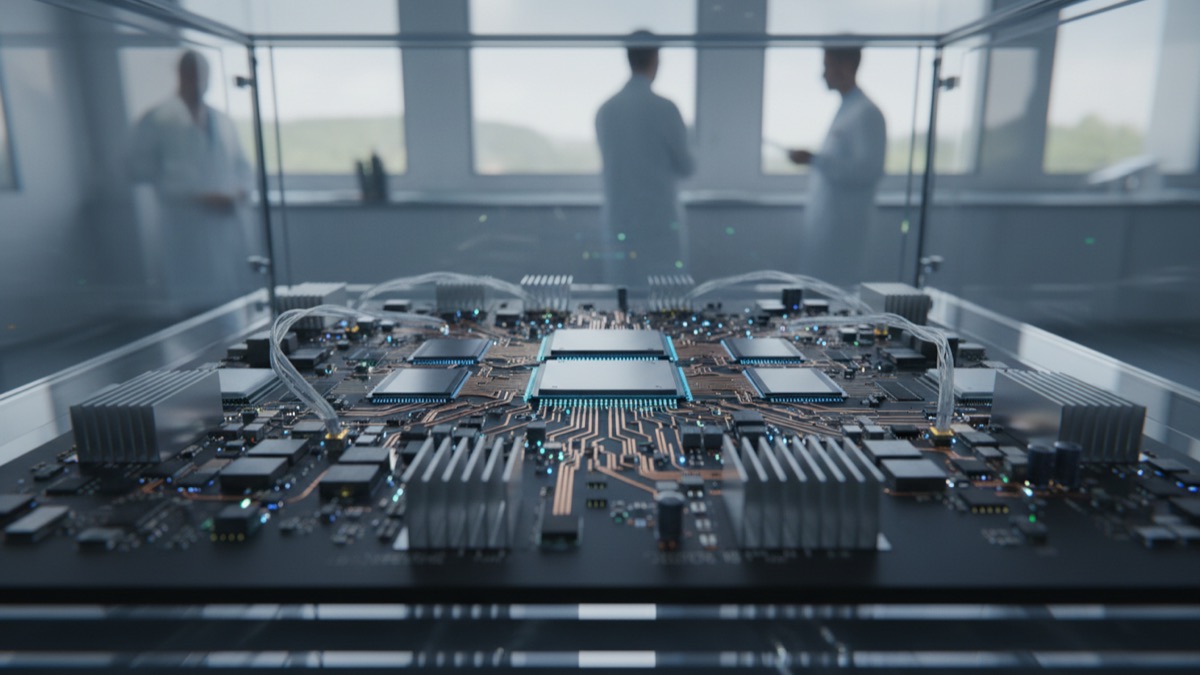
As individual chips approach physical manufacturing limits, chip designers increasingly use chiplet architectures, combining several smaller specialized chip dies into a single package connected by extremely fast internal links, rather than building one enormous single die. This approach improves manufacturing yield, since a defect on a small chiplet wastes less material than a defect on one giant chip, and allows different chiplets to be optimized for different functions within the same package.
Beyond a single chip, large AI training runs use thousands of chips connected together in data centers, making the speed and design of the networking between chips nearly as important as the chips themselves for overall system performance.
Why AI Chips Are a Bottleneck
Advanced AI chips require some of the most sophisticated semiconductor manufacturing processes in the world, concentrated in a small number of facilities globally, most notably Taiwan Semiconductor Manufacturing Company (TSMC). This concentration, combined with surging demand from AI companies, has made access to the newest, most powerful AI chips a genuine bottleneck and strategic concern, influencing everything from company earnings to national technology policy.
Export controls on advanced AI chips, introduced by some governments for national security reasons, have also become a significant factor shaping which companies and countries have access to the most capable hardware, adding a geopolitical dimension to what is fundamentally an engineering and manufacturing story.
Sources
These sources were selected from official documentation and reputable technology explainers. Always check the original pages because AI and computing products change quickly.
Frequently Asked Questions
What is the difference between a GPU and a regular CPU for AI?
A CPU handles varied tasks sequentially very quickly, while a GPU contains thousands of smaller cores that perform the same simple calculation across millions of values simultaneously, which matches how AI models process data much more efficiently.
What is a TPU?
A TPU (Tensor Processing Unit) is a type of custom AI chip developed by Google, built from the ground up specifically for AI math rather than adapted from a graphics chip, making it more power-efficient for that narrow purpose.
Why are AI chips considered a bottleneck?
Advanced AI chips require extremely sophisticated manufacturing concentrated in a small number of facilities worldwide, most notably TSMC, and surging demand from AI companies has made access to the newest chips a genuine supply constraint.
What is a chiplet?
A chiplet is a smaller specialized chip die that is combined with other chiplets into a single package, rather than building one giant single chip. This approach improves manufacturing yield and allows different parts of a chip to be optimized separately.
Why can't AI models just run on a normal laptop chip?
Regular processors are not built for the massive parallel repetition of simple math operations that AI models require. They can technically run small AI models, but training or running today's largest models this way would be impractically slow.
About the Author
The doyouknow.app Editorial Team writes bilingual explainers that make technology and everyday services easier to understand, with attention to primary sources and the limits of fast-changing information.
Loved This Article?
Share on WhatsApp · Subscribe to our newsletter