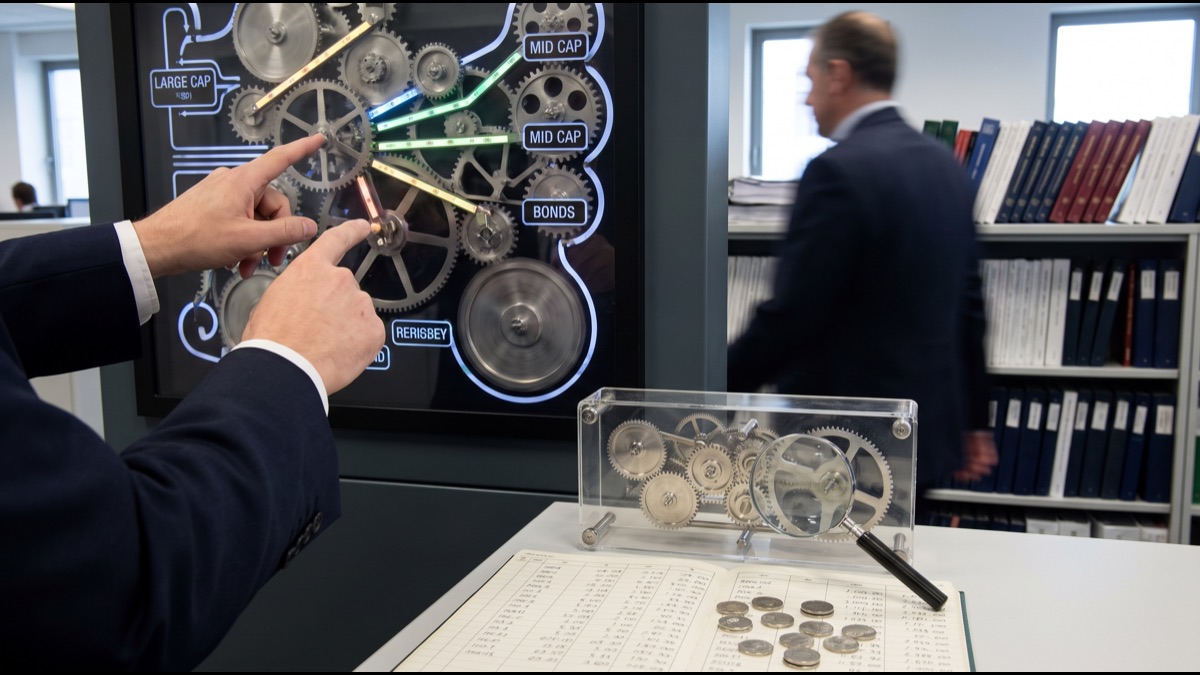
An index fund does not try to beat the market — it tries to become the market, or at least a very close copy of one small, precisely defined slice of it. Behind that simple pitch sits a genuinely mechanical discipline: a published rulebook, a rebalancing calendar, and a constant effort to keep the fund's return as close as possible to a benchmark it has no discretion to deviate from.
Most investors understand the marketing line — buy the whole market instead of trying to pick winners — without ever seeing the machinery that actually keeps a multi-billion-dollar fund honest to an index it does not control. That machinery explains why some index funds track their benchmark almost perfectly while others drift, why fees differ even among funds chasing the identical index, and why an index fund can still lose real money in a falling market.
What an Index Fund Actually Is
An index is simply a defined, rules-based list of securities and a formula for weighting them, maintained by a provider such as a stock exchange or a specialist index company rather than by the fund itself. The fund's only job is to hold a portfolio that mirrors that list and those weights as closely as its structure allows.
This is a fundamentally different mandate from an actively managed fund, where a manager or team decides what to buy and sell based on judgment about which securities will outperform. An index fund manager has essentially no such discretion; the index provider's published methodology dictates the target portfolio, and the fund's job is purely operational.
That operational job is harder than it sounds once real money, real trading costs, and real-world frictions like taxes and settlement delays are involved, which is why tracking an index well is itself a specialized skill even though no forecasting is required.
How Market-Cap Weighting Actually Works
Most major equity indexes weight each constituent by its market capitalization, meaning larger companies make up a proportionally larger share of the index and therefore of any fund tracking it. A company worth ten times another company's value will typically occupy roughly ten times the weight in the index, all else equal.
Many indexes further adjust this using a float-adjusted calculation, which excludes shares that are not actually available for public trading, such as those held by founders, governments, or other companies in long-term strategic stakes. This keeps the weighting reflective of shares an ordinary investor could realistically buy.
The practical consequence is that a market-cap-weighted index fund automatically tilts toward whichever companies the market currently values most highly, which means the fund's composition shifts continuously as prices move, without any manual intervention or judgment call by the fund manager.
Why Index Funds Skip Stock-Picking Entirely
The case for passive index investing rests on a large body of research showing that the average actively managed fund, after fees, underperforms its benchmark index over most extended time periods, even though a handful of active managers do outperform in any given year.
Because it is extremely difficult to identify in advance which manager will be among that outperforming minority, and because underperformance compounds painfully over long holding periods, many investors and institutions choose to simply capture the market's average return at the lowest possible cost instead of paying for a forecast that is more likely than not to disappoint.
Index funds turn this observation into a product: by refusing to make any predictive judgment at all, they sidestep the research costs, trading costs, and behavioral mistakes that erode active returns, and pass most of that savings directly to the investor as a lower fee.
The behavioral cost is often underappreciated: active investors and even professional fund managers tend to buy after prices have already risen and sell after they have already fallen, a pattern that quietly erodes returns even when the underlying stock selection is reasonably sound. An index fund structurally removes that specific temptation, since there is no discretionary decision left to make once the target weights are published.
How Full Replication Actually Happens
For indexes covering a manageable number of large, liquid securities, such as a country's flagship stock index, fund managers typically use full replication, meaning the fund literally buys every single constituent in exactly the proportion the index specifies.
This is operationally straightforward when the underlying securities trade in deep, liquid markets, since the fund can buy and sell the exact quantities needed without materially moving prices or incurring excessive trading costs relative to the size of the position being adjusted.
Full replication produces the tightest possible tracking of the underlying index, because there is no approximation involved — the fund's holdings are, by construction, a scaled-down copy of the index itself, differing only by the small cash buffer most funds hold for redemptions and fees.
Why Sampling Replaces Replication for Some Indexes
Indexes covering thousands of constituents, including many smaller or less liquid securities across international or fixed-income markets, are often impractical to fully replicate, since trading costs for the smallest positions can exceed any benefit they add to tracking accuracy.
In these cases, fund managers use statistical sampling, selecting a subset of securities whose combined risk characteristics, sector exposure, and factor profile closely approximate the full index, without literally owning every single name on the list.
A well-constructed sample can track its benchmark almost as closely as full replication in normal market conditions, though sampling strategies tend to diverge more noticeably from the index during unusual market stress, when the correlations the sample relied upon can temporarily break down.
What Tracking Error Actually Measures
Tracking error is the statistical measure of how consistently a fund's returns deviate from its benchmark's returns over time, expressed as a standard deviation rather than a single number, since the gap fluctuates day to day even for a well-run fund.
A small, consistent tracking error is generally considered a sign of skilled index management, while a large or erratic tracking error suggests either an aggressive sampling strategy, high trading costs relative to fund size, or operational inefficiencies in how the fund executes its rebalancing trades.
Tracking error should not be confused with a fund simply charging a higher fee, since fees create a steady, predictable drag on relative performance, whereas tracking error reflects genuine variability in how closely the fund's actual holdings match the index at any given moment.
How Rebalancing and Reconstitution Work
Index providers periodically reconstitute their indexes, adding newly qualifying companies and removing those that no longer meet the criteria, typically on a published quarterly or annual schedule that fund managers can plan around well in advance.
On the announced reconstitution date, funds tracking that index must simultaneously sell the removed securities and buy the newly added ones, a coordinated, mechanical trading event that can itself move prices noticeably given how much passively managed money often needs to transact on the identical day.
Separately, rebalancing adjusts the weights of existing constituents as their relative market values shift between reconstitution dates, ensuring the fund's proportions do not drift meaningfully away from the index's current published weights.
How Dividends Move Through an Index Fund
When a company held by an index fund pays a dividend, the fund receives that cash directly and, depending on the fund's structure, either distributes it periodically to fund shareholders or reinvests it automatically into the underlying holdings.
Total-return index calculations, which most fund providers benchmark against, assume dividends are reinvested immediately back into the index, so a fund manager must reinvest received dividends reasonably promptly to avoid a cash drag that would otherwise show up as unwanted tracking error against that total-return benchmark.
The timing gap between when a dividend is actually received and when it can practically be reinvested is one of many small operational frictions that professional index management exists specifically to minimize.
Why Expense Ratios Matter More Than They Look
An expense ratio expressed in a fraction of a percent can look trivial on paper, but because it is charged every single year against the full invested balance, its effect compounds substantially over a multi-decade holding period in a way that is easy to underestimate.
Two funds tracking the identical index with a seemingly small fee difference can produce meaningfully different ending balances after several decades purely from that compounding effect, even though both funds delivered essentially the same gross market return before fees.
This is why cost has become one of the most heavily marketed differentiators among index funds tracking the same benchmark, since the underlying exposure is functionally identical and fee is one of the few genuine, controllable differences an investor can evaluate in advance.
Fee competition among index providers has driven expense ratios on the largest, most liquid benchmark funds down dramatically over the past two decades, to the point where several major providers now offer certain broad-market funds at a cost close to zero, treating them as a way to attract investors who then hold other, higher-margin products alongside the loss-leading fund.
How Securities Lending Adds Hidden Return
Many index funds generate a modest additional stream of income by lending out portfolio securities to other market participants, such as short sellers, in exchange for a fee, an activity that operates largely invisibly to the ordinary fund investor.
This lending is generally structured with collateral requirements designed to protect the fund if the borrower defaults, and the resulting income is typically used to offset a portion of the fund's operating costs, sometimes allowing the effective cost to investors to run below the stated expense ratio.
The scale of securities lending income varies considerably by fund and by how in-demand its specific holdings are for borrowing, which is one reason two funds with identical headline fees can still deliver subtly different net returns over time.
Index Funds Versus ETFs in Practice
An index fund can be structured either as a traditional mutual fund, priced once daily and bought or sold directly through the fund provider, or as an exchange-traded fund, which trades continuously on an exchange throughout the day like an individual stock.
ETFs use a distinct creation-and-redemption mechanism involving specialized institutional participants who exchange baskets of the underlying securities for new ETF shares, a process that generally keeps the ETF's market price closely aligned with the value of its actual holdings.
Both structures can track the same underlying index equally well; the meaningful differences for most investors tend to involve trading flexibility, minimum investment amounts, and in some tax jurisdictions, differing tax treatment of the two structures.
Why Index Funds Can Still Lose Money
An index fund's entire purpose is to mirror its underlying market, which means it offers no protection whatsoever if that market falls; a well-run index fund tracking a falling index will fall right alongside it, precisely as designed.
This is a frequently misunderstood point, since the marketing emphasis on low cost and broad diversification can create an impression of safety that the product was never designed to provide — diversification reduces the risk of any single company's failure, not the risk of the entire market declining together.
Investors seeking protection against broad market declines need a different tool entirely, such as asset allocation across uncorrelated investments, since an index fund by design offers no mechanism to sidestep a genuine market-wide downturn.
How Passive Investing Reshaped Market Structure
The dramatic growth of index investing over recent decades has itself become a subject of active debate among market researchers, since a growing share of total market ownership now sits in vehicles that, by design, make no independent judgment about individual company value.
Some researchers argue this concentration could weaken the market's overall price-discovery process, since fewer active participants remain doing the fundamental research that historically helped keep asset prices aligned with underlying business performance.
Others counter that active managers, collectively, still trade enough to keep prices reasonably efficient, and that the debate is unlikely to be settled definitively while passive ownership continues its multi-decade rise across most major markets.
What Actually Separates a Good Index Fund from a Weak One
Given that two funds tracking the identical index hold functionally the same underlying exposure, the meaningful differences an investor can actually evaluate come down to expense ratio, historical tracking error, fund size and liquidity, and the reputation of the manager's operational execution.
Larger, longer-established index funds generally benefit from scale efficiencies in trading and securities lending that smaller or newer competing funds have not yet had time to build, which can show up as marginally tighter tracking even at similar headline fees.
An index fund's genuine value proposition is not cleverness but discipline: the ability to faithfully, cheaply, and consistently replicate a benchmark year after year without deviation, which is a far less glamorous skill than stock-picking but one with a substantially better track record on average.
Sources
- Wikipedia — overview of index fund structure and history
- U.S. Securities and Exchange Commission — regulatory guidance on mutual funds and ETFs
- S&P Dow Jones Indices — index methodology and reconstitution rules
- OECD — research on passive investing and market structure
- Investor.gov (U.S. SEC) — investor education on fund fees and tracking
FAQ
Do index funds ever hold every single stock in the index?
Large, liquid indexes are usually fully replicated, but funds tracking thousands of small or hard-to-trade securities often use sampling instead of buying every constituent.
Why do two funds tracking the same index have different returns?
Differences in expense ratios, sampling methodology, securities lending income, and the timing of rebalancing trades all create small but measurable gaps between otherwise similar funds.
Can an index fund lose money even if the index is well-designed?
Yes — the fund simply mirrors whatever the underlying market does, so if the index itself falls, the fund falls with it regardless of how efficiently it tracks that index.
What happens to a fund when a company is removed from the index?
The fund manager sells the removed stock and buys the newly added replacement around the announced reconstitution date, a mechanical trade unrelated to any judgment about the company.
Why do index funds usually have such low fees?
Because there is no research team picking stocks — the fund simply follows a published rulebook, which removes most of the labor cost that active management requires.
About the Author
We reference Wikipedia, the U.S. Securities and Exchange Commission, S&P Dow Jones Indices, the OECD, and Investor.gov to explain the background and current understanding of this topic.
Loved This Article?
Share it on WhatsApp → Share it on WhatsApp
Get more guides in your inbox — Subscribe to our newsletter for weekly surprising stories from Egypt, Saudi Arabia, Dubai, and beyond.