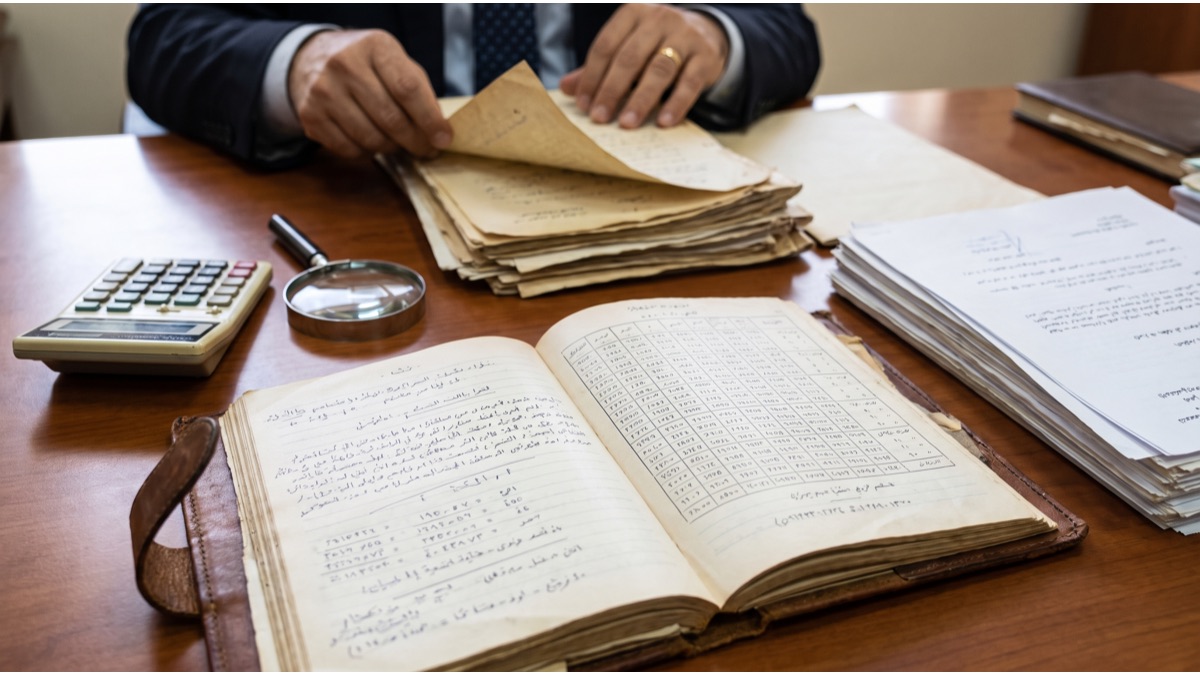
Islamic inheritance law, known as faraid, begins from a position most legal systems do not share. A substantial portion of who inherits and how much is fixed directly by the Quran itself, leaving comparatively little room for a deceased person's personal preference to override it, a structure that produces a genuinely mathematical process of calculation rather than a simple matter of following a will.
The system is built around specific, named categories of relatives entitled to fixed fractional shares, a residual category that absorbs whatever remains after those fixed shares are paid, and a hard limit on how much a person can redirect through a will, together forming one of the most detailed and mathematically precise areas of Islamic jurisprudence.
Why Islamic Inheritance Starts From Fixed Shares
Unlike legal systems where a will can freely distribute an estate however its owner chooses, Islamic law treats a specific portion of inheritance as already assigned by Quranic text before any personal preference enters the picture, based on the view that these divinely fixed shares protect vulnerable family members, particularly women and children, from potentially being disinherited entirely by an individual's personal wishes.
This does not mean personal choice plays no role at all, since a limited portion of the estate can still be directed through a will, but it does mean the starting point for any Islamic inheritance calculation is fundamentally different from a system built around near-total testamentary freedom, requiring specific fixed shares to be calculated and satisfied first.
What Must Happen Before Any Inheritance Is Calculated
Before any inheritance shares are calculated, Islamic law requires several prior steps to be completed, including paying funeral expenses from the estate, settling all outstanding debts owed by the deceased in full, and fulfilling any valid bequest made through a will, all of which must be satisfied before the remaining net estate is divided among the heirs according to their fixed and residuary shares.
This ordering matters considerably in practice, since an estate that appears substantial on paper can shrink dramatically once outstanding debts and funeral costs are properly deducted, and heirs are only ever entitled to shares of what genuinely remains after these prior obligations have been fully satisfied.
Who the Quran's Fixed-Share Heirs Actually Are
The Quran specifies fixed fractional shares, generally one-half, one-quarter, one-eighth, two-thirds, one-third, or one-sixth, for a defined set of relatives under specific conditions, including a surviving spouse, parents, daughters in certain configurations, and in some cases siblings, with the applicable fraction depending heavily on which other relatives also survive the deceased.
These fixed shares are not simply divided equally among everyone in a broad family circle, but assigned according to precise, named categories, meaning the actual outcome of a real case depends heavily on the specific combination of surviving relatives, which is precisely why faraid calculations require careful case-by-case analysis rather than a single universal formula applied identically every time.
Why a Widow's Share Depends on Whether Children Exist
A surviving wife's fixed share illustrates how conditional these calculations genuinely are. A wife inherits one-eighth of her husband's estate if he leaves surviving children, but one-quarter if he does not, a distinction rooted directly in specific Quranic verses rather than later juristic elaboration, and one that a widow, and anyone advising her, must apply correctly from the outset.
A surviving husband's corresponding shares are one-quarter with surviving children and one-half without them, a structural pattern, generally double the wife's equivalent share in the same configuration, that recurs at several points throughout the broader system and reflects the traditional maintenance obligations historically assigned to male relatives within the family structure.
How Residuary Heirs Receive What Remains
After the Quran's fixed-share heirs receive their designated fractions, whatever remains of the estate passes to a separate category called residuary heirs, generally close male relatives in the paternal line such as sons, and in specific circumstances daughters inheriting alongside sons, who divide the remainder according to established rules rather than another fixed fraction.
This residuary category exists specifically to ensure the estate is fully distributed rather than leaving an unallocated remainder, and in the common configuration of a deceased man survived by a wife, parents, and children, calculating exactly how much passes to fixed-share heirs before the residue is determined requires working through the fractions in a specific, well-established sequence.
Why Sons and Daughters Often Receive Different Shares
Perhaps the most widely known and most frequently misunderstood feature of faraid is the general rule that a son typically receives twice the share of a daughter when they inherit together as residuary heirs, a ratio explicitly stated in the Quran and consistently applied across the major schools of Islamic jurisprudence.
Classical and contemporary scholars generally explain this ratio by reference to the traditional financial maintenance obligations placed on male relatives, including supporting wives, children, and in some cases extended family, obligations that female relatives were not traditionally required to bear even over property and wealth they held and controlled independently in their own right, a distinction scholars argue makes the arrangement more balanced overall than the raw ratio alone suggests.
How the One-Third Will Limit Actually Works
Islamic law permits a person to direct up to one-third of their net estate through a will to beneficiaries of their choosing, commonly used to provide for individuals who would not otherwise inherit under the fixed faraid rules, such as a close friend, a charitable cause, or a more distant relative outside the defined circle of fixed and residuary heirs.
This one-third limit is treated as a firm ceiling rather than a starting point for negotiation, based on prophetic guidance specifically cautioning against leaving one's heirs in financial hardship by directing away too large a portion of the estate through personal bequest, a concern that continues to shape how contemporary scholars advise Muslims drafting wills today.
Why a Fixed Heir Generally Cannot Also Be a Will Beneficiary
A further significant restriction holds that a bequest generally cannot be made to someone who is already entitled to a fixed share under faraid, since doing so would effectively allow a person to override the Quranic distribution scheme for their own preferred heir by supplementing their guaranteed share through a separate bequest, defeating the underlying purpose of the fixed-share system entirely.
A minority of scholars hold that such a bequest becomes valid only if the other heirs subsequently and voluntarily consent to it after the person's death, a position reflecting ongoing genuine juristic disagreement on this specific restriction rather than a single universally agreed rule applied identically across every school of thought.
How Debts Are Handled Before Inheritance
Outstanding debts owed by the deceased must be settled in full from the estate before any inheritance distribution occurs, a principle stated explicitly in the same Quranic verses that establish the fixed inheritance shares themselves, reflecting the seriousness with which Islamic teaching treats unpaid financial obligations even after a person's death.
This requirement extends to less obvious categories of debt as well, including unpaid religious obligations such as an outstanding pledge of charity or an unfulfilled vow, which some schools of jurisprudence treat as legitimate claims against the estate that must be satisfied before heirs receive their respective shares of what remains.
What Happens When Shares Exceed the Full Estate
In certain rare combinations of surviving relatives, the mathematical sum of the applicable fixed shares can exceed the total value of the available estate, a scenario Islamic jurisprudence resolves through a specific proportional reduction method, commonly called awl, that scales every fixed share downward proportionally so the total still equals exactly the full estate.
The opposite scenario can also occur, where fixed shares are correctly calculated but a remainder is left over with no residuary heir available to absorb it, addressed through a separate mechanism called radd that proportionally returns the surplus to the fixed-share heirs themselves, excluding a surviving spouse in most schools of jurisprudence applying this particular rule.
Why Adopted Children Are Treated Differently
Formal adoption in the sense recognised by many Western legal systems, where an adopted child is legally treated as a biological child for all purposes including inheritance, does not create automatic inheritance rights under classical Islamic jurisprudence, which maintains a firm distinction between biological or marital lineage and other forms of guardianship or fostering.
This does not leave a fostered or informally adopted child without any provision, since a caregiver can still provide for such a child through the permitted one-third bequest, or through lifetime gifts made while still alive, both of which operate independently of the fixed faraid framework and remain fully available regardless of a child's formal legal status.
How Modern States Have Codified Faraid
Many contemporary Muslim-majority countries have codified faraid principles into formal national inheritance statutes, generally preserving the core Quranic fixed shares while adding modern procedural elements such as formal probate courts, registration requirements, and specific administrative rules for handling contested estates that did not exist in earlier historical periods.
Muslims living as minorities in countries with entirely secular inheritance law often address this gap through carefully drafted wills structured to approximate faraid outcomes as closely as the local legal system permits, frequently working with specialised legal advisors familiar with both the relevant civil law and the underlying Islamic requirements they are attempting to satisfy.
Why Heirs Can Sometimes Agree to a Different Division
Many scholars hold that once faraid shares have been correctly calculated according to the applicable rules, adult heirs are generally free to voluntarily agree among themselves to redistribute the estate differently, provided every heir consents genuinely and without coercion, a position that distinguishes the mandatory calculation stage from what heirs choose to do with their legally confirmed entitlement afterward.
This distinction matters considerably in families seeking practical flexibility, since it allows heirs to address genuine family circumstances, such as one sibling's greater financial need or another's prior informal contribution to a family business, without abandoning the underlying religious requirement to calculate the correct shares as a mandatory starting point for any subsequent voluntary rearrangement.
How Faraid Software and Calculators Are Used Today
Given the genuine mathematical complexity involved in cases with multiple surviving relatives, unusual combinations of heirs, or scenarios requiring awl or radd adjustments, specialised faraid calculation software and online calculators have become widely used tools among both Islamic scholars and ordinary families seeking to correctly determine each heir's precise entitlement.
These tools generally require users to input the exact surviving relatives and their relationship to the deceased, then apply the established jurisprudential rules automatically, though scholars consistently caution that unusual or contested cases still genuinely benefit from qualified human review rather than relying solely on an automated calculation regardless of how sophisticated the underlying software may be.
Why Grandchildren's Inheritance Rights Are Sometimes Debated
Under classical faraid rules, a grandchild whose parent has predeceased the grandparent generally does not automatically inherit in place of that deceased parent, since inheritance passes to the nearest surviving relatives in the defined categories rather than following a strict per-family-branch representation principle familiar from some other legal traditions.
This outcome has prompted considerable modern debate and reform in several countries, with some contemporary legal systems introducing a concept sometimes called obligatory bequest, which requires a grandparent's estate to provide for such grandchildren up to the one-third bequest limit even without an explicit will naming them, addressing a gap many contemporary scholars and lawmakers viewed as producing unintended hardship for grandchildren in this specific situation.
How Faraid Interacts With Life Insurance and Modern Assets
Contemporary financial instruments largely unknown to classical jurists, including life insurance payouts, employer pension benefits, and jointly held bank accounts with named beneficiaries, raise genuine questions about whether such assets fall under faraid rules at all or are instead governed by the separate contractual terms under which they were established.
Scholarly opinion varies considerably on this question, with some jurists treating conventional life insurance proceeds as outside the deceased's estate entirely and therefore not subject to faraid distribution, while others argue that funds genuinely originating from the deceased's own contributions should still be integrated into the estate and divided according to the standard fixed and residuary shares regardless of how the underlying financial product was structured.
Faraid represents one of the most detailed, mathematically precise, and consistently applied areas of Islamic jurisprudence, combining fixed Quranic shares, a residuary category, a limited testamentary allowance, and specific correction mechanisms into a coherent system designed to distribute an estate fairly while protecting relatives who might otherwise be vulnerable to being disinherited entirely.
Understanding even the basic structure of fixed shares, residuary inheritance, and the one-third will limit equips a reader to recognise why a specific Islamic inheritance outcome looks the way it does, even though the full calculation in any individual case, particularly one involving awl, radd, or unusual combinations of surviving relatives, is genuinely best left to a qualified scholar or specialised calculator rather than informal estimation.
Sources
- Wikipedia — overview of faraid rules and jurisprudential detail
- Encyclopaedia Britannica — background on Islamic inheritance law
- Oxford Islamic Studies — scholarly reference on Islamic jurisprudence and family law
- JSTOR — academic research on comparative Islamic inheritance systems
FAQ
Can a Muslim leave their entire estate to one child in a will?
No. A will can only dispose of up to one-third of the estate, and generally cannot benefit someone who is already a fixed heir under faraid.
Why do daughters often receive half the share of sons?
The classical ratio reflects that male heirs traditionally carried financial maintenance obligations toward female relatives that female heirs did not carry.
What happens if debts exceed the estate's value?
Debts are paid first from the estate before any inheritance is distributed, and if debts exceed the estate's value, heirs generally receive nothing.
Do adopted children inherit under faraid?
Formal adoption in the Western legal sense does not create inheritance rights under classical Islamic law, though a will or gift can still provide for a child.
Can heirs agree to divide an estate differently than faraid requires?
Many scholars hold that adult heirs can voluntarily agree among themselves to a different division after the faraid shares are correctly calculated first.
About the Author
We reference Wikipedia, Encyclopaedia Britannica, Oxford Islamic Studies, and JSTOR to explain the background and current understanding of this topic.
Loved This Article?
Share it on WhatsApp → Share it on WhatsApp
Get more guides in your inbox — Subscribe to our newsletter for weekly surprising stories from Egypt, Saudi Arabia, Dubai, and beyond.