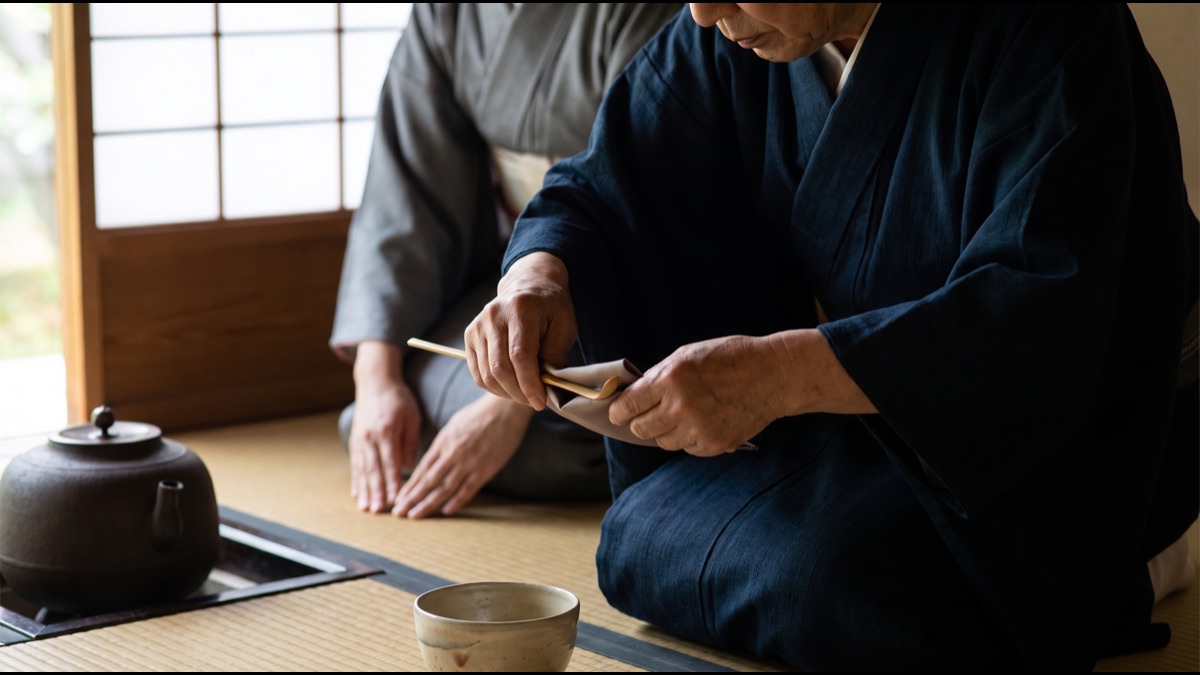
A trained tea master can spend more than fifteen seconds folding a single silk cloth before ever touching the tea, and every one of those seconds is deliberate rather than ceremonial padding. The Japanese tea ceremony, known formally as chanoyu or sado, is often described to outsiders as simply "the way tea is served," but that description badly undersells what is actually happening: a sequence of dozens of individually named, individually practiced movements, refined over roughly five centuries, in which almost nothing is left to a host's personal preference.
What looks to an untrained eye like unhurried, almost meditative motion is in fact a strict choreography, transmitted through direct physical instruction from teacher to student rather than written instructions alone, in which the angle of a wrist, the number of steps taken across a tatami mat, and the exact point at which a guest bows have all been fixed by tradition and are corrected, sometimes for years, until they become second nature.
This is not decoration layered onto the act of drinking tea. The choreography is the point. Chanoyu developed specifically as a disciplined practice for cultivating awareness, humility, and presence, using the preparation of a bowl of powdered green tea as the vehicle rather than the goal, and every physical detail of the ritual, from the shape of the doorway guests crawl through to the direction a host rotates a tea bowl, was designed to serve that underlying purpose.
Understanding how the ceremony actually works means looking past the tea itself and toward the structure holding it together: the philosophy that governs it, the architecture that stages it, the exact sequence of hand movements that prepare it, and the decades most practitioners spend simply learning to perform it correctly.
Why the Ceremony Rests on Four Guiding Principles
Japanese tea practice is traditionally organized around four core principles, commonly rendered in English as harmony, respect, purity, and tranquility, and attributed in their most influential formulation to the sixteenth-century tea master Sen no Rikyu, whose codification of the ceremony still shapes how it is taught today. These four words function less as abstract slogans and more as literal instructions guiding every physical choice a host makes, from how utensils are arranged to how a guest is greeted at the entrance.
Harmony refers primarily to the relationship between host, guest, utensils, and the surrounding season, meaning a host actively selects objects and gestures that suit the specific weather, occasion, and people present rather than repeating an identical performance regardless of context. Respect governs how people and objects alike are treated during the gathering, extending even to inanimate tools, which are handled with a level of physical care that would look excessive if applied to ordinary kitchenware.
Purity operates on both a literal and symbolic level: utensils are visibly cleaned in front of guests as part of the ritual itself, not merely before it begins, transforming an act of hygiene into a deliberate, watched gesture of mental and physical clearing. Tranquility describes the state the first three principles are ultimately meant to produce, a calm, undistracted presence in both host and guest that the entire choreography is structured to make achievable rather than merely hoped for.
How the Tea Room Itself Shapes the Ritual
The traditional tea room, or chashitsu, is deliberately small, often measuring only about four and a half tatami mats, a size chosen specifically to force physical closeness and remove the possibility of a host and guest maintaining the kind of distance more spacious rooms would allow. Every element inside this compact space, down to the placement of a single hanging scroll, is considered part of the choreography rather than passive decoration.
Guests traditionally enter through a small crawl-through entrance called a nijiriguchi, sometimes no more than sixty centimetres square, which forces everyone, regardless of social rank outside the tea room, to bow low and enter humbly on hands and knees. This architectural detail was historically significant precisely because it flattened status distinctions between samurai and commoners for the duration of the gathering, a deliberate design choice rather than a practical space-saving measure.
The tokonoma, a recessed alcove typically holding a hanging scroll and a seasonal flower arrangement, functions as the room's focal point and the first thing a guest is expected to observe and acknowledge upon entering, since its contents are chosen specifically to set the day's theme and are read by attentive guests as a deliberate message from the host rather than generic ornamentation.
The Precise Sequence Behind Preparing a Bowl of Matcha
Preparing matcha, the finely powdered green tea used in the ceremony, follows a fixed sequence: the host measures a precise quantity of powder into the bowl using a bamboo scoop called a chashaku, adds hot water from an iron kettle using a ladle called a hishaku, and whisks the mixture with a bamboo whisk called a chasen, using a specific brisk, controlled motion designed to produce an even, light froth rather than simply dissolving the powder.
The whisking motion itself is taught with considerable precision, typically a rapid back-and-forth "W" or "M" shaped movement of the wrist rather than a circular stir, since a circular motion tends to produce clumps of undissolved powder and an uneven, flat surface rather than the fine, consistent froth considered correct. Students commonly spend months simply practicing this whisking motion on its own before it is ever combined with the rest of the sequence.
The finished bowl is placed with its front, typically the side bearing the most visually significant design element, facing the guest, a deliberate act of respect requiring the guest to then rotate the bowl before drinking so as not to place their lips directly on the design, a small reciprocal gesture that mirrors the host's own careful attention back toward the object itself.
Why Every Utensil Is Handled in a Fixed Order
Each utensil used in the ceremony, the tea caddy, the scoop, the whisk, the water ladle, and the bowl itself, is picked up, used, cleaned, and set down according to a fixed sequence called temae, and the order in which these actions occur is not left to a host's discretion but follows one of dozens of standardized procedures depending on the season, the type of gathering, and the specific school of tea being practiced.
This fixed handling order serves a genuinely practical function alongside its symbolic one: because every object has a designated position on the mat and a designated moment in the sequence when it is touched, a host can perform the entire ceremony without needing to consciously plan the next step, freeing mental attention to remain with the guests rather than with logistics, which is precisely the state of unforced presence the ceremony is designed to cultivate.
Guests are also expected to know a corresponding, though simpler, sequence for handling objects handed to them, including how to accept a bowl with both hands, where to place it on the mat, and in what order to admire and return accompanying items like the tea caddy, meaning the choreography extends well beyond the host alone into a shared, mutually rehearsed exchange.
How the Bowl Is Turned and Why It Matters
Turning the tea bowl before drinking is one of the ceremony's most visible and widely recognized gestures, and it happens at least twice during a typical exchange: once by the host, who turns the bowl so its most attractive face points toward the guest as a gesture of honor, and again by the guest, who turns it back roughly ninety to one hundred eighty degrees before drinking so as not to drink directly from the bowl's most valued or decorated surface.
The exact number of turns and the direction they occur in varies somewhat between schools and specific ceremony types, but the underlying logic is consistent across nearly all of them: the gesture exists to demonstrate that the guest has genuinely noticed and appreciated the bowl's design, since the bowl itself, particularly in a formal gathering, is frequently a valuable piece of pottery selected specifically for that day's occasion.
After finishing the tea, a guest is also expected to examine the bowl closely, sometimes turning it in their hands and commenting on its craftsmanship, glaze, or history before returning it, transforming what might otherwise be a purely functional drinking vessel into an object of shared aesthetic attention central to the gathering's social purpose.
The Guest's Role Is Just as Choreographed as the Host's
While public attention tends to focus on the host's elaborate hand movements, a guest attending a formal tea gathering follows an equally structured, if less physically demanding, set of expectations, beginning with the order in which multiple guests enter the tea room, since the most senior or honored guest, called the shokyaku, enters first and sits closest to the host, with subsequent guests seated in a specific descending order of status.
Guests are expected to bow at specific points, admire the tokonoma display before being served, accept and drink the tea using prescribed hand positions, and exchange a scripted sequence of polite phrases with the host at defined moments, including a specific compliment offered before drinking and a specific expression of thanks offered after, meaning very little of a formal gathering's verbal exchange is genuinely improvised.
This shared choreography is precisely what allows the ceremony to function as a coherent social ritual rather than an individual performance watched passively by an audience: because both host and guests know their respective sequences, the entire gathering proceeds as a kind of rehearsed conversation conducted primarily through gesture rather than speech.
Why Seasonal Awareness Governs Nearly Every Choice
Seasonal awareness is woven so deeply into tea practice that it directly determines physical choices most outside observers would assume are fixed, including which style of hearth is used: a sunken hearth called a ro is used during the colder months roughly from November through April, placing the heat source and kettle closer to guests, while a portable brazier called a furo is used during the warmer months, positioning the heat source farther away to avoid adding unwanted warmth to the room.
The utensils themselves, the design on the tea bowl, the choice of sweets served before the tea, and the flower selected for the tokonoma alcove are all expected to reflect the specific season and, ideally, the specific week, since using a bowl decorated with autumn maple leaves during early spring would be read by knowledgeable guests as a genuine misstep rather than a minor stylistic inconsistency.
This seasonal precision reflects the same underlying discipline found in the physical choreography: nothing in the ceremony is treated as generic or interchangeable, and a host's ability to select objects and gestures appropriate to the exact moment is considered a genuine measure of skill, distinct from and in some respects more demanding than simply executing the physical movements correctly.
How Long It Actually Takes to Train as a Tea Master
Formal tea ceremony training is organized around a graded system of certificates and licenses issued by a school's head family, and progressing from a beginner's first lessons to the advanced certifications associated with teaching authority typically takes well over a decade of regular, ongoing practice, with the most senior levels of certification sometimes taking several decades to reach.
Training proceeds primarily through direct physical repetition under a teacher's close correction rather than through written manuals, since the precise angle of a wrist or the correct pacing of a step across tatami cannot be fully conveyed through text alone, meaning students typically practice the same basic movements hundreds of times across many months before advancing to more complex procedures.
Even accomplished practitioners describe tea ceremony as a lifelong discipline rather than a skill with a defined endpoint, since the deeper goals the choreography serves, genuine presence, humility, and undistracted attention, are treated within the tradition as qualities that can always be refined further rather than states a student either has or has not yet achieved.
The Two Main Schools That Shape How Chanoyu Is Taught
Contemporary Japanese tea ceremony is dominated by several major schools descended from Sen no Rikyu's teachings, with the Urasenke and Omotesenke schools among the most widely practiced both within Japan and internationally, each maintaining its own specific variations on temae sequences, utensil choices, and even the precise way tea is whisked.
These schools trace direct, documented lineages of teachers back through many generations to Rikyu himself or his immediate descendants, and a practitioner's specific school affiliation genuinely matters, since the correct sequence for a given procedure in one school may differ meaningfully from the sequence considered correct in another, meaning there is no single universal choreography but rather several closely related, carefully maintained variants.
Despite these differences in specific technique, all major schools share the same underlying four principles and the same fundamental commitment to precise, repeatable, teacher-transmitted movement, meaning the variation between schools operates more like regional dialects of a shared language than as genuinely competing philosophies of what the ceremony is for.
Why Wabi-Sabi Sits at the Philosophical Core of the Ceremony
Wabi-sabi, an aesthetic sensibility centered on finding beauty in imperfection, impermanence, and simplicity, is closely associated with the specific style of tea ceremony developed and popularized by Sen no Rikyu, who favored rustic, irregularly shaped, unglazed or minimally decorated utensils over the ornate imported Chinese ceramics that had previously dominated elite tea culture in Japan.
This aesthetic choice was itself a deliberate act of choreography extended into object selection: a deliberately asymmetrical tea bowl, or one bearing a visible repair, is not treated as a flawed object to be hidden but as a genuinely superior expression of the ceremony's underlying values, since its imperfection is read as evidence of honesty, humility, and the passage of time rather than as a defect.
This philosophy directly shapes the physical choreography as well, since the careful, unhurried, deliberately simple movements of temae are themselves an expression of wabi-sabi values applied to human action rather than to objects alone, meaning the ceremony's slow pacing is not merely a stylistic preference but a direct enactment of the same aesthetic principle governing its utensils and room design.
The Concept of Ichigo Ichie and Why It Matters So Much
Ichigo ichie, a phrase often translated as "one time, one meeting," expresses the idea that any given tea gathering, with its specific combination of people, season, utensils, and mood, can never be genuinely repeated, meaning both host and guests are encouraged to treat the encounter as a singular, unrepeatable event deserving full attention rather than as one interchangeable instance of a routine practice.
This concept directly explains why so much of the ceremony's choreography is devoted to seasonal specificity, careful utensil selection, and unhurried pacing: if a gathering is genuinely unrepeatable, then every detail within it becomes meaningful precisely because it will never occur in exactly that combination again, transforming what could otherwise be a routine, mechanical procedure into something treated as quietly significant.
Modern tea teachers frequently cite ichigo ichie as the philosophical justification for why the ceremony cannot be meaningfully rushed or simplified without losing its actual purpose, since compressing or skipping steps for convenience directly undermines the premise that this particular gathering, on this particular day, deserves the full, undivided choreography rather than an abbreviated substitute.
How the Ceremony Differs Between Formal and Casual Settings
The most elaborate version of the ceremony, called chaji, is a lengthy formal gathering that can last four hours or longer, including a full kaiseki meal, a charcoal-laying ritual, and the preparation of both a thick, concentrated tea called koicha and a thinner, more commonly recognized tea called usucha, representing the complete choreography in its fullest, most demanding form.
A shorter, more common version called chakai typically involves only the lighter usucha tea and simple sweets, lasting perhaps an hour, and is the format most visitors and casual practitioners actually encounter, whether at a public demonstration, a cultural event, or an introductory lesson, meaning the full four-hour chaji choreography remains comparatively rare even among regular practitioners.
Despite this range in length and formality, the underlying principles and the core sequence of movements remain recognizably consistent across both formats, since a chakai is generally understood as a compressed expression of the same choreography found in a full chaji rather than a fundamentally different or lesser practice, meaning the core discipline scales down without being replaced.
Why This Choreography Still Matters in Modern Japan
Tea ceremony instruction remains a widely practiced extracurricular and adult education activity across contemporary Japan, taught in dedicated schools, university clubs, and community centers, and continues to be viewed by many practitioners as a valuable form of physical and mental discipline distinct from, though compatible with, its historical and aesthetic significance.
Corporate and hospitality training programs in Japan have at times incorporated elements of tea ceremony etiquette specifically to teach precision, attentiveness to others, and composed physical bearing, reflecting a broader cultural understanding that the choreography's value extends well beyond tea itself into any context requiring disciplined, considerate physical presence.
The continued popularity of tea ceremony among younger practitioners and international students alike suggests the underlying appeal was never really about the beverage: a structured practice offering genuine, repeatable access to focused attention and quiet presence retains real value in exactly the kind of fast-paced, distraction-heavy environment that makes such qualities increasingly difficult to access through ordinary daily routine.
Sources
- Wikipedia — overview of chanoyu, its history, principles, and major schools
- Urasenke Foundation — background on tea ceremony practice and training within the Urasenke school
- The Metropolitan Museum of Art — curatorial background on Japanese tea utensils and ceremony aesthetics
- Japan Government (JapanGov) — cultural context on traditional arts and their role in contemporary Japan
FAQ
What are the four core principles of the Japanese tea ceremony?
Harmony, respect, purity, and tranquility, a set of guiding principles most associated with tea master Sen no Rikyu that shape nearly every physical and social choice made during the ceremony.
Why do guests turn the tea bowl before drinking?
To avoid drinking directly from the bowl's most decorated or valued face, which the host has turned toward the guest as a gesture of honor, making the guest's turn a reciprocal gesture of respect.
How long does it take to become a qualified tea master?
Well over a decade of regular practice for foundational teaching certification, with the most senior levels within major schools sometimes taking several decades to reach.
What is the difference between chaji and chakai?
Chaji is the full formal gathering, often four hours or longer with a meal and two types of tea, while chakai is a shorter, more common version focused mainly on lighter tea and simple sweets.
What does ichigo ichie mean?
Roughly "one time, one meeting," the idea that a specific tea gathering can never be genuinely repeated, which is why hosts treat every seasonal and material detail as meaningful rather than routine.
Why is the tea room entrance so small?
The traditional crawl-through entrance forces every guest, regardless of outside social rank, to bow low and enter humbly, historically flattening status distinctions for the duration of the gathering.
About the Author
We reference Wikipedia and other authoritative sources to explain the background and current understanding of this topic.
Loved This Article?
Share it on WhatsApp → Share it on WhatsApp
Get more guides in your inbox — Subscribe to our newsletter for weekly surprising stories from Egypt, Saudi Arabia, Dubai, and beyond.