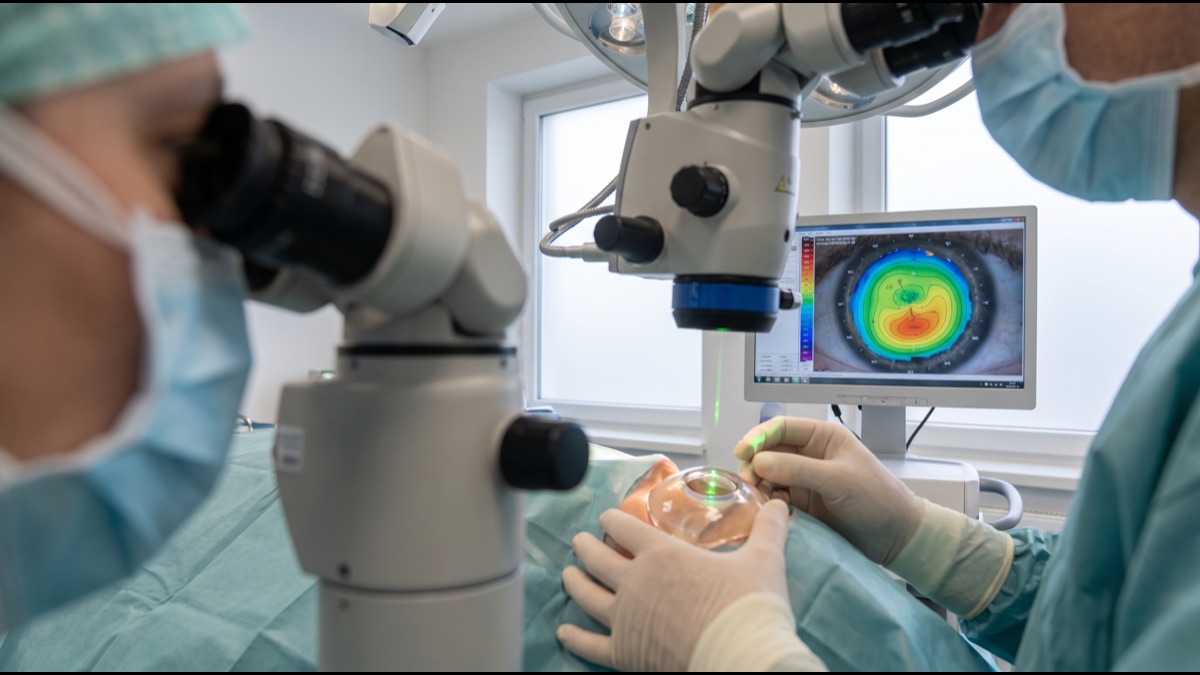
A LASIK procedure typically reshapes the cornea in under thirty seconds of actual laser time per eye, yet the effect on someone's vision can last for decades. The speed is part of what makes the procedure sound almost too simple for something as delicate as permanently changing the shape of a living, transparent tissue at the front of the eye.
The apparent simplicity hides a genuinely precise two-step process: a thin flap of corneal tissue is created and lifted, and then a completely different, computer-guided laser sculpts the tissue underneath according to a personalized map of exactly how that person's eye bends light incorrectly.
Understanding what actually happens during those thirty seconds, and why the procedure works for some vision problems and not others, means looking closely at both the eye's own optics and the two distinct lasers doing two very different jobs.
It also means understanding why the procedure cannot simply be repeated indefinitely, why some patients are turned away as poor candidates before ever reaching the operating table, and why the recovery process looks so different from almost any other kind of surgery.
Why Blurry Vision Is Fundamentally a Focusing Problem
Clear vision depends on light entering the eye being bent, or refracted, by just the right amount so that it converges precisely onto the retina at the back of the eye, and the cornea, the clear dome covering the front of the eye, does roughly seventy percent of that bending on its own before light even reaches the eye's internal lens.
Nearsightedness, farsightedness, and astigmatism are all, at their core, different ways the cornea's natural curvature bends light incorrectly relative to the exact length of a particular eyeball, causing the point of sharpest focus to land slightly in front of, behind, or unevenly across the retina instead of squarely on it.
Glasses and contact lenses correct this by adding an external piece of curved glass or plastic in front of the eye to compensate for the cornea's imperfect bending, whereas LASIK takes a fundamentally different approach: physically reshaping the cornea itself so it does the correct amount of bending without any external help at all.
Mapping the Eye Before Any Laser Touches It
Before surgery, a detailed instrument called a corneal topographer scans the surface of the cornea in fine detail, producing a precise three-dimensional map of its exact curvature, thickness, and irregularities, essentially a fingerprint unique to that specific eye.
This map, combined with a separate measurement of exactly how the eye currently misfocuses light, called a wavefront analysis in more advanced procedures, becomes the actual surgical plan: a highly individualized instruction set telling the laser precisely how much tissue to remove from which specific points across the cornea.
Because this plan is generated from measurements of one particular eye, no two LASIK treatments are identical even when correcting a similar glasses prescription, and the accuracy of this initial mapping step is widely considered the single most important factor in how good the final visual outcome will be.
The First Laser: Cutting a Flap, Not Reshaping Anything
The procedure begins with a femtosecond laser, a laser that fires extremely short pulses of infrared light focused at a precise depth just beneath the corneal surface, creating a pattern of microscopic bubbles that separate a thin layer of tissue without cutting all the way through it.
This creates a flap, still attached along one edge like a hinge, that the surgeon then gently lifts open, exposing the deeper corneal tissue underneath, a step that involves no actual reshaping of vision-correcting tissue at all; its entire purpose is simply to grant access.
Earlier generations of the procedure used a mechanical blade called a microkeratome to cut this flap instead of a laser, and while both methods are still used today, femtosecond lasers have become dominant because they produce a more uniform, predictable flap thickness with a lower rate of complications.
The Second Laser: Where the Actual Vision Correction Happens
With the flap lifted aside, a second, completely different laser, an excimer laser emitting a specific ultraviolet wavelength, goes to work on the exposed corneal tissue underneath, guided precisely by the personalized map created before surgery.
This laser does not cut or burn tissue the way a scalpel or a heat-based laser would; instead it uses a process called photoablation, where each pulse breaks the molecular bonds holding a microscopically thin layer of tissue together, causing that layer to essentially vaporize away without transferring significant heat to the surrounding tissue.
The laser fires in a computer-controlled pattern, removing more tissue from certain points and less from others according to the surgical plan, gradually reshaping the cornea's curvature: flattening it slightly to correct nearsightedness, steepening it to correct farsightedness, or smoothing out irregular curvature to correct astigmatism.
Why the Laser Has to Track a Moving Target
A human eye is never perfectly still, even when a patient is deliberately trying to hold their gaze fixed on a target light during surgery, since tiny involuntary movements called microsaccades happen constantly and unconsciously as part of normal eye function.
Modern LASIK lasers include an eye-tracking system that monitors the eye's position many hundreds of times per second and automatically adjusts where each laser pulse lands in real time, effectively cancelling out these small involuntary movements so the treatment pattern stays correctly aligned with the surgical map regardless of minor eye drift.
If the tracking system detects movement large enough to fall outside a safe tolerance, or if the patient blinks, the laser automatically pauses firing entirely until the eye returns to the correct position, a safety feature that adds negligible time to the overall procedure but meaningfully reduces the risk of an off-target treatment.
Putting the Flap Back and Why No Stitches Are Needed
Once the reshaping is complete, the surgeon carefully repositions the flap back over the treated area, smoothing it into place, and the flap adheres on its own within minutes through the eye's natural fluid pressure and the tissue's own adhesive properties, without requiring any stitches.
Over the following days, the eye's surface layer, called the epithelium, grows across the flap's edge and effectively seals it in place permanently, though the underlying flap technically never fully fuses back with the same strength as the surrounding untouched cornea, which is part of why LASIK patients are advised to avoid rubbing their eyes vigorously for weeks after surgery.
This lack of stitches is a major reason LASIK recovery feels so different from other eye surgeries: most patients notice a meaningful improvement in vision within hours, not weeks, because the corrected corneal shape underneath the flap is already doing its job the moment the flap is repositioned.
Why Corneal Thickness Decides Who Is a Candidate
Because the procedure permanently removes a thin layer of corneal tissue, and because the cornea needs to retain enough remaining thickness and structural rigidity to safely withstand normal internal eye pressure for the rest of a person's life, surgeons carefully calculate exactly how much tissue a given correction will remove before ever recommending the procedure.
Patients with corneas that are naturally thinner than average, or prescriptions strong enough to require removing an unusually large amount of tissue, are sometimes told they are not good LASIK candidates specifically because not enough safe structural tissue would remain afterward, regardless of how much they might otherwise want the procedure.
This thickness requirement is also the direct reason LASIK cannot simply be repeated over and over as a person's eyes change with age: each treatment permanently removes tissue that never grows back, so the total amount of correction available across a person's lifetime is fundamentally limited by how much cornea they started with.
Why Dry, Gritty Eyes Are the Most Common Side Effect
Creating the corneal flap unavoidably severs some of the microscopic nerve fibres running through the front surface of the cornea, nerves that normally help trigger the reflex to produce tears and blink at a healthy baseline rate.
While these nerves do regenerate over time, the process can take several months to fully complete, which is why temporary dry eye, a gritty or sandy sensation, is by far the single most commonly reported side effect after LASIK, affecting a majority of patients to some degree in the initial weeks.
Surgeons routinely prescribe lubricating eye drops for the weeks following surgery specifically to manage this predictable, usually temporary drop in natural tear film quality while the severed nerve fibres gradually reconnect and normal blink-triggered tear production returns.
What LASIK Cannot Fix, and Why
LASIK corrects how light is focused by the front of the eye, but it does nothing to address age-related changes inside the eye's internal lens, which is why patients who develop presbyopia, the gradual loss of close-up focusing ability that affects nearly everyone starting in their forties, will still eventually need reading glasses even after a successful LASIK procedure.
The procedure also cannot correct vision problems caused by the retina, optic nerve, or brain's visual processing rather than by the cornea's shape, meaning conditions like macular degeneration or optic nerve damage remain entirely unaffected by any amount of corneal reshaping.
Surgeons screen for these underlying conditions before surgery precisely because reshaping a healthy, well-functioning cornea attached to a damaged retina would improve nothing meaningful for that patient while still carrying the ordinary risks of any eye procedure.
Why Night Vision Sometimes Changes After Surgery
Some patients notice increased halos, starbursts, or glare around bright lights at night in the weeks or months following LASIK, an effect generally linked to how the treated, reshaped zone of the cornea compares in size to how widely the pupil naturally dilates in low light.
If the pupil dilates in darkness to a diameter larger than the precisely treated optical zone, light passing through the untreated peripheral cornea just outside that zone can scatter differently than light passing through the center, producing the visual artifacts many patients describe as halos around headlights or streetlights.
Modern treatment planning accounts for this by calculating a wider treatment zone whenever a patient's measured pupil size in darkness suggests they are at higher risk, which has meaningfully reduced how often this particular side effect persists long-term compared to earlier generations of the procedure.
How Long the Correction Actually Lasts
Because LASIK physically reshapes structural tissue rather than applying a temporary treatment, the corrected curvature itself does not fade or wear off over time the way, for instance, a topical medication's effect would, and most patients retain excellent vision from a single procedure for many years or decades.
What can still change vision later in life is not the treated cornea reverting to its old shape, but the separate, unrelated aging processes that affect every eye regardless of past surgery: the internal lens gradually losing flexibility, which causes presbyopia, or the slow development of cataracts, both of which happen inside the eye entirely independent of the cornea's reshaped curvature.
A small percentage of patients do experience gradual shifts in prescription over subsequent years for reasons related to normal age-related changes in eye shape, and in some of these cases a limited touch-up procedure, using whatever remaining safe corneal thickness is available, can be performed to fine-tune the correction.
Why LASIK Is Not the Only Laser Vision Correction Option
An alternative procedure called PRK achieves a similar end result, reshaping the cornea's curvature with the same excimer laser technology, but skips the flap-cutting step entirely by removing the cornea's thin outer surface layer directly instead of cutting underneath it, which the eye then regrows naturally over several days.
PRK is often recommended over LASIK specifically for patients with corneas too thin to safely support a cut flap, or for people in occupations at higher risk of eye trauma, such as certain military roles, since there is no flap that could theoretically be dislodged by a significant impact long after the initial healing period.
The tradeoff is a meaningfully longer and more uncomfortable initial recovery for PRK, since regrowing an entire surface layer takes noticeably longer than an already-cut flap reattaching, which is precisely the recovery-speed advantage that keeps LASIK the more commonly chosen procedure whenever a patient qualifies for both.
What Surgery Day Actually Looks Like for a Patient
Most patients arrive at the clinic fully awake and conscious for the entire procedure, since LASIK never requires general anesthesia; instead, only numbing drops are applied directly to the surface of the eye right before the procedure begins, and some patients are given a mild oral sedative simply to reduce anxiety without affecting their awareness.
The patient is typically asked to lie back under the laser system and stare at a fixed point of light that helps the eye-tracking system maintain correct alignment, and while the actual surgical steps for both eyes combined usually take under thirty minutes total, most of that time goes toward preparation and final measurements rather than the laser firing itself.
Most patients are able to go home within minutes of the procedure ending, though it is always recommended that someone else drive them rather than driving themselves, since vision is temporarily blurry and light sensitivity is elevated in the first few hours immediately after the protective flap is repositioned.
Why Health Insurance Rarely Covers the Cost
Most health insurance providers classify LASIK as an elective lifestyle procedure rather than a medically necessary treatment, similar in insurance terms to certain cosmetic procedures, because glasses and contact lenses already offer an effective non-surgical alternative for correcting the same vision problem.
This classification means most patients pay for the entire procedure out of pocket, which is part of why LASIK clinics compete so heavily on price and direct-to-consumer marketing rather than relying on insurance network referrals the way most other medical specialties do.
Some employer-sponsored flexible spending or health savings accounts in certain countries do allow pre-tax funds to be used toward LASIK costs, which reduces the effective financial burden on the patient somewhat without counting as insurance coverage in the traditional sense.
Sources
- Wikipedia — overview of LASIK surgical technique, outcomes, and complications
- American Academy of Ophthalmology — clinical background on refractive surgery and corneal anatomy
- U.S. Food and Drug Administration — regulatory guidance and patient information on LASIK devices and outcomes
- American Optometric Association — patient-facing background on refractive errors and vision correction options
FAQ
How long does the actual LASIK laser treatment take?
The excimer laser reshaping step itself typically takes well under a minute per eye, though the full appointment, including preparation, flap creation, and post-procedure checks, usually takes around fifteen to twenty minutes per eye in total.
Does LASIK hurt during the procedure?
Numbing eye drops are applied before surgery, so most patients feel pressure or mild discomfort rather than sharp pain during the procedure itself, with any noticeable soreness or gritty sensation typically appearing several hours later as the numbing wears off.
Can LASIK correct vision back to a perfect score?
Most patients achieve vision sharp enough to legally drive without glasses, and a large share reach the equivalent of perfect standard vision, though outcomes depend on the original prescription strength, corneal thickness, and how precisely the eye heals afterward.
Will I still need reading glasses after LASIK?
LASIK corrects how the cornea focuses light but does not prevent presbyopia, the natural age-related stiffening of the eye’s internal lens that affects reading vision starting around the mid-forties, so most patients eventually need reading glasses regardless of LASIK.
Why are some people rejected as LASIK candidates?
Corneas that are too thin, prescriptions strong enough to require removing more tissue than is safe, certain corneal irregularities, or unstable prescriptions that are still actively changing are the most common reasons a surgeon will recommend against LASIK for a given patient.
What is the difference between LASIK and PRK?
LASIK cuts and lifts a thin corneal flap before reshaping the tissue underneath, while PRK removes the surface layer entirely instead of cutting a flap; PRK suits thinner corneas and higher-impact occupations better but involves a longer, more uncomfortable initial recovery.
About the Author
We reference Wikipedia and other authoritative sources to explain the background and current understanding of this topic.
Loved This Article?
Share it on WhatsApp → Share it on WhatsApp
Get more guides in your inbox — Subscribe to our newsletter for weekly surprising stories from Egypt, Saudi Arabia, Dubai, and beyond.