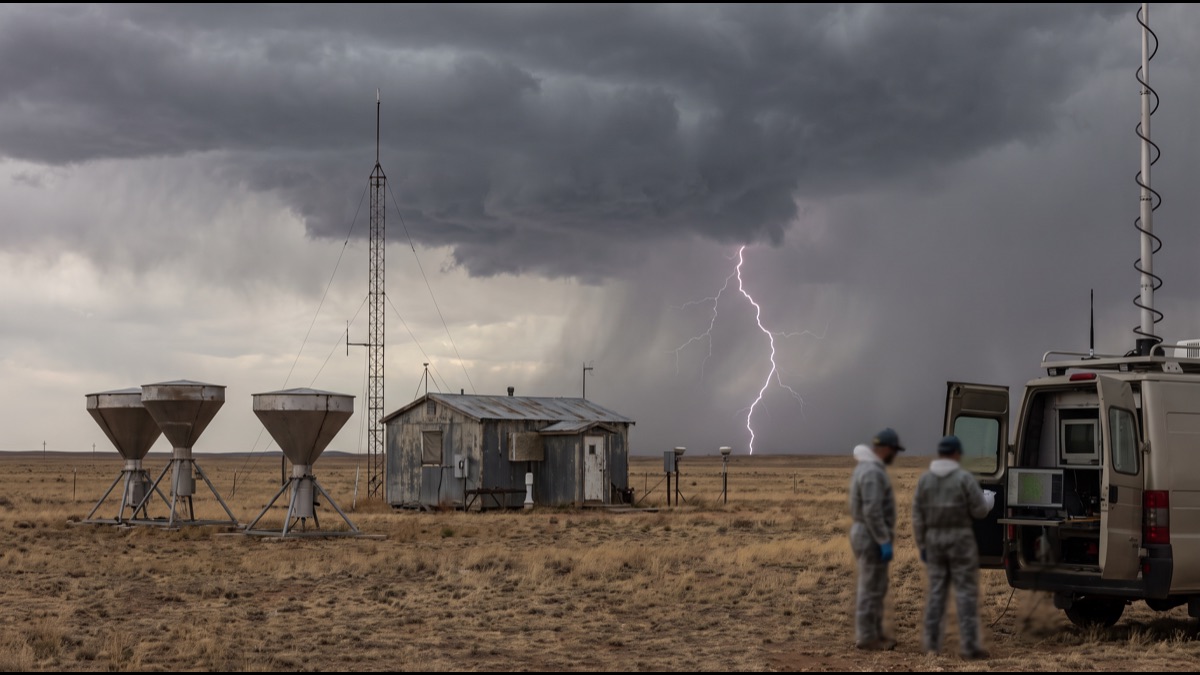
Lightning begins inside a storm cloud, not the moment it hits the ground. Inside a growing cumulonimbus cloud, ice crystals and soft hail called graupel collide constantly as strong updrafts toss them around. Those collisions strip electrons from the lighter ice crystals and leave them on the heavier graupel.
The lighter, now positively charged crystals get carried toward the top of the cloud, while the heavier, negatively charged graupel sinks toward the base. That separation builds an enormous voltage difference, sometimes hundreds of millions of volts, until the surrounding air can no longer act as an insulator.
Charge Separation Inside a Storm Cloud
Why the Bolt Chooses Its Jagged Path
A negatively charged channel called a stepped leader edges downward from the cloud in roughly 50-meter jumps, invisible to the naked eye and taking a different, unpredictable route each time. As it nears the ground, positively charged streamers rise up from tall objects, trees, and even people to meet it.
The instant they connect, a return stroke races back up the completed channel at close to a third of the speed of light, and that's the bright flash people actually see. The channel can reach roughly 30,000°C, about five times hotter than the surface of the sun, which is why the surrounding air expands explosively and produces thunder.
Sources
- NOAA National Severe Storms Laboratory — overview of how lightning forms
- National Weather Service — the physics of the lightning strike sequence
- National Geographic — lightning facts and temperature data
FAQ
Why does thunder come after lightning, not with it?
Light travels far faster than sound, so you see the flash almost instantly but hear the resulting shockwave seconds later — roughly every 3 seconds equals about a kilometer of distance.
Can lightning strike the same place twice?
Yes, tall or exposed structures like the Empire State Building are struck dozens of times a year because height and shape matter more than luck.
Is heat lightning a different kind of lightning?
No, "heat lightning" is just an ordinary flash from a storm too far away for its thunder to be heard, often glimpsed as a silent glow on the horizon.
About the Author
We reference NOAA National Severe Storms Laboratory, National Weather Service, National Geographic to explain the background and current understanding of this topic.
Loved This Article?
Share it on WhatsApp → Share it on WhatsApp
Get more guides in your inbox — Subscribe to our newsletter for weekly surprising stories from Egypt, Saudi Arabia, Dubai, and beyond.