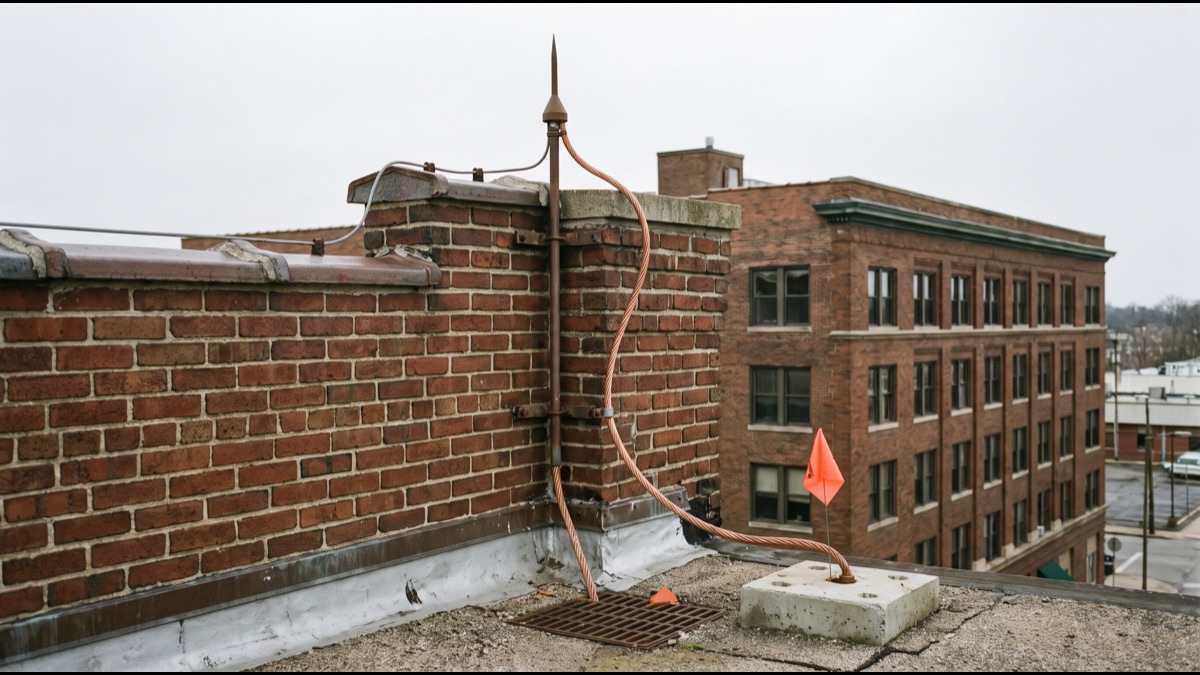
A lightning rod does not attract lightning, does not repel it, and does not stop a building from being struck at all. What it actually does is far more modest and far more useful: once a lightning strike is already headed toward a structure, the rod simply offers that strike an easier, lower-resistance route to the ground than punching through brick, wood, or a person standing on the roof. The popular image of a metal spike reaching up to "catch" bolts out of the sky is a folk exaggeration of a system that is really about controlled surrender, not attraction.
This distinction matters because it explains almost every design decision that follows. If a rod actually pulled lightning toward it from a distance, installing one badly would be relatively harmless since the strike would still be captured somewhere on the metal. But because a rod only wins the electrical race in the final few dozen meters of a strike that is already forming, every part of the system between the rod tip and the earth has to be engineered correctly, or the current finds a worse path instead, often straight through the building's structure or its wiring.
Benjamin Franklin's 1752 proposal for the lightning rod remains one of the most consequential and least understood pieces of applied physics in everyday life. Nearly three centuries later, the core principle he identified is still the basis of every lightning protection system installed today, from a farmhouse in Iowa to the tallest building on Earth in Dubai.
Understanding how a rod actually works also clears up a surprisingly common and genuinely dangerous myth: that a metal rod on the roof, by itself, protects the building. A rod with no proper conductor to the ground, or a ground connection that offers real resistance, does not fail safely. It can make a strike considerably more destructive than if no rod had been installed at all.
How Lightning Actually Forms Before It Ever Strikes Anything
Lightning begins inside a thunderstorm cloud, where rising and falling air currents drive collisions between ice crystals and soft hail called graupel. These collisions strip electrons from some particles and deposit them on others, and because lighter ice crystals tend to get carried upward while heavier graupel sinks, the cloud develops a rough charge separation: predominantly negative charge low in the cloud, positive charge higher up.
As that negative charge builds near the cloud base, it repels electrons in the ground below, leaving the surface directly under the storm with a relative positive charge. This sets up a strong electric field between cloud and earth. When the field becomes intense enough, usually on the order of tens of thousands of volts per meter of air, the insulating properties of the air itself begin to break down along the path of least resistance.
A stepped leader, a faint, branching channel of ionized air, then descends from the cloud in short, jagged increments, pausing and re-forming as it feels out the easiest route toward the ground. As it nears the surface, sharp or elevated objects, tree branches, chimneys, radio masts, and, if present, a properly installed lightning rod, respond by sending up their own short channels called streamers. Whichever streamer connects with the descending leader first completes the circuit, and the massive return stroke, the bright flash most people think of as "the lightning," rushes back up that newly completed path.
Why Franklin's Rod Was Never About Attracting Lightning
Benjamin Franklin proposed the lightning rod in 1752 after his famous, and genuinely dangerous, kite experiment demonstrated that the electricity in storm clouds was the same phenomenon as the static electricity already being studied in laboratories. His practical insight was that a grounded metal rod, mounted higher than the structure it protected and connected all the way down to the earth, could intercept a strike that was going to happen regardless and carry it away from the building's flammable materials and occupants.
Franklin himself described the rod's function in terms of prevention as much as interception, believing a sharply pointed rod could gradually bleed off charge from the air around it before a full strike ever developed. Modern research has shown that this slow-discharge effect is real but far too weak, especially on a natural building scale, to meaningfully prevent strikes; the rod's actual, dominant job is intercepting a strike that is coming anyway and giving it a safe route down.
This reframing matters enormously for how people think about the technology. A homeowner who believes a rod "keeps lightning away" from a building has an entirely different mental model, and different maintenance priorities, than one who understands the rod is a sacrificial, deliberately attractive terminal designed to win the streamer race and then dump enormous current safely into the earth. The second model is the one that actually explains why grounding quality matters as much as the rod itself.
How a Lightning Rod Actually Provides a Preferential Path
Air is a poor conductor of electricity under normal conditions, which is exactly why lightning has to ionize a channel through it before current can flow. Metal, by contrast, offers dramatically lower resistance to the flow of electric current than air, wood, brick, or the human body. A lightning rod exploits this difference directly: by presenting a continuous, low-resistance metal path from the highest point of a structure down to the ground, it becomes, quite simply, the easiest way for a strike that is already forming nearby to complete its circuit.
This is a probabilistic advantage, not an absolute guarantee. Lightning does not calculate the single lowest-resistance path across an entire region before striking; the stepped leader responds to local field strength and geometry as it descends, favoring whichever nearby point offers the strongest upward streamer in its immediate vicinity. A well-designed rod system, positioned at the highest points of a structure and appropriately distributed across a roof, dramatically increases the odds that any given strike in the vicinity terminates on the rod system rather than elsewhere on the building.
Once the connection is made and current begins flowing, the rod's entire purpose becomes conducting that current, which can exceed 30,000 amps and reach temperatures around 30,000 kelvin in the channel, away from anything flammable or anything alive, as quickly and directly as possible into the earth, where it can disperse harmlessly into a very large volume of conductive soil.
What the Cone and Zone of Protection Actually Mean
Lightning protection engineers describe the area a single rod effectively shields using models like the "cone of protection," an older and simpler concept that treats the rod as the apex of an inverted cone extending downward and outward at roughly a 45-degree angle, within which strikes are assumed likely to terminate on the rod rather than on the structure itself.
More modern designs favor the "rolling sphere method," which better reflects how lightning strike distance actually behaves. In this model, an imaginary sphere, typically with a radius around 45 to 60 meters based on statistical strike data, is conceptually rolled over the entire structure and its surroundings; any point the sphere touches is considered exposed and potentially vulnerable, while any point the sphere cannot reach because a rod or other grounded conductor is in the way is considered protected.
The rolling sphere method is why tall, complex buildings need multiple rods and interconnected conductors rather than a single spike on the highest point. Corners, edges, parapets, and protruding equipment like antennas or cooling units can all fall outside a single rod's protected zone, which is exactly why comprehensive lightning protection design treats the whole building envelope as a system rather than relying on one dramatic-looking spike.
How the Down Conductor Actually Carries the Current Away
The rod itself, sometimes called an air terminal, is only the visible tip of the system. Just as important, and far less discussed, is the down conductor, a heavy-gauge copper or aluminum cable that runs from each air terminal along the exterior or structural frame of the building all the way to ground level, following the most direct practical route.
Down conductors are deliberately routed to avoid sharp bends, since lightning current behaves differently from ordinary household electricity and does not travel smoothly around tight corners. A bend sharper than roughly 90 degrees, or one with too tight a radius, can cause the current to arc directly across the bend through the air rather than following the conductor's full path, a phenomenon engineers specifically design around when routing cable across a roofline or down an exterior wall.
For larger or taller structures, codes generally require multiple down conductors distributed around the building's perimeter rather than a single cable, both to reduce the current carried by any one path and to reduce the induced magnetic and electrical effects inside the building that a single large current surge would otherwise create in nearby wiring and metal objects.
Why the Grounding Electrode Is the Part That Actually Matters Most
At the bottom of every down conductor sits the grounding electrode system, typically one or more metal rods driven several meters into the soil, sometimes supplemented with buried conductive plates, grids, or rings, whose entire job is presenting the lowest possible electrical resistance between the building's lightning protection system and the earth itself.
Soil resistivity varies enormously by location, moisture, and composition, which is why grounding design is genuinely site-specific rather than a fixed formula. Sandy, dry soil conducts poorly and may require considerably more grounding electrodes, spaced further apart or driven deeper, than the moist clay soil common in other regions, where a single rod might achieve adequate resistance on its own.
Multiple grounding electrodes around a structure's perimeter are also typically bonded together underground, both to lower overall resistance and to ensure the current disperses across a wider area of soil rather than concentrating dangerously at a single point, which reduces the risk of dangerous voltage gradients developing in the ground immediately around the building, a real hazard to anyone or anything standing nearby during a strike.
Why an Ungrounded Rod Is Actually More Dangerous Than No Rod
This is the single most important safety fact about lightning protection, and the one most frequently misunderstood: a metal rod mounted on a roof without a proper, low-resistance path all the way to the earth does not simply fail to help. It actively increases the odds of a direct strike to that specific point on the building, because it is still an elevated metal object that a stepped leader is statistically more likely to connect with, while providing no safe way to dissipate the resulting current.
When a strike terminates on an ungrounded or poorly grounded rod, the enormous current has nowhere appropriate to go, and it will seek out the next lowest-resistance path available, which is very often through the building's internal wiring, plumbing, structural steel, or even through the walls themselves toward the ground, causing fires, explosive damage to masonry as trapped moisture flashes to steam, and severe risk to anyone inside.
This is exactly why professional lightning protection installation and inspection standards treat the grounding system, not the rod itself, as the component requiring the most rigorous testing, and why a decorative "lightning rod" installed without a certified grounding path, something that unfortunately does happen on older or poorly renovated buildings, can leave a structure meaningfully worse off than having no rod at all.
What Side Flash Is and Why It Actually Happens
Side flash, sometimes called side flashover, occurs when lightning current traveling down a conductor encounters another nearby conductive object, metal ductwork, plumbing, structural beams, or even a person, that offers a comparatively easier path to ground than continuing along the intended down conductor, and the current arcs sideways to jump onto it.
This risk is highest wherever a down conductor passes close to other metal building elements without being electrically bonded to them, since the massive voltage difference that briefly exists across even a well-designed conductor during a strike is enough to jump a meaningful air gap to any nearby metal that is not at the same electrical potential.
Modern lightning protection design addresses side flash primarily through bonding: deliberately connecting all major metal elements in and around a structure, gutters, railings, HVAC units, structural steel, plumbing stacks, back to the same grounding system, so that everything reaches the same electrical potential simultaneously during a strike and there is no voltage difference left to jump across as a dangerous arc.
How Skyscrapers Like Burj Khalifa Are Actually Protected
Extremely tall buildings face a fundamentally different lightning exposure than low structures: above roughly 100 meters, buildings are struck by "upward lightning" almost as often as by the conventional downward strikes that dominate at lower elevations, meaning the structure itself can initiate an upward streamer that triggers a strike rather than simply intercepting a leader descending from a cloud.
The Burj Khalifa, at over 828 meters the world's tallest building, uses a lightning protection system built directly into its architecture rather than bolted on afterward: a network of air terminals along the spire and upper setbacks, extensive interconnected down conductors integrated with the building's structural steel and metal cladding, and a comprehensive grounding grid at the base, all designed to a standard well beyond typical low-rise requirements given how frequently a structure of that height is actually struck, often dozens of times per year.
For supertall buildings, the structural steel frame itself is typically bonded and used as a supplementary conductive path, since a discrete cable system alone would struggle to safely carry the current from strikes that can occur simultaneously at multiple points along such an enormous vertical surface. This integrated approach, sometimes called a Faraday cage design at building scale, is now standard practice for the tallest structures being built across the Gulf and worldwide.
Why Lightning Rods Do Not Actually Protect Your Electronics
A properly grounded lightning protection system is very effective at preventing structural fire and physical damage from a direct strike, but it does essentially nothing to protect sensitive electronics from a separate and far more common hazard: the voltage surge that travels into a building through power lines, telephone lines, or data cables when lightning strikes anywhere nearby, even a considerable distance away.
This happens because a nearby strike, whether it hits the building's lightning protection system, a neighboring structure, or a power line itself, induces a massive but extremely brief voltage spike in any long conductive cable in the vicinity, and that spike propagates through the electrical grid into homes and offices far faster than the physical distance might suggest, arriving through an ordinary wall outlet rather than through the roof.
This is precisely why lightning protection professionals and electrical codes recommend surge protection devices, at the main electrical panel and, ideally, at individual sensitive equipment, as a completely separate layer of defense from the structural lightning rod system. A building can have an excellent, correctly grounded rod system and still lose computers, appliances, and networking equipment to a surge unless that second, independent layer of protection is also in place.
How Modern Lightning Protection Standards Actually Work
Lightning protection installation is governed by detailed technical standards rather than informal tradition, most notably NFPA 780 in the United States and the international IEC 62305 series, which together specify everything from acceptable materials and conductor sizing to the exact spacing rules for air terminals and the minimum number and quality of grounding electrodes required for a given building size and risk category.
These standards classify structures into risk levels based on factors including height, occupancy, contents, and regional lightning-strike frequency, known as isokeraunic or ground flash density data, and require correspondingly more rigorous protection, more air terminals, tighter rolling-sphere radii, more grounding electrodes, for higher-risk classifications such as hospitals, fuel storage facilities, and very tall buildings.
Certified installers are also required to periodically inspect and test grounding resistance, since soil conditions change over time, corrosion can degrade buried connections, and construction work near a building can disturb or sever grounding conductors without anyone noticing until the system is actually needed during a storm, at which point a hidden fault can be catastrophic rather than merely inconvenient.
Why Bonding and Equipotential Grounding Actually Matter So Much
Beyond the rod, conductor, and ground electrode, modern lightning protection design places enormous emphasis on equipotential bonding, the practice of electrically connecting every major metal system in a building, structural steel, plumbing, gas lines, electrical grounding, and the lightning protection system itself, to a single common reference point.
Without proper bonding, different metal systems in the same building can briefly sit at wildly different electrical potentials during a strike, even if each system is individually grounded, because the actual physical grounding points may be meters apart and the soil between them is not a perfect conductor. That potential difference is exactly what drives dangerous side-flash arcing between systems that were each, individually, technically grounded.
This is why a genuinely well-designed lightning protection system is really a whole-building electrical integration project rather than an isolated add-on: the rods and conductors on the roof are only as effective as their integration with every other metal system the building already contains, from structural rebar to the metal frame of a bathroom window.
How Engineers Actually Decide Where Rods Go on a Roof
Placement of air terminals follows the rolling sphere method combined with practical rules about maximum spacing between terminals and maximum distance any point on a roof can be from the nearest terminal or conductor, figures that are specified precisely in the governing standard rather than left to installer judgment.
Ridgelines, roof edges, corners, and any object protruding above the general roof plane, chimneys, vents, satellite dishes, decorative elements, all typically require their own dedicated air terminal or a conductor routed close enough to bring them within the protected zone, since these protruding features are statistically the most likely points on an unprotected roof for a strike to terminate.
Engineers also account for the building's actual usage and contents when finalizing terminal placement, positioning additional protection near rooftop equipment like elevator machine rooms, fuel vents, or HVAC condensers where a direct strike would be particularly costly or dangerous, rather than distributing terminals purely on geometric grounds alone.
Sources
- Wikipedia — overview of lightning rod history, design principles, and protection theory
- National Weather Service — official guidance on lightning formation and strike safety
- National Fire Protection Association — source of NFPA 780, the US standard for lightning protection systems
- International Electrotechnical Commission — publisher of the IEC 62305 international lightning protection standard series
FAQ
Does a lightning rod attract lightning to a building?
Not in the sense of pulling a strike in from far away; it only provides the easiest path for a strike that is already forming nearby, winning the final connection to a descending leader rather than drawing lightning toward the building from a distance.
Is an ungrounded lightning rod dangerous?
Yes, an ungrounded or poorly grounded rod can be more dangerous than having no rod at all, since it still attracts a strike but gives the current no safe path to disperse, often forcing it through the building's structure or wiring instead.
Do lightning rods protect electronics from damage?
No, a structural lightning rod system protects against fire and physical damage from a direct strike but does not stop voltage surges traveling in through power or data lines, which require separate surge protection devices.
How is a very tall building like Burj Khalifa protected?
Supertall buildings use an integrated system of air terminals, down conductors bonded to the structural steel frame, and a comprehensive grounding grid, since buildings of that height are also struck by upward lightning initiated from the structure itself.
What is side flash and why does bonding prevent it?
Side flash is a dangerous arc that jumps from a lightning conductor to a nearby ungrounded metal object; bonding all major metal systems to the same ground eliminates the voltage difference that causes that arc.
What standards govern lightning protection system design?
NFPA 780 in the United States and the international IEC 62305 series set the technical requirements for air terminal spacing, conductor sizing, and grounding, with stricter rules applied to taller and higher-risk buildings.
About the Author
We reference Wikipedia and other authoritative sources to explain the background and current understanding of this topic.
Loved This Article?
Share it on WhatsApp → Share it on WhatsApp
Get more guides in your inbox — Subscribe to our newsletter for weekly surprising stories from Egypt, Saudi Arabia, Dubai, and beyond.