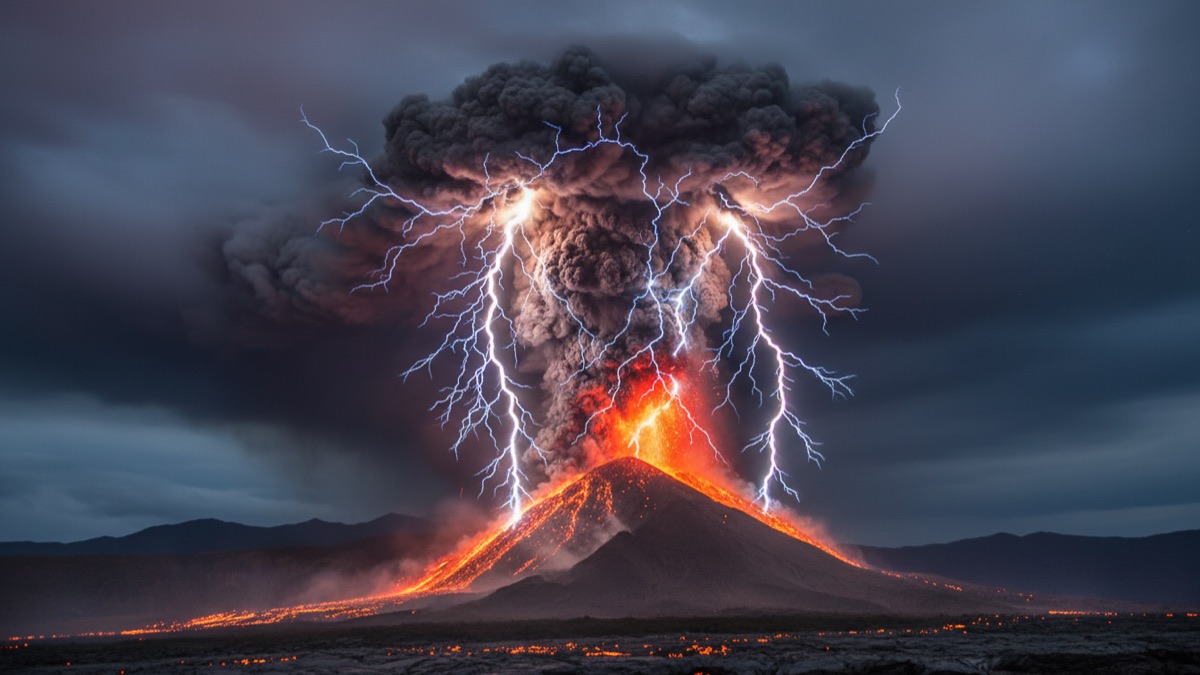
An erupting volcano can generate more lightning strikes in a single hour than an ordinary thunderstorm produces in its entire lifetime, and it can do so from a cloud containing no water droplets at all. That fact alone breaks the mental model most people carry about how lightning works, since thunderstorm lightning is so closely associated with rain clouds that a lightning-filled cloud made of ash, rock fragments, and volcanic gas seems almost contradictory.
Volcanologists call this phenomenon a dirty thunderstorm, a name that captures both its visual drama and the fact that it runs on an entirely different charging mechanism than the ice-crystal collisions responsible for ordinary weather lightning.
Understanding how a plume of superheated ash and gas becomes electrically charged enough to produce visible lightning bolts, sometimes within seconds of an eruption beginning, means looking closely at what is actually colliding inside that churning cloud and why volcanic material turns out to be unusually good at generating static electricity.
It also explains why scientists have started using lightning detection itself as a genuinely useful early-warning tool for tracking eruptions in progress, sometimes even when the volcano itself is hidden by darkness or its own ash.
Why This Is Called a Dirty Thunderstorm
Ordinary thunderstorm lightning forms through collisions between ice crystals and soft hail-like pellets called graupel inside a towering cumulonimbus cloud, a process that separates electrical charge as the two types of ice particles brush past each other at different altitudes and temperatures within the storm.
Volcanic lightning achieves a broadly similar end result, a highly charged cloud that eventually discharges as visible lightning, but starts from an entirely different set of ingredients: ash particles, rock fragments, and volcanic gas ejected violently from the eruption, none of which resemble the ice crystals driving a normal thunderstorm.
The nickname dirty thunderstorm reflects exactly this contrast, acknowledging that the visible spectacle looks remarkably similar to ordinary lightning while the actual physical process generating the charge is built from solid volcanic debris rather than the frozen water responsible for weather-driven lightning.
How Colliding Ash Particles Actually Build Up a Charge
As a volcano erupts, enormous quantities of ash particles, ranging from fine dust to larger rock fragments, are thrown violently upward and outward at high speed, colliding with each other constantly within the dense, turbulent plume in a process scientists call fractoemission and triboelectric charging.
These constant, high-energy collisions strip electrons from some particles and deposit them onto others, a phenomenon closely related to the same static electricity effect that builds up when you rub a balloon against your hair, except happening at enormous scale and with far more violent, high-speed collisions than anything a household static shock could produce.
Because smaller, lighter ash particles tend to become negatively charged while larger, heavier fragments tend to become positively charged, and because these different-sized particles naturally separate within the plume as they rise and fall at different rates, the ash cloud develops distinct charged regions much like the layered charge structure inside an ordinary thunderstorm cloud.
Why the Charging Can Begin Within Seconds of an Eruption
Unlike an ordinary thunderstorm, which typically needs tens of minutes of ice crystal collisions building up inside a growing cloud before producing its first lightning strike, some volcanic eruptions have been observed producing lightning within mere seconds of the eruption column first bursting from the vent.
This near-instant charging happens because the initial eruption column often contains an especially dense, high-velocity mixture of freshly fragmented rock and gas, providing ideal conditions for extremely rapid, high-energy particle collisions right from the very first moments, rather than requiring the gradual buildup a weather-driven thunderstorm needs.
Researchers specifically study this near-vent lightning, sometimes called vent discharges, because its almost immediate appearance makes it a potentially valuable signal for detecting the exact moment an eruption becomes explosive, even in situations where other monitoring instruments have not yet registered the event clearly.
The Role Ice Still Plays Higher in the Plume
While the lowest part of a volcanic plume, closest to the vent, generates charge almost entirely through ash particle collisions, an eruption column powerful enough to rise many kilometres into the atmosphere eventually reaches altitudes cold enough for atmospheric water vapor to freeze onto the rising ash particles, forming ice.
At these higher altitudes, the same ice-crystal and graupel collision process responsible for ordinary thunderstorm lightning can begin operating alongside the ash-collision charging happening lower down, meaning a single large volcanic plume can actually run two different lightning-generating mechanisms simultaneously at different heights.
This layered structure, ash-driven charging near the vent and ice-driven charging higher up, is part of why the largest, most explosive eruptions tend to produce the most prolific and visually dramatic lightning displays, since they are tall enough to combine both charging mechanisms rather than relying on just one.
Why Some Eruptions Produce Almost No Lightning at All
Not every volcanic eruption generates significant lightning, and researchers have found that eruption style matters considerably: highly explosive eruptions that violently fragment large volumes of rock and gas at high velocity tend to produce abundant lightning, while slower, effusive eruptions that mainly release flowing lava with comparatively little explosive fragmentation generate very little charging activity and correspondingly little or no lightning.
The water content and composition of the erupting magma also influences lightning production, since magma with higher gas and water content tends to fragment more violently upon reaching the surface, producing the fine, abundant ash particles that drive the strongest triboelectric charging.
This connection between eruption violence and lightning frequency is precisely why volcanologists increasingly treat a sudden, dramatic increase in lightning activity at a monitored volcano as a meaningful signal that an eruption is intensifying or becoming more explosive in real time.
How Scientists Actually Detect Volcanic Lightning From Far Away
Volcanic lightning, like ordinary weather lightning, emits radio waves across a broad range of frequencies as it discharges, and specialized ground-based sensor networks designed to detect these radio signatures can pinpoint the location and timing of individual lightning strokes with considerable precision, even from hundreds of kilometres away.
This radio-based detection is especially valuable during nighttime eruptions or when a volcano's own ash cloud obscures direct visual or satellite observation of the eruption column itself, since the lightning's radio signature can pass through conditions that would completely block a camera's view.
Some monitoring agencies have begun incorporating these lightning detection networks directly into official volcanic ash advisory systems used by the aviation industry, since a documented lightning-producing ash cloud is itself strong independent evidence of an ongoing explosive eruption capable of threatening aircraft, useful even when satellite imagery is delayed or obscured.
Why Volcanic Lightning Matters So Much for Aviation Safety
Volcanic ash poses a severe hazard to aircraft engines, capable of causing catastrophic engine failure if a plane inadvertently flies through a dense ash cloud, which makes rapid, reliable detection of an ongoing eruption's location and intensity a genuinely serious aviation safety concern rather than merely a scientific curiosity.
Because volcanic lightning detection can sometimes identify an eruption's onset and intensity faster than satellite imagery, which depends on daylight, clear sightlines, and satellite pass timing, lightning data has become a valuable supplementary tool for the volcanic ash advisory centres responsible for warning airlines to reroute around dangerous ash plumes.
This aviation safety application has driven meaningful investment in expanding ground-based lightning detection coverage around some of the world's most active and aviation-relevant volcanoes, turning what began as a striking natural phenomenon into a genuinely practical monitoring tool.
What the Lightning Itself Looks Like Up Close
Photographs and video of volcanic lightning often show branching, jagged bolts arcing through a dark, roiling ash column, visually similar to ordinary cloud-to-cloud or cloud-to-ground lightning but frequently appearing in far greater density and frequency within a smaller, more concentrated volume of cloud.
Observers have also documented smaller-scale electrical phenomena around erupting volcanoes beyond the dramatic large bolts, including a faint, continuous glow around sharp rock edges and instrument masts called a corona discharge, caused by the intensely charged surrounding air rather than a distinct visible lightning strike.
The overall visual effect, a churning column of ash lit intermittently from within by branching electrical discharges, has made volcanic lightning one of the most photographed and widely shared natural phenomena in volcanology, appearing in extensive documentation of major eruptions over the past several decades.
How Researchers Study a Phenomenon That Is Genuinely Dangerous to Approach
Directly studying volcanic lightning up close is obviously hazardous, since an active eruption column combines lightning risk with falling rock, toxic gas, and extreme heat, so researchers rely heavily on remote sensing tools, ground-based radio detection networks, satellite imagery, and long-range camera and audio equipment rather than close physical proximity.
Some research teams have also used laboratory experiments that simulate volcanic ash collisions under controlled conditions, shaking and colliding volcanic ash samples inside sealed chambers to measure exactly how much electrical charge different ash compositions and particle sizes actually generate, isolating the physics from the chaos of a real eruption.
This combination of remote field observation and controlled laboratory experimentation has allowed volcanologists to build a fairly detailed physical model of volcanic lightning despite never being able to safely place instruments directly inside the most electrically active part of an eruption column itself.
Why Volcanic Lightning Was Documented Long Before It Was Understood
Historical accounts and artwork depicting dramatic eruptions, including well-known depictions of major nineteenth-century eruptions, show lightning within eruption plumes clearly recorded by observers long before scientists had any real physical explanation for how ash alone, without rain or ice, could produce visible lightning strikes.
For much of the twentieth century, volcanic lightning remained a striking but scientifically under-studied phenomenon precisely because directly measuring the electrical properties of an active ash plume was so much more difficult and dangerous than studying an ordinary accessible thunderstorm using established meteorological instruments.
Modern remote sensing technology, particularly radio-based lightning detection networks originally developed for tracking ordinary weather lightning, is what finally allowed scientists in recent decades to study volcanic lightning systematically and in real time, transforming it from a dramatic historical curiosity into an active, quantifiable area of research.
Why Ash Composition Changes How Much Lightning a Volcano Produces
Different volcanoes erupt magma with different chemical compositions, and this composition directly affects how the resulting ash fragments, how fine the particles become, and how efficiently those particles generate charge through collision, meaning otherwise similarly sized eruptions from different volcanoes can produce noticeably different amounts of lightning.
Silica-rich magma tends to be more viscous and prone to violent, highly fragmenting explosions that produce abundant fine ash ideal for triboelectric charging, while less viscous, lower-silica magma tends to erupt more gently with larger, less numerous ash particles that generate comparatively less charge through collision.
This composition-dependent variation is one reason volcanologists cannot simply use eruption size alone to predict how much lightning a given eruption will produce, and why lightning monitoring is treated as a complementary data source rather than a standalone measure of eruption magnitude.
What Volcanic Lightning Reveals About the Eruption Column Itself
Because the intensity, altitude, and frequency of volcanic lightning correlate with how vigorously an eruption column is fragmenting rock and mixing turbulently, tracking these lightning characteristics over the course of an eruption gives scientists indirect but genuinely useful insight into how the eruption's intensity is changing minute by minute.
A sudden surge in lightning frequency during an ongoing eruption often signals that the eruption column has become more explosive or that a new, more violent phase has begun, information that can arrive faster through lightning detection than through some other monitoring methods, particularly at night or when satellite coverage is limited.
Conversely, a marked decline in lightning activity can indicate an eruption is transitioning toward a calmer, less explosive phase, giving volcanologists a genuinely useful, if indirect, real-time window into the internal violence of a process that is otherwise almost impossible to observe or measure directly from a safe distance.
What Happens to the Charge Once the Ash Settles
Once an ash plume settles or disperses away from the volcano, the electrical charge it carried dissipates relatively quickly, since settled particles lose the continuous contact with each other that generated the collisions responsible for charging in the first place.
This means most volcanic lightning remains tightly linked in time to the active phase of the eruption itself rather than continuing for hours after the explosive activity stops, a temporal pattern researchers have confirmed clearly by comparing lightning detection records against the precise start and end times of different eruption pulses at the same volcano.
This close temporal link between explosive activity and lightning gives scientists an additional diagnostic tool: a sudden stop in detected lightning can reliably signal that the most violent explosive phase of an eruption has genuinely ended, sometimes even before other monitoring instruments confirm that same transition.
Sources
- Wikipedia — overview of volcanic lightning formation, detection, and notable eruptions
- U.S. Geological Survey — scientific background on volcanic eruption dynamics and ash plume behavior
- National Oceanic and Atmospheric Administration — background on lightning detection networks and atmospheric electricity
- Smithsonian Magazine — science reporting on volcanic lightning research and aviation ash monitoring
FAQ
Does volcanic lightning need rain or ice to form?
No, unlike ordinary thunderstorm lightning, volcanic lightning near the vent forms through collisions between ash particles and rock fragments, though ice can also contribute to charging higher up in very tall eruption columns that reach freezing altitudes.
Why is volcanic lightning called a dirty thunderstorm?
The nickname reflects that the visible lightning looks similar to ordinary thunderstorm lightning, but the charge is generated by solid volcanic ash and rock debris colliding rather than by ice crystals, hence a thunderstorm made of dirt rather than water.
Can lightning appear within seconds of a volcanic eruption starting?
Yes, some eruptions have produced lightning within seconds of the eruption column bursting from the vent, because the dense, high-velocity mix of fresh ash and gas provides ideal conditions for very rapid charge buildup.
How do scientists detect volcanic lightning from far away?
Ground-based radio sensor networks detect the radio waves emitted when volcanic lightning discharges, allowing scientists to locate and time individual strikes precisely even at night or when the ash cloud blocks direct visual or satellite observation.
Why does volcanic lightning matter for airline safety?
Volcanic ash can cause severe or catastrophic aircraft engine damage, so detecting lightning inside an ash plume gives aviation safety centres a fast, independent way to confirm an active eruption and warn airlines to reroute around it.
Do all volcanic eruptions produce lightning?
No, highly explosive eruptions that violently fragment rock into fine ash tend to produce abundant lightning, while slower, effusive eruptions that mainly release flowing lava generate very little charging activity and often no lightning at all.
About the Author
We reference Wikipedia and other authoritative sources to explain the background and current understanding of this topic.
Loved This Article?
Share it on WhatsApp → Share it on WhatsApp
Get more guides in your inbox — Subscribe to our newsletter for weekly surprising stories from Egypt, Saudi Arabia, Dubai, and beyond.