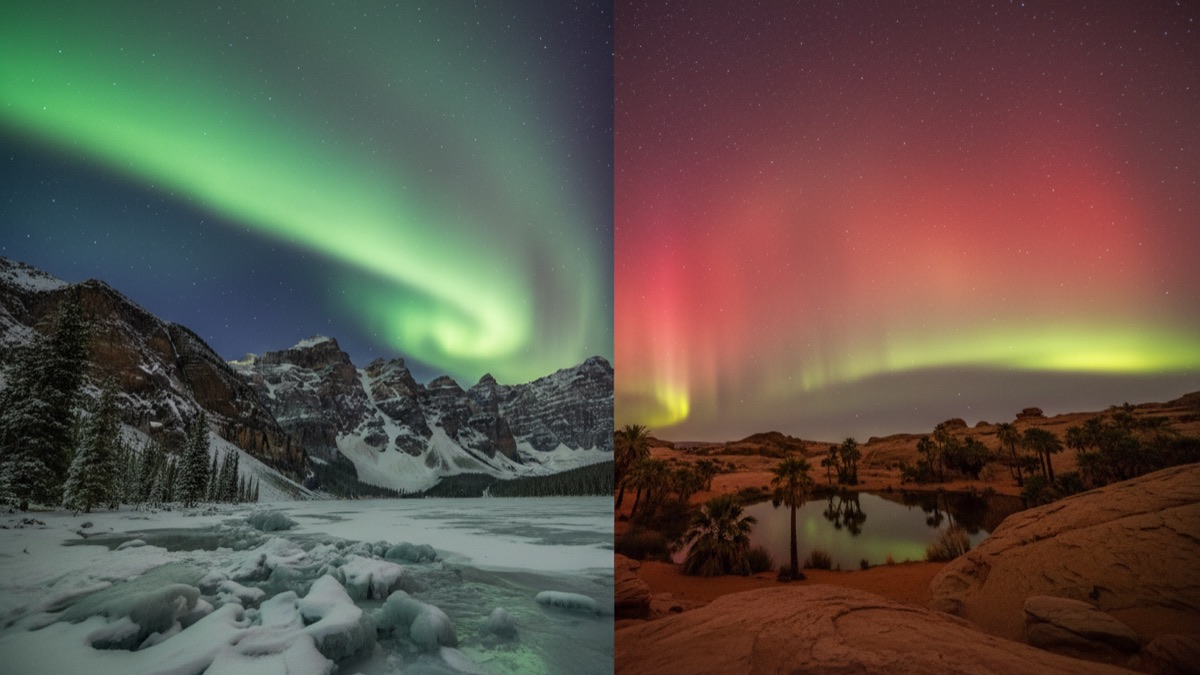
The aurora borealis and aurora australis are famous for shifting curtains of light, but the color of that light is not random or decorative; it is a direct readout of physics happening high above the ground, determined by which gas molecule gets struck by an incoming charged particle and at what altitude the collision happens. Green is by far the most commonly photographed aurora color, but the same basic mechanism can also produce red, blue, and purple displays under the right conditions, and understanding why requires looking at how the sun, Earth's magnetic field, and the atmosphere's own chemistry interact. None of it is decorative or symbolic in a scientific sense, and once the underlying mechanism is clear, the color of any given aurora display becomes a way of reading directly what altitude and what atmospheric gas is involved in that particular moment.
Where Aurora Light Actually Comes From
Auroras begin with the sun, which constantly releases a stream of charged particles, mostly electrons and protons, known as the solar wind, along with occasional larger bursts during solar storms that dramatically increase the number of particles heading toward Earth.
Earth's magnetic field deflects most of this particle stream around the planet, but some particles get funneled down along magnetic field lines toward the polar regions, which is why auroras are concentrated near the North and South poles rather than appearing evenly across the globe.
When these funneled particles reach the upper atmosphere, they collide with gas molecules already present there, and it is this collision, not the particles themselves glowing, that produces the visible light of an aurora.
How a Collision Actually Produces Light
When a charged particle from the solar wind strikes an atmospheric gas molecule, it transfers energy to that molecule, temporarily bumping one of its electrons into a higher, more energetic state, a process physicists call excitation.
This excited state is inherently unstable, and the molecule quickly releases the extra energy by emitting a photon of light as the electron drops back to its normal, lower-energy state, and it is this emitted photon that an observer on the ground actually sees.
Different gas molecules release this excess energy at different specific wavelengths of light, which is the direct reason why different gases produce different colors, the same underlying principle used in neon signs and other gas-discharge lighting.
Why Green Is the Most Common Aurora Color
Green aurora light comes primarily from oxygen atoms located at altitudes roughly between 100 and 300 kilometers above the ground, a layer where oxygen is abundant and where the specific green-light-emitting transition in oxygen happens relatively quickly after excitation.
This altitude band also happens to be where the highest concentration of incoming solar wind particles collides with the atmosphere, which combines with oxygen's efficient green emission to make green the brightest and most frequently observed aurora color by a wide margin.
Because green light is both common and relatively bright, it is often the first color visible to the naked eye even when a display also contains other colors that are dimmer or require darker skies and longer camera exposures to detect clearly.
Why Red Auroras Appear at Higher Altitudes
Oxygen atoms can also emit red light, but through a different energy transition than the one that produces green, and this particular red-emitting transition takes considerably longer to occur after the initial excitation event.
At lower altitudes, oxygen atoms are packed closely enough together that they tend to collide with neighboring molecules before this slower red-light transition has time to complete, which effectively cancels out the red emission through what is called collisional de-excitation.
At higher altitudes, roughly above 300 kilometers, the atmosphere is thin enough that oxygen atoms are spaced far apart, giving the slower red transition enough uninterrupted time to complete, which is why red aurora light is specifically associated with the highest-altitude portions of a display.
Why Blue and Purple Auroras Involve Nitrogen
While oxygen is responsible for the green and red colors, nitrogen molecules in the atmosphere are primarily responsible for blue and purple hues, which involve a different excitation and emission process than the oxygen-based mechanism.
Nitrogen-based blue emission tends to occur at lower altitudes than the green oxygen layer, typically below around 100 kilometers, where nitrogen molecules are more abundant relative to atomic oxygen.
Purple and pink shades that sometimes appear along the lower edge of a bright aurora display are often the result of blue nitrogen emission mixing visually with red light, a blend effect rather than a distinct third gas mechanism on its own.
How Altitude Maps Directly to Color
Because different emission processes dominate at different altitudes, a strong, well-developed aurora display effectively functions as a vertical cross-section, with green typically forming the main, brightest band, red appearing above it at the highest altitudes, and blue or purple sometimes visible along the lower edge.
This layered color structure is why experienced aurora photographers and scientists can often estimate roughly how high a particular part of a display extends just from its color, without needing separate direct measurement equipment.
The exact boundaries between these color bands shift somewhat depending on the specific conditions of a given solar storm, including the energy of the incoming particles, but the general ordering from green low, to blue lower still, to red high remains a consistent pattern.
Why Solar Activity Affects Aurora Frequency and Intensity
The sun's output of charged particles is not constant; it follows an approximately eleven-year solar activity cycle, with periods of higher activity producing more frequent solar storms and therefore more frequent, more intense, and more geographically widespread aurora displays.
During particularly strong solar storms, the increased flow of particles can push visible auroras to much lower latitudes than they normally reach, occasionally becoming visible in regions that almost never see them during quieter solar periods.
Solar activity forecasts, produced by agencies that monitor the sun continuously, are the basis for the aurora visibility predictions many enthusiasts follow, since a forecast of an incoming strong solar storm is a direct predictor of a more likely and more intense aurora display.
Why Auroras Concentrate Near the Poles
Earth's magnetic field lines converge toward the magnetic poles, and the charged particles funneled by that field tend to follow those converging lines down into the atmosphere specifically in oval-shaped regions surrounding each magnetic pole, called auroral ovals.
This is why the aurora borealis in the north and aurora australis in the south are both typically best seen from high-latitude regions close to the poles, rather than from locations near the equator, under normal, non-storm conditions.
The size of the auroral oval expands during stronger solar activity, which is the direct mechanism behind auroras occasionally becoming visible at unusually low latitudes during major solar storms, since the oval itself has temporarily grown larger.
Why Cameras Often Capture Colors the Eye Misses
Human night vision relies heavily on light-sensitive cells in the eye that are much better at detecting brightness than color, which means faint aurora light, especially the dimmer red emissions, can appear as a pale grayish glow to the naked eye even when it is genuinely colored.
Camera sensors do not have this same biological limitation and can accumulate light over a longer exposure time, which allows them to register color information from faint light that the human eye perceives as essentially colorless under low-light conditions.
This is why aurora photographs frequently show more vivid and more varied colors than what an observer standing at the same location actually perceived with their own eyes in the moment, a genuine difference in detection capability rather than any exaggeration in processing.
The Physics Behind Why Different Gases Emit Different Colors
Every type of atom or molecule has a specific, fixed set of energy levels its electrons can occupy, determined by the particle's underlying atomic structure, and the difference in energy between two of those levels directly determines the wavelength, and therefore the color, of light emitted when an electron drops from one level to another.
This is the same fundamental physical principle behind neon signs, sodium streetlights, and laboratory spectroscopy, where scientists can identify what elements are present in a distant star or gas cloud purely by analyzing the specific colors of light it emits.
Aurora colors are, in this sense, a naturally occurring, large-scale version of the same gas-discharge process used deliberately in commercial lighting, just powered by solar wind particles instead of an electrical current running through a sealed glass tube.
Why Some Storms Produce More Red Than Others
Because the slower red-emitting transition in oxygen requires undisturbed time to complete, storms that inject particularly energetic particles deep into lower, denser layers of the atmosphere can sometimes produce unusually strong or extensive red displays even at somewhat lower altitudes than typical.
Extremely powerful geomagnetic storms have historically produced aurora displays dominated by red light visible across much wider areas than a typical green-dominant display, a pattern documented in several notable historical solar storm events.
This variability is part of why aurora forecasting remains genuinely difficult in terms of predicting exact color and intensity, even though predicting the general likelihood of some aurora activity from known solar storm data has become considerably more reliable.
How Aurora Australis Compares to Aurora Borealis
The southern lights follow the same underlying physical mechanism as the northern lights, driven by the same solar wind interacting with the same atmospheric gases, since Earth's magnetic field creates roughly mirrored auroral ovals around both poles.
The aurora australis is observed far less often by the general public simply because the land area at far southern latitudes is much smaller and less populated than the equivalent northern regions, with much of the relevant southern latitude range covered by ocean or Antarctica.
Scientific expeditions and specialized observation stations in Antarctica and nearby southern regions do regularly document aurora australis displays, confirming the same color mechanisms and altitude-dependent patterns seen in the north.
Why This Mechanism Was Not Always Understood
For much of human history, auroras were observed and recorded, sometimes with considerable cultural and mythological significance, long before anyone understood the underlying physical cause, since the connection to solar activity and atmospheric gas emission required scientific tools and knowledge not available until relatively recently.
Understanding developed gradually through the twentieth century as scientists combined spectroscopy, which could identify the specific wavelengths of light being emitted, with an improving understanding of Earth's magnetic field and the newly discovered solar wind.
This scientific explanation does not diminish the historical or cultural significance auroras have held in many societies located at high latitudes, but it does provide a complete, testable physical account of why the lights appear the way they do.
What Determines Whether a Display Is Visible at All
Beyond solar activity and geographic latitude, local conditions matter significantly for whether an aurora display is actually visible to an observer, including cloud cover, which can completely block a view of an otherwise strong display, and light pollution from nearby cities.
The timing within a night also matters, since aurora activity itself can fluctuate over the course of hours as the underlying geomagnetic conditions shift, meaning a location with genuinely dark, clear skies can still see nothing during a lull even during an active solar storm period.
Moon phase affects visibility as well, since a bright full moon can wash out fainter aurora displays in the same way it washes out fainter stars, making a new moon or minimal moonlight generally more favorable for observing dimmer aurora activity.
Why Scientists Still Actively Study Aurora Physics
Beyond their visual appeal, auroras provide scientists with a direct, observable way to study how energy from the sun transfers into Earth's magnetic field and upper atmosphere, information relevant to understanding and eventually better predicting space weather events.
Strong geomagnetic storms, the same events that produce the most dramatic aurora displays, can also disrupt satellite operations, GPS accuracy, and electrical power grids, which gives aurora and space weather research a practical, applied dimension beyond pure scientific curiosity.
Continued monitoring of solar activity and aurora displays therefore serves both the ongoing scientific goal of understanding sun-Earth interactions and the practical goal of forecasting space weather events that can have real infrastructure impacts.
Why Cameras Often Capture Colors the Eye Cannot See
Long-exposure camera sensors accumulate light over several seconds, which lets them register faint colors, especially reds, that the human eye's low-light vision is simply too weak to perceive clearly in real time, even when standing under the exact same display.
This is why aurora photographs frequently show vivid, saturated colors that visitors on location describe as looking far more muted, greenish-white, or grayish in person, a genuine physiological difference rather than any kind of photographic exaggeration or trickery.
Human night vision relies heavily on rod cells, which are highly sensitive to light but essentially color-blind, while the cone cells responsible for color vision need more light than a typical aurora display provides, especially for fainter, more diffuse displays low on the horizon.
Why Solar Activity Cycles Affect Aurora Frequency
The sun's activity follows an roughly eleven-year cycle of rising and falling magnetic activity, and during periods of peak activity, solar storms and coronal mass ejections that drive strong auroras become both more frequent and more intense.
During a solar maximum, auroras can become visible at much lower latitudes than usual, sometimes reaching regions that rarely see them at all, while during a solar minimum, strong displays become rarer and generally confined closer to the polar regions where they occur most nights regardless of solar activity level.
Space weather forecasters track this cycle and specific solar events closely, since a large coronal mass ejection aimed at Earth can be tracked for one to three days before arrival, giving aurora watchers advance notice of an unusually strong display.
How Aurora Shapes and Movement Are Formed
Auroras are not static glows but dynamic, shifting curtains, arcs, and rays that move because the charged particles are being guided along Earth's shifting magnetic field lines, which themselves flex and realign in response to the ongoing pressure of the solar wind.
The rippling, curtain-like motion many observers describe comes from particles entering the atmosphere along slightly different field lines at slightly different times, creating the visual effect of a wave traveling across the sky rather than a fixed, unmoving light source.
Particularly intense solar storms can cause auroras to pulse rapidly or appear to dance vigorously across large sections of sky, a visually striking effect that correlates with especially turbulent conditions in the interaction between the solar wind and Earth's magnetosphere.
Auroras on Other Planets
Earth is not the only planet with a magnetic field capable of producing auroras; planets like Jupiter and Saturn, both of which have far stronger magnetic fields than Earth's, display auroras that space telescopes have imaged in ultraviolet light, invisible to the human eye but detectable by specialized instruments.
These other planetary auroras follow the same basic physical principle, charged particles guided by a magnetic field into the upper atmosphere, colliding with atmospheric gases and releasing energy as light, even though the specific gases and resulting colors differ from Earth's oxygen-and-nitrogen-dominated display.
Studying auroras on other planets gives researchers a useful comparison point for understanding the general physics of magnetosphere-atmosphere interactions, since testing theories against multiple planetary examples helps confirm which parts of the explanation are universal physics and which are specific to Earth's particular atmospheric composition.
Why Solar Activity Cycles Matter for Visibility
The sun runs on an activity cycle of roughly eleven years, during which the frequency of solar flares and coronal mass ejections — the bursts of charged particles that ultimately create auroras — rises and falls. Near the peak of this cycle, called solar maximum, auroras become more frequent, more intense, and visible at lower latitudes than usual.
During solar minimum, the opposite is true: displays become rarer and are typically confined to locations very close to the poles, since a weaker stream of charged particles reaching Earth produces a less energetic interaction with the atmosphere and a smaller geographic footprint for the resulting light show.
This cyclical pattern is why aurora tourism operators and photographers track solar activity forecasts closely, and why a trip planned during solar maximum has a meaningfully higher chance of a strong display than the same trip planned during a quiet period of the cycle, even at the same location and time of year.
Why Auroras Form Rings Around the Poles Rather Than Randomly
Auroras are not scattered randomly across the sky; they concentrate into oval-shaped bands centered on Earth's magnetic poles, called auroral ovals, because the planet's magnetic field funnels incoming charged particles along field lines that converge near the poles rather than allowing them to strike the atmosphere uniformly.
During intense geomagnetic storms, this oval expands outward toward the equator, which is why unusually strong displays occasionally become visible from latitudes that almost never see them, a rare event that draws significant public attention precisely because it deviates from the normal polar-concentrated pattern.
Understanding this oval structure is also why aurora forecasts specify a location's approximate distance from the current oval boundary rather than a single global probability, since visibility depends heavily on how far a viewer is from that band on a given night.
How Cameras Capture Colors the Naked Eye Often Misses
Human night vision is significantly less sensitive to color than daytime vision, which means faint auroral displays that a camera renders in vivid green or red often appear as a pale, colorless glow to someone observing with the naked eye, especially away from the very brightest, most active displays.
Camera sensors, particularly with a longer exposure time, gather and accumulate light over several seconds in a way the human eye cannot, which is why long-exposure aurora photography frequently produces far more vibrant and colorful images than what the photographer actually perceived while standing under the display.
This gap between photographed and perceived color has become a source of some public confusion in the smartphone-camera era, since modern phone cameras with strong low-light processing can now reveal faint auroral activity invisible to the eye, occasionally leading people to photograph and share auroras they did not realize they were even standing under.
The color of an aurora is not a matter of atmosphere or artistic license; it is a precise physical signal of which gas molecule was struck by an incoming solar particle and at what altitude that collision happened. Oxygen produces the dominant green glow at mid-altitudes and a slower, rarer red glow higher up, while nitrogen contributes blue and purple tones lower in the atmosphere, and the same basic gas-discharge physics used in neon signage plays out on a planetary scale above the poles. Solar activity determines how often and how intensely this process occurs, Earth's magnetic field determines where it concentrates, and the specific mix of colors visible on any given night is simply a readout of which layers of the atmosphere are being struck most strongly at that moment. Once the mechanism is understood, an aurora display becomes not just a beautiful sight but a visible, real-time map of solar particles colliding with the planet's own atmosphere.
Sources
- NOAA Space Weather Prediction Center — Aurora — US government space weather agency's technical overview of aurora formation and forecasting.
- NASA — Space Weather — NASA educational resource on solar wind, geomagnetic storms, and aurora physics.
- European Space Agency — Space Science — European space agency resources on solar activity and its effects on Earth's magnetosphere.
- Encyclopaedia Britannica — Aurora — Reference overview of aurora formation, color mechanisms, and historical observation.
FAQ
What determines an aurora's color?
Color depends on which atmospheric gas is struck by a charged solar particle and at what altitude the collision occurs, since different gases and altitudes produce different emitted wavelengths.
Why is green the most common aurora color?
Green comes from oxygen at mid-altitudes (roughly 100-300 km), where solar particles collide most frequently and oxygen's green-light transition happens quickly after excitation.
Why does red aurora light appear higher up?
Red comes from a slower oxygen emission process that needs undisturbed time to complete, which only happens at higher altitudes where the thin atmosphere prevents interrupting collisions.
Why do cameras show more colorful auroras than what I see with my eyes?
Human night vision is much better at detecting brightness than color, while camera sensors accumulate light over time and can register faint color the naked eye misses.
Are the northern and southern lights caused by the same process?
Yes. The aurora borealis and aurora australis share the same underlying physical mechanism, occurring in mirrored oval regions around Earth's magnetic poles.
About the Author
We reference NOAA Space Weather Prediction Center — Aurora, NASA — Space Weather, European Space Agency — Space Science, and Encyclopaedia Britannica — Aurora to explain the background and current understanding of this topic.
Loved This Article?
Share it on WhatsApp → Share it on WhatsApp
Get more guides in your inbox — Subscribe to our newsletter for weekly surprising stories from Egypt, Saudi Arabia, Dubai, and beyond.