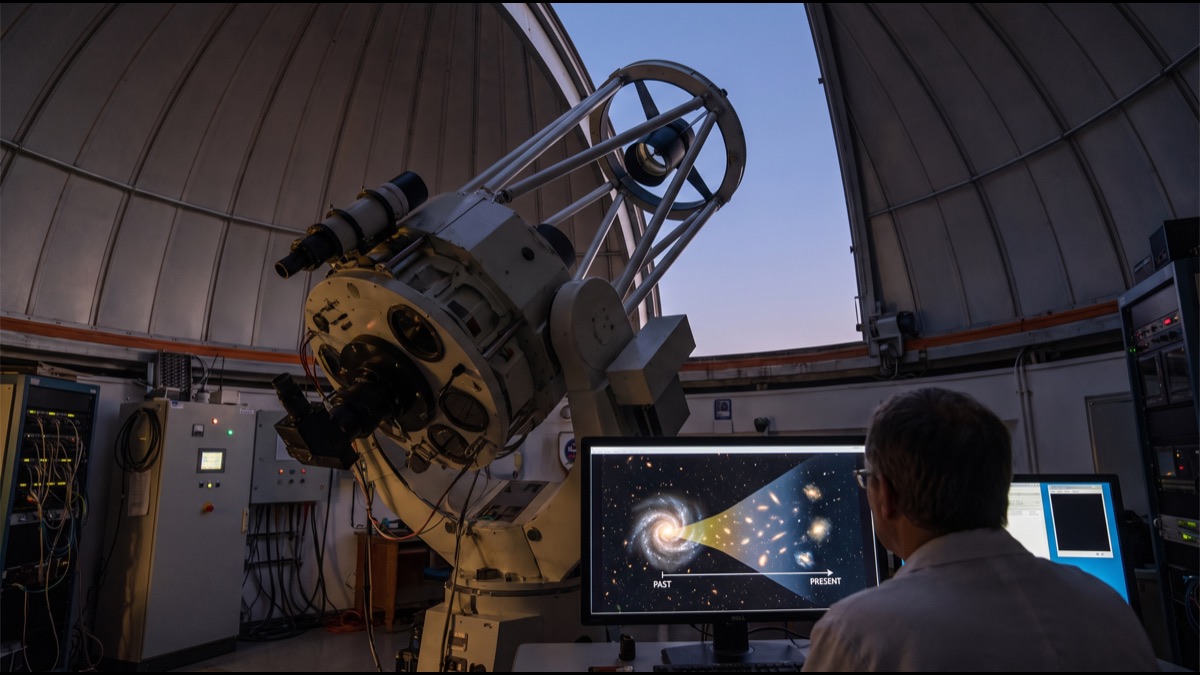
Every image of a distant galaxy is a picture of the past, which is stated so often that it has stopped sounding remarkable. The explanation usually offered, that light takes time to travel, is correct but leaves out nearly everything interesting about how the effect is actually used.
Looking further away is the only method astronomers have for observing cosmic history directly, since no other field can watch its subject at earlier stages rather than inferring them. It also runs into a hard limit: there is a distance beyond which nothing can be seen, not because telescopes are insufficient but because the early universe was opaque. Understanding both the technique and the wall explains most of modern cosmology.
Why Light Delay Means Looking Back
Light travels at a fixed speed, which means any observation is necessarily of the past, with the delay depending entirely on distance from the observer.
For everyday distances the delay is imperceptible, but across astronomical distances it becomes enormous, with light from the nearest star taking years and light from distant galaxies taking billions.
This means a telescope pointed at a distant object is not observing what is there now but what was there when the light departed, and there is no way to observe the present state of anything far away.
What a Light Year Actually Measures
A light year is a distance rather than a duration, defined as how far light travels in a year, which is roughly nine and a half trillion kilometres.
The unit is useful precisely because it collapses distance and lookback time into a single number, so an object a thousand light years away is seen as it was a thousand years ago.
This equivalence breaks down at cosmological scales, where the expansion of space means the relationship between distance and travel time becomes considerably more complicated.
Why Bigger Telescopes See Further
A telescope's primary function is collecting light, and the amount collected depends on the area of its mirror or lens, which is why aperture is the defining specification.
Distant objects appear faint because light spreads out as it travels, diminishing rapidly with distance, so detecting them requires gathering photons over a large area.
Larger apertures also improve the ability to distinguish fine detail, though in practice atmospheric distortion limits this for ground-based instruments unless corrective techniques are applied.
How Long Exposures Reveal the Faintest Objects
Rather than relying on aperture alone, astronomers accumulate light over extended periods, since detectors count individual photons and a longer count builds a stronger signal.
Some of the most significant images ever produced came from pointing a telescope at an apparently empty patch of sky for days, revealing thousands of galaxies where nothing was visible.
This technique works because the sky is not actually empty at any resolution, and sufficiently long observation eventually accumulates enough photons from extremely distant sources to form an image.
Why Redshift Is the Key Measurement
Light from distant galaxies arrives stretched toward longer wavelengths, an effect called redshift, which is measured precisely by identifying known spectral features and observing how far they have shifted.
This shift occurs because space itself has expanded during the light's journey, stretching the wave along with it, which makes redshift a direct measure of how much expansion occurred while the light travelled.
Because expansion has been continuous, redshift translates into both distance and lookback time, making it the single most important quantity in observational cosmology.
How Redshift Differs From the Doppler Effect
Cosmological redshift is frequently explained by analogy to the change in pitch of a passing siren, which is a useful starting point but genuinely misleading if pushed too far.
The Doppler effect results from motion through space, whereas cosmological redshift results from the expansion of space itself while light is in transit.
The distinction matters because it explains why extremely distant objects can recede faster than light without violating relativity, since they are not moving through space at that speed.
Why the Furthest Objects Are Infrared
Light emitted as visible or ultraviolet by the earliest galaxies has been stretched so severely by expansion that it now arrives as infrared, beyond the range of human vision.
This is the fundamental reason the newest generation of large space telescopes was designed for infrared observation rather than visible light, since the earliest objects cannot be seen any other way.
Infrared observation requires extremely cold instruments, because a warm telescope glows in infrared and would drown out the faint signals it is attempting to detect.
Why Space Telescopes Exist
The atmosphere absorbs large portions of the electromagnetic spectrum, including most infrared, ultraviolet, and all X-ray wavelengths, making those observations impossible from the ground.
Atmospheric turbulence also blurs images, which is the same effect that makes stars appear to twinkle, and it fundamentally limits the detail achievable from the surface.
Placing instruments above the atmosphere removes both problems at enormous cost, which is why space telescopes are reserved for observations that genuinely cannot be made otherwise.
How Adaptive Optics Fights Back
Ground-based telescopes counteract atmospheric blurring by measuring the distortion hundreds of times per second and deforming a flexible mirror to cancel it.
The distortion is measured using a bright reference star, or where none is conveniently placed, by projecting a laser into the upper atmosphere to create an artificial one.
This technology has advanced enough that large ground telescopes now match or exceed space telescopes for certain observations, though only at wavelengths the atmosphere transmits.
What Gravitational Lensing Adds
Massive objects bend the path of light passing near them, which means a galaxy cluster can act as a lens, magnifying more distant objects behind it.
This provides magnification that no instrument could achieve directly, and several of the most distant known galaxies were detectable only because a foreground cluster amplified their light.
The effect also distorts the images into arcs and multiple copies, requiring careful modelling of the intervening mass to reconstruct what the background object actually looks like.
Why There Is a Limit to Looking Back
For roughly the first several hundred thousand years, the universe was hot enough that matter was ionised, and free electrons scattered light continuously.
This made the early universe opaque in the same way fog is opaque, since photons could not travel any meaningful distance before being scattered in a random direction.
No telescope of any design can see past this period using light, because there was no light travelling freely to observe, which is a physical limit rather than a technological one.
What the Cosmic Microwave Background Is
When the universe cooled enough for electrons to bind into atoms, it became transparent, and the light released at that moment has been travelling ever since.
That light is still arriving from every direction, stretched by expansion from its original visible glow into microwaves, forming a faint uniform background across the entire sky.
It represents the earliest observable light and is effectively a photograph of the universe at the moment it became transparent, which is why it has been studied so intensively.
Why Its Tiny Variations Matter
The background radiation is almost perfectly uniform, but contains variations of roughly one part in a hundred thousand, which required extraordinary instrument sensitivity to detect.
These variations map slight differences in density in the early universe, and those differences are the seeds from which gravity eventually assembled galaxies and clusters.
Measuring their statistical pattern has constrained the age, composition, and geometry of the universe with a precision that no other single observation approaches.
How Astronomers See Past the Wall
Light cannot reach us from before the universe became transparent, but other messengers might, since neutrinos and gravitational waves pass through matter that blocks light.
A background of neutrinos from a far earlier moment should exist, though detecting it is beyond current capability by an enormous margin, and may remain so indefinitely.
Primordial gravitational waves would carry information from earlier still, and searching for their imprint on the microwave background is among the most actively pursued goals in cosmology.
What Gravitational Wave Astronomy Changed
Detecting ripples in spacetime from merging black holes opened an observational channel entirely independent of light, which had been the only messenger for all previous astronomy.
These signals come from events that emit almost no light at all, meaning an entire category of cosmic phenomena had been completely invisible before the detectors began operating.
Combining gravitational wave detection with telescope observation of the same event has become a distinct discipline, since the two carry different and complementary information.
Why the Observable Universe Has an Edge
Because the universe has a finite age, light from beyond a certain distance has not had time to reach us, which defines a boundary to what can be observed in principle.
This boundary is not a physical edge, and the universe is presumed to continue beyond it, but nothing outside can have influenced us or be detected in any way.
The boundary is also personal to the observer's position, meaning every location has its own observable region, with no location being central despite appearances.
Why the Observable Universe Is Larger Than Its Age Suggests
A naive calculation multiplying the speed of light by the age of the universe gives a radius considerably smaller than the accepted figure, which seems contradictory.
The discrepancy arises because space expanded while light was in transit, so objects whose light has just reached us are now considerably further away than they were when it departed.
This is why the observable universe is described as tens of billions of light years in radius despite the universe being far younger than that in years.
How Distances Are Actually Established
Astronomical distance measurement proceeds through a chain of overlapping techniques, each calibrated against the one below it, known as the cosmic distance ladder.
The nearest rungs use geometry, measuring the apparent shift of nearby stars as the Earth orbits, which requires no assumptions beyond trigonometry.
Further rungs rely on objects of known intrinsic brightness, including certain variable stars and a specific type of supernova, whose apparent faintness then indicates distance.
Why the Distance Ladder Is Contested
Measurements of the expansion rate obtained by climbing the distance ladder disagree with the value inferred from the microwave background, by an amount too large to dismiss as error.
This disagreement has persisted and sharpened as both methods improved, which is the opposite of what would be expected if it reflected a straightforward measurement mistake.
It is currently among the most significant unresolved problems in cosmology, since a genuine discrepancy would indicate something missing from the standard model of the universe.
What Early Galaxies Revealed
Observations of the most distant galaxies found them to be more massive and more developed than models had predicted for such an early period.
This does not overturn established cosmology, but it does indicate that galaxy formation proceeded faster than simulations suggested, requiring revision of how early structures assembled.
It illustrates the central value of looking back directly, since these constraints could not have been obtained by studying nearby galaxies and reasoning backwards.
How Spectroscopy Extracts Composition
Splitting light into its component wavelengths reveals dark or bright lines at specific positions, corresponding to elements that absorbed or emitted at characteristic energies.
This allows the chemical composition of an object to be determined from its light alone, without any physical access, which is the foundation of nearly all astrophysics.
Applied across cosmic time, it shows that the earliest stars formed from almost pure hydrogen and helium, with heavier elements accumulating only after generations of stars produced them.
Why Looking Back Shows Chemical Evolution
Because heavier elements are manufactured inside stars and dispersed when stars die, the chemical composition of the universe has changed progressively over its history.
Observing galaxies at different distances therefore samples different stages of this enrichment, providing a direct record rather than an inference from present-day composition.
This is how it was established that the atoms making up planets and living things were produced in stars that had already completed their lives before the solar system formed.
How Radio Telescopes Extend the Range
Radio wavelengths pass through dust clouds that block visible light entirely, revealing regions of star formation and galactic centres that optical instruments cannot penetrate.
Because resolution depends on aperture relative to wavelength, radio observation requires enormous collecting areas, which is achieved by combining widely separated dishes rather than building single huge ones.
Linking instruments across continents produces an effective aperture the size of the planet, which is how an image of a black hole's shadow was eventually assembled.
Why Neutral Hydrogen Maps the Dark Ages
Between the release of the microwave background and the formation of the first stars lies a long period with no luminous sources, frequently described as the cosmic dark ages.
Neutral hydrogen filling that era emits at a specific radio wavelength, which expansion has stretched into a range that current and planned radio arrays are designed to detect.
Successfully mapping this signal would fill the largest remaining gap in the observational record, covering a stretch of cosmic history currently known almost entirely from theory.
What Cannot Be Learned by Looking Back
Each distant object is seen at one moment only, so astronomers cannot watch an individual galaxy evolve and must instead compare many objects at different distances.
This requires assuming that objects observed at different epochs are representative samples of the same underlying population at different ages, which is reasonable but not directly verifiable.
Selection effects complicate this further, since the most distant detectable objects are necessarily the brightest, meaning early samples are systematically unrepresentative.
How Time Dilation Confirms Expansion
Events occurring in very distant objects appear to unfold more slowly than identical events nearby, because expansion stretches the arrival times of successive light signals.
This has been measured using supernovae, whose brightness changes over a characteristic period, which is observed to be stretched by exactly the amount redshift predicts.
It is a genuinely independent confirmation that redshift reflects expansion rather than some alternative process affecting light over long distances.
What the Technique Fundamentally Provides
No other science can observe its subject at earlier stages directly, since geology, biology, and archaeology must all reconstruct the past from present-day evidence.
Astronomy alone receives information emitted at the time the events occurred, which makes distance a form of direct access to history unavailable in any other discipline.
The limitation is that the record is fixed and cannot be interrogated further, since a single view of each object is all that will ever arrive from that particular moment.
Why This Reframes What a Telescope Is
Describing a telescope as a device for seeing distant things is accurate but understates what it does, since distance and time are inseparable in observation.
Every image contains objects at many different ages simultaneously, with nearby stars seen as they were years ago alongside galaxies seen as they were billions of years ago.
The result is that a single photograph of the sky is a composite of the entire history of the universe, ordered by distance, which is a considerably stranger object than it first appears.
The standard explanation — light takes time to travel, so distant objects are seen as they were — is correct but understates the technique. Looking further away is the only method any science has for observing its subject at earlier stages directly. Geology, biology and archaeology must reconstruct the past from present evidence; astronomy receives information emitted at the time. The key measurement is redshift, the stretching of light by the expansion of space during its journey. It is not the Doppler effect, and that distinction matters — it is why very distant objects can recede faster than light without violating relativity. Redshift also explains why the newest large telescopes were built for infrared: light from the earliest galaxies has been stretched so far that it arrives beyond visible range. And there is a wall. For roughly the first few hundred thousand years the universe was ionised and opaque, so no light travelled freely to observe. The cosmic microwave background is the light released the moment it became transparent, and no telescope of any design can see past it. Getting earlier requires messengers that pass through what blocks light — neutrinos, or primordial gravitational waves, whose faint imprint is among the most actively pursued targets in the field.
Sources
- Wikipedia — lookback time, cosmic horizons, and observable limits
- NASA — space telescope missions and infrared astronomy
- European Space Agency — cosmic microwave background measurements and cosmology missions
- European Southern Observatory — adaptive optics and ground-based large telescope programmes
- Nature — research on early galaxy observations and expansion rate measurements
FAQ
Does looking at a distant galaxy really show the past?
Yes. Light travels at a fixed speed, so an object a billion light years away is seen as it was a billion years ago. There is no way to observe the present state of anything far away.
Why can't telescopes see all the way back to the beginning?
For the first few hundred thousand years the universe was ionised and opaque, scattering light continuously. No light travelled freely, so there is nothing from that period to observe.
What is the cosmic microwave background?
The light released when the universe cooled enough to become transparent, stretched by expansion from a visible glow into microwaves. It is the earliest observable light.
Why are the newest telescopes built for infrared?
Light from the earliest galaxies has been stretched so severely by expansion that it now arrives as infrared, beyond visible range, so it cannot be seen any other way.
Is redshift the same as the Doppler effect?
No. The Doppler effect comes from motion through space; cosmological redshift comes from space itself expanding while light is in transit. That is why distant objects can recede faster than light.
About the Author
We reference Wikipedia, NASA, European Space Agency, European Southern Observatory, and Nature to explain the background and current understanding of this topic.
Loved This Article?
Share it on WhatsApp → Share it on WhatsApp
Get more guides in your inbox — Subscribe to our newsletter for weekly surprising stories from Egypt, Saudi Arabia, Dubai, and beyond.