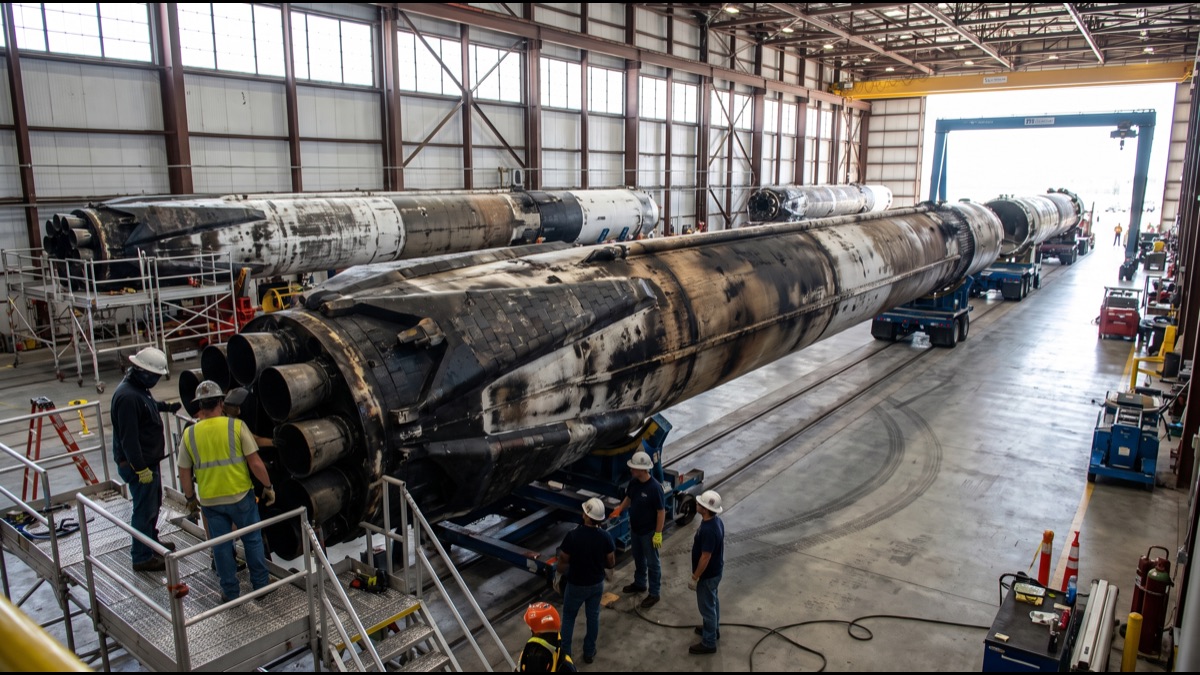
For most of the history of spaceflight, a rocket was fundamentally a disposable object. After lifting its payload into orbit, the multi-stage vehicle that got it there would fall back to Earth, burn up in the atmosphere, or sink into the ocean, discarded entirely after a single use that had taken years of work and enormous sums of money to design, build, and eventually launch. This single-use assumption was baked so deeply and thoroughly into the aerospace industry's thinking for decades that it was rarely even questioned as a design choice worth reconsidering.
The successful development and routine operational use of reusable rocket boosters has fundamentally overturned that decades-old assumption, and with it, much of the underlying cost structure of getting mass into orbit. Understanding why true reusability took so remarkably long to achieve, and what it actually changes economically once genuinely achieved, requires looking past the dramatic footage of boosters landing themselves and into the genuinely difficult engineering and economic problems that had to be solved first.
Why Rockets Were Always Considered Disposable
Early spaceflight engineers were acutely aware that reusing a rocket, rather than discarding it after every single flight, would in principle reduce launch costs considerably, and reusability was in fact seriously discussed and studied as a design goal from the earliest days of the space program, not an idea that only occurred to engineers decades later.
The core obstacle wasn't a lack of ambition or imagination on the part of engineers, but a genuinely difficult set of engineering problems: a rocket booster returning from space experiences extreme heat, violent aerodynamic forces, and enormous structural stress, all of which had to be survived intact and then followed by a landing precise and gentle enough that the vehicle could be safely inspected, refurbished, and confidently flown again.
For decades, the combined difficulty of solving all of these problems simultaneously, while also keeping the rocket light enough to still efficiently reach orbit in the first place, meant that a fully disposable, single-use rocket remained the more practical and reliable engineering choice, even though everyone in the industry understood conceptually that reusability could offer major cost advantages if it could ever actually be achieved reliably.
Why a Disposable Rocket Is So Expensive in the First Place
A modern orbital rocket is an extraordinarily complex machine, built from expensive specialized materials, precision-manufactured engines capable of extreme thrust, and extensive guidance, navigation, and structural systems, all of which have to perform flawlessly under some of the most demanding physical conditions any human-built machine ever experiences.
When a rocket is thrown away after a single flight, the entire cost of manufacturing that extraordinarily complex machine has to be recovered from that one single launch alone, meaning the launch price charged to a customer has to include the full cost of building an entirely new rocket essentially from scratch every single time a payload needs to reach orbit.
This underlying dynamic is roughly comparable to the economics of discarding an airliner after every single individual flight, an approach that would make air travel financially catastrophic and effectively impossible for ordinary passengers at any reasonable scale, illustrating just how fundamentally reusability, once genuinely achieved and made reliable, can reshape the basic cost structure of an entire transportation industry.
The Specific Engineering Breakthroughs That Made Reusability Work
Achieving reliable rocket reusability ultimately required several distinct engineering breakthroughs working together in careful combination, including engines specifically capable of being reignited multiple times in rapid succession under precise and reliable control, rather than firing only once continuously from launch until the fuel supply was exhausted.
Precision guidance and control systems also had to be developed to the point of being able to steer a returning rocket booster back through the atmosphere and land it gently, upright, and accurately on a small designated landing target, whether a fixed pad on land or a floating platform positioned out at sea, a genuinely difficult control problem given the booster's high speed and limited remaining fuel.
Structural engineering also had to advance considerably, since a rocket designed specifically for reuse needs additional structural elements like extendable landing legs and aerodynamic grid fins for in-flight steering, components that add extra weight and complexity a fully disposable rocket simply never needed to carry at all, representing a genuine engineering tradeoff that had to be carefully managed.
How the Landing Sequence Actually Works
After a rocket's first stage booster separates from the upper stage that continues carrying the payload onward toward orbit, the booster itself is still traveling at extremely high velocity and altitude, requiring a precisely controlled multi-step sequence of engine burns to slow down, reorient, and guide itself safely back toward its designated landing target.
The first of these controlled engine burns, often called a boost-back burn, actively redirects the booster's overall trajectory back toward the intended landing site, since the momentum from launch would otherwise carry it well past the target area entirely, followed later by a separate entry burn that helps slow the vehicle further and protect it from the most extreme heat generated during re-entry into the thicker lower atmosphere.
A final landing burn then slows the booster down to a controlled, gentle final descent speed in the last critical seconds before touchdown, deploying landing legs at the very last moment before the vehicle settles precisely onto its designated target, a sequence that depends on extremely precise real-time calculations and split-second automated control decisions happening continuously throughout the entire process.
What Refurbishment Between Flights Actually Involves
A returned rocket booster isn't simply refueled and immediately launched again without any further work; it goes through a structured inspection and refurbishment process to verify that every critical system, including engines, structural components, and electronics, remains genuinely safe and fully reliable to fly again after surviving the significant stresses of launch, re-entry, and landing.
Over time, as manufacturers have gained more real-world operational experience with reusability, the scope and duration of this refurbishment process has been reduced considerably, with some boosters now capable of flying again within just a matter of weeks rather than the many months of inspection and rework that early reused boosters originally required after their first several flights.
This steady reduction in refurbishment time and cost has been just as economically important as the original core achievement of successful landing itself, since a reusable rocket that still required nearly as much total time and expense to refurbish as building an entirely new one would have offered only a fairly limited practical cost advantage in actual day-to-day commercial operation.
How Much Reusability Actually Reduces Launch Costs
The first stage booster of a typical orbital rocket generally represents the large majority of a vehicle's total manufacturing cost, meaning that successfully recovering and reusing just that single component alone captures the great majority of the total potential cost savings available, even when the smaller upper stage still has to be discarded after each individual flight.
Companies operating reusable rockets have reported launch cost reductions that are genuinely substantial compared to fully disposable rockets performing a broadly comparable mission, savings that have directly translated into meaningfully lower prices charged to commercial satellite operators and other paying launch customers across the industry.
These cost reductions have compounded further as reusable boosters have been flown repeatedly many times over, since the fixed manufacturing cost of building the original booster gets effectively spread out and amortized across a steadily growing number of individual flights, continuing to push the true effective cost per individual launch down further with each additional successful reuse.
How Lower Costs Have Reshaped the Broader Launch Market
Substantially lower launch costs have made entirely new categories of space-based commercial activity genuinely financially viable that would have remained prohibitively expensive under the old fully disposable-rocket cost structure, including large satellite constellations designed to provide global broadband internet coverage, which require regularly launching very large numbers of individual satellites into orbit.
The lower cost of access to orbit has also meaningfully lowered the financial barrier to entry for smaller companies, research institutions, and even individual universities seeking to launch their own dedicated satellites, a level of practical access to space that would have been genuinely and completely unaffordable for most such smaller organizations under the older, fully disposable launch cost structure of prior decades.
Increased launch frequency, made possible in part by faster and more efficient booster turnaround and refurbishment times, has also meaningfully improved overall scheduling flexibility for customers across the industry, reducing the once-common long wait times for an available launch slot that were considerably more typical throughout the earlier disposable-rocket era of commercial spaceflight.
Why Competitors Have Raced to Develop Their Own Reusable Systems
Once one company convincingly demonstrated that rocket reusability could work reliably and repeatedly at meaningful commercial scale, competing launch providers faced substantial and immediate competitive pressure to develop comparable reusable technology of their own, since continuing to operate a fully disposable rocket fleet risked leaving a company structurally unable to compete on price against reusable competitors over the longer run.
Several other companies and national space agencies around the world have since actively pursued their own distinct reusable rocket programs, each independently working through broadly similar core engineering challenges around controlled landing, structural reuse durability, and efficient turnaround and refurbishment, though often pursuing meaningfully different specific technical approaches to solving those same underlying problems.
This growing wave of industry-wide competition in reusable launch technology is widely expected to continue driving launch costs down further still over time, following a familiar broader pattern common across many other transportation and manufacturing industries, where a genuinely disruptive core technology eventually diffuses more broadly across an entire competitive industry rather than remaining the exclusive advantage of just one single early pioneering company.
The Environmental Tradeoffs Involved in Reusability
Reusable rockets meaningfully reduce the sheer volume of raw materials and manufacturing resources consumed per individual orbital launch, since a single booster now flies many times instead of being built completely from scratch for every single mission, a resource-use reduction that carries some genuine, if modest, environmental benefit relative to a fully disposable launch approach.
At the same time, the substantially increased overall launch frequency made newly possible and economically viable by lower reusable-rocket costs means more total rocket engine burns are occurring in the atmosphere overall, an area that atmospheric scientists and environmental researchers are actively studying further to better understand the true cumulative long-term climate and upper-atmosphere effects involved as launch cadence continues to increase substantially across the industry.
This developing tradeoff between meaningfully reduced manufacturing waste on one hand and increased overall atmospheric launch activity on the other remains an active and genuinely open area of ongoing scientific study, without any fully settled, universally agreed-upon consensus yet on the precise net long-term environmental impact of substantially increased launch frequency across the wider industry.
What Full and Rapid Reusability Would Still Add on Top of This
Current operational reusable rocket systems still typically discard the smaller upper stage of the vehicle after every single flight, meaning that meaningful additional cost savings remain genuinely available if that upper stage could also eventually be recovered and reliably reused, an especially difficult engineering challenge given the significantly higher speeds and much greater re-entry heat that upper stages typically experience.
Several companies are now actively working specifically toward fully and rapidly reusable rocket systems, in which effectively every major component of the entire vehicle is recovered intact and can be reflown again quickly, an ambitious engineering goal that, if fully and reliably achieved at real operational scale, could push launch costs down substantially further still beyond what has already been achieved with partial booster-only reusability.
Achieving genuinely rapid, airline-style reusability, meaning a vehicle that can be turned around, inspected, and relaunched again within mere hours or days rather than weeks, remains a distinctly more difficult engineering target still being actively worked toward, one that would represent a further, similarly significant step change in the overall economics of spaceflight if and when it is eventually and reliably achieved.
How Reusability Is Changing What Rockets Are Designed to Carry
As launch costs have fallen and flight frequency has risen, rocket designers have increasingly optimized new vehicles around flying often and cheaply rather than purely around maximizing the payload mass a single expensive flight can carry, a subtle but meaningful shift in overall design philosophy compared to the disposable-rocket era, when every single launch had to be treated as a rare and precious opportunity.
This shift has also encouraged satellite designers to rethink their own approach, since launch has become cheap and frequent enough that it can sometimes make more economic sense to build many smaller, simpler, less expensive satellites launched routinely over time rather than investing in a single enormous, extremely expensive satellite designed to last for decades on one precious launch opportunity.
Together, these interconnected shifts on both the launch-vehicle and payload sides of the industry illustrate how a single core technological breakthrough in reusability can ripple outward to reshape design philosophy and decision-making across an entire interconnected industry, not just the immediate rocket-building companies directly responsible for the original underlying breakthrough itself.
What This Could Eventually Mean for Human Spaceflight and Beyond
Lower launch costs driven by reusability are widely viewed within the industry as a foundational prerequisite for eventually supporting significantly more ambitious human spaceflight goals, including sustained crewed presence on the Moon and eventually crewed missions to Mars, since these kinds of ambitious missions require launching enormous total quantities of cargo, fuel, and equipment that would be financially prohibitive under the older fully disposable-rocket cost structure.
Some proposed mission architectures for these more ambitious future goals explicitly depend on flying the same reusable vehicle repeatedly in relatively rapid succession to build up the total fuel and cargo needed in orbit before a longer deep-space journey can safely begin, an approach that would have been essentially unworkable both financially and logistically without genuine, reliable, and rapid reusability already in place.
Whether or not these more ambitious specific missions ultimately unfold exactly as currently envisioned, the underlying cost-reduction trend driven by reusability has already fundamentally shifted what serious planners across the space industry consider realistically achievable within a normal human career timespan, rather than treating it as a distant, multi-generational aspiration confined mostly to speculative fiction.
The shift from fully disposable to genuinely reusable rockets represents one of the more significant structural changes in the entire economics of spaceflight since the earliest days of the space program, driven not by any single dramatic breakthrough moment but rather by years of accumulated, incremental engineering progress across propulsion, guidance, structural design, and operational refurbishment that all had to come together successfully at once. The resulting cost reductions have already meaningfully reshaped what kinds of space-based commercial activity are genuinely financially viable today, from vastly larger satellite constellations to meaningfully broader access to orbit for smaller organizations that previously had no realistic way to afford it. The underlying economic logic driving all of this is fairly straightforward even if the engineering required to achieve it reliably was genuinely, notably difficult: a vehicle that can fly many times instead of just once spreads its substantial fixed manufacturing cost across many more individual launches, pushing the true effective cost of each individual flight steadily and meaningfully downward over time. As more launch providers around the world develop their own competing reusable systems, and as engineers continue actively pushing toward fuller and increasingly rapid reusability, that same underlying cost-reduction dynamic is widely expected to keep extending further, continuing to reshape what is realistically possible in space for years, and likely decades, still to come.
Sources
- Wikipedia — overview of reusable rocket technology and its development history
- NASA — background on rocket propulsion, launch systems, and spaceflight economics
- Federal Aviation Administration — regulatory data on commercial launch activity and licensing
- The Aerospace Corporation — independent technical analysis of launch vehicle engineering and economics
- Nature — peer-reviewed research on rocket launch environmental and atmospheric effects
FAQ
Why were rockets historically thrown away after a single use?
Surviving re-entry heat and aerodynamic forces intact, then landing precisely enough to safely reuse the vehicle, was an extremely difficult combined engineering problem that took decades to solve reliably.
Which part of a reusable rocket is actually recovered and reused?
Typically the first stage booster, which represents the large majority of a rocket's total manufacturing cost, while the smaller upper stage is usually still discarded after each flight.
How much does reusability actually reduce launch costs?
Companies operating reusable rockets have reported substantial cost reductions compared to disposable rockets, with savings compounding further as individual boosters are reflown many times.
How long does it take to refurbish a rocket booster between flights?
This has decreased considerably with experience, with some boosters now capable of flying again within weeks rather than the many months required for early reused boosters.
Are there environmental downsides to more frequent rocket launches?
Increased launch frequency means more total rocket engine burns in the atmosphere, an area researchers are still actively studying to understand its full long-term climate effects.
About the Author
We reference Wikipedia, NASA, Federal Aviation Administration, The Aerospace Corporation, and Nature to explain the background and current understanding of this topic.
Loved This Article?
Share it on WhatsApp → Share it on WhatsApp
Get more guides in your inbox — Subscribe to our newsletter for weekly surprising stories from Egypt, Saudi Arabia, Dubai, and beyond.