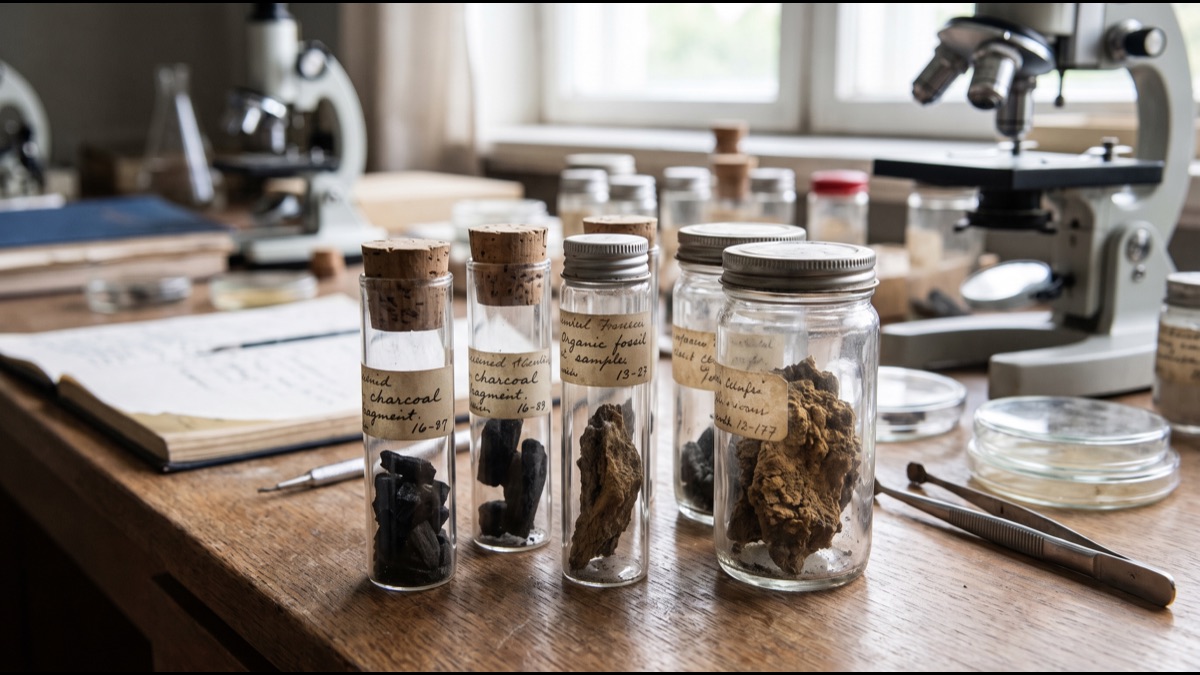
Few scientific techniques have reshaped our understanding of the past as thoroughly as radiocarbon dating. Before its development, archaeologists dated most finds by comparing them to other finds, building relative sequences that could establish what came before what without ever fixing anything to an actual calendar year. Radiocarbon dating changed that fundamentally, supplying absolute ages measured in years rather than positions in a sequence.
The technique is frequently described in popular accounts as though it were a simple matter of measuring a substance and reading off an age, which considerably understates both the underlying physics and the genuine complications involved. Understanding how it actually works, including what it can and cannot date and why results require calibration before they mean anything, clarifies both its remarkable power and the real limits that specialists work within every day.
Where Radioactive Carbon Comes From
Carbon exists in several forms called isotopes, which are atoms sharing the same chemical identity but differing in the number of neutrons in their nucleus. The overwhelming majority of carbon in the world is carbon-12, a stable form that does not decay, alongside a smaller quantity of carbon-13 which is likewise stable and persists indefinitely without changing.
A tiny fraction of all carbon exists as carbon-14, an unstable isotope that is continuously created high in the atmosphere when cosmic radiation arriving from space collides with nitrogen atoms, converting them into carbon-14 through a nuclear reaction. This process has been running continuously throughout the atmosphere for as long as the planet has had an atmosphere and a supply of incoming cosmic radiation.
The newly formed carbon-14 quickly combines with oxygen to form carbon dioxide, which then mixes throughout the atmosphere and becomes chemically indistinguishable from carbon dioxide made with ordinary stable carbon. This means it enters the biological world through exactly the same pathways, participating in every process that ordinary carbon does without any biological system distinguishing between them.
How Living Things Take It Up
Plants absorb carbon dioxide from the atmosphere during photosynthesis, incorporating that carbon into their own tissues without any mechanism for distinguishing carbon-14 from ordinary carbon-12. The proportion of the two isotopes within a living plant therefore closely tracks the proportion present in the surrounding atmosphere at that time.
Animals eating those plants incorporate the same carbon into their own bodies, and animals eating those animals do likewise, meaning the isotopic proportion propagates upward through the entire food chain. Every living organism therefore carries roughly the same ratio of carbon-14 to carbon-12 as the atmosphere it ultimately draws that carbon from.
Crucially, this exchange continues throughout an organism's life. Carbon is constantly being taken in and released as tissues are built, maintained, and replaced, meaning the internal ratio is continuously refreshed and stays in equilibrium with the surrounding environment for as long as the organism remains alive and metabolically active.
What Happens at Death
When an organism dies, it stops taking in new carbon from its environment. The carbon already locked into its tissues remains, but nothing further is added, which means the internal ratio of carbon-14 to carbon-12 stops being refreshed and begins to drift away from the atmospheric value.
From that moment, the carbon-14 already present begins steadily converting back into nitrogen through radioactive decay, while the stable carbon-12 remains entirely unchanged. The consequence is that the ratio between them falls progressively, and it falls at a rate governed purely by the physics of radioactive decay rather than by any environmental circumstance.
This is the entire basis of the technique. Because the starting ratio is known from the atmosphere and the rate of decline is a fixed physical constant, measuring how much carbon-14 remains in a sample allows calculation of how long ago that sample stopped exchanging carbon with its environment, which for organic material generally means how long ago it died.
What a Half-Life Actually Means
Radioactive decay is described using a half-life, meaning the period required for half of the atoms in any given quantity of a radioactive isotope to decay. For carbon-14 this period is approximately five thousand seven hundred years, a figure determined through careful laboratory measurement rather than derived from theory.
A common misunderstanding treats half-life as though it means a substance is entirely gone after two half-lives, which would follow if decay were linear. It is not. After one half-life, half remains; after two, a quarter; after three, an eighth, and so on, with the quantity approaching zero without ever quite reaching it in a mathematical sense.
Radioactive decay is fundamentally a probabilistic process operating at the level of individual atoms, meaning it is genuinely impossible to predict when any particular atom will decay. What makes the technique work is that samples contain enormous numbers of atoms, and the aggregate behaviour of an enormous population is extremely predictable even when individual events are not.
Why the Method Has an Upper Age Limit
Because each successive half-life removes half the remaining carbon-14, samples older than roughly ten half-lives contain so little that the remaining quantity becomes genuinely difficult to distinguish from background contamination and measurement noise, which places a practical ceiling on the technique.
In practice this limit falls somewhere in the region of fifty thousand years, beyond which radiocarbon dating cannot produce reliable results regardless of how carefully a sample is handled or how sensitive the instrument used to measure it happens to be.
This limit is precisely why radiocarbon dating cannot be applied to dinosaur fossils or to anything from the deep geological past, a genuinely common misconception. Material from those periods is dated using entirely different radiometric techniques based on isotopes with vastly longer half-lives, measured in millions or billions of years rather than thousands.
What Can and Cannot Be Dated
The technique applies only to material that was once part of a living organism and that acquired its carbon from the atmosphere, which includes wood, charcoal, bone, textiles made from natural fibres, seeds, leather, and similar organic remains commonly recovered from archaeological sites.
Materials such as stone, metal, and pottery cannot be dated directly, because they never participated in the carbon exchange the method depends on. Archaeologists work around this by dating associated organic material found in the same deposit, such as charcoal from a hearth adjacent to a pottery assemblage.
This indirect approach introduces a genuine interpretive complication, because the date obtained applies strictly to the organic sample rather than to the object of interest. Establishing that the two are genuinely contemporary requires careful attention to how the deposit formed and whether material could have been introduced from elsewhere.
Why Raw Results Must Be Calibrated
A crucial complication is that the original method assumed atmospheric carbon-14 concentration had remained constant over time, an assumption that turned out to be incorrect. Cosmic radiation intensity varies, the Earth's magnetic field shifts, and ocean circulation changes, all of which alter how much carbon-14 is produced and how it is distributed.
Because the starting ratio therefore differed at different periods in the past, a raw measurement does not directly give a calendar age. It gives a figure that must then be converted using a calibration curve built from samples of independently known age, most importantly tree rings, which can be counted individually to give an exact year.
This is why properly reported radiocarbon results distinguish between uncalibrated and calibrated dates, and why calibrated results are typically presented as a range with an associated probability rather than a single number. The calibration curve is not perfectly smooth, and some periods correspond to several possible calendar ranges.
How Tree Rings Made Calibration Possible
Trees in temperate climates add one growth ring per year, and the pattern of thick and thin rings reflects the growing conditions of each particular year, producing a distinctive sequence that can be matched between different pieces of wood from the same region.
By overlapping sequences from living trees, older timber from buildings, and preserved wood from archaeological and natural contexts, researchers have assembled continuous ring chronologies extending back many thousands of years, in which every single ring corresponds to a known calendar year.
Measuring the radiocarbon content of individual rings of known age reveals exactly what the atmospheric carbon-14 level was in that specific year, and assembling these measurements produces the calibration curve that converts raw radiocarbon measurements into genuine calendar dates.
How Modern Measurement Works
Early radiocarbon dating measured decay events directly, using detectors that counted the individual decays occurring within a sample over a period of time. Because decay is relatively infrequent, this approach required substantial sample quantities and lengthy counting periods to accumulate enough events for a reliable result.
The dominant modern approach instead counts carbon-14 atoms directly using accelerator mass spectrometry, which separates atoms by mass and counts them individually rather than waiting for them to decay, an approach that is dramatically more efficient in both sample size and time required.
This shift transformed the practical reach of the technique, reducing required sample sizes from substantial quantities of material to fragments small enough that precious artefacts can be dated with minimal damage, which opened up categories of object that could not previously be tested at all.
How Contamination Distorts Results
The single largest practical threat to accuracy is contamination, meaning the introduction of carbon from a source other than the original organism, which shifts the measured ratio and produces an age that may be substantially wrong in either direction.
Contamination with modern carbon, whether from handling, root growth penetrating a buried sample, or laboratory exposure, adds carbon-14 that was not originally present and therefore makes a sample appear considerably younger than it truly is. Even small quantities of modern contamination distort very old samples severely.
Contamination with ancient carbon, for instance from groundwater carrying dissolved carbonate from limestone, has the opposite effect, adding carbon containing no carbon-14 whatsoever and making a sample appear older. Laboratories therefore apply extensive chemical pretreatment specifically designed to strip away anything not originally part of the sample.
The Reservoir Effect and Why It Matters
Organisms that obtain carbon from the ocean rather than directly from the atmosphere present a systematic complication, because deep ocean water can remain isolated from the surface for many centuries, during which its dissolved carbon continues decaying without being replenished.
Marine organisms therefore incorporate carbon that already appears older than the atmosphere at the moment they are alive, meaning a marine shell dated without correction can return an age several hundred years too old purely because of where its carbon originated.
This effect extends to humans and animals with substantially marine diets, whose bones can return misleadingly old dates for the same reason, which is why researchers analyse dietary indicators alongside dating and apply regionally specific corrections when the reservoir effect is likely to apply.
How Nuclear Testing Changed the Atmosphere
Atmospheric nuclear weapons testing during the mid-twentieth century released large quantities of neutrons that generated carbon-14, sharply raising atmospheric levels well above the natural background within a period of only a few years.
This produced a distinctive spike in the atmospheric record, after which levels have been declining as the excess carbon-14 gradually mixes into oceans and biological systems, creating a steep and well-documented curve across the decades since testing was largely halted.
Somewhat unexpectedly, this contamination created a genuinely useful forensic tool, since organic material formed during this period carries a carbon-14 signature that can pin its formation to within a small number of years, an unusually precise capability applied in fields ranging from forensic investigation to authenticating artworks.
How Fossil Fuel Emissions Are Complicating Things
Fossil fuels formed so long ago that they contain no measurable carbon-14 at all, having been isolated from the atmosphere for periods vastly exceeding the point at which any would remain, which means burning them releases carbon dioxide containing only stable carbon isotopes.
This steadily dilutes the atmospheric proportion of carbon-14, a documented trend that has been progressing throughout the industrial period and which is accelerating as emissions continue, gradually pushing atmospheric levels downward.
The projected consequence is genuinely awkward for future dating work, since material formed in the coming decades may carry a carbon-14 signature resembling that of material many centuries old, potentially making it considerably harder to distinguish recent material from genuinely historic samples.
Why Results Are Reported as Ranges
A properly reported radiocarbon date is never a single year. It is a range accompanied by a stated confidence level, reflecting both the measurement uncertainty inherent in counting atoms and the additional uncertainty introduced when converting through the calibration curve.
The shape of the calibration curve means some periods produce much wider ranges than others, and certain intervals where the curve flattens can yield results spanning several centuries no matter how precisely the underlying measurement was made.
Popular reporting frequently strips this nuance away, presenting a single dramatic year where the underlying result was a probability distribution across a range, which contributes considerably to public misunderstanding of how precise the technique genuinely is.
How Dating Fits Alongside Other Evidence
Radiocarbon dating is rarely used in isolation. Archaeologists combine it with stratigraphy, meaning the physical layering of deposits, alongside artefact typology, historical documentation where available, and other dating techniques, building an interpretation supported by multiple independent lines of evidence.
This matters because a radiocarbon date establishes when an organism stopped exchanging carbon, which is not necessarily when the event of interest occurred. Timber may have been reused decades after felling, and old wood may have been burned long after the tree died.
Specialists therefore treat radiocarbon results as one constraint among several rather than as a definitive answer, an approach that produces considerably more reliable conclusions than treating any single measurement as settling a question on its own.
What the Old Wood Problem Actually Is
A specific and genuinely consequential interpretive difficulty, generally known as the old wood problem, arises because the outer rings of a tree are considerably younger than the inner ones, meaning a sample taken from the centre of a substantial timber can be centuries older than the date the tree was actually felled.
This compounds when timber is reused, a genuinely common practice in periods when working wood was labour-intensive and structural beams were valuable enough to salvage from demolished buildings and incorporate into new construction, sometimes repeatedly across generations.
Researchers address this by preferentially sampling from short-lived material such as seeds, twigs, or the outermost rings where these survive, since these grew within a narrow window and therefore date the event of interest far more tightly than a sample from deep within a long-lived timber ever could.
How the Technique Changed Archaeology Itself
The arrival of radiocarbon dating did more than supply dates. It overturned a substantial number of established chronologies that had been built on the assumption that innovations spread outward from a small number of supposed centres of civilisation, an assumption that had shaped interpretation for decades.
When absolute dates revealed that certain monuments and technologies in outlying regions were considerably older than the supposed sources they were assumed to have derived from, the entire diffusion framework required serious revision, demonstrating that independent development had occurred far more often than had been assumed.
This episode is frequently cited as an instance where a measurement technique reshaped not merely the details of a field but its underlying interpretive assumptions, forcing a discipline to reconsider a framework that had appeared well established precisely because no independent means of testing it had previously existed.
Radiocarbon dating rests on a genuinely elegant principle. Cosmic radiation continuously creates carbon-14 in the atmosphere, living organisms incorporate it in the same proportion as their surroundings, and at death that intake stops while decay continues, leaving a diminishing quantity that acts as a clock running from the moment of death. What popular accounts generally omit is everything that makes the technique genuinely difficult. Atmospheric levels have varied over time, so raw measurements mean nothing until converted through a calibration curve built from tree rings of known age. Contamination in either direction distorts results severely. Marine carbon introduces systematic offsets requiring correction. Results are probability ranges rather than single years, and dating an organism's death is not the same as dating the human event a researcher actually cares about. Understanding those limits is what separates using the technique well from treating it as a machine that simply reads out ages.
Sources
- Wikipedia — overview of radiocarbon dating principles, calibration, and limitations
- National Institute of Standards and Technology — reference data on isotopes and radiometric measurement standards
- Nature — peer-reviewed research on calibration curves and dating methods
- U.S. Geological Survey — background on radiometric dating techniques across timescales
- Encyclopaedia Britannica — historical background on the development of radiocarbon dating
FAQ
Can carbon dating be used on dinosaur fossils?
No — the technique has a practical limit around fifty thousand years, far too recent for dinosaurs. Deep-time material is dated using other isotopes with vastly longer half-lives.
What is the half-life of carbon-14?
Approximately five thousand seven hundred years, meaning half the carbon-14 in a sample decays over that period, then half the remainder over the next, and so on.
Why do radiocarbon dates need calibration?
Atmospheric carbon-14 levels have varied over time, so raw measurements must be converted using a calibration curve built from tree rings whose exact calendar year is known.
Can stone or pottery be carbon dated?
Not directly, since they never took in atmospheric carbon. Archaeologists date associated organic material such as charcoal found in the same deposit instead.
Why is a radiocarbon date given as a range rather than one year?
It reflects both measurement uncertainty and the shape of the calibration curve, which in some periods flattens enough that results span several centuries.
About the Author
We reference Wikipedia, National Institute of Standards and Technology, Nature, U.S. Geological Survey, and Encyclopaedia Britannica to explain the background and current understanding of this topic.
Loved This Article?
Share it on WhatsApp → Share it on WhatsApp
Get more guides in your inbox — Subscribe to our newsletter for weekly surprising stories from Egypt, Saudi Arabia, Dubai, and beyond.