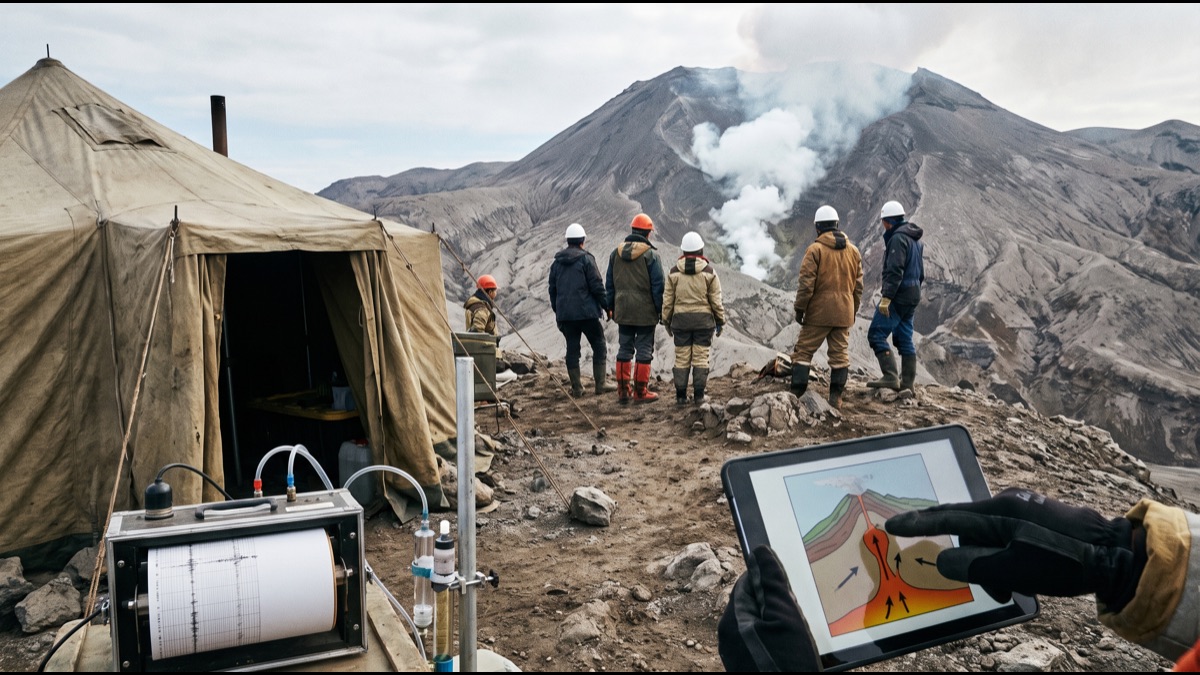
Volcanic eruptions occur when magma, molten rock formed deep within the Earth, along with dissolved gases, builds up enough pressure to force its way through a weak point in the Earth's crust, typically at a volcano's central vent.
Magma forms when intense heat and pressure inside the Earth's mantle melt rock, and because molten rock is generally less dense than the solid rock around it, it gradually rises toward the surface, collecting in underground magma chambers before an eruption.
Molten Rock Under Immense Pressure
Why Some Eruptions Explode and Others Ooze
As magma rises, the pressure surrounding it decreases, allowing dissolved gases within it to expand into bubbles, similar to opening a shaken soda bottle, and it's largely this gas expansion that drives magma the rest of the way to the surface.
Whether an eruption is a slow, oozing lava flow or a violent, explosive blast depends heavily on the magma's chemical composition and gas content — thicker, gas-rich magma traps pressure until it releases explosively, while thinner, gas-poor magma tends to flow out more gradually.
Sources
- Wikipedia — overview of volcanic formation and eruption mechanisms
- United States Geological Survey — scientific background on volcano monitoring and eruption types
- Smithsonian Institution — Global Volcanism Program — global database and research on volcanic activity
FAQ
What is magma, and how is it different from lava?
Magma is molten rock while it's still underground; once it reaches the surface during an eruption, it's called lava.
Why do some volcanoes erupt explosively while others don't?
It largely depends on magma composition — thicker, gas-rich magma traps pressure until it releases explosively, while thinner, gas-poor magma tends to flow out more gradually.
What actually pushes magma up to the surface?
As magma rises, surrounding pressure decreases, allowing dissolved gases to expand into bubbles, and this gas expansion is a major force driving magma the rest of the way up.
About the Author
We reference Wikipedia, United States Geological Survey, and Smithsonian Institution — Global Volcanism Program to explain the background and current understanding of this topic.
Loved This Article?
Share it on WhatsApp → Share it on WhatsApp
Get more guides in your inbox — Subscribe to our newsletter for weekly surprising stories from Egypt, Saudi Arabia, Dubai, and beyond.