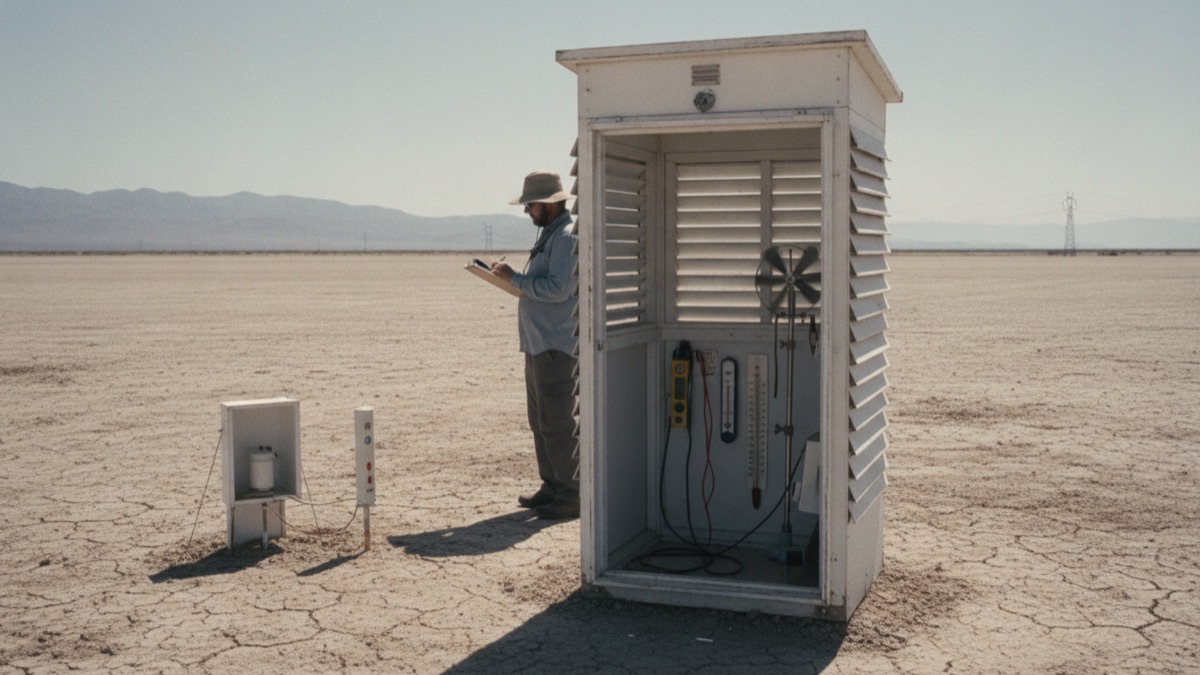
Almost every summer, a headline announces the hottest temperature ever recorded somewhere, and almost every time, that number takes weeks or months to actually become official, if it becomes official at all. This gap between a viral claim and a certified record surprises people who assume a thermometer reading is simply a fact. In practice, an extreme weather record is a claim that has to survive a formal verification process involving instrument calibration, site inspection, and committee review, precisely because so many things can make a raw reading wrong. Understanding that process explains why some widely reported 'hottest day ever' headlines quietly disappear from the record books weeks later.
Why a Thermometer Reading Isn't Automatically a Record
A temperature reading becomes a candidate for a record, not a record itself, the moment it is reported, because the reading alone carries no information about the condition of the instrument, its exposure to direct sunlight, or whether it was sited according to established meteorological standards.
National meteorological agencies and the World Meteorological Organization treat any exceptional reading as provisional until a formal review confirms the instrument and its surroundings met the conditions required for the reading to be considered scientifically valid.
This distinction matters because the raw number that goes viral on social media is often the provisional reading, not the verified one, which is why a temperature reported in the news can later be revised downward or thrown out entirely without any suggestion of dishonesty on anyone's part.
The Official Instrument Standards Behind a Valid Reading
Official temperature measurement requires a thermometer housed inside a ventilated shelter, typically a Stevenson screen or an equivalent electronic sensor enclosure, positioned at a standard height above natural ground cover and shielded from direct sunlight so it measures air temperature rather than the temperature of the sun-heated instrument casing itself.
The surface beneath the sensor also matters enormously: standards call for the sensor to sit over natural vegetation such as grass rather than pavement, concrete, or rooftop material, because those surfaces absorb and re-radiate heat in ways that can push a reading several degrees above the actual surrounding air temperature.
A sensor installed too close to a building wall, an air conditioning exhaust, a parking lot, or an airport tarmac can register a locally accurate but regionally misleading reading, which is why site inspection is one of the very first steps in any serious record verification.
Why Car Dashboard and Phone Readings Get Thrown Out
Vehicle dashboard displays and many consumer weather apps report the temperature of a sensor mounted near the engine, close to hot pavement, or influenced by direct sun exposure, none of which reflects standard meteorological air temperature under any recognized methodology.
This is why claims of extraordinary temperatures based on a car's dashboard reading are dismissed almost immediately by meteorologists, not out of skepticism about the person reporting it, but because the measurement method itself is known to run several degrees hotter than a properly sited official station under comparable conditions.
The same logic applies to informal personal weather stations that amateur enthusiasts install at home, some of which are genuinely useful for local trend tracking but are rarely certified to the siting and calibration standard required to contribute an official record claim.
The Instrument Calibration Check
Once siting is confirmed to be acceptable, verification teams check the specific instrument's calibration history, since even a well-sited thermometer can drift out of accurate calibration over time due to component aging, moisture intrusion, or electronic sensor degradation.
Modern automated weather stations typically log their own calibration checks on a defined schedule, and investigators compare the flagged reading against the instrument's calibration record from around that date to confirm it was operating within its certified accuracy range at the time.
If calibration records are missing, outdated, or show the instrument was already drifting before the record-breaking reading, that alone can be enough to invalidate an otherwise plausible claim, regardless of how extreme or newsworthy the number appeared.
Cross-Checking Against Nearby Stations
A genuine extreme temperature event, whether a heat wave or a cold snap, typically affects an entire region rather than a single isolated point, so verification teams compare the candidate reading against neighboring official stations to see whether the surrounding area shows a consistent, physically plausible pattern.
A reading that is dramatically higher than every station within a reasonable radius, with no clear meteorological explanation such as a localized foehn wind effect, is treated as a red flag warranting deeper investigation rather than being accepted at face value simply because it came from an otherwise legitimate station.
This regional consistency check has caught genuine instrument malfunctions in the past, where a single station recorded an implausible spike that no neighboring station corroborated, later traced to a specific sensor fault rather than an actual atmospheric extreme.
The Role of Satellite Data as a Secondary Check
Satellite-based land surface temperature measurements, while not a direct substitute for standard air temperature readings due to differences in what they actually measure, provide investigators a useful independent check on whether the general thermal pattern over a region is consistent with an extraordinary claim.
If satellite data shows an unusually intense heat signature covering a broad area consistent with the reported extreme, that strengthens confidence in the ground-based reading; if satellite data shows nothing unusual regionally while one station reports a record, that mismatch raises the bar for what the ground station needs to prove before acceptance.
This satellite cross-check has become a standard part of the toolkit only in the past couple of decades, as consistent, high-resolution satellite coverage became widely available, and it is now considered good practice for any headline-grabbing record claim rather than an optional extra step.
The Formal Committee Review Process
For records with international or national significance, a formal evaluation committee, often convened by the relevant national meteorological service or coordinated through the World Meteorological Organization's weather and climate extremes archive, reviews the full evidence package assembled by field investigators.
This committee typically includes climatologists and instrumentation specialists who were not directly involved in the initial site inspection, providing an independent second look specifically designed to catch anything the original investigating team might have missed or interpreted too generously.
The committee's decision is published with its reasoning, which is why some record disputes become genuinely public, technical debates rather than quiet internal determinations, especially when a claim has already received wide media attention before the review concludes.
Why Verification Takes Weeks or Months
Gathering an instrument's full calibration history, arranging a physical site inspection that may require travel to a remote location, cross-referencing satellite archives, and convening an independent expert committee are all steps that simply cannot be compressed into the hours or days that a news cycle demands.
This mismatch in timescale is precisely why an extreme reading is reported publicly the same day it occurs, while its official verification status is often still labeled provisional weeks or months later, creating an awkward gap where the public has already absorbed the headline before the scientific process concludes.
Meteorological agencies have increasingly tried to address this gap by publishing preliminary assessments alongside initial reports, explicitly flagging a headline number as unverified, though this nuance is frequently lost by the time the figure is repeated a few steps down the media chain.
Notable Cases Where a Record Was Later Overturned
Meteorological history includes several instances where a long-standing extreme temperature record, once accepted for years or even decades, was later formally decertified after a retrospective review found the original instrument siting or reading methodology did not meet the standard eventually adopted.
One of the most well known involved a record that stood in official reference works for over ninety years before a dedicated international investigative committee examined period instrument documentation and concluded the original reading was very likely inflated by measurement error typical of the era's equipment.
These retrospective corrections are not embarrassing failures of the system; they are treated within the field as evidence the verification process works as intended, applying improved historical understanding and modern investigative rigor even to claims that had gone unchallenged for a very long time.
How Cold Extremes Are Verified Differently
Extreme cold record verification follows a broadly similar process to heat record verification, but with additional attention to instrument-specific issues such as whether a liquid-in-glass thermometer's fluid actually froze or contracted in a way that could distort the final reading at very low temperatures.
Remote cold-record locations, often in polar or high-altitude regions, add logistical difficulty to site inspection, since verification teams may need specialized transport and equipment simply to physically reach and examine a station that recorded an extraordinary reading.
Because instruments in extreme cold environments face unique maintenance and calibration challenges compared to instruments in temperate or hot climates, cold record disputes historically have had a higher rate of eventual correction or decertification than heat record disputes, according to climatological archive reviews.
Why National Records and Global Records Follow Different Tracks
A national meteorological agency typically maintains its own record-verification process for temperatures within its own territory, applying that country's specific instrumentation standards and historical archive, independent of any international body.
A claim aspiring to global significance, by contrast, is generally referred to the World Meteorological Organization's international evaluation committee, which applies a globally standardized methodology specifically so that records from different countries, using potentially different national instrumentation histories, can be compared on a consistent basis.
This two-track system explains why a reading can be confirmed as an official national record relatively quickly while its status as a candidate for a global record remains under review for a much longer period, since the international bar for evidence and cross-checking is generally higher.
The Difference Between a Record and a Record-Adjacent Event
Meteorologists distinguish carefully between an officially verified record and an event that was merely extreme and newsworthy but never formally submitted for verification, since submission itself requires the original station operator or a national agency to initiate the process.
Many genuinely extraordinary temperature events never go through formal verification at all, simply because no one files the paperwork, which means the absence of an official record for a given event says nothing about how extreme that event actually was, only that it was never formally evaluated.
This is part of why a careful reader should treat 'unofficial record' language in a headline as a meaningfully different claim from 'officially verified record,' since the former simply means an extreme reading was reported, while the latter means it survived the full evaluation process described throughout this piece.
What Urban Stations Complicate About Long-Term Records
Some of the world's longest-running weather stations are located in what were once open rural areas but have since been surrounded by urban development, meaning the station's own physical surroundings have changed dramatically over the decades even though the instrument location itself has not moved.
This creates a genuine analytical challenge for long-term climate record-keeping, since researchers need to account for the urban heat island effect described in related research to separate a genuine climatic warming trend from an artifact of the station's surroundings becoming progressively more built-up over time.
Climatologists address this using homogenization techniques that adjust historical records for known, documented changes in station siting, instrumentation, and surroundings, a technical process that is itself subject to independent scientific review precisely because getting it wrong could distort the long-term climate record in either direction.
Why Public Skepticism of the Process Sometimes Emerges
Because verification takes time and occasionally results in a widely reported number being revised downward or rejected, some public skepticism toward the process is understandable, particularly when a rejected reading aligned with what people were already experiencing on the ground during a genuinely brutal heat event.
Meteorological agencies generally respond to this by publishing their full reasoning for any rejection, specifically to distinguish a legitimate instrumentation or siting problem from any suggestion that the underlying weather event itself wasn't extreme, since the two are separate questions.
It is entirely possible, and quite common, for a specific record claim to be rejected on technical grounds while the broader heat wave or cold snap it occurred during is still recognized as a genuinely significant, dangerous weather event by the same agencies doing the rejecting.
What This Means for How to Read a 'Hottest Ever' Headline
A careful reader encountering a hottest-ever headline should treat the number as provisional by default, since that is technically accurate for the vast majority of such headlines at the moment they are published, well before any formal review has had time to occur.
Checking whether a national meteorological agency or the World Meteorological Organization has issued any follow-up statement, whether confirming or revising the figure, is the single most reliable way to know whether a viral number has actually survived the process described throughout this piece.
This does not mean every dramatic headline is wrong; many verified records genuinely are as extreme as initially reported, but the interval between the headline and the verified answer is real, methodical, and worth waiting for before treating a specific number as scientifically settled.
Why Some Regions Lack the Infrastructure to Verify Claims at All
Formal record verification depends on a dense, well-maintained network of properly sited and calibrated stations, resources that are unevenly distributed globally, with some regions having far sparser official networks than others due to funding, geography, or historical investment in meteorological infrastructure.
In regions with fewer official stations, an extreme reading may simply have no nearby official station to cross-check against, which does not necessarily mean the reading is wrong, but does mean the verification process described throughout this piece has less corroborating evidence available to draw on before reaching a conclusion.
International meteorological bodies have made expanding station density in under-monitored regions a stated priority precisely because gaps in the network make both routine forecasting and record verification meaningfully harder in exactly the places often most vulnerable to extreme weather in the first place.
The Economic and Insurance Stakes Behind an Official Record
An officially verified extreme weather record carries consequences well beyond scientific bragging rights, since insurance models, agricultural planning benchmarks, and building codes in some jurisdictions reference official record thresholds directly when calculating risk exposure or setting design standards.
This is part of why the verification process is deliberately conservative and resistant to shortcuts: an erroneously certified record could ripple into insurance pricing or infrastructure design decisions made by parties who reasonably assume a certified figure has already been rigorously checked.
Financial and infrastructure stakeholders in some sectors track pending record evaluations closely for this reason, since a record's eventual certification or rejection can have measurable downstream effects on cost models built around the assumption of an officially confirmed extreme.
How Verified Records Feed Into Long-Term Climate Science
Beyond any single headline, verified extreme records form part of the long-term dataset climate scientists use to track how the frequency and intensity of extremes are changing over time, which is why the rigor applied to any individual record matters for a purpose well beyond that one data point.
A single false or improperly verified record entering this long-term dataset could distort trend analysis in ways that take years to notice and correct, which is why the verification standards described throughout this piece are held to a demanding, conservative bar rather than a looser standard that might let more claims through faster.
This is ultimately the deeper reason the verification process resists shortcuts even under public pressure for a quick answer: the data produced by rigorous verification serves scientific purposes that outlast any single news cycle by decades, and a mistake introduced today can compromise research long after the original headline is forgotten.
The gap between a viral 'hottest ever' headline and an officially confirmed weather record exists for good reason: a raw thermometer reading carries no information about instrument calibration, site conditions, or regional consistency on its own, and any of those factors can turn a dramatic number into a false one. The verification process — checking instrument siting against strict standards, confirming calibration history, cross-referencing neighboring stations and satellite data, and subjecting the result to independent committee review — exists precisely because so many plausible-looking readings turn out, on closer inspection, to reflect a measurement artifact rather than a genuine atmospheric extreme. None of this makes the underlying weather any less real or dangerous; a heat wave can be genuinely brutal and historically significant even if its single most extreme reported number is later revised or thrown out. Understanding this process is the difference between treating a headline number as settled fact and understanding it for what it actually is at the moment of publication: a claim still working its way through a careful, deliberately slow verification system.
Sources
- World Meteorological Organization Weather and Climate Extremes Archive — the international body's official database and methodology for verifying extreme weather records
- U.S. National Weather Service — background on official instrument siting and observation standards
- Wikipedia: Stevenson screen — explanation of the standard ventilated instrument shelter used for official temperature readings
- National Oceanic and Atmospheric Administration — climate data archives and homogenization methodology for long-term temperature records
FAQ
Why isn't a reported record temperature official right away?
A raw reading is only a candidate for a record until a formal review confirms the instrument was properly sited, calibrated, and consistent with neighboring stations. That review process takes weeks to months, so most headline numbers are provisional at the moment they're published.
Why do car dashboard temperature readings get dismissed by meteorologists?
Dashboard sensors are mounted near the engine or exposed to hot pavement and direct sun, none of which matches the standardized, shaded, ventilated conditions required for an official reading, so they routinely run several degrees hotter than a properly sited station.
Can an old, long-accepted weather record actually be overturned?
Yes. Several historical records have been formally decertified after retrospective committees reviewed original instrument documentation and found the reading likely reflected measurement error typical of the era's equipment rather than a genuine atmospheric extreme.
What's the difference between a national record and a global record?
National agencies verify records within their own territory using their own standards and archives. A claim for global significance goes through the World Meteorological Organization's international committee, which applies a standardized cross-country methodology, generally taking longer to confirm.
Does a rejected record mean the heat wave wasn't real?
No. A specific reading can be rejected for a technical siting or instrument problem while the broader heat wave or cold snap it occurred during is still recognized as a genuinely extreme, dangerous weather event by the same agency that rejected the individual number.
About the Author
We reference World Meteorological Organization Weather and Climate Extremes Archive, U.S. National Weather Service, Wikipedia: Stevenson screen, and National Oceanic and Atmospheric Administration to explain the background and current understanding of this topic.
Loved This Article?
Share it on WhatsApp → Share it on WhatsApp
Get more guides in your inbox — Subscribe to our newsletter for weekly surprising stories from Egypt, Saudi Arabia, Dubai, and beyond.