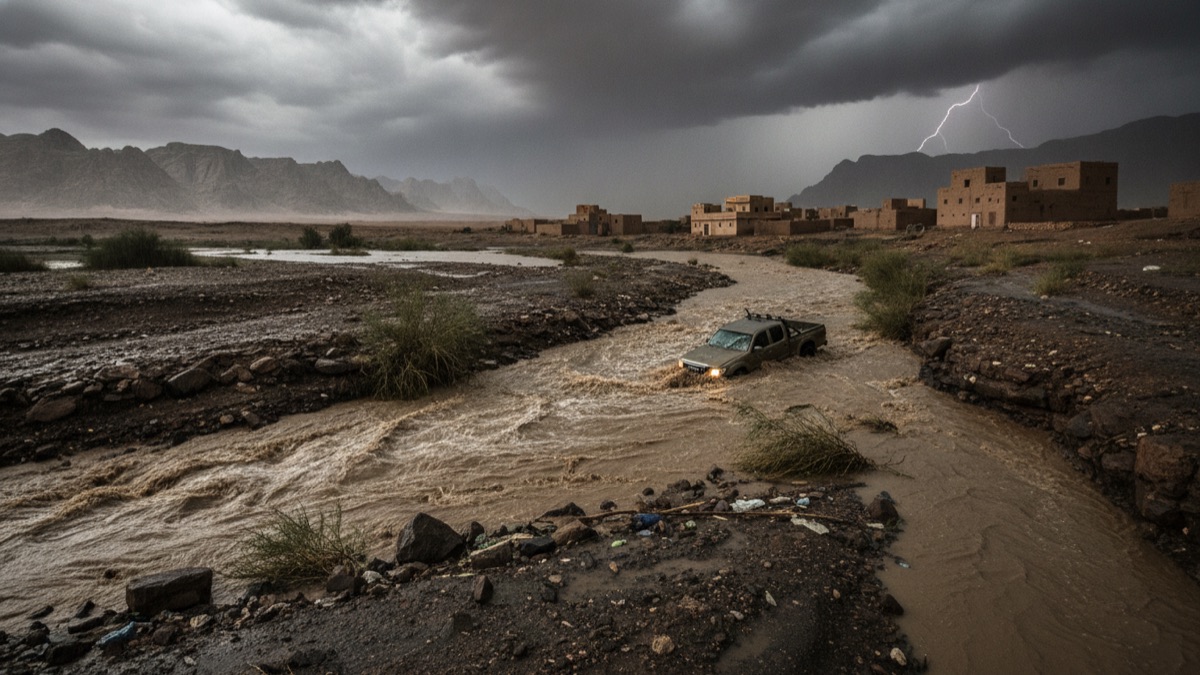
Rain in a Desert Kingdom
Every year, usually between late autumn and early spring, the same question trends across the Kingdom: why is rain in Saudi Arabia so sudden, so heavy, and so often followed by flooding? A country where most regions receive well under 150 millimeters of rain a year can see a month's worth fall in a single afternoon — and images of flooded streets in Jeddah, Riyadh, or Makkah follow within hours.
The explanation sits at the meeting point of geography, atmosphere, and urban design. This guide walks through it: which seasons bring rain to each region, why desert ground turns short storms into flash floods, what Saudi Arabia's cloud seeding program actually does, and how to read official weather warnings when a storm is on the way.
Saudi Arabia's Rainy Seasons, Region by Region
Most of the Kingdom receives its rain between November and April. In winter, low-pressure systems from the Mediterranean push cold fronts southeast across the Arabian Peninsula. When these fronts meet moist air flowing in from the Red Sea or the Arabian Gulf, the collision produces bands of thunderstorms that can sweep across the northern, central, and western regions within hours. The Red Sea Trough — a persistent low-pressure feature over the warm water — is a frequent trigger for the western coast's heaviest downpours.
The southwest follows a different rhythm. The highlands of Asir, Al-Baha, and Jazan catch moist summer winds linked to the Indian Ocean monsoon, the same system that delivers the khareef season to nearby Oman and Yemen. As a result, the southwestern mountains are the wettest part of the country, receiving roughly two to three times the national average in some districts, much of it between June and September. Our guide to Asir and Abha shows how this climate shapes the region's terraced farms and misty peaks.
Between the two regimes lie the transition months — roughly March to May and September to November — when intense surface heating meets leftover atmospheric moisture. The result is isolated convective storms: fast-building cells that can park over one district and dump their load while the rest of the city stays dry. These are the storms that most often surprise city residents, because they form with little warning and vary street by street.
Why Flash Floods Form So Quickly
Desert ground is the first culprit. Months of heat bake the soil into a hard crust that absorbs water slowly, so when heavy rain arrives, most of it runs off the surface instead of soaking in. Saudi Arabia has no permanent rivers to carry that runoff away; it collects instead in wadis — dry valleys that can become fast-moving torrents within minutes, sometimes under clear skies downstream. Our explainer on why Saudi Arabia has no permanent rivers covers this geography in detail.
Cities amplify the effect. Asphalt and concrete shed almost all rainfall into streets and underpasses, and drainage networks built for rare events can be overwhelmed when 30 to 50 millimeters fall in a single hour — totals that official storm reports have recorded repeatedly in recent years. The Jeddah floods of 2009 and 2011, which killed dozens of people, remain the benchmark disasters that pushed the Kingdom to rebuild drainage systems and strengthen early-warning practices.
Dust and terrain complete the picture. Fine desert dust supplies condensation nuclei around which cloud droplets form, while the western mountain escarpment forces moist air upward, cooling it and squeezing out heavier rain on the slopes. That water then races downhill toward coastal cities such as Jeddah and Yanbu — which is why a storm over the mountains is a warning for the valleys and coast below.
Cloud Seeding: The Saudi Rain Enhancement Program
Saudi Arabia runs one of the region's most ambitious weather-modification efforts. The national cloud seeding program, supervised by the National Center of Meteorology (NCM) together with the Ministry of Environment, Water and Agriculture, began flight operations in 2022 and has expanded in phases since. Specially equipped aircraft release flares carrying hygroscopic materials into suitable clouds, encouraging tiny droplets to merge into drops heavy enough to fall as rain.
Cloud seeding cannot manufacture rain from a clear sky; it can only increase what an existing cloud might yield. International assessments reviewed by the World Meteorological Organization suggest gains on the order of 5 to 20 percent under favorable conditions. Saudi officials have reported hundreds of seeding flights across regions from Riyadh and Qassim to Asir, presenting the program as one tool among several — alongside desalination, groundwater management, and water reuse — in the Kingdom's long-term water security strategy.
The Kingdom has actually experimented with rain enhancement on and off since the early 2000s, when joint studies with international specialists tested seeding over the southwest. The current program adds research aircraft, radar monitoring, and published results, and officials have continued to expand its fleet and geographic coverage since launch.
Reading Warnings and Staying Safe
The NCM issues color-coded weather alerts — typically yellow for conditions worth watching, orange for significant weather, and red for dangerous situations — through its website, app, and social channels, alongside the national early-warning platform. Civil Defense guidance during red alerts is consistent: keep away from wadis and low crossings, never drive into moving water, and avoid valley floors even when the rain directly above you seems light.
The physics explain the advice. Around 30 centimeters of moving water can push a car, and wadi currents are far stronger than they look; most flood deaths in the region involve vehicles. Checking the forecast before desert trips, and treating a thunderstorm warning over the mountains as a warning for the wadis below, remains the simplest protection available.
Sources
- National Center of Meteorology — official Saudi weather forecasts, warnings, and climate data
- Saudi Gazette — report on the expansion of the national cloud seeding program
- World Meteorological Organization — global scientific assessments of weather modification and rainfall
- Saudi Press Agency — official announcements on weather events and government programs
FAQ
When is the rainy season in Saudi Arabia?
For most regions, rain falls mainly between November and April, brought by winter frontal systems from the Mediterranean. The southwestern highlands — Asir, Al-Baha, and Jazan — follow a different pattern and receive much of their rain in summer from monsoon-influenced winds.
Why does rain cause floods so quickly in Saudi cities?
Baked desert soil absorbs little water, and asphalt sheds almost all of it into the streets. With no permanent rivers, runoff concentrates in wadis and underpasses, so one intense hour-long storm can flood districts that were dry minutes earlier.
What is cloud seeding, and does Saudi Arabia use it?
Cloud seeding means releasing particles such as hygroscopic salts into suitable clouds to help droplets merge into rain. Saudi Arabia has operated a national program since 2022, flying seeding missions over several regions to raise rainfall from existing clouds by an estimated few percent up to around a fifth in good conditions.
Which part of Saudi Arabia gets the most rain?
The southwestern highlands are the wettest region. Mountain districts in Asir, Al-Baha, and Jazan receive roughly two to three times the national average, largely during the summer months.
How do I get official Saudi weather warnings?
Follow the National Center of Meteorology's website or app and the national early-warning platform. Alerts run from yellow to red; during red alerts, Civil Defense advises staying away from wadis, underpasses, and flooded roads.
About the Author
doyouknow.app AI-assisted Editorial Workflow — This article was prepared with AI-assisted research and editing, using the sources listed on the page. It is not based on firsthand testing, on-the-ground reporting, or a claim of personal experience or professional credentials. Please check official sources for current details.
Loved This Article?
Share it on WhatsApp → Share on WhatsApp
Get more Saudi explainers in your inbox — Subscribe to our newsletter for weekly surprising stories from Saudi Arabia and beyond.