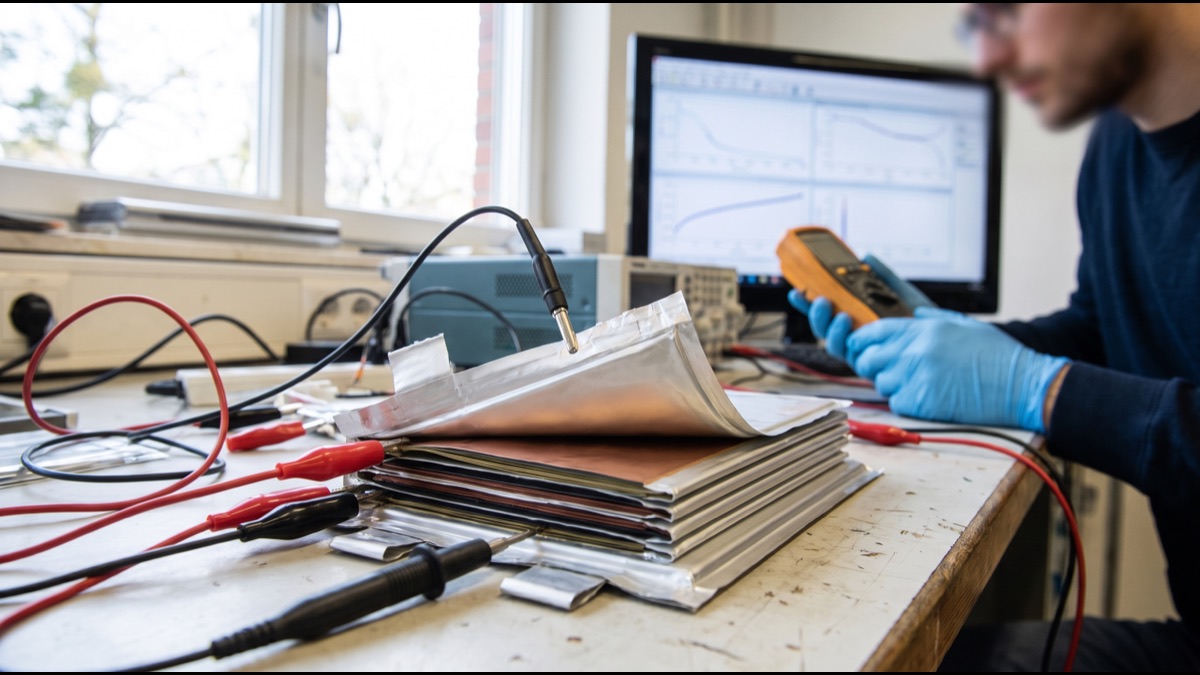
Every time a phone battery drops from 100% to 0%, roughly a quintillion lithium ions have physically moved from one side of the battery to the other. That migration, repeated reliably tens of thousands of times over a battery's life, is the entire mechanism behind how a lithium-ion cell stores and releases electrical energy.
The chemistry involved is genuinely elegant once unpacked, explaining not only how batteries work but also why they degrade over time, why fast charging generates heat, why certain chemistries are safer than others, and why a phenomenon called thermal runaway occasionally makes headlines when it goes wrong.
What a Battery Actually Is at the Simplest Level
A battery is fundamentally a device that stores energy in chemical form and converts it into electrical energy on demand, built around two electrodes of different materials separated by a chemical medium that allows a controlled reaction to occur between them.
In a lithium-ion cell specifically, that controlled reaction involves lithium ions moving repeatedly between two electrode materials, releasing electrical energy that can do useful work as the ions travel from one side to the other during discharge.
Why Lithium Was Chosen Over Other Elements
Lithium sits at a uniquely favorable position on the periodic table for battery chemistry, being the lightest metal that exists and having a strong natural tendency to give up an electron, both properties that translate directly into storing more energy per unit of weight than competing chemistries.
This combination of light weight and high reactivity is precisely why lithium-based batteries deliver dramatically better energy density than older technologies like nickel-cadmium or lead-acid, making practical smartphones, laptops, and long-range electric vehicles possible in the first place.
What the Anode Actually Does During Discharge
During discharge, the anode, typically made from layered graphite in most commercial cells, releases lithium ions that have been stored between its carbon layers, sending them on a journey toward the opposite electrode while simultaneously releasing electrons into the external circuit.
Those freed electrons cannot travel through the electrolyte itself, so they are forced to take the long way around through the external circuit, powering whatever device the battery is connected to before eventually reuniting with the lithium ions on the other side.
What the Cathode Actually Does During Discharge
The cathode, commonly built from a lithium metal oxide compound incorporating elements like cobalt, nickel, or manganese, receives both the incoming lithium ions traveling through the electrolyte and the electrons arriving via the external circuit, absorbing them back into its crystal structure.
This absorption process is what completes the electrical circuit and allows current to flow continuously as long as lithium ions keep migrating from anode to cathode, a flow that continues until the anode's available lithium supply is largely depleted.
How the Electrolyte Lets Ions Move But Not Electrons
The electrolyte, usually a lithium salt dissolved in an organic solvent, is specifically engineered to conduct lithium ions freely between the two electrodes while being a poor conductor of electrons, a selective property that is absolutely essential to how the battery functions.
If the electrolyte conducted electrons as easily as it conducts ions, the battery would simply short-circuit internally, converting its stored chemical energy directly into heat rather than delivering usable electrical current to an external device.
What the Separator Actually Prevents
A thin, porous polymer separator sits physically between the anode and cathode, riddled with microscopic holes small enough to let lithium ions pass through while being solid enough to physically prevent the two electrodes from ever touching each other directly.
Direct contact between anode and cathode would cause an immediate and dangerous short circuit, which is why separator quality and integrity are treated as one of the most safety-critical components in the entire cell design and manufacturing process.
How Charging Actually Reverses the Ion Flow
Charging simply runs the entire discharge process in reverse, using an external power source to force lithium ions back out of the cathode and push them back across the electrolyte to be reabsorbed into the anode's graphite layers, ready for the next discharge cycle.
This reversal requires driving electrons against their natural preferred direction of flow, which is precisely why charging requires an active power source doing work, rather than happening spontaneously the way discharge does once a circuit is connected.
Why Fast Charging Genuinely Stresses the Battery
Forcing lithium ions to move faster than their natural rate during rapid charging increases the risk that some ions will fail to insert properly into the graphite structure and instead deposit as metallic lithium on the anode's surface, a process called lithium plating.
Plated lithium is both a permanent loss of usable battery capacity and a genuine safety concern, since it can eventually grow into sharp structures capable of piercing the separator, which is why manufacturers deliberately limit charging speed, especially at very low or very high states of charge.
How Battery Management Systems Actually Protect Cells
A battery management system continuously monitors individual cell voltage, temperature, and charge current, cutting off charging or discharging the instant any reading drifts outside safe parameters, functioning as the primary defense against the battery being pushed into a genuinely dangerous state.
In devices with multiple cells wired together, the management system also balances charge levels between individual cells, since even small manufacturing variations can cause one cell to age faster than its neighbors if left uncorrected over hundreds of charge cycles.
Why Batteries Degrade With Every Single Charge Cycle
Each charge and discharge cycle causes microscopic physical changes inside the electrode materials, including the gradual formation of a solid layer on the anode surface called the solid-electrolyte interphase, which consumes a small amount of active lithium every time it grows.
Over hundreds or thousands of cycles, this cumulative loss of usable lithium, combined with slow physical degradation of the electrode structures themselves, is what causes a battery's maximum usable capacity to shrink gradually, the underlying reason an older phone holds less charge than it did when new.
How Temperature Genuinely Affects Battery Performance and Lifespan
Chemical reactions inside a battery, including both the useful ones that store energy and the unwanted ones that degrade it, generally accelerate as temperature rises, meaning a battery kept consistently hot ages measurably faster than an identical battery kept cool.
Extreme cold creates the opposite but equally real problem, slowing the underlying chemistry enough that the battery can temporarily deliver far less power than normal, which is why phones and electric vehicles both perform noticeably worse in freezing conditions.
Why Different Cathode Chemistries Trade Off Energy and Safety
Cathode formulas heavy in nickel and light in cobalt generally deliver higher energy density, meaning more range or runtime per unit of weight, but tend to be somewhat less thermally stable than cathode chemistries that include more manganese or use an entirely different structure like lithium iron phosphate.
Manufacturers choose among these established chemistries based on the specific priorities of their product, favoring maximum energy density for premium electric vehicles chasing range, while favoring the inherently more stable lithium iron phosphate chemistry for applications where cost and safety margin matter more than squeezing out maximum range.
How Thermal Runaway Actually Happens
Thermal runaway begins when internal heat generation inside a cell, whether from physical damage, a manufacturing defect, or severe overcharging, exceeds the rate at which that heat can escape, triggering a self-reinforcing cycle where rising temperature accelerates further unwanted chemical reactions.
Once this cycle takes hold, temperatures can climb rapidly enough to break down the electrolyte and separator entirely, releasing flammable gases and, in the most severe cases, causing the cell to catch fire, which is why isolating a single failing cell quickly matters enormously in multi-cell battery packs.
How Manufacturers Actually Test Battery Safety Before Shipping
Battery cells undergo an extensive battery of tests before reaching consumers, including deliberate crushing, puncturing, overcharging, short-circuiting, and extreme temperature exposure, all specifically designed to confirm the cell fails safely rather than catastrophically under realistic worst-case conditions.
Regulatory bodies in most major markets require passing standardized versions of these tests before a battery design can be certified for sale, and manufacturers additionally run statistical sampling across production batches to catch manufacturing defects before they ever reach a finished consumer product.
How Lithium-Ion Cells Are Actually Manufactured at Scale
Manufacturing begins with coating thin metal foils with the electrode materials in a carefully controlled slurry-coating process, then stacking or winding those coated foils together with the separator in between before sealing them inside a rigid can or flexible pouch.
The finished cell then undergoes a critical formation step, an initial slow charge and discharge cycle that establishes the protective solid-electrolyte interphase layer under controlled conditions, a step that significantly influences the cell's eventual lifespan and is treated as a genuinely precise manufacturing science.
Why Battery Recycling Is Difficult But Increasingly Valuable
Recovering the valuable metals inside a used lithium-ion battery, particularly cobalt and nickel, requires either energy-intensive smelting or complex chemical processing, and current recycling rates for consumer batteries remain relatively low despite the genuine economic value locked inside spent cells.
Rising demand for battery materials driven by the growth of electric vehicles has made recycling considerably more commercially attractive in recent years, with several companies now building dedicated recycling facilities specifically designed to recover lithium, cobalt, and nickel at a scale that was not economically justified a decade earlier.
What the Next Generation of Battery Chemistry Actually Looks Like
Solid-state batteries, which replace the liquid electrolyte with a solid material, promise both higher energy density and substantially improved safety by eliminating the flammable liquid component responsible for many thermal runaway incidents, though manufacturing them at automotive scale remains a genuine engineering challenge.
Other active research directions include silicon-based anodes that can theoretically store far more lithium than graphite, and sodium-ion chemistry that trades some energy density for using considerably more abundant and cheaper raw materials, each representing a different bet on where battery technology moves next.
How Device Batteries Actually Differ From Electric Vehicle Battery Design
A typical electric vehicle battery pack contains thousands of small individual cells wired together rather than a single large cell, a design choice that allows better heat distribution and a greater safety margin if any one cell fails, unlike a phone's comparatively large single cell.
EV packs also include active liquid cooling systems that keep cells within a tight temperature range during fast charging and demanding driving, while phone batteries rely purely on passive cooling through the device casing itself, a difference that partly explains why EV packs tolerate far more stress without rapid degradation.
How Battery Capacity Is Actually Measured and Why Real-World Numbers Differ
Battery capacity is measured in amp-hours or watt-hours, but the number printed on a battery's label represents nominal capacity under ideal test conditions, while the actual usable capacity in daily use is affected by temperature, discharge rate, and the battery's age.
Manufacturers also deliberately reserve a margin of total capacity that remains inaccessible to the user, usually through battery management software, specifically to slow long-term degradation by avoiding truly full charges or truly full discharges of the cell most of the time.
Why Battery Longevity Advice Differs Depending on the Device
Phone manufacturers typically advise against leaving a device plugged in overnight constantly and against repeatedly draining the battery completely, because both extremes place additional chemical stress on the electrodes compared with keeping charge levels moderate, roughly between 20% and 80%, most of the time.
Electric vehicle management systems often apply this same principle automatically through their own software, quietly restricting access to the extreme ends of the pack's nominal capacity without the driver even being aware, which is why many EV packs keep performing well after years of intensive daily use.
How Cylindrical Cells Actually Differ From Pouch and Prismatic Cells
Commercial lithium-ion cells come in three main physical formats: rigid metal cylindrical cells common in power tools and older electric vehicles, rectangular hard-cased prismatic cells common in modern EV packs, and flexible pouch cells common in slim smartphones and laptops.
Each format carries different trade-offs between packing density, structural durability, ease of cooling, and manufacturing cost, which is why manufacturers of entirely different product categories choose entirely different cell formats despite using largely similar internal chemistry in every case.
How a Single Charge Cycle Is Actually Counted and What Warranties Mean
A single charge cycle does not necessarily mean one complete charge from zero to a hundred percent in one sitting; it is instead counted as the cumulative use of capacity equal to 100% of the battery's total, whether achieved through one full charge or several smaller partial charges across a day or several days.
Manufacturer warranties for products like electric vehicles are typically built around exactly this definition, promising to maintain a minimum percentage of original capacity after a specified number of cycles counted this way, rather than a specified number of times the device was physically plugged into a charger.
Why Battery Prices Keep Falling Despite the Underlying Chemical Complexity
The cost of producing each kilowatt-hour of lithium-ion battery capacity has fallen sharply over the past decade and a half, driven mainly by a massive expansion in global manufacturing scale and steady incremental improvements in electrode and electrolyte production processes.
Industry analysts generally expect this downward trend to continue as newer, cheaper chemistries such as lithium iron phosphate mature further and sodium-ion becomes commercially viable, though raw material price swings for lithium itself still introduce short-term volatility into that longer-term trend.
Where Lithium Actually Comes From Before It Reaches a Battery
Most of the world's lithium is extracted either from hard-rock deposits known as spodumene, processed through conventional mining and crushing, or from evaporation ponds concentrating lithium-rich brine beneath arid high-altitude land in South America, a process that takes months of slow solar evaporation.
The environmental and time footprint of each method differs considerably, making lithium sourcing an increasingly significant consideration for battery manufacturers facing pressure from both customers and regulators to document more transparent and sustainable supply chains for this foundational raw material.
Sources
- Wikipedia — overview of lithium-ion battery chemistry, structure, and history
- U.S. Department of Energy — research and data on battery technology and energy storage
- National Renewable Energy Laboratory — technical research on battery degradation and performance
- International Energy Agency — global data on battery demand, materials, and recycling trends
- National Institute of Standards and Technology — safety standards and testing protocols for battery cells
FAQ
Why does my phone battery degrade even if I barely use it?
Batteries lose some capacity simply through calendar aging from chemical side reactions that continue slowly even in storage, though usage cycles accelerate the process considerably more than idle time does.
Is fast charging genuinely bad for battery health?
Frequent fast charging does accelerate degradation somewhat, mainly by increasing the risk of lithium plating, which is why most devices automatically slow charging speed as the battery approaches full.
What actually causes a lithium battery to catch fire?
Fire results from thermal runaway, a self-reinforcing heat buildup usually triggered by physical damage, a manufacturing defect, or severe overcharging that breaks down the cell's internal components.
Why do electric vehicle batteries last longer than phone batteries?
EV battery management systems are far more sophisticated, actively controlling temperature and limiting charge range, and the cells themselves are engineered with more safety margin than compact phone cells.
Are solid-state batteries actually available yet?
Limited solid-state cells exist in early commercial products, but manufacturing them reliably at large automotive scale remains an active engineering challenge that most major manufacturers are still working to solve.
About the Author
We reference Wikipedia, U.S. Department of Energy, National Renewable Energy Laboratory, International Energy Agency, and National Institute of Standards and Technology to explain the background and current understanding of this topic.
Loved This Article?
Share it on WhatsApp → Share it on WhatsApp
Get more guides in your inbox — Subscribe to our newsletter for weekly surprising stories from Egypt, Saudi Arabia, Dubai, and beyond.