Somewhere between two and three percent of checked bags on any given day fail to arrive with their owner, triggering a claims process that is far more structured, and far slower, than most travelers expect. Behind the frustrating experience of standing at an empty carousel sits an entire global tracing infrastructure, a set of international liability rules dating back decades, and a compensation formula that has almost nothing to do with what the bag's contents were actually worth.
Understanding how that process actually works, from the first report filed at the airport counter to the eventual resolution weeks later, explains both why airlines seem maddeningly slow at times and why a small number of genuinely straightforward steps at the very start of a claim make a measurable difference to how quickly it gets resolved.
What Actually Counts as Lost Luggage
Airlines and the industry generally distinguish between three separate categories that are easy to confuse. A delayed bag is one the airline can identify and locate but has not yet delivered to the passenger, typically because it missed a connection or was misrouted, and this accounts for the overwhelming majority of mishandled-baggage reports filed worldwide.
A damaged bag arrived with its owner but suffered physical harm during handling, a separate claims category with its own documentation requirements. A genuinely lost bag is one the tracing system cannot locate within a defined window, typically 21 days for international travel, at which point it is formally reclassified and a different compensation process begins.
This distinction matters enormously for what a passenger should actually expect, since well over ninety percent of mishandled bags fall into the first category and are typically returned within a few days, meaning true permanent loss, while it does happen and deserves proper explanation, is genuinely the less common outcome of a baggage mishandling report.
The First 24 Hours After You Report It
Filing a Property Irregularity Report at the airport baggage service desk before leaving the airport is the single most consequential step in the entire process, since it creates the official record that triggers the tracing system and establishes the timeline against which every subsequent compensation deadline is measured.
The report captures the bag's tag number, a description of its appearance, the passenger's itinerary, and a contact address for delivery, all of which get entered into a shared industry database that participating airlines and airports around the world can search, rather than remaining isolated within the single airline's own internal system.
Within the first day, ground staff at the airport where the bag was last confirmed scanned typically conduct a physical search of the immediate area, since a large proportion of delayed bags are simply sitting in the wrong terminal, on the wrong aircraft, or misrouted onto a connecting flight the passenger did not board, rather than genuinely missing in any deeper sense.
How the World Tracing System Actually Works
The global airline industry relies heavily on a shared electronic tracing system, historically built around a standard called WorldTracer, which the large majority of international carriers and airports use to log, search, and match mishandled bags against incoming reports from passengers worldwide, regardless of which specific airline actually lost the item.
When a bag without a passenger is discovered anywhere in the system, whether sitting unclaimed on a carousel or found loose in a cargo hold, staff enter its tag details into the same shared database, and the system automatically attempts to match it against open passenger reports based on tag number, flight history, and physical description.
This shared infrastructure is precisely why a bag mishandled by one airline can sometimes be located and forwarded by an entirely different carrier at a different airport days later, since the tracing system functions as an industry-wide network rather than a set of isolated systems each airline maintains independently for its own flights alone.
Why Most Bags Are Found Within Days
The overwhelming majority of delayed bags are located and returned within 48 to 72 hours, largely because the most common causes of mishandling, a missed connection, a misapplied tag, or a bag loaded onto the wrong aircraft, are relatively easy to trace once ground staff at the relevant airports actually search for the specific tag number involved.
Industry-wide mishandling rates have also fallen substantially over the past two decades as more airports adopted radio-frequency tracking tags and automated sorting systems, reducing the proportion of bags that go missing due to manual handling error compared with the era when the entire tracing process depended on paper tags and manual data entry.
Once a delayed bag is located, airlines typically arrange delivery directly to the passenger's stated address at no cost, a service usually completed within one to three additional days depending on distance from the airport, meaning the full experience from report to delivery for a typical delayed bag runs well under a week in most cases.
What Happens to Bags That Stay Missing
When a bag remains untraced beyond the initial search window, airlines escalate the case to a more thorough investigation stage, cross-referencing the report against unclaimed bags sitting in storage at airports system-wide and, in some cases, physically inspecting unidentified bags that have accumulated without a matching claim.
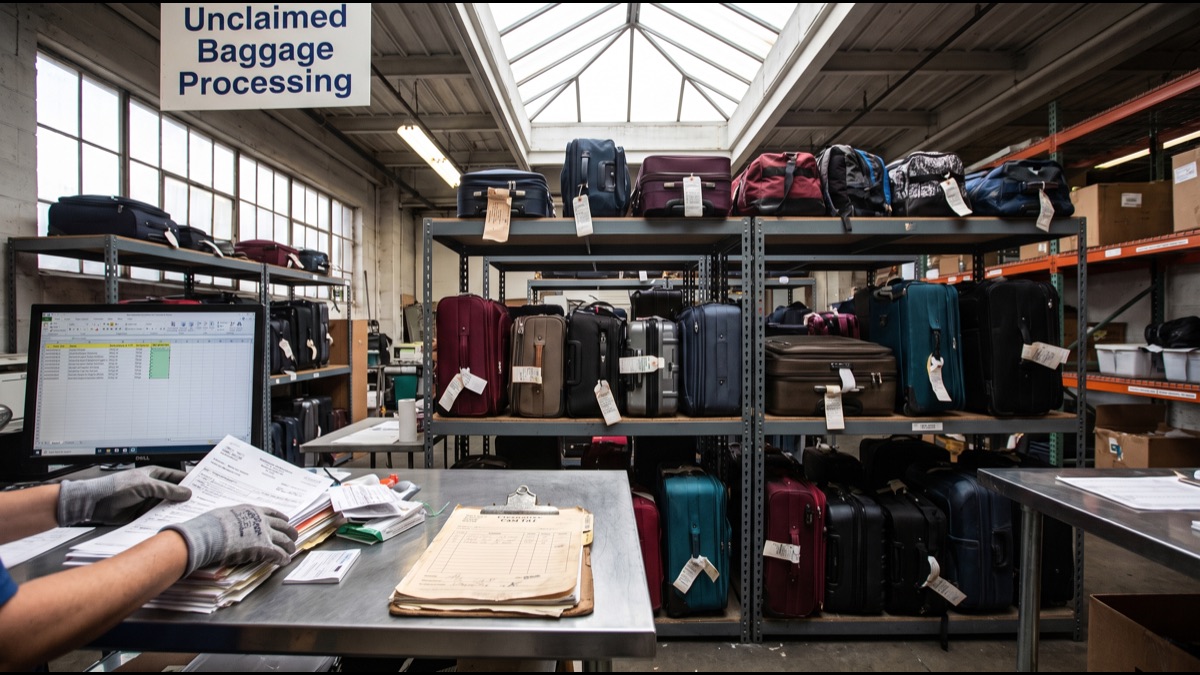
Airports maintain dedicated storage areas for unclaimed baggage specifically for this purpose, and a bag that was scanned onto the wrong flight can sometimes sit unclaimed at a distant airport for an extended period before staff there manually notice and match it against an open tracing request from a completely different city.
If this extended search fails to produce a match within the airline's defined window, the case transitions from a delayed-bag claim to a lost-bag claim, triggering a different and more formal compensation process rather than simply continuing indefinitely as an open search with no resolution timeline attached.
How Compensation Limits Are Actually Calculated
For international flights, compensation for a genuinely lost bag is governed by the Montreal Convention, an international treaty that caps liability at a fixed amount denominated in Special Drawing Rights, an International Monetary Fund accounting unit, rather than at the actual replacement value of whatever the passenger happened to be carrying.
This cap, translating to roughly 1,600 to 1,800 US dollars depending on current exchange rates, applies regardless of whether the bag actually contained items worth considerably more, meaning passengers carrying particularly valuable items are generally advised to declare excess value in advance or carry such items separately, since the treaty cap is a genuine hard ceiling rather than a starting negotiating position.
Within that overall cap, airlines typically require an itemized inventory of the bag's contents with estimated values, and most apply depreciation to used items rather than reimbursing original purchase price, treating a two-year-old jacket, for instance, at a fraction of its retail cost rather than its full original price.
Why International and Domestic Rules Differ
Domestic flights within a single country typically fall under that country's own aviation regulations rather than the Montreal Convention, which can produce meaningfully different compensation caps, documentation requirements, and claim deadlines depending entirely on which specific national framework applies to a given itinerary.
In the United States, for example, domestic liability limits are set separately by the Department of Transportation and have historically been adjusted upward periodically to account for inflation, producing a cap that has moved independently of the Montreal Convention's international figure over the years covered by each respective framework.
Passengers on itineraries mixing domestic and international segments should generally expect the rules of whichever specific segment the mishandling occurred on to govern their claim, which can create genuine confusion when a bag is lost during a connection between a domestic and an international leg of the same overall journey.
What You Actually Need to Prove a Claim
Airlines generally require the original Property Irregularity Report number, boarding passes or e-ticket confirmation, baggage claim tags if retained, and a detailed itemized list of the bag's contents with estimated value, ideally supported by receipts, photographs, or credit card statements for higher-value items included in the claim.
Passengers who photograph their packed luggage before departure, a habit increasingly recommended by consumer advocacy groups and even by some airlines themselves, put themselves in a considerably stronger position when a claim requires demonstrating what a bag actually contained, since airlines are understandably skeptical of itemized lists submitted with no supporting evidence whatsoever.
Claims lacking sufficient documentation are not necessarily rejected outright, but they are typically settled at the lower end of the plausible range, or sometimes at a flat standard amount, rather than at whatever figure the passenger initially claimed, making documentation quality a genuinely significant factor in the final settlement amount received.
How Airlines Decide What to Reimburse
Claims adjusters, whether airline staff or a contracted third-party claims service many carriers now use, generally cross-reference the submitted itemized list against typical contents for a bag of that size and the traveler's stated trip purpose, flagging unusually high-value claims for additional scrutiny or documentation requests before final settlement.
Depreciation schedules applied to clothing, electronics, and other used goods vary by airline but generally follow an industry-standard pattern reducing reimbursable value by a set percentage per year of estimated age, meaning a claim listing brand-new, unworn items with retained receipts is settled considerably more favorably than an identical list of well-used equivalent items.
Certain categories, including cash, jewelry, electronics beyond a certain declared value, and business documents, are frequently excluded entirely from standard baggage liability coverage under the fine print of most carriers' conditions of carriage, regardless of how thoroughly a passenger documents having packed them.
The Interim Expenses Allowance
While a bag remains delayed but not yet declared lost, most airlines provide a separate interim expenses allowance intended to cover essential items the passenger needs during the delay period, typically covering basic toiletries and a change of clothing appropriate to the destination's climate and the length of the anticipated delay.
This allowance is deliberately modest and explicitly distinct from eventual lost-bag compensation, meaning receiving reimbursement for emergency purchases during a delay does not reduce or replace whatever compensation is later due if the bag is ultimately declared permanently lost after the tracing window closes.
Passengers are generally required to keep receipts for interim purchases and submit them promptly, since airlines typically impose their own deadline, often 30 to 45 days from the incident, after which interim expense reimbursement requests may be declined regardless of how legitimate the original delay was.
What Happens to Bags Declared Permanently Lost
Once the tracing window formally closes and a bag is reclassified as permanently lost, most airlines require the passenger to submit a final formal claim within a specific deadline, commonly between six months and two years depending on jurisdiction and the specific carrier's own conditions of carriage.
Compensation is then typically calculated using the itemized contents list, subject to depreciation and the overall liability cap discussed earlier, and paid out as a lump sum, generally by bank transfer or check, closing the case formally from the airline's perspective regardless of whether the bag is subsequently found somewhere in the system months later.
Bags that are eventually located after a claim has already been paid out are typically offered back to the original owner, who then has the option of returning the received compensation and keeping the recovered items, or in some cases keeping both under specific circumstances the airline defines in its own policy.
How Connecting Flights Complicate Everything
Itineraries involving a connection, particularly one switching between two different airlines rather than staying with a single carrier, introduce a genuine complication in determining liability, since the airline actually responsible for a bag going missing during a self-transfer connection can become a point of dispute between carriers before a passenger's claim is even processed.
Most passengers dealing with a multi-airline itinerary are advised to file their initial report with the final operating carrier of their journey, the airline whose flight they were on when they discovered the bag missing, since that carrier is generally responsible for coordinating the claim even if the mishandling actually occurred on an earlier connecting segment operated by a different airline entirely.
Codeshare flights, where one airline sells tickets for a flight actually operated by a different carrier, add a further layer of complexity, since passengers may be uncertain which airline's baggage policies and liability limits actually apply, a question generally resolved by looking at which airline's aircraft and crew were actually operating the specific flight segment where the mishandling occurred.
What Actually Improves Your Odds of a Fast Resolution
Filing the Property Irregularity Report at the airport before leaving, rather than attempting to report a missing bag later by phone or online, remains the single most impactful action available to a passenger, since it starts the tracing clock immediately and creates the documentary anchor every subsequent step of the process depends on.
Photographing packed luggage before departure, retaining boarding passes and baggage tags until any potential claim is fully resolved, and keeping a simple written inventory of higher-value items are all low-effort habits that meaningfully strengthen a passenger's position if a bag genuinely does go missing rather than merely being delayed.
Persistent, polite follow-up through the airline's dedicated baggage service channel, rather than general customer service, tends to produce faster responses, since baggage claims teams are typically a distinct, more specialized unit better equipped to check tracing system updates than general call center staff handling unrelated inquiries.
How Travel Insurance Interacts With Airline Compensation
Many travel insurance policies include a baggage delay and loss benefit that operates alongside, rather than instead of, whatever the airline itself pays, meaning a traveler can sometimes recover additional amounts beyond the airline's Montreal Convention cap by filing a supplementary claim with their own insurer once the airline's settlement is finalized.
Insurers typically require documentation of the airline's own settlement before processing a supplementary claim, specifically to avoid double-paying for the same lost item, and most policies explicitly subtract whatever the airline already paid from the insurer's own payout calculation rather than treating the two sources as fully independent windfalls.
Credit cards used to purchase the ticket sometimes provide a similar baggage protection benefit automatically, another potential recovery source travelers frequently overlook, though these benefits typically carry their own separate documentation deadlines and exclusion lists that differ from both the airline's rules and any standalone travel insurance policy purchased for the same trip.
Common Mistakes That Slow Down a Claim
The single most damaging mistake is leaving the airport without filing a Property Irregularity Report, trusting instead that the bag will simply turn up or attempting to report it later by phone, since without that initial report the tracing system never actually begins searching and the passenger has no documented timeline to point to later.
Submitting a vague, unsupported list of contents with round, generous estimated values rather than a specific itemized inventory tends to trigger additional scrutiny and delay rather than a faster settlement, since adjusters generally treat unusually high or imprecise claims as requiring further verification before approval.
Failing to track the airline's own claim deadlines, which vary by carrier and by whether the itinerary was domestic or international, is another common and entirely avoidable cause of otherwise legitimate claims being rejected purely on procedural grounds rather than any dispute over the underlying facts of the loss itself.
Sources
- Wikipedia — overview of the Montreal Convention and international baggage liability rules
- International Air Transport Association — industry data on baggage mishandling rates and tracing systems
- U.S. Department of Transportation — domestic baggage liability rules and consumer protection guidance
- SITA — background on WorldTracer and global baggage tracing infrastructure
- Consumer Reports — practical consumer guidance on filing lost luggage claims
FAQ
How long before a bag is officially declared lost?
Most airlines classify a bag as delayed for up to 21 days on international itineraries before reclassifying it as permanently lost and starting formal compensation.
What is the maximum compensation for a lost bag internationally?
The Montreal Convention caps liability at roughly 1,600 to 1,800 US dollars equivalent, regardless of the bag's actual contents value, unless excess value was declared in advance.
Do I need receipts to file a claim?
Receipts and photos strengthen a claim significantly; without them, claims are typically settled at the lower end of a plausible value range rather than rejected outright.
Which airline handles my claim on a multi-airline itinerary?
Generally the final operating carrier of the journey, even if the mishandling occurred on an earlier connecting segment operated by a different airline.
Can I get reimbursed for emergency purchases while my bag is delayed?
Yes — most airlines offer a separate interim expenses allowance for essentials, distinct from and not deducted from any later lost-bag compensation.
About the Author
We reference Wikipedia, International Air Transport Association, U.S. Department of Transportation, SITA, Consumer Reports to explain the background and current understanding of this topic.
Loved This Article?
Share it on WhatsApp → Share it on WhatsApp
Get more guides in your inbox — Subscribe to our newsletter for weekly surprising stories from Egypt, Saudi Arabia, Dubai, and beyond.