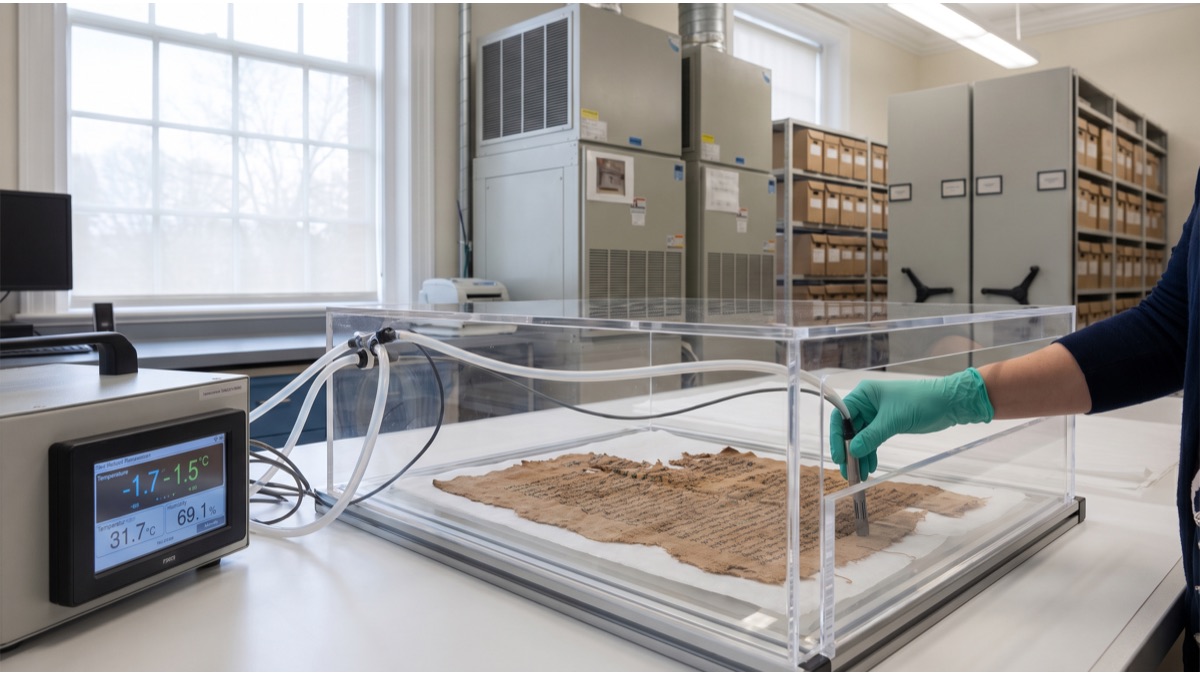
Walk into almost any major museum and the temperature feels unremarkable, the air neither warm nor cold, the humidity neither damp nor dry. That blandness is not accidental. It is the visible absence of an enormously deliberate, continuously monitored engineering effort designed specifically to keep centuries-old materials from quietly falling apart in real time, gallery by gallery, case by case.
Behind that unremarkable air sits a discipline called preventive conservation, which treats the building itself as a piece of conservation equipment. Understanding how it actually works explains why a painting can hang safely for a century in one room and visibly crack within months in another, and why museums spend far more on mechanical systems than most visitors ever notice.
Why Artifacts Are More Fragile Than They Look
Most objects in a museum collection are made of organic or semi-organic materials — wood, canvas, paper, animal-based glues, natural pigments, textiles — that continuously exchange moisture with the surrounding air. A wooden panel or a stretched canvas is not inert; it is hygroscopic, meaning it absorbs and releases water vapor as ambient humidity rises and falls, expanding and contracting by fractions of a millimeter with every shift.
Those movements are invisible in isolation but compound across seasons and years. Paint layers that expand at a different rate than the wood or canvas beneath them eventually crack, flake, or delaminate, while metal objects corrode faster in humid air and stone can spall as trapped moisture freezes or crystallizes salts within its pores.
Because this deterioration is cumulative and largely irreversible, conservation science has shifted its focus away from repairing damage after the fact and toward preventing the environmental conditions that cause it in the first place, which is precisely the job climate control systems are engineered to do.
What Relative Humidity Actually Does to Materials
Relative humidity, the amount of moisture air holds relative to what it could hold at that temperature, is generally considered the single most influential factor in artifact decay, more consequential than temperature on its own for most organic materials. Many institutions target roughly 45-55%, a band broad enough to avoid the extremes of both desiccation and dampness.
Air that is too dry causes organic materials to lose bound moisture, becoming brittle, shrinking, and cracking, an effect visible in warped wooden panels and curling parchment. Air that is too humid encourages mold growth, accelerates chemical degradation, and can cause metal fastenings or frames to corrode and stain the materials around them.
Because different collections were made under different historical climates, a single universal humidity target is somewhat artificial, and modern conservation increasingly sets targets based on an object's own material history and prior storage conditions rather than one figure applied uniformly across an entire building.
Why Stability Matters More Than the Exact Number
A common misconception is that hitting a precise humidity number matters more than anything else. In practice, the rate and frequency of change matters at least as much as the absolute figure, because materials respond to fluctuation, not to a static condition, however imperfect that condition might be.
A gallery held steadily at 50% humidity causes an object far less physical stress than one that swings repeatedly between 35% and 65% even if the swinging gallery averages out to the same midpoint over a year. Repeated expansion and contraction fatigues materials in much the way repeated bending fatigues metal, eventually producing cracks that a single, unchanging condition would never have caused.
This is why modern museum engineering increasingly emphasizes damping out short-term swings and slow seasonal drift rather than chasing an exact figure every hour, and why some institutions have deliberately relaxed their historical targets slightly to reduce energy consumption without materially increasing risk to the collection.
How Gallery HVAC Differs From Ordinary Air Conditioning
Museum heating, ventilation, and air conditioning systems share basic components with a commercial office building, but the engineering tolerances are considerably tighter. Ordinary building HVAC is designed around human comfort, which tolerates a fairly wide temperature and humidity range, while gallery systems must independently regulate temperature and humidity to narrow bands simultaneously, a genuinely harder control problem.
Achieving this typically requires dedicated air handling units with reheat coils, humidification and dehumidification stages working in tandem, and sensors distributed throughout each gallery rather than a single thermostat for an entire zone, feeding a building management system that continuously adjusts output in response to real conditions rather than a fixed schedule.
Ductwork routing, filtration, and even the physical sealing of a gallery envelope are all considered conservation infrastructure in this context, since air leakage around windows or doors can undermine the most sophisticated mechanical system by allowing uncontrolled outdoor air to bypass it entirely.
Why Different Materials Need Different Microclimates
A single museum rarely maintains one climate throughout the entire building. Metals generally tolerate lower humidity better and prefer drier conditions to slow corrosion, while wooden furniture and panel paintings need a moderate, stable band to avoid cracking, and archival paper collections often require cooler temperatures specifically to slow chemical aging of the paper itself.
This means a natural history department, a paintings gallery, and a paper archive within the same institution may run under meaningfully different setpoints, each optimized for the specific material vulnerabilities of what it holds rather than a single compromise value applied indiscriminately across the whole building.
Managing several distinct microclimates under one roof adds considerable mechanical complexity, requiring zoned systems, separate air handling for archival storage versus public galleries, and careful attention to the boundaries between zones so that air does not simply migrate from one controlled space into another and undermine both.
How Display Cases Create Their Own Controlled Environments
For the most sensitive objects, museums often go a step further than room-level climate control and build the microclimate directly into the display case itself. Sealed cases with buffering materials such as conditioned silica gel can hold a stable internal humidity for months, largely independent of fluctuations in the surrounding gallery air.
This approach is particularly valuable for objects on long-term loan from institutions with different environmental standards, or for historically significant items too fragile to expose to the wider gallery's inevitable, if small, daily variation, giving conservators a second, more precise layer of control on top of the building system.
The tradeoff is that sealed cases require periodic monitoring and buffer material replacement, since a case that appears sealed and stable can drift silently over months if the buffering material becomes saturated or depleted without anyone noticing until damage has already begun.
Why Light Exposure Is Managed Alongside Climate
Climate control addresses moisture and temperature, but light is an equally serious threat to organic materials and is managed as part of the same overall conservation strategy. Ultraviolet and even visible light break down pigments and fibers through photochemical reactions that are entirely separate from, but compound, the physical stress of humidity fluctuation.
Museums typically filter UV light almost entirely through window films and specialized glazing, and further limit total visible light exposure using dimmable lighting, timed gallery lighting schedules, and rotating especially light-sensitive works such as watercolors and textiles out of permanent display after a defined cumulative exposure limit.
This is also why some galleries feel noticeably dimmer than a typical retail or office space, a deliberate tradeoff between visitor visibility and cumulative light damage that curators and conservators negotiate object by object rather than applying a single lighting standard throughout the building.
How Pollutants and Particulates Are Filtered Out
Airborne pollutants, including sulfur compounds, ozone, and fine particulates carried in from outdoor air or generated by visitors and building materials themselves, accelerate chemical degradation and cause visible soiling on porous surfaces over time. Museum air handling systems typically include multiple stages of particulate and, increasingly, gas-phase filtration specifically to intercept these before they reach gallery air.
Interior finishes are also chosen with this in mind, since certain woods, adhesives, and paints off-gas compounds that can react with metals or dyes inside nearby display cases, which is why conservation-grade construction materials are specified for new galleries and case interiors rather than standard commercial-grade equivalents.
Visitor volume itself is a measurable pollutant and humidity load in high-traffic institutions, meaning that popular temporary exhibitions sometimes require supplemental air handling capacity calculated specifically around expected crowd size rather than the building's baseline design conditions.
What Happens During Transport and Museum Loans
Objects traveling between institutions for temporary exhibitions face the single greatest environmental risk of their display life, since they leave the controlled building envelope entirely and pass through loading docks, aircraft holds, and trucks where conditions are largely outside the lending museum's control.
Specialized transport crates address this by creating a sealed, insulated microclimate around the object using buffering materials similar to display cases, engineered to hold a stable internal condition for the duration of the journey regardless of what the surrounding vehicle or storage area is experiencing outside the crate.
Loan agreements between institutions typically specify acceptable environmental ranges, required data logging throughout transit, and acclimatization periods once the object arrives, allowing it to adjust gradually to the receiving gallery's conditions rather than being unpacked directly into a potentially different climate.
How Storage Vaults Differ From Public Galleries
The vast majority of most museum collections are never on public display at all, held instead in dedicated storage facilities that can be engineered to far tighter and more stable tolerances than a gallery, since they do not need to accommodate visitor comfort, natural light, or public circulation.
These vaults often run cooler and drier than public spaces, particularly for archival paper, photographic film, and certain organic specimens where slower chemical aging is the primary conservation goal, and access is typically restricted specifically to limit the frequency of door openings that introduce outside air.
Purpose-built storage architecture, including dense shelving systems and climate zoning by material type, allows institutions to extend the working life of a much larger share of their collection than gallery-level climate control alone could achieve for the entire holding.
Why a Climate Failure Can Cause Irreversible Damage
Mechanical failures, whether a burst pipe, an HVAC outage during extreme weather, or a simple sensor malfunction that goes unnoticed overnight, represent one of the most serious operational risks a museum manages, precisely because the resulting damage to organic materials is frequently irreversible.
A sudden humidity spike from a leak can cause mold to establish itself within days, while a prolonged dry spell from a failed humidification system can crack panel paintings in ways no subsequent conservation treatment can fully undo, which is why institutions invest heavily in redundant sensors, automated alerts, and backup mechanical capacity.
Emergency response planning, including pre-positioned drying equipment and trained disaster response teams, has become a standard part of institutional risk management specifically because prevention is dramatically cheaper and more effective than any recovery effort undertaken after environmental damage has already occurred.
How Museums in Hot, Humid Climates Adapt
Institutions operating in naturally hot, humid environments face a considerably harder engineering problem than those in temperate climates, since the gap between outdoor and target indoor conditions is far larger and must be maintained continuously rather than seasonally.
Museums built in such regions, including newer Gulf institutions, typically invest in oversized dehumidification capacity relative to comparable buildings elsewhere, heavier building envelope insulation to reduce the mechanical load, and vapor barriers specifically designed to prevent moisture migration through walls from the exterior humid air into climate-controlled interior spaces.
The energy cost of maintaining stable interior conditions against a consistently hostile exterior climate is substantial, which has pushed several newer institutions in hot climates toward more sophisticated building envelope design from the outset rather than relying purely on mechanical brute force to compensate for a leakier building.
What Conservators Actually Monitor Day to Day
Modern museums rely on networks of data loggers distributed throughout galleries, storage areas, and display cases that record temperature and humidity continuously, feeding dashboards that conservation staff review regularly rather than relying on occasional spot checks with a handheld meter.
This continuous record allows staff to catch gradual drift long before it becomes visible damage, to correlate any condition changes in an object with specific environmental events, and to build an evidence base justifying environmental targets for that specific collection rather than relying purely on generic published guidelines.
Condition reports, periodic physical inspection of vulnerable objects, and photographic documentation over time complement the purely mechanical monitoring, since some forms of deterioration are easier to detect by direct examination than by any sensor reading alone.
Why Climate Control Is a Continuous Investment, Not a Fix
Climate control is not a system that is installed once and then forgotten. Filters need replacement, sensors drift out of calibration, buffering materials in display cases become saturated, and building envelopes degrade over years in ways that gradually undermine even a well-designed original system if left unmaintained.
Museums that treat environmental control as ongoing operational spending rather than a one-time capital project tend to protect their collections far more effectively over decades than those that install sophisticated systems and then defer the maintenance and monitoring that keeps them performing as designed.
Understood this way, the unremarkable, forgettable air inside a gallery is not an absence of effort but its most successful outcome: a continuously engineered, continuously maintained environment quiet enough that visitors never have reason to think about it at all, while doing the invisible work of keeping irreplaceable material culture intact for the next generation to see.
Sources
- Wikipedia — overview of conservation and restoration practice, including preventive conservation
- International Council of Museums (ICOM) — global museum standards and conservation guidance
- Getty Conservation Institute — research on environmental management for cultural heritage collections
- Smithsonian Museum Conservation Institute — technical guidance on preventive conservation and environmental monitoring
- UNESCO — international guidance on protecting cultural heritage and museum collections
FAQ
What humidity level do most museums target?
Many institutions aim for roughly 45-55% relative humidity, though the ideal figure varies by collection type and some museums now accept a wider seasonal drift to reduce energy use.
Why is stable temperature more important than a specific number?
Materials expand and contract with every fluctuation, so repeated swings cause more cumulative stress and cracking than a constant temperature that is merely a few degrees off the theoretical ideal.
Can climate control alone stop artifact decay?
No — climate control slows chemical and physical degradation dramatically but cannot halt it entirely, which is why conservators also manage light, pollutants, and periodic condition assessments.
How do museums protect art during shipping?
Loaned works travel in sealed, insulated crates with buffering materials that hold a stable internal microclimate for days, independent of conditions in the truck, aircraft hold, or loading dock.
Why do older buildings struggle to meet modern climate standards?
Historic buildings were rarely designed with sealed envelopes or space for modern ductwork, forcing museums to retrofit systems or rely more heavily on individually controlled display cases.
About the Author
We reference Wikipedia, the International Council of Museums, the Getty Conservation Institute, the Smithsonian Museum Conservation Institute, and UNESCO to explain the background and current understanding of this topic.
Loved This Article?
Share it on WhatsApp → Share it on WhatsApp
Get more guides in your inbox — Subscribe to our newsletter for weekly surprising stories from Egypt, Saudi Arabia, Dubai, and beyond.