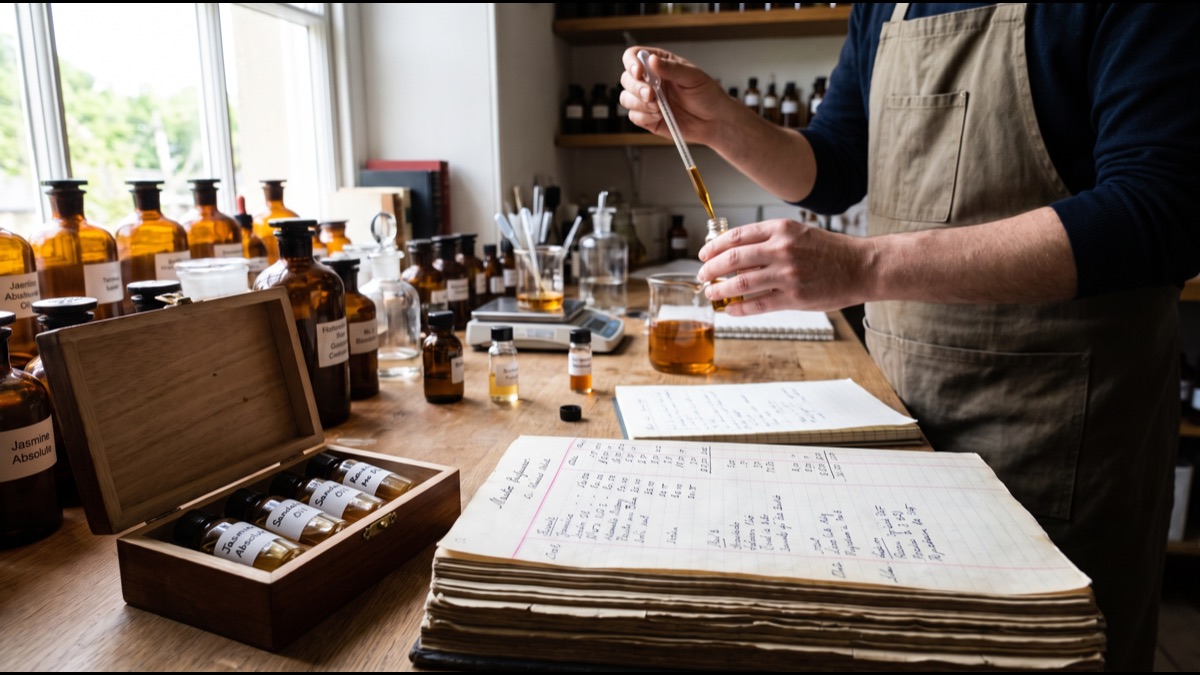
A bottle of perfume that retails for two hundred dollars can contain raw liquid worth only a few dollars, and that gap is not simply markup greed but the visible tip of an entire industry built on invisible, carefully engineered chemistry. What actually costs money in perfume is rarely the fragrance oil itself; it is the years of formula development, the rare or difficult-to-source materials in small quantities, and the branding, packaging, and marketing machinery required to make a stranger want to smell like a specific idea rather than any other.
Understanding how a fragrance is actually blended starts with recognizing that a perfume is not one smell but a structured sequence of many, deliberately engineered to unfold differently over the hours it sits on skin. What you smell in the first five minutes, the next hour, and six hours later can be almost entirely different compounds, evaporating at different rates according to their own molecular weight and volatility.
This layered structure, formalized by perfumers more than a century ago into what the industry still calls the fragrance pyramid, is why a scent that seems overwhelming in the store can smell completely different, often better, once it has actually dried down on a person's own skin chemistry for a while.
The economics behind that structure are just as engineered as the chemistry. Every tier of a formula, every concentration label on a bottle, and every regional preference in how strong a scent should be, from Gulf attar traditions to lighter European colognes, reflects deliberate decisions perfumers and fragrance houses make long before a bottle ever reaches a shelf.
How the Fragrance Pyramid Actually Structures a Scent
Perfumers organize a fragrance formula into three tiers, commonly called top notes, heart or middle notes, and base notes, based primarily on how quickly each ingredient evaporates once exposed to air and skin warmth, a property chemists refer to as volatility.
This structure is often visualized as a pyramid because the top tier typically contains the lightest, smallest, and most volatile molecules, present in relatively modest concentration, while the base tier contains heavier, larger, and much less volatile molecules that persist far longer but usually contribute a broader, more foundational character rather than sharp, immediately identifiable detail.
The pyramid is not simply an aesthetic metaphor; it directly reflects real, measurable evaporation rates. A perfumer building a formula essentially chooses which molecules will announce the fragrance in the first instant, which will define its personality for the bulk of the wear time, and which will remain detectable on skin or fabric long after the initial impression has faded entirely.
Why Top Notes Vanish First and What Actually Replaces Them
Top notes, sometimes called head notes, are typically built from small, highly volatile molecules such as citrus oils, light florals, or fresh green accords, chosen specifically because they evaporate within the first fifteen to thirty minutes of application and create the crucial, immediate first impression that determines whether a shopper decides to keep smelling a fragrance at all.
Because top notes are so fleeting, perfumers do not expect them to carry the fragrance's actual identity; their job is almost purely psychological, a bright, attractive opening statement designed to draw the wearer and people nearby into the scent before the more substantial middle and base structure has had time to fully emerge on skin.
This is precisely why judging a perfume purely by a quick sniff of the bottle or a paper strip in a store is genuinely misleading: what a shopper smells in those first seconds is disproportionately the top notes, a fraction of the full composition, and largely gone within the hour that actually matters for how the fragrance will read for the rest of the day.
How Heart Notes Actually Define a Perfume's Character
Heart notes, also called middle notes, emerge as the top notes fade, typically becoming dominant somewhere between twenty minutes and two hours after application, and are generally considered the true core identity of a fragrance, the notes a perfumer intends people to actually remember and associate with the scent overall.
Common heart-note materials include rose, jasmine, and other rich florals, along with spice accords like cardamom or cinnamon, and these ingredients are chosen both for their inherent character and, critically, for how well they bridge the volatile top notes above them with the heavier, longer-lasting base notes below, smoothing what would otherwise be an abrupt transition into something that reads as a single coherent scent rather than three unrelated smells layered on top of each other.
Perfumers often describe heart-note selection as the most technically demanding part of formula-building, since these materials have to work in harmony with both faster and slower evaporating ingredients simultaneously, a genuinely difficult balancing act that separates a formula that smells expensive and cohesive from one that smells disjointed or unbalanced on skin.
Why Base Notes Actually Anchor a Fragrance for Hours
Base notes are built from the heaviest, slowest-evaporating molecules in a formula, materials like sandalwood, musk, amber, vanilla, and oud, which can remain detectable on skin or fabric for many hours after application and, in some cases, the following day, and their primary job is providing longevity and depth rather than an immediately identifiable, sharp character.
Because base notes evaporate so slowly, they also function as fixatives, chemically slowing the evaporation rate of the more volatile top and heart notes above them, which is exactly why a well-constructed base structure genuinely extends how long an entire fragrance lasts on skin, not merely how long the base notes themselves remain detectable.
This fixative role is one reason certain base materials, particularly natural musk derivatives, ambergris, and aged sandalwood, became historically prized and, in several cases, genuinely scarce, which pushed the fragrance industry toward developing synthetic alternatives capable of reproducing similar fixative and olfactory properties without depending on animal products or slow-growing, over-harvested trees.
How Natural and Synthetic Ingredients Actually Compare
Natural aromatic materials are extracted directly from plants, flowers, resins, woods, or, in a small number of traditional cases, animal sources, typically through steam distillation, solvent extraction, or cold pressing, processes that can require an enormous quantity of raw plant material to produce a genuinely small volume of usable oil.
Synthetic aromatic molecules, by contrast, are created in a laboratory, either by isolating and reproducing a specific molecule that also exists in nature or by engineering an entirely novel molecule that has no direct natural equivalent at all, and the popular assumption that synthetic automatically means inferior or cheap badly misrepresents how the modern fragrance industry actually works.
Many of perfumery's most celebrated and expensive fragrances rely heavily on synthetic molecules specifically because certain effects, a genuinely clean, sparkling aldehydic opening, a photorealistic marine or ozonic accord, or a musk that smells soft and skin-like rather than animalic, simply do not exist as extractable natural materials and can only be created synthetically in a laboratory.
Synthetics also serve a genuinely important conservation function: species like sandalwood, agarwood, and various musk-producing animals have faced real, well-documented pressure from unsustainable harvesting driven by fragrance demand, and high-quality synthetic alternatives allow perfumers to recreate a similar olfactory profile without contributing further to the depletion of naturally slow-growing or endangered sources.
Why a Perfumer's Nose Takes Years to Actually Train
A professional perfumer, sometimes still called a "nose" within the industry, typically trains for five to seven years, often through a formal perfumery school or an intensive apprenticeship inside a major fragrance house, memorizing the character, intensity, and evaporation behavior of many hundreds, eventually thousands, of individual aromatic materials well enough to combine them mentally before ever mixing a physical sample.
This training is genuinely closer to a musician learning to compose by ear than to a chemist following a recipe, since a trained perfumer has to hold in memory not just what an individual material smells like in isolation, but how it will interact, sometimes unpredictably, with dozens of other materials simultaneously present in a working formula, and how that entire combination will shift as the different materials evaporate at different rates over time.
Only a relatively small number of perfumers worldwide work at the most senior levels of the largest fragrance houses, and their names, once largely anonymous even on the products they created, have increasingly become genuine marketing assets in their own right, with some contemporary niche and luxury brands explicitly naming and promoting the specific perfumer behind a given release.
How Long a Fragrance Formula Actually Takes to Develop
Developing a new commercial fragrance formula from initial concept to a final, approved version generally takes anywhere from twelve months to several years, depending on the complexity of the brief, the number of revisions requested by the commissioning brand, and how thoroughly the formula needs to be tested for stability, skin safety, and consistent performance across different climates and storage conditions.
A perfumer typically produces dozens, sometimes hundreds, of successive formula variations, called "mods" or modifications, over the course of development, adjusting the ratio and selection of specific materials in response to feedback from the client brand's marketing and evaluation teams, a genuinely iterative process closer to product engineering than to a single moment of creative inspiration.
Regulatory compliance adds significant additional time to development as well, since fragrance formulas must be tested and adjusted to comply with international safety standards set by organizations like the International Fragrance Association, which restrict or cap the permitted concentration of numerous individual materials based on documented allergy and sensitization data.
What Actually Separates Parfum From Eau de Toilette
The various concentration labels found on perfume bottles, parfum or extrait, eau de parfum, eau de toilette, and eau de cologne, refer specifically to the percentage of concentrated aromatic oil dissolved in the alcohol and water base, not to different formulas or different quality tiers as many shoppers assume.
Parfum, also called extrait de parfum, typically contains roughly twenty to thirty percent aromatic concentrate, the highest common concentration, resulting in the strongest projection and longest wear time, while eau de parfum generally falls between fifteen and twenty percent, eau de toilette between five and fifteen percent, and eau de cologne typically between two and four percent, each step down generally trading intensity and longevity for a lighter, more casual, and often less expensive product.
Because the same underlying formula can often be diluted to different concentration tiers, a fragrance house can sell essentially the same creative composition across an entire product line at different price points and for different occasions, which is exactly why an eau de toilette and a parfum from the same collection can smell recognizably related but noticeably different in intensity and how long they actually last on skin.
Why Raw Material Cost Is Actually a Small Slice of Price
Industry cost breakdowns for mainstream, mass-market fragrances consistently show that the actual liquid inside the bottle, including even relatively expensive natural materials, typically represents a genuinely small percentage of the final retail price, often estimated in the low single digits to low teens percentage range depending on the brand tier and positioning.
The overwhelming majority of retail price is instead consumed by bottle design and glass manufacturing, outer packaging, advertising campaigns and celebrity endorsement fees, retailer and distributor margins, and the brand's own overhead and profit expectations, a cost structure that explains why two fragrances with genuinely similar raw ingredient costs can carry wildly different price tags depending purely on brand positioning.
Niche and luxury fragrance houses generally justify meaningfully higher prices through a combination of factors that do carry real cost, rarer or higher-grade raw materials, smaller production runs that lose economies of scale, more elaborate bottle and packaging design, and often genuinely longer formula-development timelines, though the relative weight of pure marketing spend versus authentic material cost still varies enormously across brands.
How a Fragrance House Actually Costs and Prices a Launch
When a fragrance house prices a new launch, the process typically begins with calculating the fully loaded cost per bottle, the concentrate, the alcohol and water base, the bottle and cap, the outer carton, and labor, then adding a target margin that must also cover the brand's marketing budget, distribution costs, and retailer markups before the product ever reaches a customer.
Retail markup structures in fragrance are notoriously steep compared to many other consumer categories, with brands commonly pricing a finished product at somewhere between four and ten times its fully loaded production cost, a multiple that has to absorb advertising spend, celebrity or influencer partnership fees, and substantial margin for both the brand itself and the retailers who stock and sell the product.
Limited or exclusive releases, smaller production batches, rarer packaging materials, and prestige positioning allow houses to command meaningfully higher multiples still, which is part of why niche and artisanal fragrance segments have grown so significantly in recent years: they let smaller houses charge premium prices without needing the enormous global advertising budgets that mass-market brands require to justify their own pricing.
Why the Gulf Actually Drives So Much of the Global Fragrance Market
The Gulf region, and the UAE and Saudi Arabia specifically, represents one of the highest per-capita fragrance spending markets in the world, driven by deeply rooted cultural traditions around scent as an expression of hospitality, personal identity, and social status that long predate the modern Western perfume industry.
This regional demand has meaningfully shaped global fragrance formulation itself, since many international houses now specifically develop stronger, oud-forward, and longer-lasting formulas tailored to Gulf preferences, both for direct regional sale and, increasingly, as standalone product lines exported to a growing global audience with a taste for richer, more intense compositions.
Dubai in particular has developed into a genuine regional and increasingly global fragrance manufacturing and trading hub, home to both major regional perfume houses producing oud-based compositions at scale and to the free-zone infrastructure that international fragrance and raw-material companies use to distribute across the wider Middle East, Africa, and South Asia.
How Oud and Attar Traditions Actually Shape Regional Formulas
Oud, the resinous, fragrant wood produced when Aquilaria trees become infected with a specific mold and respond by producing a dense, aromatic resin in self-defense, has been prized across the Gulf and broader Middle East for centuries, traditionally burned as incense or worked into oil-based fragrances rather than the alcohol-based formulas dominant in Western perfumery.
Attar, an oil-based perfume tradition using ingredients steeped or distilled directly into a carrier oil rather than alcohol, remains widely used and commercially significant across the region, prized partly because oil-based fragrances behave differently on skin, generally developing more slowly and clinging closer to the body rather than projecting broadly outward the way alcohol-based sprays typically do.
Genuine natural oud, particularly from older, wild-harvested trees, is now genuinely scarce and can be extraordinarily expensive per gram, which has driven both a significant plantation-cultivation industry across Southeast Asia specifically to meet Gulf demand and a parallel synthetic oud category that reproduces the material's distinctive smoky, animalic character at a fraction of the cost of the genuine resin.
Why Concentration Strength Actually Matters More in Hot Climates
Fragrance perception and projection are meaningfully affected by ambient temperature and humidity, since heat accelerates the evaporation rate of aromatic molecules, which means a fragrance genuinely smells stronger and fades faster in a hot climate than the identical formula would in a cooler one, a well-documented effect perfumers explicitly account for during formulation.
This is a significant part of why Gulf consumers, along with fragrance markets in other consistently hot regions, have historically gravitated toward higher-concentration parfum and attar formats over the lighter eau de toilette and eau de cologne tiers more common in cooler European markets, since a lighter concentration can simply evaporate too quickly to remain detectable through a hot day.
Fragrance houses selling into the region have responded by formulating region-specific concentration variants of popular releases, sometimes labeled distinctly for Gulf distribution, reflecting a genuine, climate-driven functional requirement rather than purely a marketing or cultural preference layered on top of an otherwise identical global product.
Sources
- Wikipedia — overview of perfume composition, concentration tiers, and the fragrance industry
- International Fragrance Association — safety standards and permitted-material guidance for the global fragrance industry
- Wikipedia — background on agarwood and oud formation, harvesting, and trade
- Dubai Chamber of Commerce — regional context on the UAE's fragrance manufacturing and trading sector
FAQ
What is the fragrance pyramid?
It is the standard model perfumers use to describe how a scent unfolds over time, dividing a formula into top, heart, and base notes based on how quickly each ingredient evaporates.
Are synthetic fragrance ingredients worse than natural ones?
Not inherently; many prized effects cannot be produced from natural materials at all, and synthetics also help protect endangered natural sources like sandalwood and certain musk-producing species from overharvesting.
What is the actual difference between eau de parfum and eau de toilette?
Primarily the concentration of aromatic oil in the formula; eau de parfum generally contains fifteen to twenty percent, while eau de toilette contains roughly five to fifteen percent, affecting strength and how long the scent lasts.
Why does perfume cost so much more than the raw ingredients inside it?
Because packaging, advertising, celebrity endorsements, and retail and distribution margins typically account for the large majority of retail price, while the aromatic liquid itself is often a small fraction of the total cost.
Why is oud so important in Gulf fragrance culture?
Oud has been prized across the region for centuries as incense and in oil-based attar perfumes, and genuine wild oud has become scarce and expensive, driving both plantation cultivation and high-quality synthetic alternatives.
Why do fragrances often smell stronger in hot climates?
Heat accelerates evaporation of aromatic molecules, making a fragrance project more intensely but also fade faster, which is part of why higher-concentration formats are historically popular in hot regions like the Gulf.
About the Author
We reference Wikipedia and other authoritative sources to explain the background and current understanding of this topic.
Loved This Article?
Share it on WhatsApp → Share it on WhatsApp
Get more guides in your inbox — Subscribe to our newsletter for weekly surprising stories from Egypt, Saudi Arabia, Dubai, and beyond.