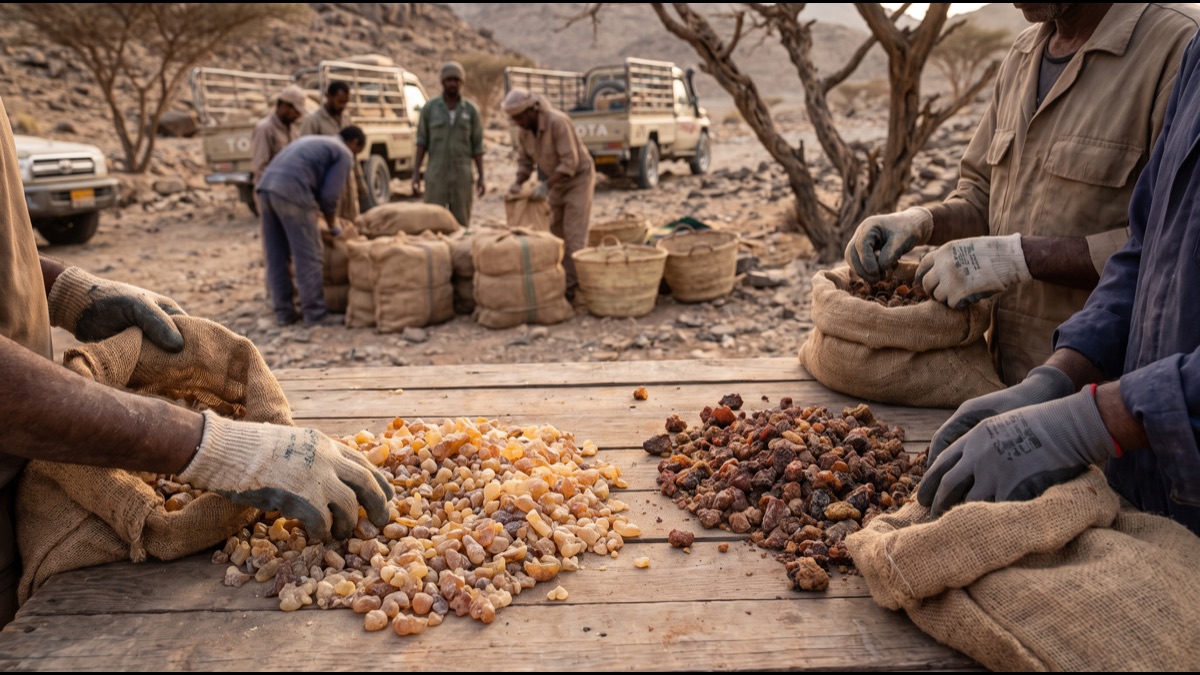
Long before the Arabian Peninsula became synonymous with oil wealth, it grew rich on something considerably stranger: hardened tree sap scraped by hand from scrubby trees clinging to arid mountainsides. Frankincense and myrrh, the aromatic resins that once moved along caravan routes worth fortunes, are still harvested today using a method that has changed remarkably little across roughly five thousand years of continuous trade.
Understanding how this ancient industry actually works today, from the specific tree species involved to how a kilogram of premium resin actually gets priced on the modern market, reveals a genuinely rare case of a pre-industrial trade surviving essentially intact into the twenty-first century, propped up by a combination of religious ritual, luxury perfumery, and a supply chain that resists mechanization for genuinely practical reasons.
It also explains why a handful of specific valleys in southern Oman and the Horn of Africa still matter enormously to global perfume houses and incense producers, despite the broader region's economy having moved on to entirely different industries over the past century.
A Tree That Bleeds Its Own Fortune
Both frankincense and myrrh come from trees in the Boswellia and Commiphora genera respectively, hardy species adapted to survive in some of the harshest, driest terrain on earth, growing directly out of rocky mountainsides in southern Arabia and parts of the Horn of Africa where little else manages to take root.
When the bark of these trees is deliberately wounded, they respond by producing a thick, aromatic resin intended to seal the injury and protect against infection and insect damage, a defensive biological response that happens to also be one of the most historically valuable substances traded across the ancient world.
What Frankincense and Myrrh Actually Are
Frankincense, harvested from Boswellia trees, hardens into golden-to-amber colored resin tears that release a distinctive warm, slightly citrusy, woody aroma when burned, while myrrh, from Commiphora trees, hardens into darker reddish-brown tears with a more bitter, medicinal scent profile, and the two have been traded together for millennia despite coming from entirely different tree genera.
Both substances have been used historically not just as incense but as embalming agents, wound treatments, and components of traditional medicine across multiple ancient civilizations, a versatility that helps explain why demand for both resins persisted across so many different cultures and historical periods rather than being tied to a single specific use case.
The Ancient Tapping Technique That Still Works Today
Harvesters, still working almost entirely by hand today, make a series of shallow, careful cuts into the tree's bark using a specialized curved blade called a mingaf in some traditions, a tool whose basic design has remained largely unchanged for thousands of years precisely because the underlying biological process it exploits has not changed either.
The tree responds to these cuts over the following weeks by oozing resin that gradually hardens on contact with air, and harvesters return repeatedly to make additional cuts and collect the hardened resin tears, a slow, seasonal, deeply hands-on process that resists mechanization since damaging the tree too aggressively or cutting incorrectly can seriously harm or kill it.
Why the Boswellia Tree Grows Where It Grows
Boswellia trees have adapted specifically to extremely arid, rocky conditions with minimal soil, often growing directly out of cracks in bare rock faces in a narrow band of terrain spanning southern Oman, Yemen, and parts of Somalia and Ethiopia, a genuinely narrow ecological niche that concentrates the world's premium frankincense supply into a surprisingly small geographic area.
This narrow habitat range is precisely why frankincense has never become a globally distributed agricultural crop the way many other valuable plants eventually did, since the specific combination of climate, soil, and terrain the tree requires simply does not exist in most parts of the world, keeping production concentrated in the same historic regions for thousands of years.
How Harvesters Grade Resin by Eye and Touch
Experienced harvesters and traders grade resin quality through visual inspection and touch, evaluating color, clarity, size of the individual resin tears, and purity, since resin contaminated with bark fragments or dirt during collection commands a noticeably lower price than clean, pale, translucent tears from a well-managed tree.
This grading process remains almost entirely a matter of accumulated human expertise passed down through harvesting families rather than a standardized industrial testing procedure, meaning the reputation of a specific harvester or trading family, built over years of consistent quality, continues to carry genuine commercial weight in a market that still operates substantially on personal trust and relationships.
Why the Incense Route Made Southern Arabia Wealthy
For over a thousand years before the common era, camel caravans carried frankincense and myrrh north from southern Arabia through a network of trading posts and cities collectively remembered as the Incense Route, generating enormous wealth for the kingdoms controlling those routes, since demand for the resins across the ancient Mediterranean, Egyptian, and later Roman worlds was consistently strong.
Cities along this route grew wealthy primarily by taxing and provisioning the caravan trade passing through their territory rather than by harvesting the resin themselves, a pattern of wealth built on controlling trade infrastructure rather than raw production that echoes in how many resource-trade economies have historically developed around the world.
What Actually Happened When Shipping Routes Changed
The rise of maritime trade routes connecting the Arabian Peninsula, East Africa, and India by sea gradually reduced reliance on the overland caravan network, and the later expansion of European sea trade routes around Africa further eroded the strategic importance of the historic overland Incense Route cities that had grown wealthy on caravan taxation.
This shift did not eliminate demand for frankincense and myrrh themselves, which continued and continues today, but it did permanently redistribute where the trade's economic value actually accumulated, moving wealth away from overland caravan-route cities and toward coastal ports better positioned for the maritime trade that eventually came to dominate global commerce.
Why Demand Never Fully Disappeared
Unlike many ancient luxury goods that faded entirely once trade patterns shifted, frankincense and myrrh retained consistent demand across the centuries specifically because they remained deeply embedded in religious ritual across multiple major faith traditions, in traditional medicine systems still practiced today, and eventually in the modern perfume industry, which discovered new applications for the same ancient resins.
This multi-pronged, durable demand base, religious, medicinal, and later cosmetic, is precisely what has kept the harvesting industry economically viable in its historic homeland regions for thousands of continuous years, rather than the resin becoming a purely historical curiosity replaced entirely by synthetic alternatives the way many other natural products eventually were.
How Modern Buyers Actually Test Quality
Beyond the traditional visual and tactile grading harvesters perform, larger commercial buyers, particularly perfume houses sourcing resin for high-end fragrance production, increasingly use gas chromatography and other laboratory analysis techniques to verify the precise chemical composition of a given batch, confirming it matches the specific aromatic profile a fragrance formula requires.
This layering of modern laboratory verification on top of traditional hand-grading reflects the resin's dual market today, a traditional trade still substantially conducted through personal relationships and inherited expertise, increasingly intersecting with a global luxury goods industry that demands documented, verifiable, batch-consistent quality for its own commercial and regulatory purposes.
The Overharvesting Problem Nobody Saw Coming
Rising global demand for natural frankincense, driven partly by renewed consumer interest in natural and traditional products, has led to documented cases of overharvesting in some regions, where trees are tapped too frequently or too aggressively in pursuit of higher short-term resin yields, weakening or eventually killing trees that would otherwise continue producing resin for decades.
Researchers studying Boswellia populations in several harvesting regions have raised genuine concern about long-term sustainability, since overharvested trees produce measurably less resin over their remaining lifespan and reproduce less successfully, a slow-motion resource depletion problem that threatens the very supply base the modern demand boom is actually trying to satisfy.
Why Oman's Dhofar Region Still Matters So Much
The Dhofar region of southern Oman remains one of the most historically significant and highest-regarded frankincense-producing areas in the world, its specific Boswellia sacra trees credited with producing resin considered exceptionally pure and aromatically superior, a reputation that has persisted since ancient times and continues to command premium prices in the modern market.
Oman has taken deliberate steps in recent years to protect and promote this heritage, including UNESCO World Heritage recognition for specific frankincense-producing land sites in Dhofar, reflecting a broader effort to preserve both the ecological resource itself and the cultural and historical significance the trade holds for the region's identity.
How the Perfume Industry Actually Uses These Resins
Major fragrance houses use frankincense and myrrh essential oils and resin extracts, called oleoresins, as base notes in luxury perfumes, valued for their warm, complex, long-lasting aromatic qualities that help fragrances develop and change character over the hours after application, a characteristic synthetic substitutes have historically struggled to replicate convincingly.
This perfume-industry demand has become a genuinely significant modern revenue stream for the traditional harvesting trade, in some cases exceeding what religious and traditional medicinal use alone would sustain, connecting harvesters working by hand on remote Omani mountainsides directly into the global luxury fragrance supply chain in a way few other traditional resource industries have managed.
What a Kilogram Actually Costs and Why
Prices for premium-grade frankincense and myrrh vary enormously based on resin quality, tree species, harvest region, and current market demand, with the highest-grade Dhofar frankincense commanding prices many multiples higher than lower-grade resin from less prestigious harvesting regions or trees managed less carefully.
This wide price range reflects a market that, despite its ancient origins, functions in genuinely modern commercial terms, with informed buyers, particularly perfume houses and specialty incense producers, willing to pay substantial premiums for documented provenance and consistently verified quality rather than treating the resin as an undifferentiated commodity.
Why This Trade Refuses to Modernize Completely
Despite growing global demand and rising prices that would, in most other agricultural commodities, attract industrial-scale mechanized production, frankincense and myrrh harvesting has remained stubbornly small-scale and hand-driven, largely because the trees themselves grow in terrain too rugged and remote for large-scale mechanized access and because incorrect harvesting technique genuinely damages or kills the trees.
This structural resistance to industrialization has, somewhat unusually among global commodity trades, helped preserve traditional harvesting knowledge and community-based production structures that might otherwise have been displaced by large commercial operations, though it has also limited how much overall supply can realistically expand to meet rising global demand.
How Religious and Cultural Demand Shapes the Market
Frankincense remains deeply embedded in religious practice across Christianity, where it continues to be used in liturgical incense, and in various traditional Islamic and regional Gulf cultural practices where burning bakhoor and frankincense in the home for guests and special occasions remains a genuinely common, everyday cultural custom rather than a purely historical or ceremonial relic.
This sustained everyday cultural demand within the Gulf and wider region specifically, distinct from the export market feeding international perfume houses, provides a stable domestic demand base that has helped insulate the traditional harvesting trade from being entirely dependent on international luxury goods market fluctuations alone.
Why Counterfeit and Adulterated Resin Is a Real Problem
Rising prices for premium-grade frankincense and myrrh have created a genuine incentive for less scrupulous traders to blend lower-quality resin from different regions or tree species together and sell it as premium single-origin product, or in more extreme cases to mix in cheaper synthetic or plant-based substitutes entirely, a fraud that is often difficult for anyone but an experienced buyer to detect by sight alone.
This authentication problem has pushed both traditional traders and modern perfume houses toward more rigorous documentation and testing, and has also driven interest in blockchain-based and other digital provenance-tracking systems intended to verify a specific batch of resin's origin and harvesting chain all the way from a specific mountainside tree to a specific bottle of finished perfume, though such systems remain far from universal across the broader trade.
How Climate Change Is Adding a New Layer of Risk
Researchers studying Boswellia populations have raised concerns that shifting rainfall patterns and rising temperatures across the already marginal, arid habitats these trees depend on could further stress tree populations already under pressure from overharvesting, potentially compounding two separate threats to the long-term resin supply into a single, harder-to-reverse decline.
Because these trees grow so slowly and in such a narrow ecological niche to begin with, any additional climate stress has an outsized potential impact compared to a more widely distributed, fast-growing crop species that could more easily be relocated or replanted in a different, more favorable region if local conditions deteriorated significantly.
Why Harvesting Families Rarely Leave the Trade
Despite the physically demanding, seasonal, and comparatively modest income the traditional harvest provides compared to other work available in the region, many families in the Dhofar highlands and similar harvesting communities elsewhere have continued the practice across many generations, a continuity rooted partly in genuine cultural pride and partly in the specialized, hard-won expertise that takes years to develop and is not easily transferable to other trades.
Government and conservation programs in several harvesting regions have begun offering direct financial incentives and sustainability training specifically to keep this traditional knowledge base intact, recognizing that once a harvesting family's accumulated expertise about specific trees and land is lost, it cannot simply be rebuilt quickly by hiring untrained replacement labor.
What the Future of This Ancient Trade Looks Like
Conservation efforts, including sustainable harvesting certification programs and research into tree cultivation and regeneration, are increasingly aimed at balancing rising global demand against the genuine risk of overharvesting damaging the wild tree populations the entire industry ultimately depends on, a tension that will likely define the trade's next several decades.
Whatever specific balance emerges, the underlying picture remains remarkable: a harvesting method essentially unchanged since antiquity, feeding both ancient religious traditions and cutting-edge modern luxury perfumery simultaneously, continues to connect harvesters on remote Omani mountainsides directly to a genuinely global market in a way few other five-thousand-year-old trades have managed to survive intact.
Sources
- Wikipedia — overview of frankincense harvesting, trade history, and Boswellia species
- UNESCO World Heritage Centre — World Heritage listing for the Land of Frankincense sites in Oman
- Royal Botanic Gardens, Kew — botanical research on Boswellia and Commiphora tree species
- National Geographic — reporting on frankincense harvesting sustainability and trade
FAQ
What is the actual difference between frankincense and myrrh?
Frankincense comes from Boswellia trees and hardens into golden-amber resin with a warm, woody scent, while myrrh comes from Commiphora trees and hardens into darker, reddish-brown resin with a more bitter, medicinal aroma, and both have been traded together for millennia despite the different source trees.
Why has frankincense harvesting never become fully industrialized?
The Boswellia trees grow in rugged, remote terrain unsuitable for mechanized access, and incorrect or overly aggressive tapping technique can seriously damage or kill the tree, so the harvest has remained a hand-driven, expertise-dependent process for thousands of years.
Why is frankincense from Oman’s Dhofar region considered special?
The specific Boswellia sacra trees native to Dhofar are credited with producing exceptionally pure, aromatically superior resin, a reputation dating back to ancient times that continues to command premium prices and has earned UNESCO World Heritage recognition for the region.
Is overharvesting actually a real threat to frankincense trees?
Yes — researchers have documented cases where trees tapped too frequently in pursuit of higher short-term yields produce measurably less resin over their remaining lifespan and reproduce less successfully, raising genuine sustainability concerns as global demand rises.
Why do perfume houses still use natural frankincense and myrrh instead of synthetics?
The natural resins offer a warm, complex, long-lasting aromatic quality that helps a fragrance evolve over the hours after application, a characteristic synthetic substitutes have historically struggled to replicate convincingly, keeping demand from luxury fragrance producers strong.
About the Author
We reference Wikipedia and other authoritative sources to explain the background and current understanding of this topic.
Loved This Article?
Share it on WhatsApp → Share it on WhatsApp
Get more guides in your inbox — Subscribe to our newsletter for weekly surprising stories from Egypt, Saudi Arabia, Dubai, and beyond.