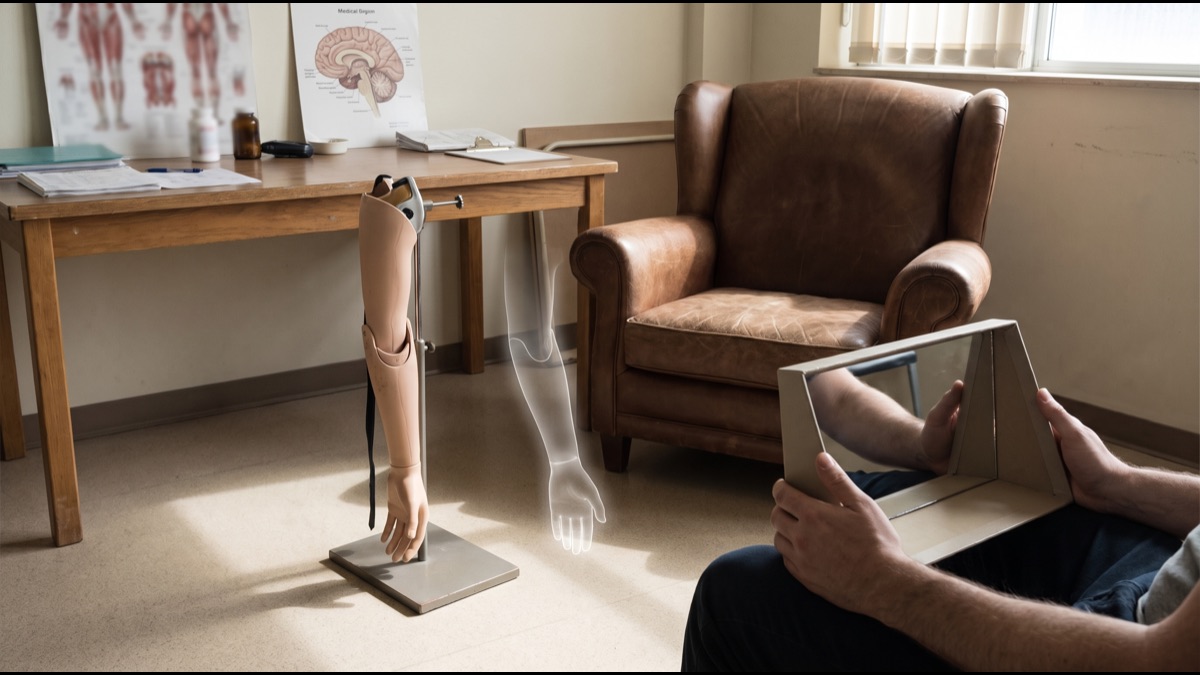
The overwhelming majority of people who lose a limb continue to feel it. Not as a vague memory or an emotional sense of loss, but as a genuine, vivid physical presence, complete with a sense of its exact position, and frequently, pain that feels like it originates from a body part that no longer exists at all.
This phenomenon, known as phantom limb sensation, and in its painful form as phantom limb pain, was once dismissed or misunderstood even within medicine, but decades of neuroscience research have revealed it to be a genuine, measurable consequence of how the brain organizes and represents the body, rather than an imagined or psychological symptom.
A Body Part the Brain Refuses to Delete
Surveys of amputees consistently find that a substantial majority experience some form of phantom sensation following limb loss, ranging from a faint, neutral awareness of the missing limb's presence to vivid sensations of movement, temperature, itching, or pain that can feel every bit as real and specific as sensation from an intact limb.
The experience is frequently detailed rather than vague. Amputees commonly report being able to sense the phantom limb's exact position, and even specific gestures, such as feeling fingers clenched into a fist, despite the hand itself being entirely absent, a level of specificity that points toward a genuine underlying neurological representation rather than simple confused memory.
Phantom sensations are not limited to limbs either, though limb amputation is by far the most studied case. Patients who have had a breast removed, a tooth extracted, or even an eye enucleated have reported comparable phantom sensations tied to the missing structure, suggesting the underlying mechanism reflects a general property of how the brain represents the body rather than something specific to arms and legs alone.
The Old Theory: A Cut Nerve Problem
Earlier medical explanations focused heavily on the amputation site itself, proposing that irritated or damaged nerve endings at the stump were essentially misfiring, sending signals that the brain simply misinterpreted as coming from the missing limb, a theory that treated phantom sensation as primarily a peripheral nervous system problem localized near the injury.
This explanation captured part of the picture but proved insufficient on its own, since it struggled to account for cases where phantom sensation persisted or even changed character years after the stump had fully healed, and it could not easily explain some of the more specific, patterned phenomena researchers later documented, which pointed toward changes happening much further upstream, inside the brain itself.
An especially telling piece of counter-evidence came from patients born without a limb, who nonetheless sometimes report phantom sensations for a limb they never physically had in the first place. This finding is difficult to reconcile with a purely peripheral, cut-nerve explanation, since there was never a functioning nerve at that specific site to become damaged or irritated, and it pushed researchers further toward looking at the brain's own representation of the body as the more fundamental site of the phenomenon.
The Sensory Map Inside the Brain
The brain maintains a detailed, organized map of the body's surface within a strip of tissue called the somatosensory cortex, with each region of skin corresponding to a specific, dedicated area of cortical tissue, an arrangement researchers often visualize using a distorted body diagram called the sensory homunculus, in which body parts with especially dense nerve supply, like the hands and face, occupy disproportionately large map territory.
This cortical map is not a passive, fixed diagram drawn once and never revisited. It is actively maintained by a continuous stream of sensory input arriving from the corresponding body part, and this dependence on ongoing input turns out to be central to understanding what happens when a limb, and the sensory signal it once provided, suddenly disappears.
The map's proportions are also not fixed across a person's lifetime even without any injury. Musicians who spend years practicing fine finger movements, for instance, have been shown to develop a measurably larger cortical territory dedicated to those specific fingers compared to non-musicians, demonstrating that this map actively responds to how intensively a given body part is used, a property called neuroplasticity that turns out to be directly relevant to what happens after amputation.
Why the Brain's Map Does Not Simply Erase
When a limb is amputated, the dedicated cortical territory that once processed sensation from it does not simply go silent or get deleted from the map. Research using brain imaging has found that this territory often remains active, generating a persistent internal representation that the brain continues to interpret as a felt, physical body part.
This finding reframed how researchers think about phantom sensation. Rather than a peripheral nerve error being misread by an otherwise normal brain, phantom limb sensation increasingly looks like the brain's stable, high-level representation of the body continuing to assert itself even after the physical structure it once mapped no longer exists to send it real sensory input.
Some researchers describe this persistent internal representation using the concept of a body schema, an integrated, continuously updated internal model of the body's shape, position, and boundaries that the brain relies on for everyday tasks like coordinating movement and maintaining balance without having to consciously recalculate the body's layout from scratch every moment. Under this framing, phantom limb sensation is not a malfunction so much as the predictable behavior of a body schema that has not yet been, or cannot be, fully updated to remove a limb it once confidently included.
Cortical Remapping and Neighboring Territory
Over time following amputation, brain imaging studies have documented a further, genuinely striking change: the cortical territory that once belonged exclusively to the missing limb can gradually become invaded by activity from neighboring body-map regions, as though adjacent territory expands to claim now-unused cortical space.
This process, called cortical remapping, appears to correlate with the character and intensity of ongoing phantom pain in some studies, with more extensive remapping associated with more severe reported pain in certain patient groups, though the precise relationship remains an active and somewhat debated area of ongoing research rather than a fully settled one.
Not all researchers accept remapping as the full explanation, and some more recent studies using higher-resolution imaging techniques have complicated the picture, finding that the original limb's cortical representation may persist in a latent, detectable form even years after amputation, rather than being fully overtaken by neighboring territory as the simplest version of the remapping theory once suggested. This ongoing scientific disagreement is a healthy sign of an active research field rather than a weakness in the science, and it means the specific relationship between remapping and pain intensity should still be treated as provisional rather than fully settled.
The Face-Hand Overlap Discovery
One of the most striking and frequently cited findings in this field involves the specific anatomical arrangement of the sensory homunculus, in which the cortical territory representing the face sits directly adjacent to the territory representing the hand, an arrangement that predates any injury and reflects normal brain organization in every person.
Researchers studying arm amputees found that touching certain points on the face could reliably trigger a felt sensation in the phantom hand, corresponding with surprising precision to where the remapped facial input appeared to be activating overlapping or newly invaded hand-territory neurons, a discovery frequently cited as some of the clearest direct evidence that phantom sensation reflects genuine, physical reorganization within the brain rather than pure imagination or memory.
In some documented cases, patients could even draw a detailed, consistent map on their own face showing exactly which points corresponded to which specific phantom finger, a map that remained stable across repeated testing sessions rather than shifting randomly, further reinforcing that a genuine, organized neural reassignment had taken place rather than a vague or inconsistent perceptual confusion.
Why Pre-Amputation Pain Predicts Later Pain
A consistent finding across multiple studies is that people who experienced significant pain in a limb before it was amputated, whether from injury, infection, or a condition like severe vascular disease, are considerably more likely to develop phantom limb pain afterward compared to those who lost a limb without prior significant pain.
This pattern has led some researchers to propose that the nervous system may retain something like a memory trace of a prior painful state, an idea sometimes discussed under the informal term pain memory, though the precise underlying neural mechanism connecting pre-amputation pain history to post-amputation phantom pain remains an area of active investigation rather than a fully resolved question. This finding has practical implications for pain management before planned amputations, with some clinicians now advocating for aggressive pre-surgical pain control specifically in hopes of reducing the severity of phantom pain that follows, though the evidence for how effective this preventive approach actually is remains mixed across different studies.
What Neuromas Contribute at the Stump
While the brain-level changes described above are now understood as central to phantom limb pain, the peripheral nervous system at the amputation site still plays a genuine contributing role. Severed nerve endings can form small, disorganized clusters called neuromas as they attempt to regrow, and these structures can generate abnormal, spontaneous electrical signals.
These peripheral signals can feed into and interact with the reorganized brain representation described earlier, meaning modern understanding treats phantom limb pain as arising from an interplay between peripheral nerve changes at the stump and central reorganization within the brain, rather than attributing it entirely to just one level of the nervous system. Surgeons have developed specific techniques intended to reduce neuroma formation or redirect regrowing nerve fibers into nearby muscle tissue during the original amputation surgery itself, an approach that some clinical evidence suggests may reduce the severity of subsequent phantom and residual limb pain compared to older surgical techniques.
How Mirror Therapy Actually Works
One of the more distinctive treatments to emerge from this research is mirror therapy, in which a mirror is positioned so that the reflection of the patient's intact limb visually appears in the location where the missing limb would be, creating a convincing visual illusion of two functioning limbs.
When the patient moves the intact limb while watching its mirrored reflection, the brain receives visual input strongly suggesting the phantom limb is moving normally and without restriction, and for some patients this visual feedback measurably reduces phantom pain, an effect researchers attribute to the visual signal helping resolve a mismatch between the brain's motor intention and its felt, absent sensory feedback.
Mirror therapy does not work equally well for every patient, and researchers are still working to understand which specific patient characteristics predict a strong response, but its development directly from an understanding of cortical reorganization is frequently cited as a clear example of basic neuroscience research translating into a genuinely usable clinical treatment. Its low cost and lack of side effects have also made it an attractive first-line option in many rehabilitation settings, even where its exact effect size compared to more invasive interventions is still being actively studied.
Other Treatment Approaches in Use Today
Beyond mirror therapy, current management of phantom limb pain typically draws on multiple approaches simultaneously, including targeted medications originally developed for other forms of nerve-related chronic pain, various forms of nerve stimulation applied at or near the amputation site, and structured physical and psychological therapy addressing both the sensory and emotional dimensions of the condition.
More recent experimental approaches include prosthetic limbs that provide direct sensory feedback to the wearer, attempting to supply the brain with genuine, real-time sensory input from the prosthetic in a way that may help stabilize the cortical representation and potentially reduce the kind of unstable remapping associated with phantom pain, though these technologies remain in comparatively early stages of clinical availability. Early trial participants using such sensory-feedback prosthetics have in some cases reported that the device itself began to feel like a genuine extension of their body over time, a subjective shift researchers are now trying to measure more rigorously as a possible marker of successful reintegration into the brain's body schema.
Phantom limb pain stands as one of the clearest illustrations available of how thoroughly the brain, rather than the body's periphery alone, constructs a person's felt sense of their own physical existence, maintaining an internal map so persistent and so actively defended that it can continue asserting the presence of a limb long after that limb is physically gone.
Understanding it this way has done more than satisfy scientific curiosity. It has directly produced treatments like mirror therapy that target the actual underlying mechanism rather than merely managing symptoms at the amputation site, a genuine example of neuroscience reshaping how a once-mysterious condition is both understood and treated, and a reminder that a symptom dismissed for decades as psychological can turn out to have a fully physical, mappable explanation once the right tools exist to look for it.
Sources
- Wikipedia — overview of phantom limb sensation and pain research
- National Institutes of Health — research on cortical remapping and chronic pain mechanisms
- Nature — peer-reviewed neuroscience research on somatosensory reorganization
- PubMed Central — clinical studies on mirror therapy and phantom limb pain treatment
FAQ
Does everyone who loses a limb experience phantom sensations?
The large majority of amputees report some phantom sensation, though the intensity, duration, and whether it involves pain rather than neutral sensation varies considerably between individuals.
What is mirror therapy for phantom limb pain?
Mirror therapy uses a mirror positioned to reflect the intact limb in place of the missing one, visually tricking the brain into perceiving normal movement, which can reduce pain for some patients.
Is phantom limb pain considered a real medical condition?
Yes — phantom limb pain is a recognized, extensively studied neurological condition, not an imagined or psychological symptom, and it is now understood to stem from measurable changes in brain organization.
Can phantom limb sensations fade over time?
For many people the intensity and frequency of phantom sensations does decrease over months to years, though for a substantial minority the pain persists chronically and requires ongoing management.
Does the amount of pain before amputation affect phantom limb pain afterward?
Research has found that significant pre-amputation pain in the limb is one of the stronger predictors of experiencing phantom limb pain afterward, suggesting the nervous system may partly retain a memory of that prior pain state.
About the Author
We reference Wikipedia, National Institutes of Health, Nature, and PubMed Central to explain the background and current understanding of this topic.
Loved This Article?
Share it on WhatsApp → Share it on WhatsApp
Get more guides in your inbox — Subscribe to our newsletter for weekly surprising stories from Egypt, Saudi Arabia, Dubai, and beyond.