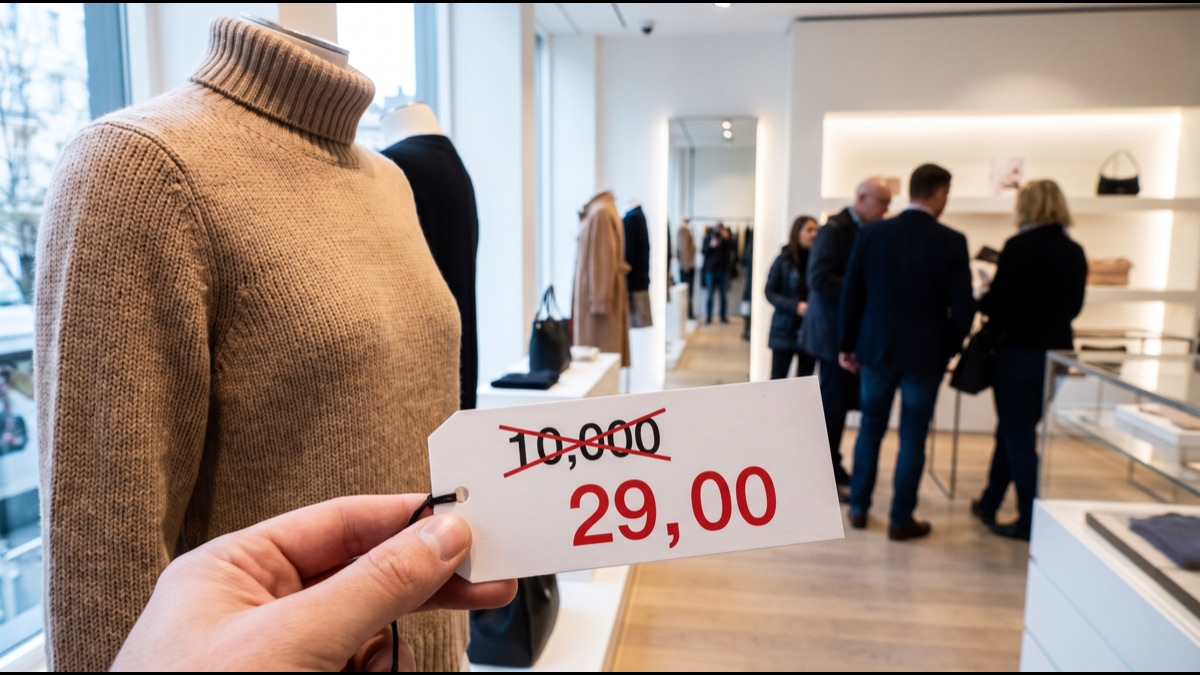
A crossed-out higher price sitting next to the real one is not a decoration and not an accident. It is a number engineered to enter your head first, on purpose, before the actual price ever does, and decades of behavioural economics research show that once that first number lands, it quietly resets what your brain considers a reasonable amount to pay for almost anything placed near it.
This effect, called anchoring, is one of the most reliably reproduced findings in behavioural economics and one of the most deliberately engineered features of modern retail, menu design, real estate listings, and salary negotiation. Understanding the actual mechanism behind it changes how a shopper reads a price tag permanently.
What an Anchor Actually Does to a Number
An anchor is any number introduced into a decision before the number that actually matters, and its defining property is that it influences the final judgment even when the anchor itself is completely irrelevant to the decision being made, a finding that surprised the researchers who first documented it.
The mechanism works because people rarely estimate value from scratch. Instead, the mind adjusts outward from whatever reference point is available first, and that adjustment is consistently insufficient, meaning the final estimate stays biased toward the original anchor even after conscious effort to correct for it.
Where Anchoring Was First Proven in the Lab
The effect was first rigorously demonstrated by psychologists Amos Tversky and Daniel Kahneman in a now-famous experiment where participants spun a wheel rigged to land on either a low or high number, then were asked to estimate the percentage of African countries in the United Nations, a question with no logical connection to the wheel at all.
Participants who saw the high number on the wheel gave systematically higher estimates than those who saw the low number, despite the wheel being visibly random and having no bearing on the actual question, establishing that even an obviously arbitrary and irrelevant number can measurably shift a completely unrelated judgment.
This original experiment has since been replicated across dozens of unrelated domains, from legal sentencing recommendations anchored by an arbitrary number rolled on dice to charitable donation amounts anchored by whatever figure appeared first on a request form, consistently finding the same basic pattern regardless of how obviously irrelevant the anchor was to the actual decision at hand.
Why Crossed-Out Prices Work Even When Shoppers Distrust Them
The strikethrough price displayed next to a sale price functions as a textbook anchor: it establishes a reference point the shopper's brain uses to judge whether the actual price represents a good deal, even among shoppers who consciously suspect that the crossed-out figure was inflated specifically to make the discount look larger.
Research on this specific tactic has found that the anchoring effect persists even when consumers explicitly state disbelief in the reference price, because the cognitive process that anchors a judgment operates largely below the level of deliberate, conscious reasoning that a shopper's stated scepticism reflects.
This gap between stated disbelief and measured behaviour is one of the more uncomfortable findings in the literature for retailers themselves to publicly acknowledge, since it implies that ordinary consumer scepticism, the very thing regulators often assume protects shoppers from manipulation, provides considerably less protection in practice than most people would expect it to.
How Decoy Pricing Actually Steers a Choice
A decoy is a deliberately unattractive third option added to a two-item choice specifically to make one of the original two look like the clearly superior deal by comparison, a tactic famously demonstrated with subscription pricing where a print-only option priced identically to a print-and-digital bundle made the bundle look like an obvious steal.
Without the decoy, most people struggled to judge whether digital access alone or the full bundle represented better value, but introducing the deliberately poor decoy option gave shoppers an easy, confident comparison point that consistently pushed the majority toward the higher-priced bundle the retailer wanted to sell all along.
Why Menus Put an Expensive Item at the Top
Restaurant menu designers frequently place an unusually expensive dish prominently near the top of the menu, not necessarily expecting many diners to order it, but specifically to reset the diner's internal sense of what counts as a reasonable price for everything listed beneath it.
Once that high anchor is established, mid-priced dishes that might otherwise seem expensive in isolation instead appear comparatively reasonable, a well-documented technique in menu engineering that restaurant consultants explicitly recommend as a way to lift average order value without needing to raise every individual price.
How Real Estate Listing Prices Anchor Buyers
A property's listing price functions as a powerful anchor for every subsequent negotiation, and research on real estate transactions has found that even experienced agents and appraisers, who should theoretically value a property independently of its asking price, produce valuations that shift measurably based on the listed figure alone.
This is part of why some sellers deliberately list slightly above expected market value, anticipating that buyers will anchor to the higher number and negotiate down from there rather than anchoring their own initial offer to an independent valuation, while other sellers list deliberately low specifically to anchor a flurry of competing offers upward through a bidding dynamic.
Why Salary Negotiations Are an Anchoring Contest
Whoever states the first specific number in a salary negotiation effectively sets the anchor for the entire remaining conversation, and research consistently finds that final agreed salaries correlate strongly with whichever side spoke first, provided the initial number was not so extreme as to seem absurd or insulting.
This is the specific mechanism behind common negotiation advice to avoid answering a recruiter's request for a current or expected salary directly, since providing a specific figure hands the other party a low anchor to negotiate down from, whereas deflecting the question preserves room to anchor the conversation around market data instead.
How Luxury Retail Uses Extreme Anchors Deliberately
Luxury boutiques frequently display an extraordinarily expensive flagship item, sometimes a handbag or watch priced far beyond what the overwhelming majority of visitors could ever consider purchasing, specifically because that item resets the entire store's perceived price scale rather than because the retailer expects to sell many units of it.
Against that extreme anchor, items that are merely very expensive in absolute terms come to feel comparatively reasonable, a documented retail strategy sometimes described informally as the "loss leader" of perception rather than of price, since the flagship item's job is psychological rather than transactional.
Why the First Number in Any Negotiation Matters So Much
Beyond retail and salary contexts, the general principle that the first number introduced into any negotiation exerts outsized influence over the eventual outcome holds across remarkably diverse settings, from legal settlement negotiations to auction opening bids to procurement contract discussions between businesses.
Skilled negotiators exploit this by deliberately making the first offer whenever they believe they have useful information about a reasonable range, specifically to anchor the discussion in their favour, while negotiators who lack that information often benefit more from letting the other side speak first and reveal an anchor to react against.
How Subscription Tiers Use Anchoring to Push a Middle Option
Software and streaming services commonly present three pricing tiers rather than one or two, and the top tier frequently exists primarily as an anchor rather than as the product the company expects most customers to actually choose, deliberately priced high enough to make the middle tier look like the sensible, moderate option.
This structure exploits a documented preference many people show for a middle option specifically because it appears to avoid the risk of either overpaying at the top tier or under-provisioning at the bottom tier, a pattern that pricing consultants openly discuss as one of the most reliable levers for shifting customers toward a specific, usually higher-margin, plan.
Why Anchoring Persists Even When People Know About It
A striking finding across anchoring research is that explicitly warning participants about the effect and asking them to actively resist it reduces the bias only modestly rather than eliminating it, suggesting the mechanism operates through a genuinely automatic cognitive process rather than a simple lack of awareness that could be corrected with a warning label.
Even professional appraisers, negotiators, and judges, who might reasonably be expected to have developed resistance through extensive experience and training, have been shown in controlled studies to remain measurably influenced by irrelevant anchors introduced experimentally, reinforcing that expertise alone does not confer immunity to the effect.
What Makes an Anchor Legally Deceptive Versus Legitimate
Regulators in many jurisdictions distinguish between legitimate reference pricing, where the higher crossed-out figure reflects a genuine price the item was actually sold at for a meaningful period, and deceptive reference pricing, where the higher figure was invented or briefly used for an unreasonably short time specifically to inflate the apparent discount.
Enforcement varies considerably between jurisdictions, and several major retailers have faced regulatory action or class-action litigation specifically over reference pricing practices found to have relied on inflated or fabricated original prices rather than genuine prior selling prices, making this one of the more actively regulated applications of anchoring in commerce.
How Anchoring Interacts With Loss Aversion
Anchoring compounds with a separate, related bias called loss aversion, the tendency to weigh a potential loss more heavily than an equivalent potential gain, because once a high anchor establishes an expected price, paying less than that anchor feels like a gain while paying the same absolute amount without the anchor present would not have felt that way at all.
This interaction is precisely why discount framing, "save fifty dollars" rather than simply stating the final price, proves so consistently effective: it explicitly frames the transaction as avoiding a loss relative to the established anchor rather than simply spending money, which most people find measurably more psychologically satisfying.
Why Anchoring Is Harder to Resist Under Time Pressure
Time-limited offers, countdown timers, and flash sales combine anchoring with urgency in a way research suggests makes the anchor particularly difficult to consciously evaluate, because the deliberate, effortful cognitive process needed to question an anchor requires time that urgency-based promotions are specifically designed to remove from the decision.
This is why urgency and anchoring so frequently appear together in the same promotional format, a combination retail behavioural researchers describe as mutually reinforcing rather than coincidental, since each tactic independently reduces the likelihood of the careful, deliberate evaluation that would otherwise partially counteract the other.
What Actually Helps Shoppers Resist an Anchor
Research suggests the most effective countermeasure is not simply being aware anchoring exists, since awareness alone has been shown to provide only modest protection, but instead deliberately researching an independent reference price from a separate source before encountering the anchored price at all.
Comparing a specific product's price history across multiple retailers, checking independent price-tracking tools, and deliberately delaying a purchase decision by even a short period to allow the initial anchor's influence to fade have all shown measurably better results in research than simply trying to mentally discount an anchor in the moment it is encountered.
Businesses evaluating their own pricing practices face a genuine ethical distinction worth drawing explicitly: using anchoring to present a genuinely good price in its best light is a normal and defensible part of marketing, while manufacturing a fictional reference price specifically to make an ordinary price look like a discount crosses into the kind of deceptive practice regulators have increasingly targeted, and the reputational cost of getting caught can outweigh whatever short-term lift the tactic produced.
Anchoring is not a trick reserved for obviously manipulative retailers; it is a structural feature of how the human mind processes numbers, which is precisely why it appears independently across menus, real estate, salary talks, luxury retail, and software pricing despite those industries having little else in common.
Recognising a specific anchor when it appears does not fully neutralise its influence, since the underlying cognitive process operates largely outside conscious control, but building the habit of seeking an independent reference point before encountering a seller's chosen anchor remains the single most evidence-backed defence available to an ordinary shopper.
The broader lesson extends well beyond shopping: any situation involving a number presented before a judgment, whether a first offer in a negotiation, a suggested donation amount, or a recommended tip percentage, carries the same anchoring risk, and the same defence applies regardless of context. Establishing an independent reference point first, before any number is presented by the other party, is consistently the most reliable way to keep a judgment genuinely one's own rather than quietly borrowed from whoever spoke first, a habit worth building deliberately rather than trusting to be automatic once the underlying research is understood.
Sources
- Wikipedia — overview of the anchoring effect in behavioural economics
- U.S. Federal Trade Commission — enforcement actions on deceptive reference pricing
- American Psychological Association — research on cognitive biases including anchoring and loss aversion
- National Bureau of Economic Research — behavioural economics research on pricing and consumer decision-making
FAQ
Is price anchoring the same as false advertising?
Not automatically — anchoring only becomes illegal false discount advertising when the reference price was never a genuine price the item actually sold at for a meaningful period.
Why do menus put an expensive item at the top?
The expensive item resets diners' internal sense of what a reasonable price is for the rest of the menu, making mid-priced items look more reasonable by comparison.
What is a decoy price?
A deliberately unattractive option added to a lineup specifically to make a different, usually higher-margin, option look like the obviously better deal by comparison.
Does knowing about anchoring make you immune to it?
Only partially — research shows the effect persists even among people who are explicitly told about it and are actively trying to resist it.
Why do luxury stores keep extremely expensive items on display?
An extremely expensive flagship item, even one that rarely sells, resets the entire store's price scale so that merely expensive items look comparatively reasonable.
About the Author
We reference Wikipedia, the U.S. Federal Trade Commission, the American Psychological Association, and the National Bureau of Economic Research to explain the background and current understanding of this topic.
Loved This Article?
Share it on WhatsApp → Share it on WhatsApp
Get more guides in your inbox — Subscribe to our newsletter for weekly surprising stories from Egypt, Saudi Arabia, Dubai, and beyond.