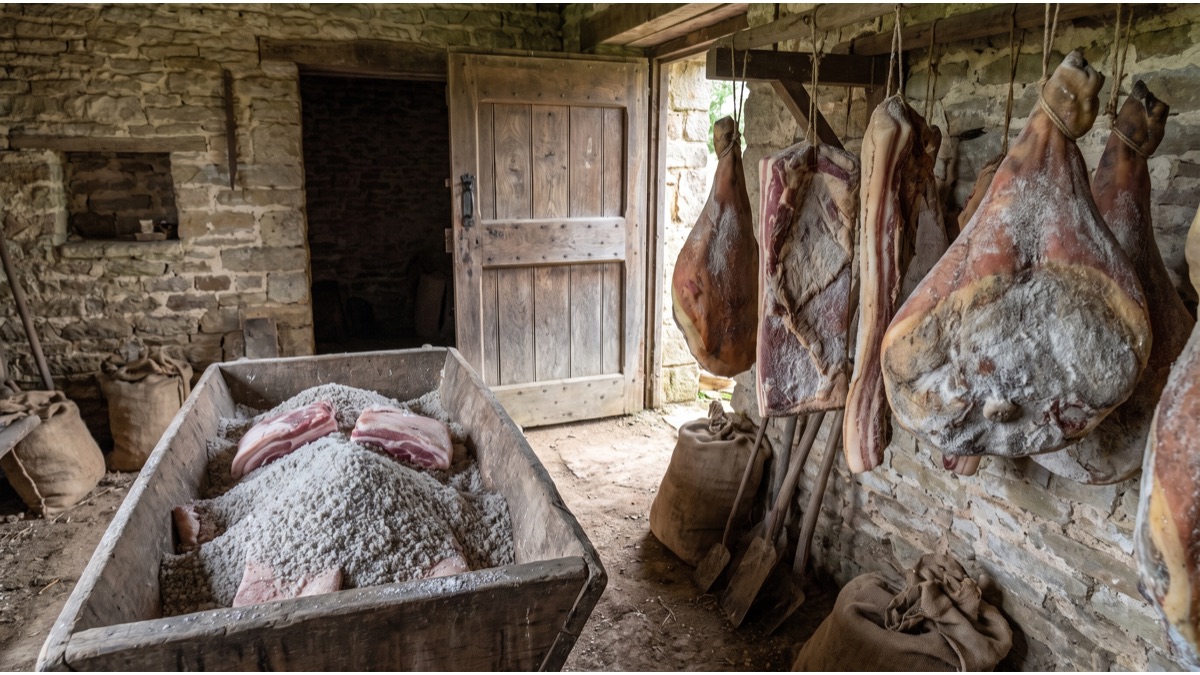
A properly salted leg of meat, hung in the right conditions, could remain edible for well over a year, centuries before anyone understood germ theory or had ever heard the word bacteria. People across nearly every continent independently discovered this same basic trick, packing meat and fish in salt to keep it from rotting, long before science could explain why it actually worked.
The explanation, once modern microbiology arrived, turned out to be elegantly simple physics and chemistry rather than any kind of mysterious effect: salt does not kill bacteria directly so much as make the environment inside the meat physically impossible for most bacteria to survive and multiply in.
Understanding exactly how salt accomplishes this means looking at a process called osmosis, the same basic phenomenon responsible for a wilted lettuce leaf perking back up in water, just running in reverse to pull water out of both the meat and any bacteria living inside it.
It also explains why salting remained the dominant meat preservation method for essentially all of recorded human history until mechanical refrigeration became widely available only around a century ago, and why the technique never fully disappeared even after refrigeration made it technically unnecessary for most households.
Why Bacteria Need Water to Survive and Multiply
Bacteria, like every living cell, need liquid water inside their own cells to carry out the basic chemical reactions of metabolism and reproduction, and without sufficient available water, a bacterial cell cannot function properly regardless of how much food or warmth surrounds it.
This dependency on available water is the single most important vulnerability that food preservation techniques throughout history have exploited, whether through drying, freezing, sugaring, or salting, since each method in its own way reduces how much water a bacterial cell can actually access even when plenty of moisture might still be visibly present in the food itself.
The scientific concept describing this is called water activity, a measure of how much water in a substance is actually free and available for biological processes rather than chemically bound up or otherwise inaccessible, and it is water activity, not total moisture content, that ultimately determines whether bacteria can thrive in a given piece of food.
How Salt Actually Pulls Water Out of Meat
When salt is packed directly against meat, it creates a powerful concentration difference across the meat's cell membranes, since the salt concentration immediately surrounding the meat's surface becomes far higher than the concentration of dissolved substances inside the meat's own cells.
Through the process of osmosis, water naturally moves from an area of lower solute concentration to an area of higher solute concentration in an attempt to balance that difference, which in salted meat means water is steadily drawn out of the meat's cells and toward the concentrated salt on the surface.
This same osmotic pulling force acts directly on any bacteria present on or inside the meat, drawing water out of their cells in exactly the same way, and a bacterial cell that loses enough of its internal water becomes physically unable to carry out the metabolic processes it needs to survive and reproduce.
Why Lowering Water Activity Matters More Than Killing Bacteria Outright
Salt curing does not necessarily kill every bacterium present on a piece of meat instantly the way boiling water or a strong chemical disinfectant might, and this is an important distinction from how many people initially assume the process works.
Instead, properly salted meat reaches a water activity level low enough that surviving bacteria, even if not immediately destroyed, simply cannot multiply, meaning the small remaining bacterial population stays effectively static rather than growing into the large numbers that would actually cause spoilage or illness.
This distinction between killing bacteria and merely preventing their growth explains why salted meat still requires reasonably careful initial preparation and clean handling, since starting with heavily contaminated meat and salting it afterward does not retroactively undo contamination that occurred before the salt had a chance to work.
Why Different Cultures Independently Discovered the Same Technique
Salt curing developed independently across essentially every region with access to a reliable salt source, from Mediterranean and European communities producing salted fish and cured hams, to Chinese and Southeast Asian traditions of salted and fermented fish products, to salt-curing practices documented across the Middle East, Africa, and the Americas long before any cultural contact between these regions existed.
This remarkably consistent independent discovery across unrelated cultures strongly suggests that salt's preservative effect is not a subtle or hard-to-notice phenomenon but rather something that becomes apparent fairly quickly to anyone experimenting with storing meat, since the difference between salted and unsalted meat left at room temperature would have been dramatic and easy to observe within just days.
Archaeological and historical records show that access to reliable salt sources, whether coastal salt evaporation, inland salt deposits, or salt trade routes, was often a matter of genuine geopolitical and economic significance precisely because of how central salt preservation was to feeding populations, particularly armies and sailors, before refrigeration existed.
The Two Main Methods: Dry Curing and Brining
Dry curing involves packing meat directly in solid salt, sometimes mixed with sugar, nitrates, or spices, and allowing the salt to draw moisture out of the meat over a period ranging from days to months depending on the size and type of cut, producing dense, intensely flavored products like traditional dry-cured hams.
Brining instead submerges meat in a concentrated salt-water solution, which achieves a broadly similar water-activity-reducing effect through the same osmotic principle but tends to produce a more evenly distributed salt penetration and a somewhat different final texture, useful for products where a milder overall salt flavor is desired.
Many traditional preserved meat products actually combine both techniques in sequence, an initial dry salt rub followed by an extended brining or aging period, reflecting generations of accumulated practical knowledge about how to balance preservation effectiveness against the final product's texture and flavor.
Why Salt Concentration Has to Be Carefully Controlled
Using too little salt fails to lower water activity sufficiently to reliably prevent bacterial growth, defeating the entire preservation purpose while still adding unnecessary flavor and cost, whereas using excessive salt can draw out so much moisture that the meat becomes unpalatably dry, tough, or overwhelmingly salty to eat.
Traditional recipes developed through generations of practical experience typically specify salt ratios calibrated to the specific type of meat, its fat content, and the intended storage duration, reflecting an empirically refined understanding of the preservation chemistry long before anyone could measure water activity directly with a laboratory instrument.
Modern food science has since quantified these traditional ratios precisely, confirming that most historically established curing recipes land remarkably close to the minimum salt concentration genuinely needed to achieve reliable microbial safety, evidence of how effectively trial-and-error refinement across generations converged on a solution close to the scientifically optimal one.
Why Some Bacteria and Molds Can Still Tolerate Salt
Not every microorganism is equally vulnerable to reduced water activity, and certain specialized bacteria and molds, sometimes called halophilic or salt-tolerant organisms, have evolved biological mechanisms allowing them to survive and even thrive in high-salt environments that would be lethal to most ordinary bacteria.
This is precisely why properly salted meat still requires appropriate storage conditions, adequate airflow, protection from excess humidity, and reasonable temperature control, rather than being treated as permanently and completely immune to any form of spoilage regardless of how it is subsequently stored.
Traditional curing practices often paired salt with additional preservation techniques, including smoking, drying, or the deliberate use of specific beneficial molds and bacterial cultures on a cured product's surface, partly to further suppress the smaller number of salt-tolerant organisms that plain salt alone could not fully control.
What Nitrates and Nitrites Add to the Process
Many traditional cured meat recipes include naturally occurring nitrate-rich ingredients, historically saltpeter, alongside plain salt, which chemically converts into nitrite during the curing process and provides additional antimicrobial protection specifically against Clostridium botulinum, the bacterium responsible for botulism, a risk that salt concentration alone does not fully eliminate in every curing scenario.
Nitrites also produce the characteristic pink color associated with cured meats like ham and traditional preserved sausages, a visible side effect of the same chemical process responsible for the additional food safety benefit, which is why cured meats look distinctly different in color from meat preserved by salt alone without nitrates.
Modern regulatory bodies carefully control permitted nitrate and nitrite levels in commercially cured meat products, reflecting ongoing scientific research into balancing their genuine food safety benefits against separate health considerations associated with long-term dietary nitrite consumption at high levels.
Why Salt Curing Shaped Global Trade and Exploration
Salted fish and cured meats made long ocean voyages and extended military campaigns logistically possible in an era when fresh food would spoil within days, directly enabling the kind of long-distance exploration, trade, and warfare that shaped major periods of world history well before refrigeration existed.
Historical demand for salt to support meat and fish preservation was significant enough to drive the establishment of dedicated salt production industries and trade networks across multiple regions and eras, with control over productive salt sources sometimes translating directly into meaningful economic and political power.
This deep historical connection between salt preservation and large-scale human mobility is part of why food historians treat salt curing as far more than a simple kitchen technique, viewing it instead as genuine enabling infrastructure that made certain kinds of historical human activity logistically possible at all.
Why Refrigeration Did Not Fully Replace Salt Curing
Despite mechanical refrigeration becoming widely available and largely eliminating the practical necessity of salt curing for basic food preservation, the technique has persisted robustly into the modern era, driven now primarily by flavor and cultural tradition rather than any remaining practical preservation need.
Traditionally cured products like prosciutto, bacon, and countless regional salted meat and fish specialties around the world are prized specifically for the distinct flavor and texture changes salt curing produces, effects that simple refrigeration alone cannot replicate regardless of how effectively it also prevents spoilage.
This persistence illustrates a broader pattern common across food preservation history: techniques originally developed purely out of necessity often survive long after that original necessity disappears, because the sensory qualities they happen to produce along the way become genuinely valued in their own right, independent of the preservation function that originally drove their invention.
How Modern Food Science Verifies Traditional Curing Recipes
Contemporary food scientists studying traditional curing recipes typically measure the final water activity of a cured product directly using specialized laboratory instruments, confirming whether a given traditional recipe actually achieves the water activity threshold considered necessary for reliable microbial safety by current food safety standards.
This modern verification process has occasionally identified traditional recipes that, while historically successful in practice, sit closer to genuinely safe thresholds than food safety regulators consider an adequate margin for large-scale commercial production, leading some commercial curing operations to adjust traditional ratios slightly for consistent industrial-scale safety.
In most cases, however, this scientific verification has simply confirmed what centuries of practical experience already established, that carefully executed traditional salt curing methods reliably produce a genuinely safe final product, offering a rare and satisfying case where ancient empirical food wisdom and modern laboratory science arrive at essentially the same conclusion.
Why Salt Curing Still Matters in a World With Refrigerators
In regions of the world where reliable electricity and refrigeration infrastructure remain inconsistent or unavailable, salt curing continues serving its original practical preservation function much as it always has, offering meaningful food security value independent of any modern technological infrastructure whatsoever.
International food security and development organizations have specifically documented traditional salt-based preservation methods as genuinely valuable, low-cost techniques worth preserving and teaching in communities where refrigeration remains unreliable or economically inaccessible, rather than treating the technique as an obsolete historical curiosity.
This continued practical relevance, alongside salt curing's enduring culinary popularity in wealthier, fully refrigerated societies, means a technique first discovered independently across ancient civilizations thousands of years ago remains genuinely useful today for reasons spanning both practical necessity and simple culinary pleasure.
How to Actually Tell if Cured Meat Has Gone Bad
Although properly salted meat resists spoilage for an unusually long time, it is not absolutely immune, and food safety experts rely on specific warning signs, an unusually sour or pungent smell, a noticeable shift in color toward unexpected grey or green tones, or a slimy surface texture, as reliable indicators that the delicate balance between salt, moisture, and time has broken down.
These warning signs differ from the expected and sometimes deliberately encouraged white surface mold found on certain traditionally cured products like Italian salami, which represents an intentional part of the aging process rather than a spoilage signal, making the distinction between the two a traditional skill passed down through generations of cured meat producers.
Modern food safety experts consistently recommend discarding any cured product showing genuinely suspicious signs rather than risking it, a reminder that curing dramatically reduces risk without eliminating it entirely, and that thousands of years of traditional experience never actually removed the need for sound, ordinary judgment when handling preserved food.
Sources
- Wikipedia — overview of salt curing methods, history, and food science
- U.S. Food and Drug Administration — regulatory background on cured meat production and nitrate and nitrite use
- Food and Agriculture Organization of the United Nations — background on traditional food preservation methods and global food security
- ScienceDirect — food science research on water activity and microbial safety in cured meat
FAQ
How exactly does salt stop bacteria from growing in meat?
Salt draws water out of meat and out of any bacteria present through osmosis, lowering the meat’s water activity to a level where surviving bacteria cannot access enough water to carry out the metabolic processes needed to multiply.
Does salting meat kill all the bacteria in it?
Not necessarily; properly salted meat mainly prevents surviving bacteria from multiplying by lowering water activity, rather than instantly destroying every bacterium the way boiling or strong chemical disinfectants would.
Why do some cured meats look pink instead of grey or brown?
Many traditional curing recipes include nitrates or nitrites alongside salt, which chemically produce the characteristic pink color while also providing extra protection against certain dangerous bacteria that salt alone cannot fully control.
Can salt-tolerant bacteria still grow in cured meat?
Yes, certain specialized halophilic bacteria and molds can survive and even thrive in high-salt environments, which is why properly cured meat still needs appropriate storage conditions rather than being treated as permanently immune to spoilage.
Why did people keep curing meat with salt after refrigeration was invented?
Salt curing produces distinct flavors and textures, seen in products like prosciutto and traditional cured sausages, that refrigeration alone cannot replicate, so the technique persisted for culinary reasons even after it became unnecessary for basic preservation.
Is traditional salt curing still useful today?
Yes, in regions without reliable refrigeration infrastructure, salt curing remains a genuinely practical, low-cost preservation method, and food security organizations continue documenting and teaching it as a valuable technique rather than an obsolete one.
About the Author
We reference Wikipedia and other authoritative sources to explain the background and current understanding of this topic.
Loved This Article?
Share it on WhatsApp → Share it on WhatsApp
Get more guides in your inbox — Subscribe to our newsletter for weekly surprising stories from Egypt, Saudi Arabia, Dubai, and beyond.