Along roughly 200 kilometers of Saudi Arabia's Red Sea coastline, a state-owned developer called Red Sea Global has spent the past several years building something that does not exist anywhere else at this scale: an entirely new luxury tourism destination, engineered from the first survey stake to run on 100% renewable energy, built around islands and lagoons that were mapped and protected before a single hotel foundation was poured. It is easy to read headlines about a "giga-project" and picture only glossy renderings, but the actual construction sequence behind the Red Sea destination and its northern neighbor AMAALA involves marine biology surveys, a purpose-built airport, an off-grid solar microgrid, and a conservation rule that has shaped which of dozens of islands get built on at all. Understanding how the pieces actually fit together explains both why the project has taken years longer than initial announcements suggested and why it has become one of the most closely watched tourism developments in the world.
What Red Sea Global Is Actually Building
Red Sea Global is the Public Investment Fund-owned company responsible for developing two adjacent luxury tourism destinations on Saudi Arabia's northwest coast: The Red Sea, formerly known as the Red Sea Project, and AMAALA. Together the two developments span an area roughly the size of Belgium, stretching across a coastline dotted with more than 90 islands, ancient dormant volcanoes, desert canyons, and one of the least-disturbed coral reef systems left in the world.
Rather than a single resort or hotel complex, the finished destination is planned as a network of standalone luxury properties spread across islands, mountains, and desert sites, each accessible primarily by boat or seaplane rather than road, with a dedicated international airport serving as the main point of arrival for guests rather than driving in from Jeddah or another existing city.
The scale is deliberately unlike anything built in the region before: when complete, the combined destination is planned to include around 50 resorts offering roughly 8,000 hotel rooms, alongside residential units, golf courses, marinas, and entertainment venues, developed in phases over more than a decade rather than delivered all at once.
The Regenerative Tourism Premise
Red Sea Global has consistently described its approach as "regenerative tourism" rather than merely sustainable tourism, a distinction the company uses to argue that the destination should leave its environment measurably better off than before construction began, not simply minimize additional harm.
In practice, this framing shapes concrete design decisions: buildings are sited to avoid disturbing turtle nesting beaches, mangrove stands are being actively replanted in degraded coastal areas, and construction crews are required to follow strict protocols around noise, lighting, and marine access near sensitive habitats during sensitive breeding seasons.
Whether "regenerative" claims fully hold up under independent long-term scrutiny remains an open and reasonable question, since much of the evidence so far comes from the developer's own environmental reporting rather than fully independent third-party audits, but the design intent is genuinely different from a conventional beach resort development that treats environmental mitigation as an afterthought.
Mapping the Reef Before Moving a Single Rock
Before any construction began, Red Sea Global commissioned extensive marine surveys of the coastline's reef systems, seagrass meadows, and mangrove stands, using both diver-based fieldwork and aerial and satellite mapping to build a detailed baseline picture of what already existed across the site.
That baseline mapping directly determined where resorts, marinas, and infrastructure could and could not be placed, with construction zones deliberately routed around the healthiest and most ecologically significant reef areas rather than the more common industry approach of surveying only the specific footprint of a planned building.
Marine biologists and coastal engineers have continued monitoring reef health and water quality throughout construction, using the same baseline data to measure whether dredging, boat traffic, and construction runoff are causing measurable degradation, and adjusting individual project timelines or methods when monitoring flags a concern.
The 90/2030 Conservation Rule
Red Sea Global set an internal target, sometimes referred to informally within the project as the conservation pledge, to develop only a small minority of the destination's islands, leaving roughly three-quarters of them completely untouched as protected conservation zones rather than future expansion sites.
The company has also set a stated goal of achieving a 30% net conservation benefit across the destination by 2030, meaning the surrounding marine and coastal ecosystem should measurably improve relative to its pre-construction baseline rather than simply avoiding further decline, a considerably more ambitious target than typical resort-scale environmental commitments.
Delivering on a net-positive conservation target while simultaneously building dozens of large resort properties is a genuinely difficult balancing act, and the company has published periodic sustainability reports tracking metrics like coral transplant survival rates and mangrove restoration acreage as evidence toward that goal, figures that outside researchers and environmental groups continue to watch closely.
Building an Off-Grid Renewable Microgrid From Scratch
Rather than connecting the destination to Saudi Arabia's national electricity grid, Red Sea Global built a standalone microgrid designed to run the entire destination on solar power paired with large-scale battery storage, a decision that required solving grid stability and reliability challenges that grid-connected renewable projects generally avoid.
The solar-plus-storage system is designed to store excess daytime solar generation in battery banks for use overnight, when resort demand for air conditioning, lighting, and desalination remains high but direct solar generation has stopped, a technical requirement that makes the battery component nearly as important as the solar panels themselves.
Achieving genuinely continuous 100% renewable operation at destination scale, without any diesel backup running during periods of low sun or high demand, is one of the most technically ambitious claims tied to the project, and Red Sea Global has stated it is targeting full completion of the renewable transition as later development phases come online.
Why Off-Grid Power Was Chosen Over the National Grid
Extending Saudi Arabia's conventional national grid across such a remote and ecologically sensitive coastline would have required substantial new transmission infrastructure cutting through desert and coastal terrain, undermining the same conservation goals the destination is built around.
An off-grid renewable system also let the destination sidestep dependency on the carbon-intensive generation mix that has historically supplied much of Saudi Arabia's grid electricity, allowing Red Sea Global to credibly market a carbon-conscious luxury travel product to international guests increasingly attentive to a destination's environmental footprint.
The off-grid approach additionally functions as a proving ground for renewable microgrid technology at a scale relevant to other remote Saudi developments, giving the kingdom's broader energy sector practical operating experience it can apply to future giga-projects facing similar grid-access challenges.
Building an Airport for a Destination That Didn't Exist
Because the destination sits far from any existing city with international air links, Red Sea Global built its own dedicated airport, Red Sea International, specifically to bring international guests directly to the destination rather than routing them through Jeddah and a long onward transfer by road or boat.
The airport opened in phases, beginning with domestic and limited international flights before expanding capacity as resort openings ramped up, reflecting the broader project pattern of building supporting infrastructure just ahead of the specific resort phases it needs to serve rather than completing all infrastructure before any hotels open.
Building a functioning international airport as essentially day-one infrastructure, before the surrounding destination had meaningful visitor volume to justify it commercially, is a distinctly giga-project approach to sequencing that smaller, incrementally built resort developments elsewhere in the world rarely attempt.
Island by Island: How Construction Actually Happens
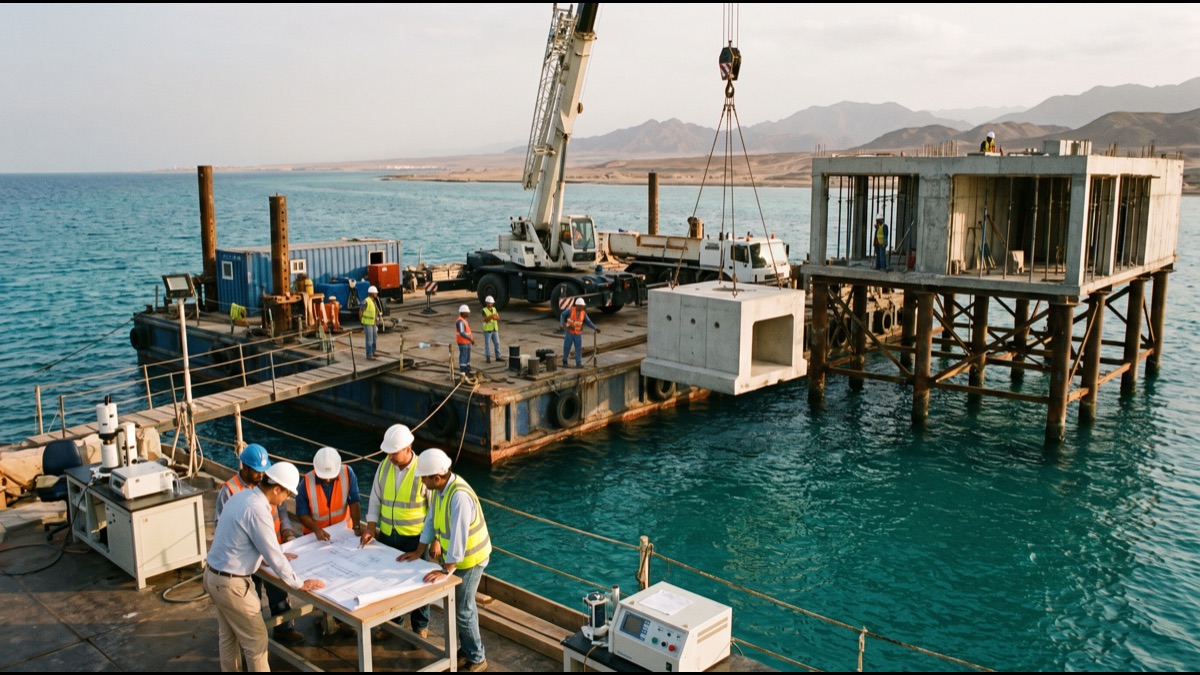
Each resort island typically begins with marine and geotechnical surveys specific to that site, followed by careful barge-based delivery of construction materials and modular building components, since heavy road access to most islands simply does not exist and is not being built.
Construction crews work from temporary marine platforms and specialized shallow-draft vessels to avoid damaging surrounding reef and seagrass areas, a materially slower and more expensive approach than conventional land-based construction logistics, which partly explains why individual resort openings have been staggered across years rather than delivered simultaneously.
Once structurally complete, each resort island still requires its own connections to the destination's shared desalination, power, and waste systems, meaning a resort can be architecturally finished well before it is actually operationally ready to receive paying guests.
AMAALA: The Wellness-Focused Neighbor Project
AMAALA occupies a separate but adjacent stretch of coastline north of the main Red Sea destination, developed under the same Red Sea Global umbrella but positioned with a distinct brand identity focused more heavily on wellness, arts, and a more design-forward hospitality concept than the broader Red Sea destination's wider island-archipelago footprint.
The two developments share underlying infrastructure logic, including off-grid renewable power and strict marine conservation standards, but are marketed and, in some cases, financed as separate destination brands, allowing Red Sea Global to target somewhat different segments of the ultra-luxury international travel market with each.
AMAALA's initial phases have opened resort properties along its own coastal strip, with further phases, including a dedicated yacht marina and additional wellness-focused resort concepts, continuing to move through construction on a broadly similar multi-year timeline to the main Red Sea destination.
The Hospitality Brand Partnerships Behind the Resorts
Rather than operating hotels itself, Red Sea Global partners with established international luxury hospitality brands to design, brand, and manage individual resort properties, a common giga-project financing and operating model that brings established operational expertise and existing loyalty program customer bases to a brand-new destination.
These operator partnerships typically involve a management contract structure, where the operating brand runs day-to-day hotel operations and guest service standards while Red Sea Global retains ownership of the underlying property and broader destination infrastructure, a split that is standard across much of the global luxury hotel industry.
Bringing in recognized international operators also gives prospective guests, particularly those unfamiliar with Saudi Arabia as a leisure destination, a familiar reference point for service quality and brand standards, which matters considerably for a market still building its international leisure tourism reputation from a low starting base.
Desalination, Waste, and the Logistics No One Sees
Because the destination sits in an arid coastal environment with no reliable freshwater source, every resort depends on desalinated seawater for drinking water, irrigation, and general use, produced by dedicated desalination facilities designed to run on the destination's renewable power supply rather than fossil-fuel-powered desalination common elsewhere in the region.
Solid waste management across a scattered island archipelago required building a centralized waste consolidation and processing system rather than relying on typical municipal waste collection, since individual island resorts cannot practically operate independent landfill or incineration facilities of their own.
These behind-the-scenes utility systems rarely appear in marketing materials focused on villas and beaches, but they represent a substantial share of the project's total capital investment and are arguably more technically challenging to deliver reliably at destination scale than the architecture of any individual resort.
Construction Progress and Phased Openings So Far
The first resorts opened in phases starting in 2023, including properties on islands such as Sheybarah and the Ummahat island group, marking the shift from a purely construction-phase project to an operating tourism destination receiving paying international guests.
Additional resorts and supporting infrastructure, including expanded airport capacity, further island properties, and AMAALA's own initial openings, have continued rolling out in subsequent phases, with Red Sea Global publicly targeting a substantially built-out destination footprint by the early 2030s rather than a single completion date.
Independent visitor and travel media reporting on early-opened properties has generally confirmed the resorts are operational and receiving guests as described, though the destination's full planned scale, including all 50 resorts and associated residential and marina components, remains years away from completion.
Who Actually Pays For All of This
Red Sea Global is wholly owned by Saudi Arabia's Public Investment Fund, the sovereign wealth fund that provides the project's primary equity capital as part of the kingdom's broader Vision 2030 economic diversification strategy aimed at reducing dependence on oil revenue.
Beyond direct PIF equity, individual resort properties and supporting infrastructure components are financed through a mix of project-specific debt facilities, construction financing arranged through both domestic and international banks, and, in some cases, direct investment partnerships with the international hospitality operators managing specific properties.
This financing structure mirrors the approach used across other Saudi giga-projects, where PIF capital seeds and de-risks the earliest, most capital-intensive phases before additional private and international capital is progressively brought in around later phases as the underlying assets begin generating revenue.
Labor, Workforce Housing, and Local Hiring
Building a destination of this scale in a remote coastal location required constructing entirely new workforce accommodation communities to house the tens of thousands of construction workers involved across the project's peak building years, since no existing town near the site could absorb that population.
Red Sea Global has publicly stated targets for Saudi national employment within its permanent operational workforce once resorts are running, part of the broader Vision 2030 push to grow private-sector employment for Saudi citizens, particularly in tourism and hospitality roles that historically relied heavily on expatriate labor across the region.
Meeting stated Saudi employment targets in specialized luxury hospitality roles, which often require years of accumulated international experience, represents a genuine long-term workforce development challenge that will likely take multiple resort operating cycles to fully assess against the project's own stated goals.
Criticism, Skepticism, and Realistic Expectations
The Red Sea destination has faced the same category of skepticism directed at other Saudi giga-projects: questions about whether ambitious sustainability and conservation targets will hold up once dozens of resorts are fully operational and generating years of continuous tourist traffic, wastewater, and boat movement across a previously undisturbed reef system.
Timeline slippage relative to original announcements is also a recurring and reasonable point of scrutiny, since initial public statements projected faster completion than what has actually materialized, a pattern common across large-scale tourism and infrastructure development globally but one that invites particular attention given the scale of public capital involved.
A fair reading of the project today treats it as a genuinely unusual, still-unfolding experiment in whether tourism development at this scale can be built with meaningfully different environmental standards than the industry's historical norm, with early operational evidence encouraging but the project's full 50-resort, decade-plus buildout still far from finished.
The Red Sea destination and AMAALA are, in the end, a test of whether a tourism giga-project can be sequenced entirely differently from the industry's usual playbook: reef surveys and conservation zoning before construction plans, an off-grid renewable microgrid before a single hotel bed is sold, and a dedicated airport built ahead of visitor demand rather than in response to it. Whether the destination's regenerative tourism claims fully hold up under a decade of real operating pressure remains to be seen, but the underlying build sequence already represents a materially different approach to large-scale coastal tourism development than has been attempted at this scale anywhere else in the world.
Sources
- Red Sea Global — Official project reporting on destination planning, sustainability targets, and construction progress.
- Saudi Arabia's Public Investment Fund — Ownership structure and strategic role of Red Sea Global within Vision 2030.
- Vision 2030, Kingdom of Saudi Arabia — National tourism and economic diversification strategy underpinning giga-project investment.
- International Union for Conservation of Nature — Independent context on coral reef conservation standards and marine ecosystem monitoring practices.
FAQ
What is the difference between The Red Sea and AMAALA?
The Red Sea (formerly the Red Sea Project) and AMAALA are two separate but adjacent destinations on Saudi Arabia's northwest coast, both developed by Red Sea Global; The Red Sea spans a wider archipelago of islands and desert terrain, while AMAALA focuses on a more concentrated coastal and wellness-oriented offering.
Is the Red Sea destination really powered entirely by renewable energy?
Red Sea Global has designed the destination to run off-grid on a dedicated solar-plus-battery-storage microgrid rather than connecting to Saudi Arabia's national power grid, with the stated goal of 100% renewable energy supply once fully operational.
How many resorts have actually opened on the Red Sea coast?
Multiple resorts opened in phases starting in 2023 on islands including Sheybarah and Ummahat, with additional properties and the destination's own airport, Red Sea International, brought online in stages as construction continued across the wider site.
How does construction avoid damaging the coral reefs?
Red Sea Global conducted extensive marine surveys before construction, designated roughly three-quarters of the destination's islands as undeveloped conservation zones, and set a stated goal of a 30% net conservation benefit for the surrounding marine and coastal ecosystem.
Who is funding the Red Sea giga-projects?
Red Sea Global is wholly owned by Saudi Arabia's Public Investment Fund, which provides its primary capital alongside project financing and private investment partnerships with international hospitality operators who manage individual resort properties.
About the Author
We reference Red Sea Global, Saudi Arabia's Public Investment Fund, the Vision 2030 program office, and the International Union for Conservation of Nature to explain the background and current understanding of this topic.
Loved This Article?
Share it on WhatsApp → Share it on WhatsApp
Get more guides in your inbox — Subscribe to our newsletter for weekly surprising stories from Egypt, Saudi Arabia, Dubai, and beyond.