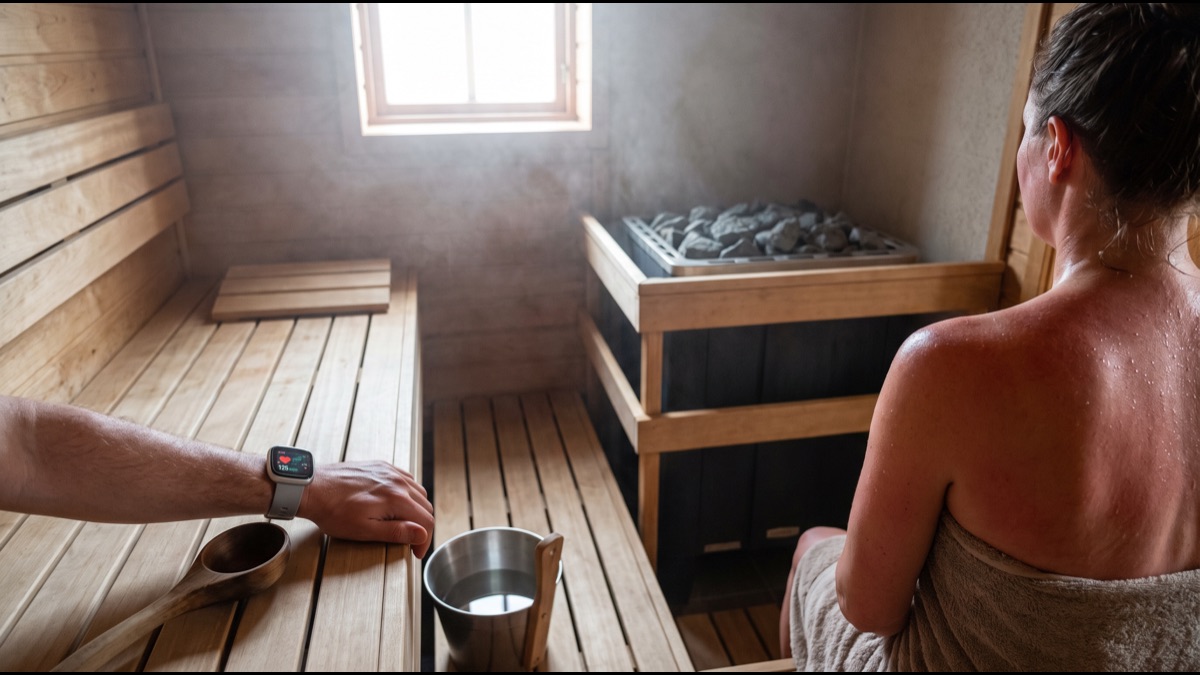
In Finland, where the practice originated and remains deeply woven into daily life, there are reportedly more saunas than cars, and stepping into one several times a week is treated less as a wellness indulgence than as an ordinary household routine, similar to how other cultures treat a daily shower. That deep cultural embedding turns out to have been a genuine gift to cardiovascular science, because it created a population large enough and consistent enough in its habits to let researchers actually measure what regular heat exposure does to the heart over years and decades.
What they found surprised even some researchers in the field: habitual sauna use is associated with a meaningfully lower risk of dying from cardiovascular disease, an association strong enough and consistent enough across multiple studies that it has moved heat exposure from a niche wellness curiosity into a subject taken seriously by cardiology researchers. Understanding what is actually happening physiologically during a sauna session explains why that association exists and what its real limits are.
A Finnish Habit Backed by Decades of Data
Sauna bathing in Finland is not a spa treatment reserved for special occasions but a routine woven into ordinary domestic life, with private saunas built into a large share of Finnish homes and apartment buildings, and public and workplace saunas widely available for everyone else. Frequent use, often several sessions a week from childhood onward, is simply how a large share of the population has always lived.
This ubiquity is precisely what made Finland the natural setting for the long-running population studies that have produced most of the strongest evidence on sauna and cardiovascular health, because researchers could follow large cohorts of ordinary adults over many years and directly correlate how often they used a sauna with what eventually happened to their hearts, without needing an artificial intervention.
These are observational studies rather than tightly controlled experiments, which matters for interpreting the results, but the sheer scale, duration, and consistency of the finding across different Finnish cohorts is what elevated sauna research from a curiosity into a genuinely active area of cardiovascular science over the past two decades.
What Actually Happens to the Heart During a Session
Sitting in a sauna at a typical temperature of roughly 80 to 100 degrees Celsius places a real and measurable load on the cardiovascular system almost immediately. Heart rate climbs substantially, in many people reaching levels comparable to brisk walking or light jogging within the first several minutes, purely as a response to the ambient heat rather than any physical exertion.
This heart rate increase occurs because the body urgently needs to move more blood to the skin's surface to shed excess heat, and the heart responds by pumping faster and, to a degree, harder to meet that demand. Skin blood flow can increase dramatically compared to resting conditions, redirecting a substantial share of the body's total circulating blood volume toward the periphery.
Sweating begins within minutes as the body's primary cooling mechanism, and a single session can produce meaningful fluid loss, which is part of why proper hydration before and after sauna use is consistently emphasized by researchers and experienced sauna-goers alike, since the cardiovascular demand of heat exposure is compounded by the fluid shifts that come with active sweating.
What the Landmark Finnish Studies Actually Found
The most frequently cited research followed a large cohort of middle-aged Finnish men for roughly two decades, tracking their self-reported sauna habits alongside detailed cardiovascular outcomes. Men who used a sauna four to seven times per week showed substantially lower rates of fatal cardiovascular events compared to men who used one only once a week, with the difference persisting after adjusting for other lifestyle and health factors.
A similarly designed follow-up study on the same cohort found a comparable association with sudden cardiac death specifically, and a separate analysis found lower rates of dementia and Alzheimer's disease among frequent sauna users, suggesting the cardiovascular benefit might extend into broader effects on brain health, likely mediated through improved vascular function.
Subsequent studies in other populations, including smaller trials outside Finland, have generally found effects consistent in direction with the original Finnish cohort work, including modest reductions in blood pressure among regular users, though the scale and duration of the original Finnish research remains unmatched anywhere else in the world.
Why Heat Stress Resembles Moderate Exercise
Physiologists have increasingly described passive heat exposure through sauna use as producing a cardiovascular response that meaningfully overlaps with moderate-intensity aerobic exercise, even though the person sitting in the sauna is not moving their muscles in any substantial way. Elevated heart rate, increased cardiac output, and dilated peripheral blood vessels all mirror what happens during a brisk walk or light jog.
This overlap has led some researchers to describe sauna use as a form of passive cardiovascular conditioning, particularly valuable for people whose joint pain, mobility limitations, or other physical constraints make traditional aerobic exercise difficult or impossible to sustain, since the heart still gets meaningful cardiovascular stimulation without any mechanical loading on joints.
The comparison should not be overstated, however, since sauna use does not build muscular strength, bone density, or the same metabolic adaptations that actual physical exercise produces, and researchers are consistent in describing it as a complement to exercise for cardiovascular purposes specifically, not a substitute for the full range of benefits that movement itself provides.
How Blood Vessels Respond to Repeated Heat Exposure
Beyond the acute response during a single session, repeated sauna exposure over weeks and months appears to produce lasting adaptations in how blood vessels function, broadly similar to the kind of vascular conditioning produced by regular aerobic exercise. Regular heat exposure is associated with improved arterial compliance, meaning blood vessels become somewhat more flexible and better able to expand and contract appropriately.
Researchers have also measured improvements in endothelial function, referring to the health of the thin layer of cells lining blood vessels that plays a central role in regulating blood pressure and preventing the kind of vascular damage that contributes to atherosclerosis over time, among people who use saunas regularly compared to those who do not.
Some studies have additionally found modest but measurable reductions in resting blood pressure among regular sauna users, an effect that, while smaller than what dedicated blood pressure medication achieves, is consistent enough across multiple studies to be taken seriously as a genuine physiological effect rather than a statistical artifact.
What the Dose-Response Pattern Actually Shows
One of the more persuasive features of the Finnish research is a clear dose-response relationship, meaning the cardiovascular benefit did not simply appear at any level of sauna use but scaled with how often people actually used one. Men using a sauna two to three times weekly showed a meaningful benefit compared to once-weekly users, and those using one four to seven times weekly showed the largest benefit of all.
This kind of graded, consistent dose-response pattern is exactly what researchers look for when trying to distinguish a genuine physiological effect from a coincidental statistical association, since a true causal relationship generally produces more benefit with more exposure up to some point, rather than an all-or-nothing effect that would be equally consistent with confounding factors.
Session duration mattered too in the same research, with sessions lasting nineteen minutes or longer associated with greater benefit than shorter sessions, further reinforcing the impression of a genuine dose-related physiological effect rather than sauna use simply being a marker for some other unmeasured healthy behavior or trait.
Why Correlation Is Not the Same as Proof
Despite the consistency and scale of the Finnish research, it remains fundamentally observational, meaning it tracks what people already chose to do rather than randomly assigning some people to use saunas and others not to, which is the gold standard for establishing causation in medical research. This distinction matters enormously for how confidently the findings should be interpreted.
People who use saunas frequently might differ from infrequent users in other ways that also affect cardiovascular health, such as overall fitness level, disposable income, social connectedness, or general health consciousness, and even careful statistical adjustment for known factors cannot fully rule out the influence of factors researchers did not measure or could not measure.
Researchers in the field are generally careful to describe the evidence honestly as strong and consistent associational evidence supported by plausible physiological mechanisms, rather than definitive proof of causation, and call for more randomized controlled research to establish the relationship with the same certainty available for interventions like exercise or specific medications.
Who Should Actually Be Cautious
The cardiovascular demand of sauna use, while beneficial for most healthy people, is genuinely not trivial, and certain groups are advised to exercise real caution or consult a doctor before adopting a regular sauna habit. People with unstable angina, recent heart attack, uncontrolled high blood pressure, or certain arrhythmias fall into this category specifically.
Pregnant women are commonly advised to avoid high-heat sauna sessions or to limit duration and temperature significantly, given concerns about elevated core body temperature during early pregnancy specifically, and anyone taking medications that affect blood pressure or fluid balance should discuss sauna use with their physician given the interaction between heat-induced blood pressure changes and those medications.
Alcohol consumption before or during a sauna session substantially increases risk by impairing the body's ability to regulate its own temperature and by contributing to dangerous drops in blood pressure upon standing, a combination that has been directly implicated in a meaningful share of sauna-related medical emergencies and fatalities specifically.
How Sauna Compares to Other Heat Therapies
Traditional dry Finnish saunas, steam rooms, infrared saunas, and hot tubs all expose the body to elevated ambient heat, but they differ meaningfully in temperature, humidity, and the mechanism by which heat reaches the body, which means the cardiovascular research on traditional dry sauna does not automatically transfer to every other form of heat exposure without qualification.
Infrared saunas operate at meaningfully lower ambient air temperatures than traditional saunas while still producing significant sweating and a real cardiovascular response, and some smaller studies suggest broadly similar cardiovascular benefits, though the body of evidence remains considerably smaller than the decades of Finnish research on traditional dry-heat sauna specifically.
Steam rooms add high humidity to elevated temperature, which changes the way the body sheds heat since sweat evaporates less efficiently in humid air, generally producing a somewhat different physiological experience and cardiovascular demand profile compared to the dry heat of a traditional sauna, even at a comparable air temperature reading.
What a Sensible Sauna Practice Actually Looks Like
For healthy adults interested in adopting the practice based on the research, the pattern most closely associated with cardiovascular benefit in the Finnish studies involved sessions of roughly fifteen to twenty minutes, taken several times a week, at temperatures in the traditional Finnish range, generally followed by a cooling period before resuming normal activity.
Adequate hydration before and after a session matters given the fluid loss involved, and easing into the practice gradually rather than attempting long sessions immediately allows the body to adapt to the cardiovascular demand, similar to the general principle of building up gradually with any new form of physical stress on the heart and circulatory system.
The honest summary of the evidence is that regular sauna use appears to be a genuinely beneficial habit for most healthy adults, supported by a strong and biologically plausible body of research, best understood as a complement to exercise, a healthy diet, and other established cardiovascular habits rather than a replacement for any of them.
Interest in this research has spread well beyond Scandinavia in recent years, with hotels, gyms, and standalone wellness facilities across the Gulf and North Africa increasingly installing traditional and infrared saunas as part of broader health and recovery offerings, particularly in cities where outdoor heat already dominates daily life for much of the year. This creates an interesting distinction worth noting for anyone in a hot climate: passive heat therapy taken deliberately in a controlled sauna session, followed by proper cooling and rehydration, is a fundamentally different physiological event than simply enduring ambient outdoor heat during a commute or errand, since the sauna session is time-limited, monitored, and followed by recovery, while uncontrolled heat exposure outdoors carries none of those safeguards and should not be assumed to confer any of the same cardiovascular benefits described in the research. Anyone regularly exposed to genuine outdoor heat stress as part of daily life, whether through work or climate, should if anything be more attentive to hydration and cardiovascular strain rather than treating that ordinary exposure as some kind of equivalent substitute for a deliberate, properly time-limited sauna practice with recovery built in — the two are simply not the same thing physiologically, even though both involve elevated body temperature.
Sources
- Wikipedia — overview of sauna history, practice, and health research
- American Heart Association — cardiovascular health guidance and research summaries
- National Institutes of Health — research on heat therapy and cardiovascular outcomes
- This is Finland — cultural and historical background on Finnish sauna tradition
FAQ
Does regular sauna use actually improve heart health?
Large observational studies from Finland have found that frequent sauna use is associated with meaningfully lower rates of cardiovascular death, though this is correlational evidence rather than definitive proof of causation.
What does heat exposure actually do to the heart during a sauna session?
Heart rate rises substantially, blood vessels near the skin dilate to release heat, and the overall response resembles a moderate-intensity cardiovascular workout without the joint loading of actual exercise.
Is sauna use safe for everyone?
People with unstable cardiovascular conditions, uncontrolled blood pressure, or certain heart conditions should consult a doctor first, since the cardiovascular demand is real and not trivial.
How hot and how long is a typical sauna session in the research?
Studies showing the strongest associations generally involved sessions of roughly 15 to 20 minutes at temperatures around 80 to 100 degrees Celsius, taken several times per week.
Can sauna use replace exercise for cardiovascular benefit?
No — researchers consistently describe it as a complement to physical activity and healthy diet rather than a substitute for either.
About the Author
We reference Wikipedia, the American Heart Association, the National Institutes of Health, and This is Finland to explain the background and current understanding of this topic.
Loved This Article?
Share it on WhatsApp → Share it on WhatsApp
Get more guides in your inbox — Subscribe to our newsletter for weekly surprising stories from Egypt, Saudi Arabia, Dubai, and beyond.