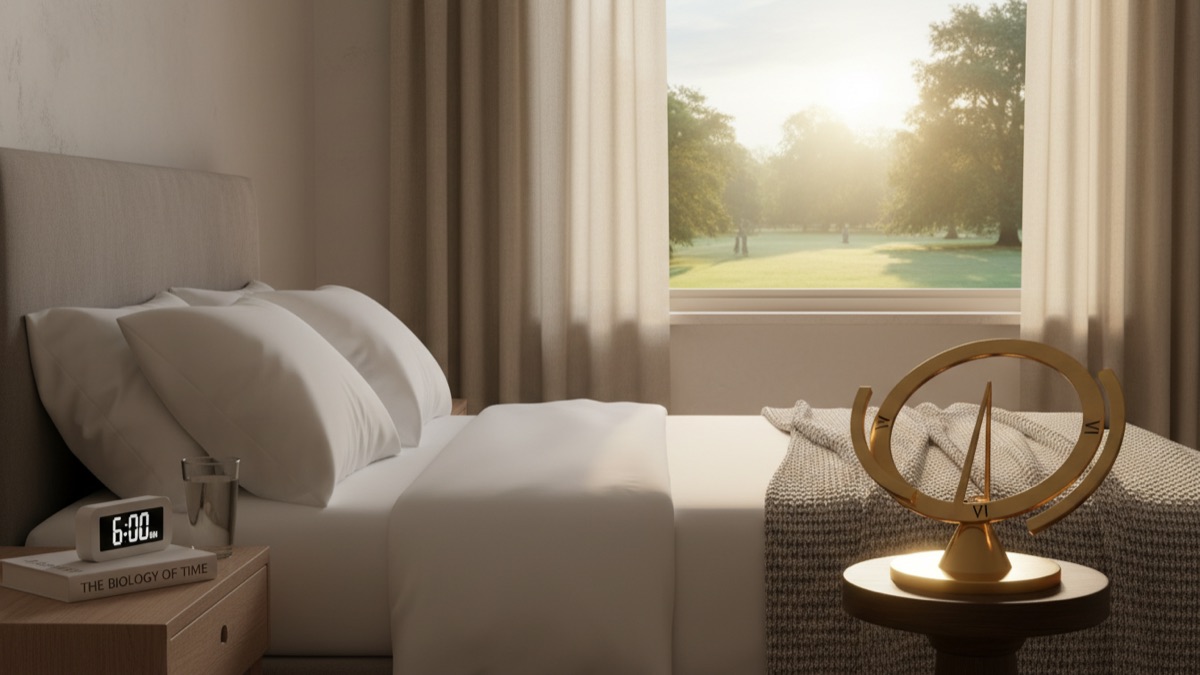
Circadian rhythm is the body's internal biological clock, running on a roughly 24-hour cycle that regulates when you feel sleepy or alert, along with hormone release, body temperature, and other physiological processes throughout the day.
This internal clock is controlled by a small region of the brain called the suprachiasmatic nucleus, which coordinates timing signals sent to nearly every organ system in the body, not just the brain regions involved in sleep.
An Internal Clock Running on Its Own Cycle
Why Light Is the Main Reset Signal
Light is the dominant external cue that keeps this internal clock synchronized with the actual day-night cycle, which is why exposure to bright light, especially in the morning, and dim light in the evening helps keep circadian rhythm properly aligned.
When circadian rhythm falls out of sync with the local day-night cycle, such as from jet lag, night-shift work, or heavy late-night screen exposure, it can affect not just sleep quality but also mood, metabolism, and long-term health if the disruption becomes chronic.
Sources
- Wikipedia — overview of circadian rhythm and its biological mechanisms
- National Institute of General Medical Sciences — background on circadian rhythms and biological clocks
- Sleep Foundation — practical guidance on circadian rhythm and sleep health
FAQ
Is circadian rhythm exactly 24 hours long?
Not exactly — left without external cues, most people's internal clocks run slightly longer or shorter than 24 hours, which is why daily light exposure is needed to keep it synchronized.
What part of the body controls circadian rhythm?
A small region of the brain called the suprachiasmatic nucleus acts as the body's master internal clock, coordinating timing signals to other organs.
Why does jet lag happen?
It happens when your internal circadian clock, still set to your original time zone, temporarily falls out of sync with the new local day-night cycle after rapid travel.
About the Author
We reference Wikipedia, National Institute of General Medical Sciences, and Sleep Foundation to explain the background and current understanding of this topic.
Loved This Article?
Share it on WhatsApp → Share it on WhatsApp
Get more guides in your inbox — Subscribe to our newsletter for weekly surprising stories from Egypt, Saudi Arabia, Dubai, and beyond.